Why Dissertation Mistakes Can Affect Career Opportunities
Introduction
For many students, a dissertation is the final academic challenge before entering the professional world. While it is primarily assessed for academic purposes, the quality of your dissertation can indirectly influence future career opportunities. Employers may never read your dissertation, but the skills demonstrated through it—research, critical thinking, communication, project management, and analytical ability—are highly valued across industries.
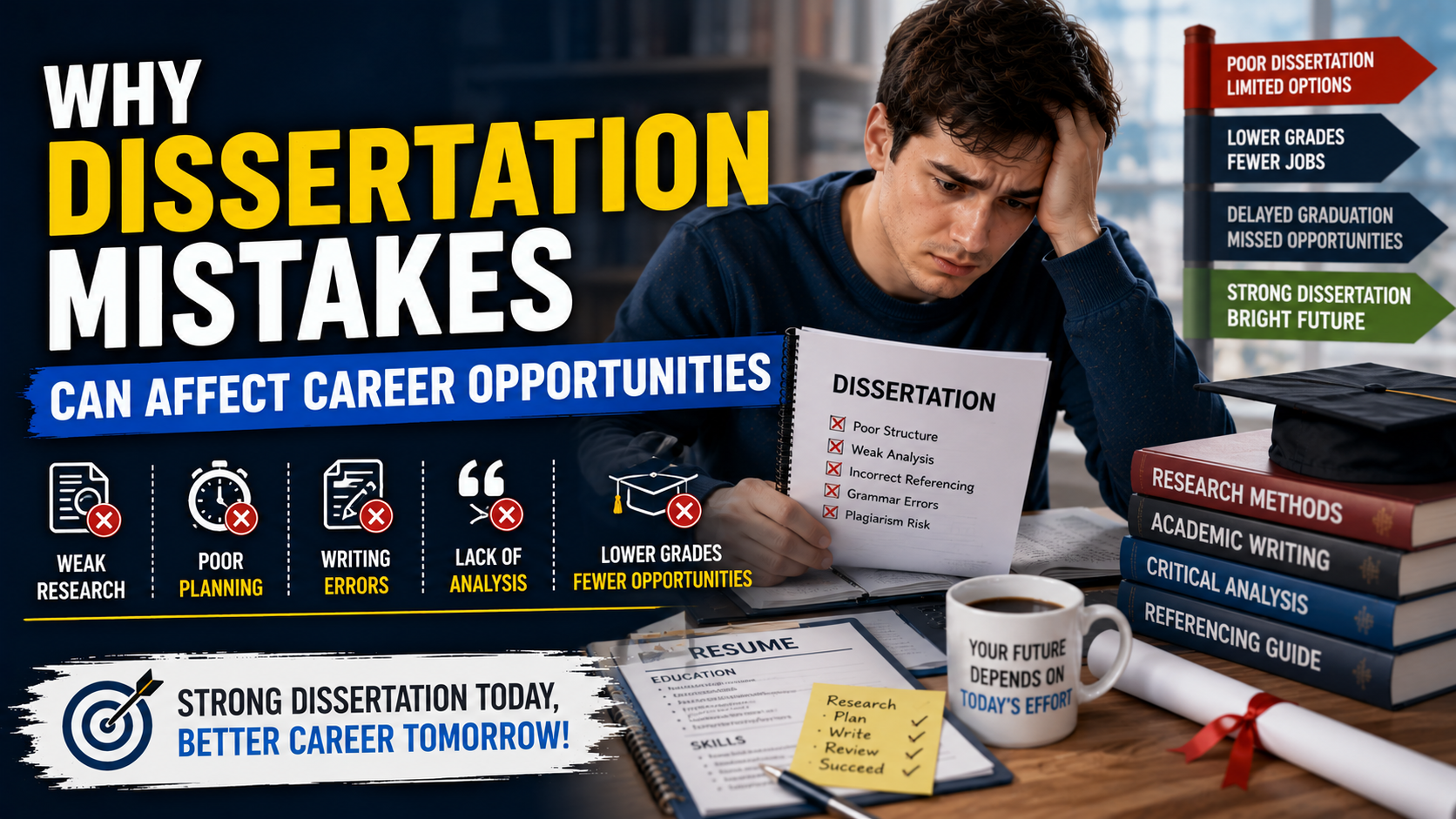
Significant dissertation mistakes can affect your final degree classification, delay graduation, reduce confidence during interviews, and even limit postgraduate opportunities. Understanding these potential consequences helps students recognise why investing time and effort into producing a high-quality dissertation is worthwhile.
Why Employers Value Dissertation Skills
A dissertation demonstrates far more than subject knowledge.
It reflects your ability to:
Conduct independent research.
Solve complex problems.
Analyse evidence critically.
Manage long-term projects.
Communicate professionally.
Work independently.
Meet deadlines.
These transferable skills are highly attractive to employers.
How Dissertation Performance Influences Career Opportunities
The dissertation itself may not determine your career, but its outcomes often influence important factors that employers consider.
For example:
Final degree classification.
Graduation date.
Academic confidence.
Research experience.
Professional communication skills.
Each of these can affect employability.
Mistake 1: Weak Research
Poor-quality research often results in weaker conclusions.
Employers value graduates who can:
Find reliable information.
Evaluate evidence.
Make informed decisions.
Developing strong research habits during your dissertation prepares you for workplace problem-solving.
Mistake 2: Poor Time Management
Missing dissertation milestones may lead to:
Late submission.
Resubmission.
Delayed graduation.
Delayed graduation can postpone:
Graduate schemes.
Job offers.
Professional training programmes.
Internships.
Time management remains one of the most important employability skills.
Mistake 3: Weak Critical Thinking
Employers increasingly seek graduates who can:
Interpret information.
Compare evidence.
Solve unfamiliar problems.
Make strategic decisions.
A dissertation with limited critical analysis may also affect your academic performance.
Mistake 4: Poor Academic Writing
Clear communication is essential in nearly every profession.
A well-written dissertation demonstrates:
Logical organisation.
Professional presentation.
Strong written communication.
Attention to detail.
These skills transfer directly to workplace reports, proposals, and presentations.
Mistake 5: Ignoring Feedback
During the dissertation process, supervisor feedback helps improve your work.
Students who respond positively to constructive criticism develop valuable workplace behaviours, including:
Adaptability.
Continuous improvement.
Collaboration.
Professional resilience.
These qualities are highly valued by employers.
Mistake 6: Academic Integrity Issues
Serious academic misconduct can have lasting consequences.
Examples include:
Plagiarism.
Fabricated research.
Incorrect referencing.
Unethical AI use.
Academic integrity protects both your degree and your professional reputation.
How Degree Classification Influences Employment
Some graduate employers specify minimum academic requirements.
For example:
First-Class Honours.
Upper Second-Class Honours (2:1).
Although experience, skills, and interviews remain important, a lower classification caused by dissertation mistakes may reduce eligibility for certain graduate opportunities.
Postgraduate Study
Students planning to continue into:
Master's degrees.
PhD programmes.
Research careers.
often need strong dissertation performance because admissions panels frequently review:
Dissertation topic.
Research quality.
Final classification.
Academic references.
Interview Confidence
Students who complete strong dissertations often feel more confident discussing:
Research methods.
Problem-solving.
Independent learning.
Data analysis.
Professional communication.
Many employers ask graduates about dissertation topics during interviews.
Common Dissertation Mistakes
Students frequently lose marks because of:
Weak planning.
Poor referencing.
Limited analysis.
Inadequate proofreading.
Weak conclusions.
Poor structure.
Ignoring supervisor comments.
Last-minute writing.
Fortunately, each of these mistakes can usually be prevented.
How to Protect Your Future Career
Plan Early
Allow enough time for:
Research.
Writing.
Revision.
Proofreading.
Use High-Quality Sources
Support arguments using:
Peer-reviewed journals.
Academic books.
Official reports.
Reliable databases.
Develop Critical Thinking
Evaluate rather than simply describe evidence.
Improve Academic Writing
Aim for:
Clear structure.
Professional language.
Logical arguments.
Consistent formatting.
Respond to Feedback
Treat supervisor comments as opportunities for improvement rather than criticism.
Proofread Carefully
Check:
Grammar.
References.
Formatting.
Figures.
Tables.
Consistency.
Presentation contributes to examiner impressions.
Career Skills Developed Through Dissertation Writing
A successful dissertation demonstrates:
Academic Skill | Workplace Skill |
|---|---|
Research | Problem-solving |
Critical analysis | Decision-making |
Academic writing | Professional communication |
Project planning | Time management |
Independent learning | Self-management |
Data analysis | Analytical thinking |
Final Thoughts
A dissertation is more than a university requirement—it is an opportunity to develop the research, analytical, communication, and project management skills that employers value across a wide range of industries. While employers may not examine every page of your dissertation, the quality of your work can influence your degree classification, postgraduate opportunities, and the confidence with which you present your achievements during interviews.
By planning ahead, engaging critically with research, responding thoughtfully to feedback, and maintaining the highest standards of academic integrity, you not only improve your dissertation but also strengthen the professional skills that support long-term career success. Treat your dissertation as an investment in both your academic achievements and your future career.
Frequently Asked Questions
Everything you need to know about our services


