What Makes Dissertation Writing Feel Overwhelming?
Introduction
For many university students, dissertation writing is the most demanding academic task they will ever complete.
Unlike essays or coursework, a dissertation requires months of independent research, planning, critical thinking, analysis, and academic writing. It often becomes the largest project students have ever managed.
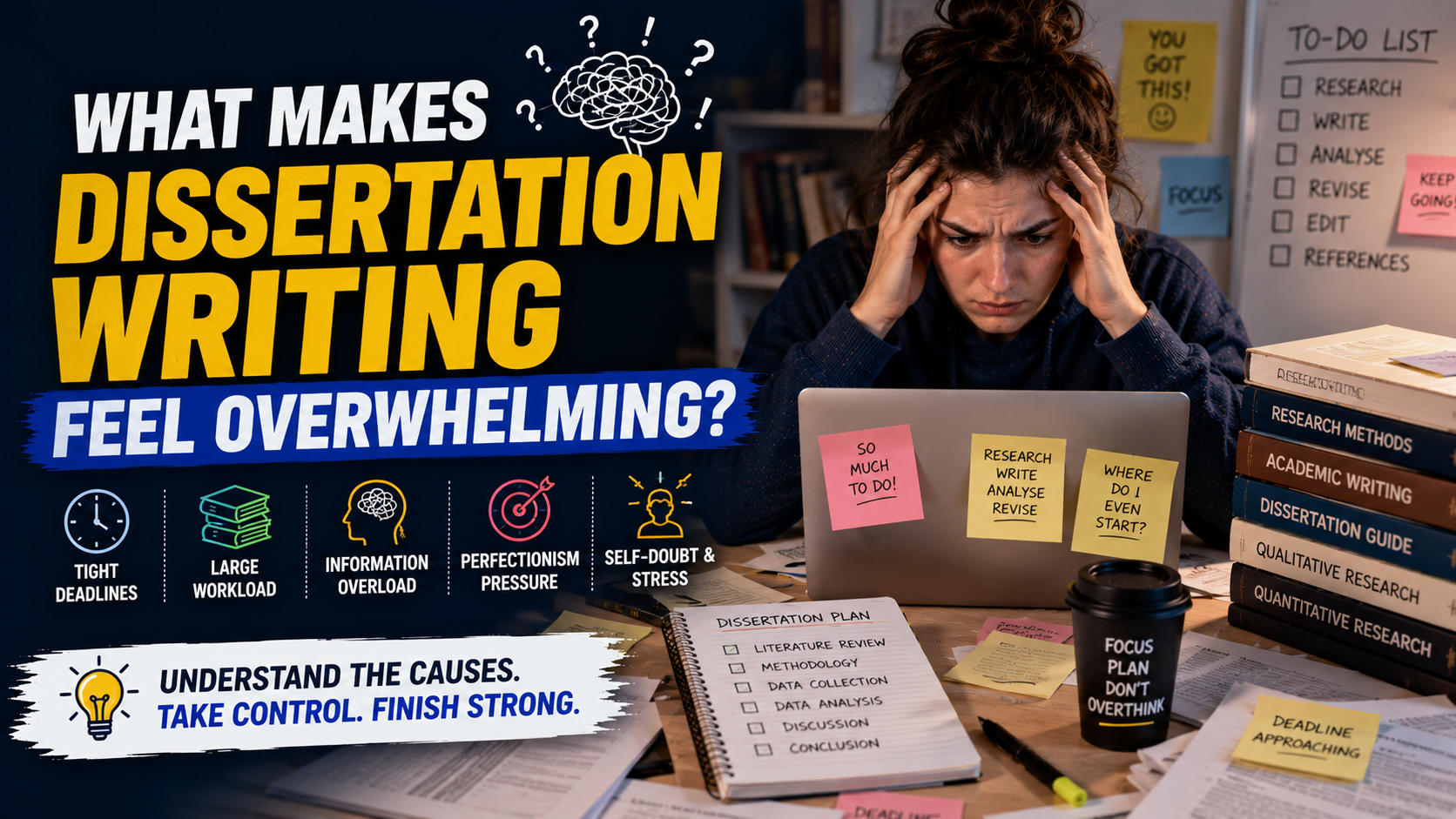
As deadlines approach, many students begin to feel overwhelmed. Some struggle to start, while others lose momentum halfway through. Even highly motivated students can experience stress, self-doubt, and frustration.
The good news is that feeling overwhelmed is common—and manageable. Understanding what causes these feelings is the first step toward completing your dissertation successfully.
Why Does Dissertation Writing Feel Different?
A dissertation differs from regular assignments in several important ways.
It requires students to:
Choose and refine a research topic.
Conduct independent research.
Critically analyse academic literature.
Design a research methodology.
Collect and interpret data (where applicable).
Present original arguments.
Write thousands of words using academic conventions.
The combination of these responsibilities makes the dissertation uniquely challenging.
Common Reasons Dissertation Writing Feels Overwhelming
The Size of the Project
A dissertation is not one task—it is dozens of smaller tasks combined.
Students must complete:
Topic selection
Research proposal
Literature review
Methodology
Data collection
Data analysis
Discussion
Conclusion
Referencing
Editing
Proofreading
Looking at the dissertation as one enormous project often increases anxiety.
Too Much Information
Students frequently feel overwhelmed by the amount of academic literature available.
Questions such as:
Which sources should I use?
Have I read enough?
Am I missing important research?
can lead to information overload.
Instead of writing, students continue searching for "just one more article."
Fear of Making Mistakes
Many students worry about:
Choosing the wrong methodology.
Misinterpreting data.
Missing references.
Receiving negative supervisor feedback.
Losing marks.
This fear can delay progress because students hesitate to make decisions.
Perfectionism
Perfectionism causes students to believe every sentence must be perfect before moving on.
As a result, they:
Rewrite introductions repeatedly.
Constantly edit existing sections.
Delay completing later chapters.
Remember, dissertations are improved through revision—not written perfectly on the first attempt.
Time Pressure
Many students balance:
University classes.
Part-time jobs.
Family responsibilities.
Placements or internships.
Personal commitments.
Limited time often makes the dissertation feel even more overwhelming.
The Psychology of Feeling Overwhelmed
When the brain perceives a task as extremely large or difficult, it often responds by:
Avoiding the task.
Procrastinating.
Feeling mentally exhausted.
Struggling to concentrate.
This is a normal psychological response.
The key is reducing the perceived size of the task.
Signs You Are Feeling Overwhelmed
You may notice:
Difficulty starting.
Constant procrastination.
Trouble concentrating.
Feeling anxious about opening your dissertation.
Losing confidence.
Becoming emotionally exhausted.
Spending more time planning than writing.
Recognising these signs early helps prevent burnout.
Why Overwhelm Reduces Dissertation Quality
Feeling overwhelmed doesn't only affect productivity.
It also influences:
Critical Thinking
Stress reduces the brain's ability to evaluate information objectively.
Students often produce more descriptive writing instead of analytical discussion.
Writing Quality
Overwhelmed students frequently:
Repeat ideas.
Write less clearly.
Miss grammar mistakes.
Forget important references.
Decision-Making
Every dissertation requires hundreds of decisions.
Feeling overwhelmed makes even simple choices feel difficult.
Motivation
When progress feels slow, motivation naturally declines.
This creates a cycle:
Feeling overwhelmed →
Less writing →
More pressure →
More overwhelm.
How to Make Dissertation Writing Feel Manageable
Break the Dissertation Into Small Sections
Instead of thinking:
"I need to write 15,000 words."
Think:
Write one paragraph.
Summarise one journal article.
Complete one subsection.
Small tasks reduce psychological pressure.
Create Weekly Goals
Rather than focusing only on the final deadline:
Set weekly objectives such as:
Finish literature review.
Draft methodology.
Proofread Chapter One.
Regular progress builds confidence.
Stop Comparing Yourself
Every dissertation is different.
Other students may have:
Different topics.
Different supervisors.
Different research methods.
Different schedules.
Compare your progress only with your previous work.
Accept Imperfect First Drafts
A first draft is supposed to be incomplete.
Writing something imperfect today is far more productive than waiting weeks for perfection.
Ask for Support
If you feel stuck:
Speak with your supervisor.
Attend university writing workshops.
Join dissertation support groups.
Discuss concerns with classmates.
You don't have to complete your dissertation in isolation.
Build Momentum Instead of Waiting for Motivation
Many students wait until they "feel motivated."
Successful dissertation writers usually do the opposite.
They:
Start with small tasks.
Build consistency.
Gain confidence through progress.
Action often creates motivation—not the other way around.
Overwhelmed vs Productive Mindset
Overwhelmed Thinking | Productive Thinking |
|---|---|
I must finish everything. | I'll complete one task today. |
This is impossible. | This is manageable in stages. |
Everything must be perfect. | I'll improve it during revision. |
I'm behind everyone else. | I'll focus on my own progress. |
I'll start tomorrow. | I'll write one paragraph now. |
Final Thoughts
Feeling overwhelmed during dissertation writing does not mean you are incapable of succeeding. It simply reflects the scale and complexity of one of the most significant academic projects in your university journey. Nearly every student experiences moments of uncertainty, stress, or self-doubt while working on a dissertation.
The key is to avoid viewing the dissertation as one impossible task. By breaking it into manageable stages, accepting that first drafts do not need to be perfect, maintaining realistic goals, and seeking support when necessary, you can steadily regain confidence and momentum. Every completed section brings you one step closer to submission, and consistent progress—not perfection—is what ultimately leads to a successful dissertation.
Frequently Asked Questions
Everything you need to know about our services


