Dissertation Anxiety Before Submission
Introduction
After months of research, writing, editing, and revisions, you would expect the final days before dissertation submission to feel rewarding. Instead, many students experience the opposite.
As the submission deadline approaches, anxiety often reaches its highest point. You may suddenly question your research, worry about forgotten mistakes, or feel convinced that your dissertation is not good enough—even after receiving positive supervisor feedback.
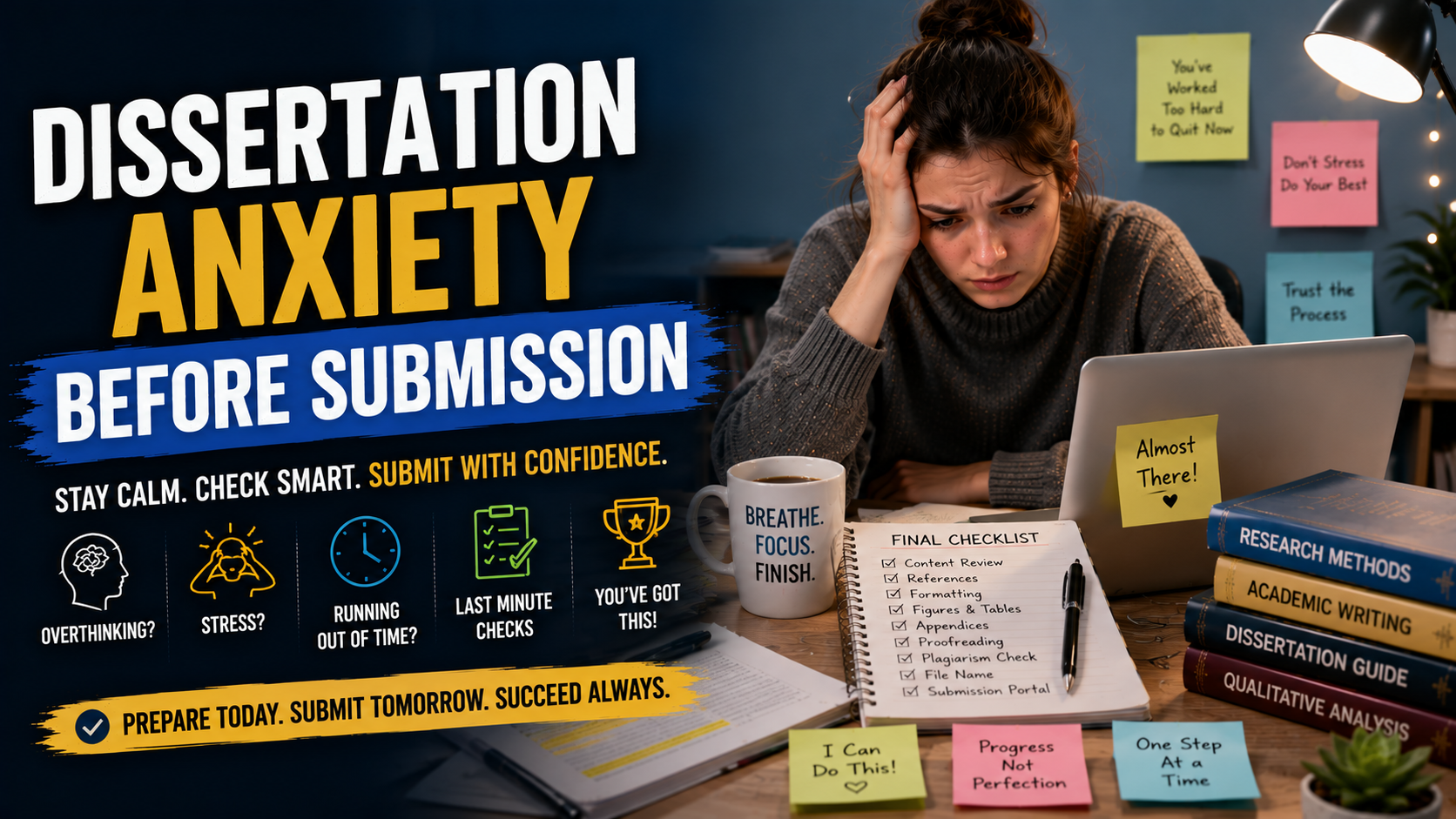
This experience is extremely common. Dissertation anxiety before submission affects students across all academic levels, from undergraduate dissertations to master's theses and doctoral research. The good news is that these feelings are usually temporary and can be managed effectively with the right strategies.
Why Anxiety Peaks Before Submission
The final submission represents the end of months—or even years—of work.
Students often feel pressure because:
Their dissertation contributes significantly to their final degree classification.
They cannot make changes after submission.
The work will be evaluated by examiners.
They fear making unnoticed mistakes.
Graduation or future career opportunities may depend on the outcome.
These factors naturally increase emotional pressure.
Common Signs of Dissertation Anxiety
Dissertation anxiety affects students differently, but common symptoms include:
Constantly checking your work for mistakes.
Difficulty sleeping.
Feeling mentally exhausted.
Increased procrastination despite approaching deadlines.
Racing thoughts about potential problems.
Difficulty concentrating.
Physical symptoms such as headaches or muscle tension.
Feeling emotionally overwhelmed.
Recognising these symptoms helps you respond proactively instead of allowing anxiety to control your decisions.
Why You Suddenly Think Your Dissertation Is Terrible
Many students experience a dramatic loss of confidence just before submission.
You may think:
"This literature review isn't good enough."
"My research question is weak."
"I've missed something important."
"Everyone else's dissertation is better."
This phenomenon is often caused by prolonged exposure to your own work.
After reading the same chapters hundreds of times, even strong writing begins to feel ordinary.
Remember:
Familiarity is not the same as poor quality.
The Fear of Making Small Mistakes
Students often worry excessively about:
Typographical errors.
Formatting inconsistencies.
Minor referencing issues.
Small grammatical mistakes.
While careful proofreading is important, minor imperfections rarely determine dissertation outcomes.
Examiners primarily assess:
Research quality.
Critical analysis.
Methodology.
Originality.
Academic argument.
The Pressure of Final Degree Classification
Many universities assign significant weighting to dissertations.
This can make students feel that:
One mistake will ruin everything.
Their entire degree depends on this submission.
In reality, dissertation marking considers the overall quality of the research rather than isolated imperfections.
Why Last-Minute Editing Can Increase Anxiety
Many students continue editing until minutes before submission.
This often creates:
Confusion.
Inconsistent writing.
New mistakes.
Increased stress.
At some point, editing no longer improves quality—it simply delays submission.
Knowing when to stop is an important academic skill.
Practical Strategies to Reduce Dissertation Anxiety
Create a Submission Checklist
Prepare a checklist including:
Final proofreading.
Formatting.
Page numbers.
Table of contents.
References.
Appendices.
File naming.
Submission confirmation.
Checking items systematically reduces uncertainty.
Stop Comparing Yourself
Avoid thinking:
"They finished weeks ago."
Every dissertation differs in:
Topic.
Research method.
Supervisor expectations.
Timeline.
Your progress is unique.
Take Short Breaks
Continuous editing reduces concentration.
Short breaks help you:
Notice errors more easily.
Think clearly.
Reduce mental fatigue.
Accept That No Dissertation Is Perfect
Every published research paper contains limitations.
Dissertations are no different.
Your goal is to produce a strong, evidence-based piece of research—not perfection.
Trust the Process
If you have:
Conducted thorough research,
Followed supervisor advice,
Revised multiple drafts,
Proofread carefully,
then you have done what was required.
At some point, trusting your preparation becomes essential.
Managing Physical Symptoms of Anxiety
Simple techniques include:
Deep breathing
Slow breathing helps calm the nervous system.
Sleep
Avoid sacrificing sleep for unnecessary last-minute edits.
A well-rested brain performs better during final checks.
Exercise
Light physical activity reduces stress hormones and improves concentration.
Healthy nutrition
Regular meals help maintain energy levels and focus.
What If You Still Feel Unprepared?
Almost every student reaches a point where they think:
"I'm not ready."
Ask yourself:
Have I answered my research question?
Have I supported my arguments with evidence?
Have I followed university guidelines?
Have I proofread my work?
If the answer is yes, your dissertation is likely ready—even if it doesn't feel perfect.
Healthy Confidence vs Anxiety
Healthy Confidence | Submission Anxiety |
|---|---|
Accepts minor imperfections | Obsessively searches for errors |
Trusts preparation | Doubts every decision |
Completes final checks | Constantly rewrites |
Submits confidently | Delays submission unnecessarily |
Focuses on overall quality | Focuses on tiny details |
Final Thoughts
Dissertation anxiety before submission is one of the most common experiences students face, yet it is rarely discussed openly. As the deadline approaches, it is natural to question your work, worry about mistakes, and feel uncertain about the outcome. These emotions reflect the importance of the project—not a lack of ability.
The key is to recognise that no dissertation is flawless. By completing systematic final checks, trusting the preparation you've invested over months of research, and resisting the urge to endlessly revise, you can submit your dissertation with confidence. Once your work is submitted, you will have achieved something significant: completing one of the most demanding academic projects of your university journey.
Frequently Asked Questions
Everything you need to know about our services
Related Posts

Dissertation Burnout: The Signs Most Students Ignore

Why High-Achieving Students Struggle With Their Dissertation
