University AI Policies Explained (2026 Guide)
Introduction
Artificial intelligence (AI) tools such as ChatGPT, Gemini, Claude, Microsoft Copilot, Grammarly, and Perplexity have become common study aids in higher education. They can help students understand complex concepts, generate ideas, improve writing, and organise research.
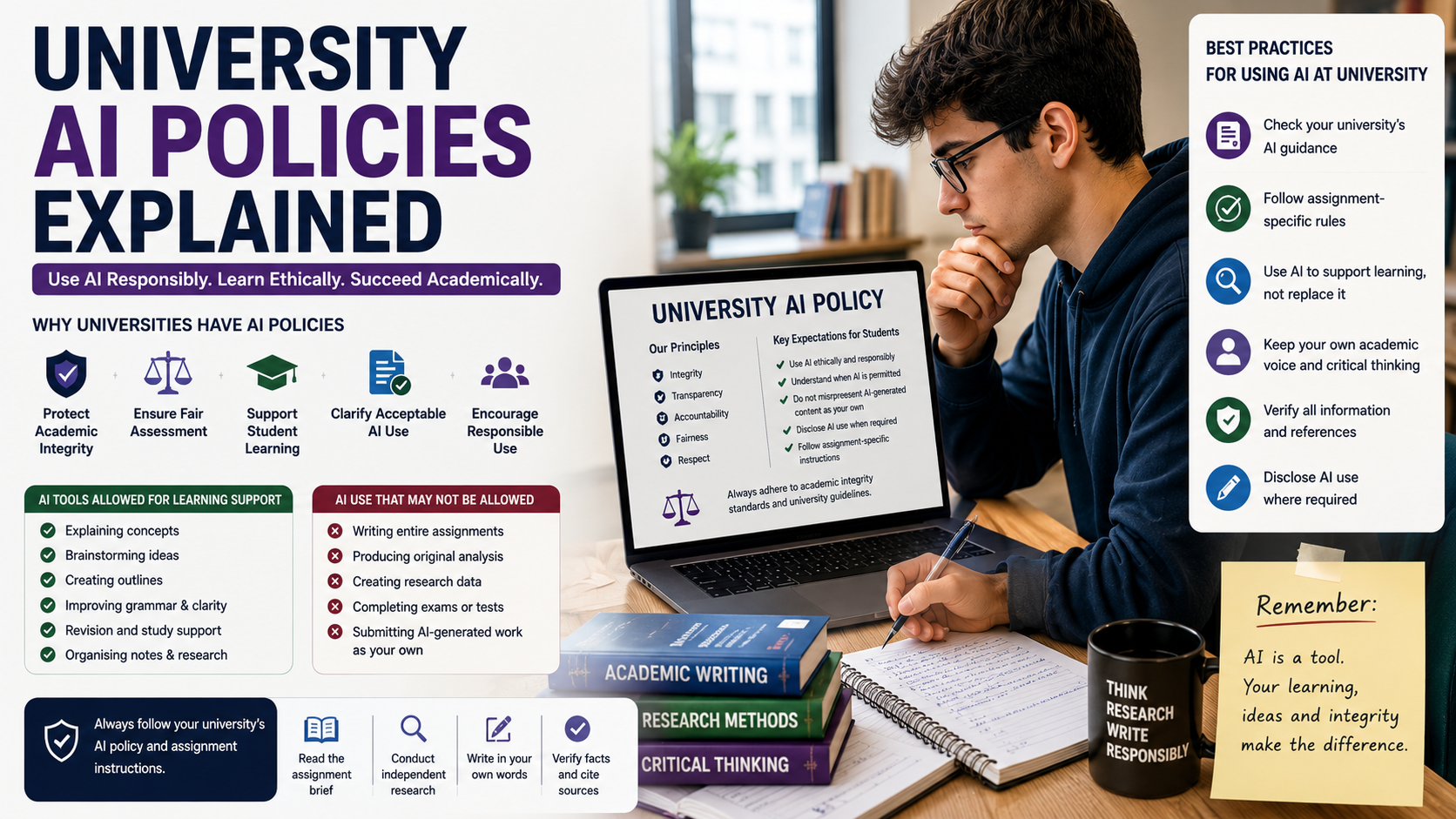
As AI becomes more widely used, universities have introduced AI policies to explain when these tools are allowed and how they should be used responsibly.
If you're wondering "Can I use AI for my assignment?" or "Will using ChatGPT break university rules?", this guide explains what university AI policies typically cover and how to stay within academic integrity guidelines.
What Is a University AI Policy?
A university AI policy is a set of rules and guidance that explains how students and staff may use artificial intelligence in academic work.
Its purpose is to:
Protect academic integrity
Ensure fair assessment
Encourage responsible AI use
Support student learning
Clarify acceptable and unacceptable AI practices
Although policies vary between institutions, they generally focus on ensuring that submitted work reflects the student's own knowledge, research, and critical thinking.
Why Have Universities Introduced AI Policies?
Generative AI tools can now produce essays, summaries, code, presentations, and other content within seconds.
Without clear guidance, students may be uncertain about:
Whether AI is allowed
Which AI tools can be used
How much AI assistance is acceptable
Whether AI use should be disclosed
What counts as academic misconduct
University AI policies aim to answer these questions while maintaining fair assessment standards.
Do All Universities Have the Same AI Policy?
No.
Each university develops its own guidance based on its academic standards and assessment methods.
Policies may also vary between:
Faculties
Departments
Modules
Individual assignments
For this reason, you should always check:
Your university's AI guidance
Module handbook
Assignment brief
Lecturer's instructions
The specific requirements for your assessment take priority.
What AI Uses Are Commonly Allowed?
Many universities permit AI for learning support rather than content replacement.
Examples often include:
Understanding Difficult Concepts
AI can explain theories, formulas, legal principles, or research methods in simpler language.
Brainstorming Ideas
Students may use AI to generate possible research questions or essay topics before conducting independent research.
Creating Assignment Outlines
AI can help organise ideas into a logical structure before writing begins.
Improving Grammar and Clarity
Proofreading tools may be used to improve:
Grammar
Spelling
Sentence structure
Readability
The underlying ideas should remain your own.
Revision Support
Students often use AI to create:
Practice questions
Flashcards
Revision summaries
Self-tests
These activities support learning without replacing assessment.
What AI Uses May Not Be Allowed?
Depending on the assessment, universities may restrict or prohibit AI from:
Writing complete assignments
Producing critical analysis
Generating original arguments
Completing examinations
Creating research data
Writing reflective journals
Producing laboratory reports
Completing take-home assessments without permission
Always follow the instructions provided for each assignment.
Academic Integrity and AI
Academic integrity means producing honest, original academic work.
Using AI responsibly generally involves:
Conducting your own research
Thinking critically
Writing independently
Acknowledging AI use if required
Verifying AI-generated information
Misrepresenting AI-generated work as entirely your own may breach academic integrity policies.
Should You Tell Your University That You Used AI?
Some universities require students to disclose AI assistance, while others only require disclosure for certain types of AI use.
Your institution may ask you to:
Include an AI acknowledgement statement
Describe how AI was used
Cite AI tools where appropriate
Keep drafts showing your writing process
Always follow your university's guidance.
Can Universities Detect AI Use?
Many universities use a combination of academic judgement and technology when reviewing assignments.
They may consider:
Writing consistency
Originality
Referencing quality
Research depth
Draft history
Assignment requirements
Academic integrity procedures
Universities generally assess the overall quality and authenticity of the work rather than relying on AI detection tools alone.
Best Practices for Following University AI Policies
1. Read the Assignment Brief
Every assessment may have different AI requirements.
2. Check Your University's AI Guidance
Policies are updated regularly as AI technology evolves.
3. Use AI to Support Learning
Use AI to:
Explain concepts
Brainstorm ideas
Organise notes
Improve grammar
Prepare for exams
Avoid using AI to replace independent work.
4. Conduct Independent Research
Support assignments with:
Peer-reviewed journals
Academic books
Government publications
Professional guidelines
Official reports
AI should complement—not replace—scholarly research.
5. Write in Your Own Words
After learning from AI, develop your own arguments and analysis.
Your assignment should reflect your understanding of the topic.
6. Verify Every Fact
AI can occasionally produce inaccurate or fabricated information.
Always verify:
Facts
Statistics
References
Quotations
Research findings
Use trusted academic sources.
Common Mistakes Students Make
Avoid these common errors:
Copying AI-generated text directly.
Using fabricated references.
Ignoring assignment-specific AI rules.
Assuming every lecturer has the same policy.
Depending on AI instead of academic research.
Submitting work you cannot explain.
Failing to disclose AI use where required.
Believing AI-generated information is always accurate.
Final Thoughts
University AI policies are designed to help students use artificial intelligence responsibly while protecting academic integrity and ensuring fair assessment. Although policies differ between institutions, the core principle remains consistent: AI should support your learning, not replace your independent thinking, research, or writing.
Before using AI for any assessment, check your university's guidance, read the assignment instructions carefully, and ask your lecturer if you're unsure. By combining responsible AI use with credible academic research, critical thinking, and original writing, you can benefit from AI while meeting university expectations and maintaining academic honesty.
Frequently Asked Questions
Everything you need to know about our services

