Does Using Grammarly Count as Cheating at University?
Introduction
With AI-powered writing tools becoming increasingly common, many university students wonder:
"Is Grammarly considered cheating?"
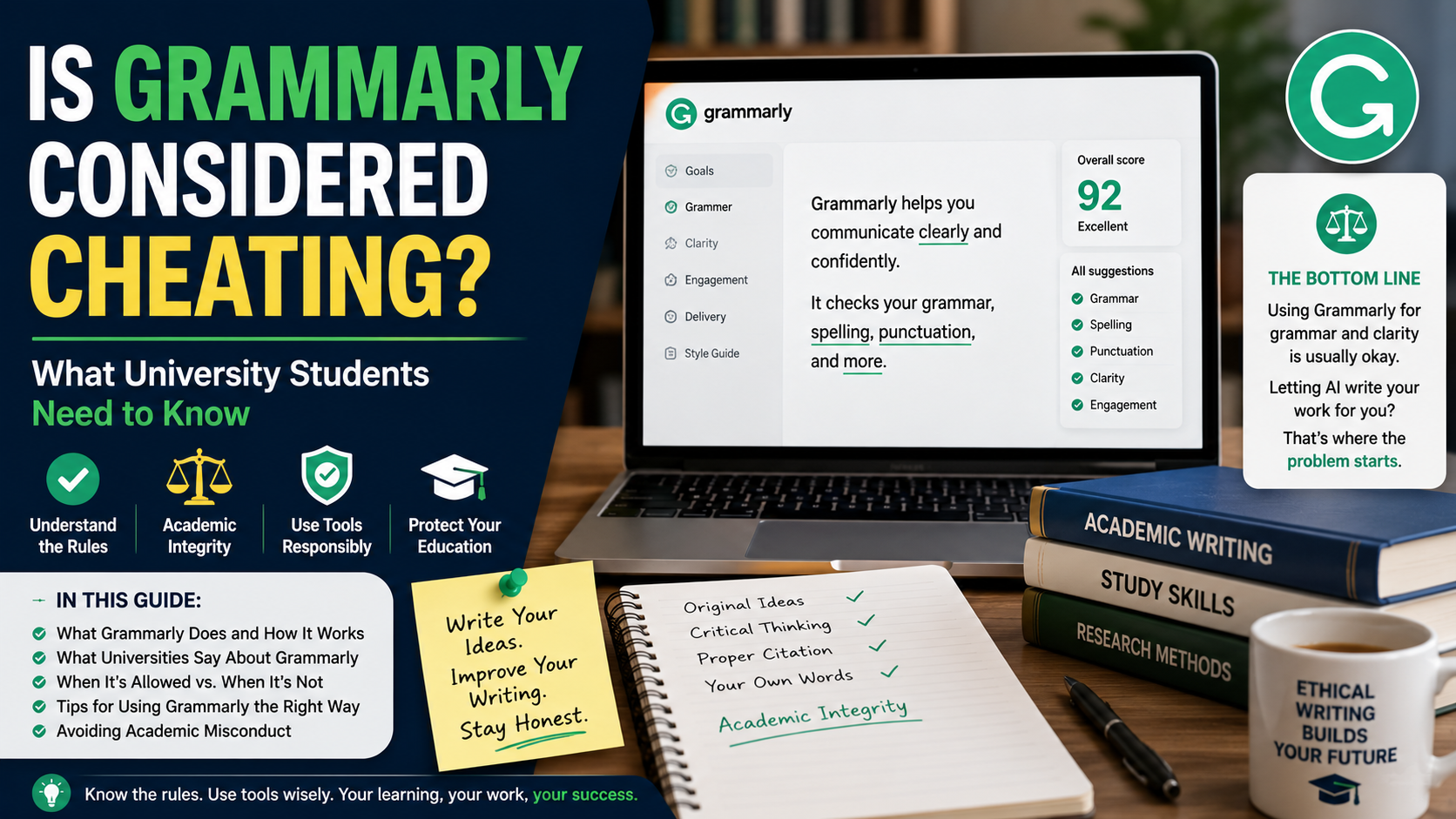
The short answer is not necessarily. Grammarly is widely used by students, professionals, and academics to improve grammar, spelling, punctuation, and clarity. However, whether using Grammarly is acceptable depends on how you use it and your university's academic integrity policy.
While basic proofreading features are generally accepted, some of Grammarly's AI-powered writing and rewriting tools may fall under institutional rules governing generative AI. Understanding the difference is essential to avoid accidental academic misconduct.
This guide explains what Grammarly does, when it is acceptable to use, when it could become problematic, and how to use it responsibly in university assignments.
What Is Grammarly?
Grammarly is an AI-powered writing assistant that helps users improve the quality of their writing.
It offers suggestions for:
-
Grammar
-
Spelling
-
Punctuation
-
Sentence clarity
-
Vocabulary
-
Tone
-
Readability
-
Style consistency
Premium and AI-enabled features can also help rewrite sentences, generate text, summarize content, and adjust writing style.
Is Grammarly Cheating?
In most cases, using Grammarly to correct grammar, spelling, punctuation, and minor writing errors is not considered cheating.
Many universities view proofreading tools similarly to spell checkers built into Microsoft Word or Google Docs.
However, if Grammarly's generative AI features significantly rewrite or create original content, some institutions may classify that use under their policies for AI-assisted writing. Always follow your university's guidance.
The Difference Between Proofreading and AI Writing
The key distinction is how much Grammarly changes your work.
Why Universities Allow Basic Grammarly Features
Universities encourage students to produce clear, accurate, and professional academic writing.
Basic proofreading tools help students:
-
Correct typing mistakes
-
Improve readability
-
Reduce grammatical errors
-
Enhance written communication
-
Learn from recurring mistakes
These improvements do not usually alter the original ideas or academic arguments created by the student.
When Grammarly Could Become Academic Misconduct
Problems may arise if Grammarly is used to:
-
Generate paragraphs or entire essays
-
Rewrite substantial sections of an assignment
-
Produce arguments the student did not develop
-
Summarize research without proper understanding
-
Replace critical thinking with AI-generated content
If the submitted work no longer reflects your own understanding, it may breach academic integrity rules.
What Do UK Universities Say?
Many UK universities now publish guidance on the use of AI writing tools.
Policies generally distinguish between:
-
Proofreading tools (often permitted)
-
Generative AI tools (may be restricted, declared, or prohibited depending on the assessment)
Some universities allow AI-assisted editing but require students to disclose any use of generative AI, while others prohibit AI assistance for specific assessments.
Always consult your:
-
Module handbook
-
Assignment brief
-
University AI policy
-
Academic integrity guidance
Grammarly vs AI Essay Writers
Students often confuse Grammarly with AI content generators.
There is an important difference.
The greater the AI contribution to your final submission, the more likely it is that your university's academic integrity and AI usage policies will apply. Grammarly is generally used for proofreading and language improvement, whereas AI essay writers generate original content that may raise concerns about authorship.
Benefits of Using Grammarly Responsibly
When used correctly, Grammarly can help students:
-
Improve grammar and punctuation
-
Develop stronger academic writing skills
-
Reduce proofreading time
-
Produce more polished assignments
-
Learn from writing feedback
It should complement—not replace—your own thinking and writing.
Tips for Using Grammarly Ethically
To use Grammarly responsibly:
-
Write your first draft yourself.
-
Use Grammarly to correct grammar and spelling.
-
Review every suggestion before accepting it.
-
Reject changes that alter your intended meaning.
-
Do not rely on AI-generated paragraphs.
-
Follow your university's AI policy.
-
Ask your lecturer if you are unsure.
Common Misconceptions
Myth: Grammarly writes my assignment for me.
Fact: Basic Grammarly features edit your writing rather than replacing your ideas. AI writing features are different and may be subject to institutional rules.
Myth: Grammarly is always cheating.
Fact: Responsible proofreading is commonly accepted, while AI-generated writing may not be.
Myth: Every university has the same AI policy.
Fact: Policies vary by institution, department, module, and assessment.
Final Thoughts
Grammarly is not automatically considered cheating. Used as a proofreading tool, it can help improve grammar, spelling, punctuation, and clarity while supporting better academic writing. However, its AI-powered writing features introduce additional considerations, and what is acceptable depends on your university's academic integrity policy.
The safest approach is to write your own work, use Grammarly for language improvement rather than content creation, and always follow your institution's guidance on AI-assisted writing. By doing so, you can benefit from modern writing tools while maintaining academic honesty and producing work that genuinely reflects your own knowledge and skills.
Frequently Asked Questions
Everything you need to know about our services
Related Posts

Assignment Help vs AI Writing Tools: Which Is Better for Students?

GPTZero vs Turnitin: Which AI Detector Is Better in 2026?
