Thesis Chapter Editing Services for Canadian Graduate Students
Introduction
A graduate thesis is rarely finished after the first draft. Chapters often go through multiple rounds of supervisor feedback, restructuring, rewriting and proofreading before they are ready for submission.
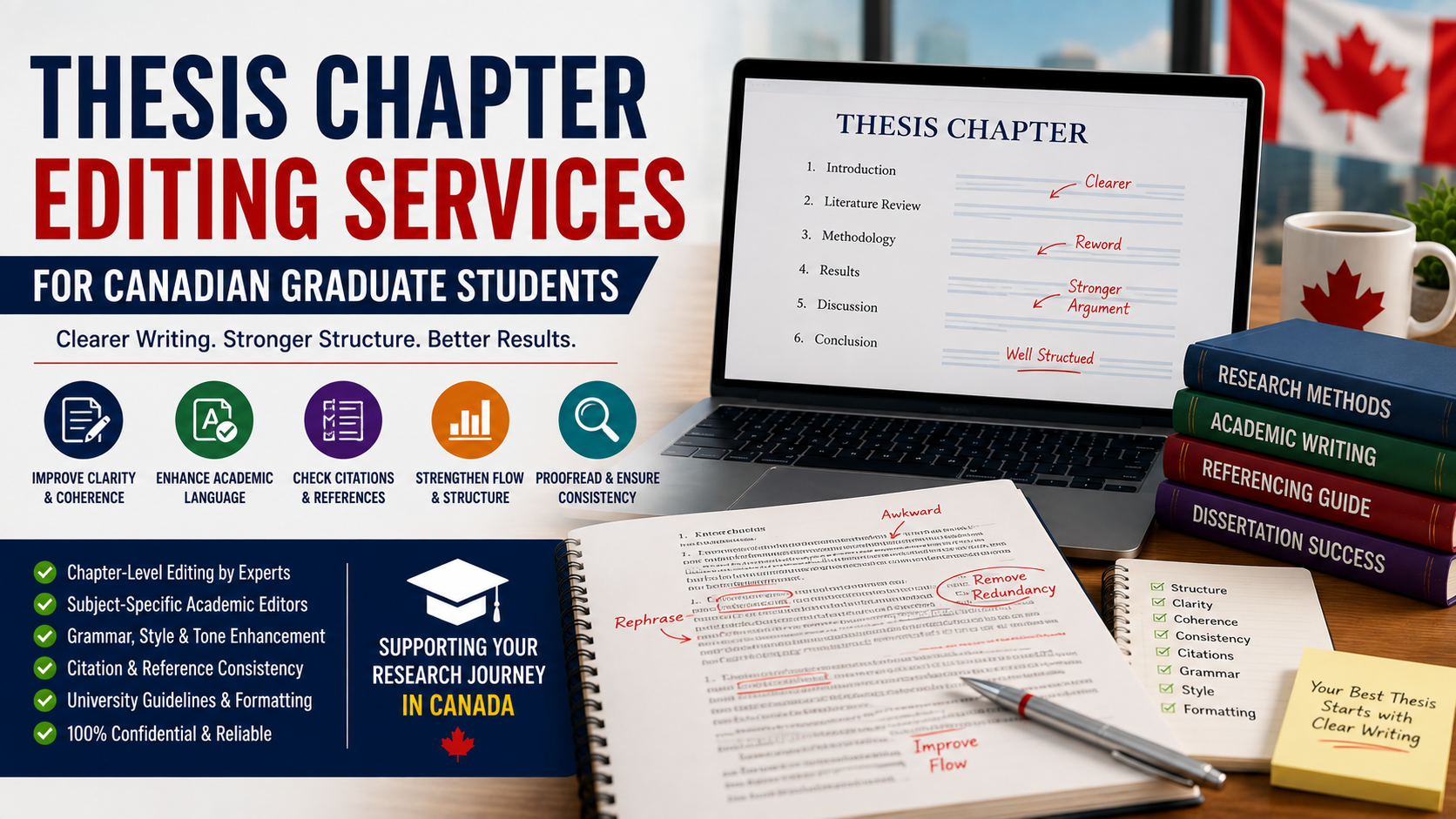
For Canadian graduate students, thesis chapter editing services can provide professional support with clarity, academic language, coherence, structure, terminology, citations and consistency across individual thesis chapters.
However, editing is different from having someone conduct the research or replace the student's academic contribution. Students should always check their university's policies before using external editing support.
This guide explains what thesis chapter editing involves, which chapters may benefit from editing, what an editor can review and how students can prepare a thesis chapter for final submission.
What Is Thesis Chapter Editing?
Thesis chapter editing is the process of reviewing an existing thesis chapter to improve its clarity, coherence, academic language, structure and consistency while preserving the student's intended meaning and scholarly contribution.
Depending on the agreed scope, editing may address:
Grammar
Sentence structure
Academic language
Clarity
Coherence
Paragraph organisation
Transitions
Terminology
Headings
Citation consistency
Reference formatting
Tables and figures
Cross-references
Formatting consistency
The precise level of editing should be agreed upon before work begins.
What Is the Difference Between Thesis Editing and Proofreading?
Editing and proofreading are related but different services.
Thesis Chapter Editing | Thesis Proofreading |
|---|---|
Improves clarity | Finds final errors |
Reviews sentence structure | Checks spelling |
Improves coherence | Checks punctuation |
Reviews paragraph flow | Checks grammar |
Examines terminology | Checks typographical errors |
May review organisation | Checks formatting consistency |
Can address awkward wording | Checks references and citations |
Editing generally happens before final proofreading.
A practical workflow is:
Draft → Supervisor Feedback → Chapter Editing → Revision → Formatting → Proofreading → Final Submission
Why Do Canadian Graduate Students Use Thesis Chapter Editing?
Graduate students may spend months or years working on their research. After repeatedly reading the same chapter, it can become difficult to notice:
Repeated wording
Awkward sentences
Missing transitions
Inconsistent terminology
Unclear paragraphs
Citation inconsistencies
Formatting problems
A fresh editorial review can help identify presentation issues that the researcher may overlook.
This can be particularly useful when a thesis has gone through several rounds of revisions.
Which Thesis Chapters Can Be Edited?
Professional chapter editing can potentially cover almost any part of a thesis.
Commonly edited chapters include:
Introduction
Literature review
Methodology
Results or findings
Discussion
Conclusion
Theoretical framework
Conceptual framework
Research background
Appendices and supporting material
The editing requirements can differ substantially between chapters.
What Does Introduction Chapter Editing Include?
The introduction establishes the context for the research.
An editor may review:
Background
Research problem
Research gap
Research questions
Research objectives
Significance of the study
Scope
Key definitions
Chapter structure
The editor can focus on whether the chapter communicates these elements clearly and logically.
The researcher remains responsible for determining the actual research problem, questions and contribution.
What Does Literature Review Editing Include?
A literature review should do more than list sources.
Editing may focus on:
Paragraph organisation
Thematic structure
Transitions
Academic language
Citation consistency
Terminology
Synthesis of sources
Connections between themes
Consistency between literature review and research questions
An editor can improve how existing content is presented, but students should remain responsible for evaluating the literature and developing their scholarly interpretation.
What Does Methodology Chapter Editing Include?
The methodology chapter explains how the research was designed and conducted.
Editing may cover:
Research philosophy
Research approach
Research design
Sampling
Participants
Data sources
Data collection
Research instruments
Data analysis
Validity
Reliability
Qualitative trustworthiness
Research ethics
Methodological limitations
The editor can improve the presentation and clarity of the methodology.
The researcher should remain responsible for the methodological decisions and justification.
What Does Results Chapter Editing Include?
The results or findings chapter presents the evidence produced by the research.
Editing may involve checking:
Logical organisation
Results-section headings
Tables
Figures
Statistical terminology
Figure captions
Table captions
Cross-references
Numbering
Consistency between text and tables
Academic language
For quantitative research, an editor may also check whether terminology and presentation are consistent.
For qualitative research, editing may focus on the organisation and presentation of themes, categories and supporting evidence.
The researcher remains responsible for the actual analysis and interpretation of their research data.
What Does Discussion Chapter Editing Include?
The discussion chapter interprets findings in relation to the research questions and existing scholarship.
Editing may focus on:
Logical flow
Connections between findings and literature
Academic language
Transitions
Organisation
Terminology
Limitations
Implications
Theoretical contribution
Practical implications
An editor can improve the presentation of an existing discussion but should not invent interpretations or research claims.
What Does Conclusion Chapter Editing Include?
The conclusion brings the thesis together.
Editing may review:
Summary of findings
Research-question responses
Contribution
Implications
Limitations
Recommendations
Future research
Closing statement
The conclusion should remain consistent with the evidence and arguments presented in earlier chapters.
What Does a Thesis Chapter Editor Check?
A professional chapter edit can involve several levels of review.
Grammar and Sentence Structure
The editor can identify:
Grammar errors
Sentence fragments
Run-on sentences
Incorrect punctuation
Subject-verb agreement
Awkward sentence construction
Academic Language
Editing can improve:
Formality
Precision
Clarity
Conciseness
Academic tone
Coherence
The editor can assess whether paragraphs connect logically.
Terminology
Important technical terms should be used consistently throughout the chapter.
Transitions
Transitions can help readers understand how one idea connects to the next.
Headings
Headings and subheadings should reflect the structure of the chapter.
Citations
Editors can identify apparent inconsistencies in citation formatting, although researchers remain responsible for verifying their sources.
Can Thesis Chapter Editing Improve Academic English?
Yes.
This can be particularly useful for graduate students writing in English as an additional language.
Academic-language editing may focus on:
Sentence clarity
Word choice
Grammar
Formal tone
Conciseness
Academic vocabulary
Transitions
Consistent terminology
The goal should be to improve the presentation of the student's ideas without changing their intended scholarly meaning.
Can a Thesis Editor Change the Meaning of My Research?
A professional editor should work within the agreed editing scope.
For standard language and copy editing, the objective is generally to improve the expression of existing ideas rather than change the researcher's conclusions.
Students should discuss the editing scope before providing a chapter.
For example, they can clarify whether they want:
Proofreading only
Language editing
Copy editing
Structural feedback
Formatting
Citation checking
Can Thesis Chapter Editing Include Structural Feedback?
Some editing services may offer structural or developmental feedback.
This can involve reviewing:
Chapter organisation
Section order
Paragraph sequence
Repetition
Transitions
Logical flow
Alignment with research questions
Structural feedback is more substantive than proofreading, so students should confirm whether their university permits this type of external assistance.
What Should Students Provide to a Thesis Chapter Editor?
Where external editing is permitted, useful materials include:
Thesis chapter draft
University thesis guidelines
Faculty requirements
Referencing style
Supervisor comments
Previous corrections
Formatting template
Editing instructions
Specific areas of concern
Supervisor feedback can be particularly useful because it tells the editor which issues the student has already been asked to address.
How Can Supervisor Feedback Be Incorporated Into Chapter Editing?
A practical process is:
Step 1: Collect Feedback
Gather comments from:
Supervisor
Committee members
Internal reviewers
External examiners where applicable
Step 2: Categorise Comments
Separate feedback into:
Content revisions
Structural revisions
Methodology revisions
Language corrections
Citation changes
Formatting changes
Step 3: Revise the Chapter
The student makes the substantive academic changes.
Step 4: Edit the Revised Chapter
The editor can then focus on clarity, coherence, language and consistency.
Step 5: Proofread the Final Version
Perform a final error check after all major revisions.
What Are Common Thesis Chapter Editing Problems?
Common issues include:
Repetitive paragraphs
Weak transitions
Inconsistent terminology
Overly long sentences
Unclear topic sentences
Grammar mistakes
Inconsistent headings
Citation inconsistencies
Incorrect cross-references
Inconsistent table numbering
Figure-caption inconsistencies
Unnecessary repetition
Inconsistent tense
Poor paragraph structure
These problems can become more noticeable when several chapters have been written at different stages of the research.
How Can Editing Improve Consistency Across Thesis Chapters?
A thesis should read like one coherent academic document.
Editors can help identify inconsistencies involving:
Terminology
The same concept should not have multiple names without a reason.
Abbreviations
Abbreviations should be introduced and used consistently.
Chapter Titles
Chapter and section titles should follow the same formatting system.
Tables and Figures
Numbering should remain consistent throughout the thesis.
References
Citation formatting should follow the required style.
Tense
Research methods, completed procedures and established findings may require different grammatical approaches depending on the discipline.
What Is a Thesis Chapter Editing Checklist?
Before finalising a chapter, review:
Structure
Chapter purpose is clear
Sections follow a logical sequence
Headings are consistent
Paragraphs have clear purposes
Transitions are effective
Language
Grammar checked
Spelling checked
Punctuation checked
Sentence structure reviewed
Academic tone maintained
Terminology consistent
Citations
Citations are formatted consistently
References are complete
In-text citations correspond to references
Required citation style is followed
Tables and Figures
Numbering is correct
Captions are consistent
Tables and figures are referenced
Cross-references are accurate
Final Review
Supervisor comments addressed
Repeated content removed
Chapter conclusion matches the chapter
Formatting is consistent
Final proofreading completed
How Much Does Thesis Chapter Editing Cost in Canada?
There is no single standard price for thesis chapter editing in Canada.
Pricing can depend on:
Word count
Academic level
Subject
Editing intensity
Deadline
Formatting requirements
Referencing requirements
Number of revisions
Technical complexity
A short proofreading request will generally require a different level of work from a detailed structural edit.
Students should request a clear quotation and scope before beginning.
How Long Does Thesis Chapter Editing Take?
Turnaround depends on:
Chapter length
Editing depth
Technical complexity
Existing writing quality
Deadline
Number of requested revisions
Students should avoid leaving substantial editing until the final hours before submission.
A better workflow is:
Draft → Supervisor Feedback → Revision → Chapter Editing → Formatting → Proofreading → Final Review
Can International Graduate Students in Canada Use Thesis Editing Services?
International graduate students may seek permitted editing or proofreading assistance, but they should first check their institution's current academic-integrity policies.
They may also need to consider:
Program requirements
Supervisor expectations
External editing policies
Thesis guidelines
AI-use rules
University policies can vary, so students should not assume that an editing practice permitted at one institution is automatically permitted elsewhere.
Can AI Be Used to Edit a Thesis Chapter?
AI tools may assist with some language-related tasks, such as:
Grammar suggestions
Sentence clarity
Proofreading
Formatting checklists
Identifying repetitive wording
However, students should check their university's current policies regarding generative AI.
AI tools can sometimes:
Change the intended meaning
Introduce inaccurate terminology
Create unsupported claims
Alter technical language
Produce incorrect citations
Students should therefore review all AI-generated suggestions carefully and remain responsible for the final submitted work.
Is Thesis Chapter Editing the Same as Thesis Writing Services?
No.
Thesis chapter editing works with an existing chapter to improve its presentation.
Thesis writing involves creating substantive academic content.
The distinction can be important for academic integrity.
Students should understand exactly what a service will do before hiring an external provider.
Can Thesis Chapter Editing Include Formatting?
Yes, if formatting is included in the agreed scope.
Possible formatting support includes:
Heading styles
Page numbers
Margins
Font
Line spacing
Tables
Figures
Captions
Contents pages
References
Appendices
Students should provide the official formatting requirements for their university or graduate program.
What Should Canadian Graduate Students Check Before Hiring a Thesis Editor?
Consider:
Editing scope — What exactly will be edited?
Academic level — Does the editor have graduate-level experience?
Subject expertise — Does the editor understand the terminology?
Formatting knowledge — Can they follow institutional requirements?
Citation knowledge — Are they familiar with the required referencing style?
Confidentiality — How are thesis files stored?
Revision policy — Are revisions included?
Turnaround — Can the work be completed before the deadline?
Academic integrity — Is the service transparent about what it does?
University rules — Is external editing permitted?
Thesis Chapter Editing vs. Proofreading vs. Formatting
Service | Primary Purpose |
|---|---|
Editing | Improve clarity, coherence, language and consistency |
Proofreading | Identify final grammar, spelling and typographical errors |
Formatting | Improve document presentation according to requirements |
Structural feedback | Review organisation and logical flow |
Citation checking | Identify apparent citation/reference inconsistencies |
A student may need one service or a combination depending on the stage of their thesis.
When Is the Best Time to Edit a Thesis Chapter?
The best time depends on the research stage.
During Drafting
Focus on getting the research and argument onto the page.
After Supervisor Feedback
Address substantive academic changes first.
After Major Revisions
Use editing to improve clarity, coherence and language.
Before Submission
Complete formatting, proofreading and final consistency checks.
Avoid performing detailed proofreading before major content changes are complete because subsequent revisions may introduce new errors.
Final Thesis Chapter Editing Workflow
A practical workflow for Canadian graduate students is:
Research → Draft Chapter → Supervisor Feedback → Substantive Revision → Chapter Editing → Formatting → Proofreading → Citation Check → Final Thesis Review → Submission
This approach separates academic decision-making from final presentation work.
Final Thoughts
Thesis chapter editing can be a useful final-stage support for Canadian graduate students who already have substantial academic content but want to improve the clarity, coherence and consistency of their writing.
Thesis chapter editing services for Canadian graduate students may include academic-language editing, grammar review, structural feedback, terminology consistency, citation checking, formatting and proofreading, depending on the agreed scope and applicable university rules.
Students should always check their university's academic-integrity and external-editing policies before using professional support.
Most importantly, the student should retain responsibility for their:
Research
Data
Analysis
Arguments
Interpretation
Conclusions
Original scholarly contribution
A strong final workflow is:
Supervisor Feedback → Substantive Revision → Chapter Editing → Formatting → Proofreading → Final Review → Submission
Frequently Asked Questions
Everything you need to know about our services


