PhD Thesis Editing Services in Canada
Introduction
Writing a PhD thesis is one of the most demanding stages of postgraduate study. A doctoral thesis must communicate original research clearly while meeting the academic, methodological and formatting expectations of the student's university and discipline.
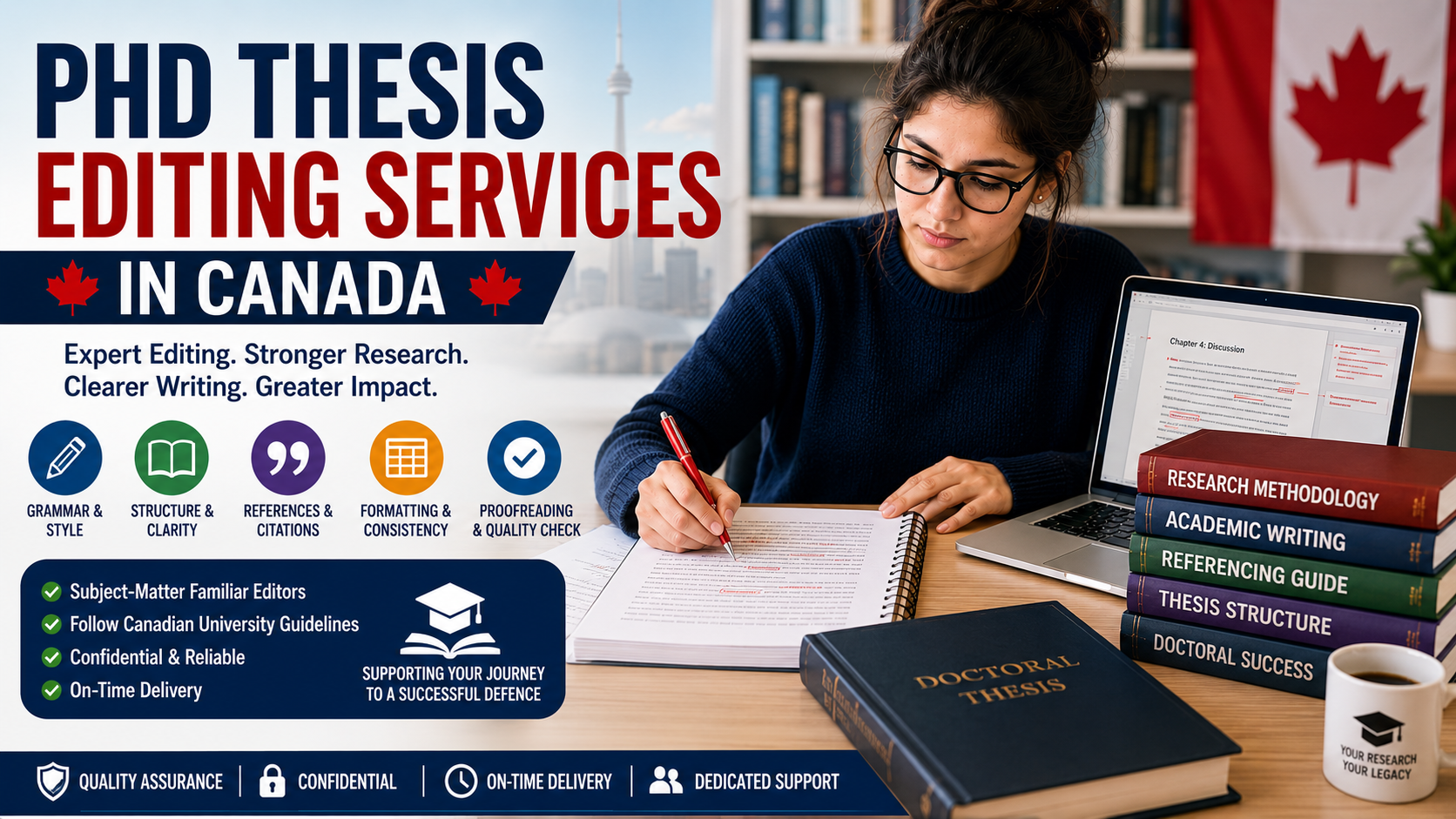
For Canadian doctoral students, PhD thesis editing services can provide permitted editorial support with grammar, clarity, academic language, consistency, formatting, references and proofreading. However, students should check their university's policies before hiring an external editor and should remain responsible for the research, methodology, analysis, arguments and original contribution presented in the thesis.
Canadian universities can have different rules regarding external editing. For example, the University of Toronto states that external copy editing may be considered in certain circumstances, but requires a strong rationale and prior approval from the supervisor(s) and supervisory committee. It also states that the intellectual content of the thesis cannot be modified through external editing.
UBC similarly advises students and supervisors to discuss whether hiring an editor is appropriate and to agree on the editing tasks that will be performed.
This guide explains what PhD thesis editing can include, when doctoral students may consider it, what to check before hiring an editor and how to prepare a thesis for final submission.
What Are PhD Thesis Editing Services?
PhD thesis editing services review an existing doctoral thesis to improve permitted aspects of writing and presentation without replacing the student's scholarly contribution.
Depending on the agreed scope, editing may include:
Grammar correction
Spelling
Punctuation
Sentence clarity
Academic language
Terminology consistency
Structural consistency
Citation formatting
Reference checking
Heading consistency
Table and figure formatting
Cross-reference checking
Proofreading
Final document review
The exact scope should be agreed upon before editing begins.
For doctoral students, the distinction between editorial assistance and substantive academic work is particularly important.
Why Is PhD Thesis Editing Important?
A doctoral thesis may contain hundreds of pages, multiple chapters, extensive references, statistical results, tables, figures and appendices.
After years of research, it can be difficult for the author to notice small errors in a document they have read repeatedly.
Editing can help identify issues such as:
Repeated terminology
Inconsistent headings
Grammar errors
Awkward sentences
Incorrect cross-references
Inconsistent citations
Formatting problems
Duplicate references
Table numbering errors
Figure-caption inconsistencies
The objective is not simply to make the thesis "sound better." A strong editorial review should help the thesis communicate the student's research more clearly while preserving the student's meaning.
What Does a PhD Thesis Editor Do?
A thesis editor may work at several different levels.
Language Editing
This can involve:
Grammar
Sentence structure
Spelling
Punctuation
Word choice
Academic tone
Clarity
Copy Editing
Copy editing can involve:
Terminology
Consistency
Headings
Capitalisation
Abbreviations
Citations
References
Tables
Figures
Cross-references
Proofreading
Proofreading is generally the final review for:
Typographical errors
Spelling mistakes
Grammar errors
Punctuation
Formatting inconsistencies
Page-number problems
Final document errors
Formatting Review
Formatting support can include checking:
Margins
Fonts
Headings
Chapter numbering
Page numbers
Tables
Figures
References
Appendices
Table of contents
The university's own thesis regulations should always take priority over a general editing style guide.
Can Canadian PhD Students Hire External Thesis Editors?
Sometimes, but students should check their university's current rules before hiring an external editor.
This is particularly important because Canadian universities do not all have identical policies.
The University of Toronto provides specific guidance on external copy editors for graduate theses. It states that external editing requires a strong rationale and prior approval from the supervisor(s) and supervisory committee. It also states that the intellectual content cannot be modified through the editing process and that the external editor's contribution must be identified.
UBC also says that students and supervisors should discuss whether it is appropriate to hire an editor and agree on the editing tasks.
Therefore, doctoral students should check:
Graduate-school regulations
Departmental requirements
Program handbook
Academic-integrity policies
Supervisor guidance
Thesis submission requirements
before arranging external editing.
What Should a PhD Thesis Editor Not Do?
A legitimate editorial service should not replace the student's academic work.
Students should retain responsibility for:
Research design
Research questions
Methodology
Data collection
Data analysis
Interpretation
Findings
Academic arguments
Original contribution
Conclusions
An editor should not fabricate:
Data
Results
References
Participants
Experiments
Citations
Research findings
Nor should an editor impersonate the student in communication with supervisors or examiners.
Why Is the Original Contribution So Important in a PhD Thesis?
A doctoral thesis is expected to make an original contribution to knowledge.
McGill's current general requirements state that a doctoral thesis must constitute original scholarship and be a distinct contribution to knowledge. It must also demonstrate the ability to plan and carry out research, organise results and defend the approach and conclusions in a scholarly manner.
This means editing should support how the research is communicated, not replace the research itself.
For example, an editor may identify an unclear sentence explaining a research finding.
The student remains responsible for determining:
What the finding means
Whether the interpretation is justified
How it contributes to the literature
Whether the evidence supports the claim
What Types of PhD Thesis Editing Are Available?
Doctoral students may require different levels of editorial support depending on the stage of their thesis.
1. Developmental Editing
This can examine broader issues such as:
Overall organisation
Chapter flow
Logical progression
Repetition
Transitions
Structural consistency
Any substantive structural changes should be discussed with the supervisor or committee where appropriate.
2. Academic Language Editing
This focuses on:
Clarity
Grammar
Sentence structure
Academic expression
Terminology
Readability
3. Copy Editing
This focuses on:
Consistency
Style
References
Citations
Headings
Abbreviations
Tables
Figures
4. Thesis Proofreading
This is generally the final error-checking stage.
It may identify:
Typos
Grammar errors
Punctuation errors
Formatting inconsistencies
Missing words
Duplicate words
Incorrect page numbers
5. Final Thesis Review
A final review can examine the thesis as a complete document rather than as individual chapters.
This is useful for identifying inconsistencies created during multiple rounds of revision.
Can a PhD Thesis Editor Help With the Literature Review?
An editor can potentially help with permitted language and presentation issues in an existing literature review.
For example, an editor may identify:
Grammar problems
Repeated terminology
Awkward transitions
Inconsistent citation formatting
Repeated ideas
Formatting inconsistencies
However, the student should remain responsible for:
Selecting literature
Evaluating sources
Identifying research gaps
Developing the theoretical argument
Interpreting previous research
The editor should not invent sources or create a research gap that the student's evidence does not support.
Can a PhD Thesis Editor Help With the Methodology Chapter?
Editorial assistance can potentially improve the clarity and consistency of an existing methodology chapter, subject to university rules.
A review might identify:
Ambiguous sentences
Inconsistent terminology
Grammar errors
Unclear descriptions
Formatting issues
Inconsistent abbreviations
The student remains responsible for the actual methodology.
This includes decisions concerning:
Research design
Sampling
Data collection
Instruments
Procedures
Analysis methods
Ethical considerations
Can Thesis Editors Help With Data Analysis?
Some providers offer statistical or data-analysis guidance, but doctoral students should distinguish between editorial review and substantive analytical work.
A thesis editor may potentially check whether statistical terminology is presented consistently or whether tables and results are clearly written.
However, the student should remain responsible for:
Selecting appropriate methods
Running analyses
Understanding statistical output
Interpreting results
Reporting findings accurately
For complex research, students should consult their supervisor, statistician or relevant methodological specialist where appropriate.
Can a PhD Thesis Editor Help With Results and Discussion Chapters?
Yes, permitted editorial support can potentially improve the presentation of existing results and discussion chapters.
Results editing may check:
Grammar
Table references
Figure references
Statistical terminology
Number formatting
Consistency
Discussion editing may check:
Sentence clarity
Terminology
Citation presentation
Transitions
Repetition
Consistency
However, the student remains responsible for deciding what the results mean and how they relate to the research questions and existing literature.
What About Manuscript-Based PhD Theses?
Some Canadian doctoral programs permit manuscript- or article-based thesis formats.
These can require additional editorial attention because the thesis needs to function as a coherent doctoral research project rather than simply as a collection of separate papers.
McGill's current thesis guidance states that manuscript-based theses must contain additional text connecting the manuscripts logically and producing a cohesive, unitary focus documenting a single program of research.
Editing a manuscript-based thesis may therefore involve checking consistency between:
Manuscripts
Introduction
Literature review
Methodology
Connecting chapters
Discussion
Overall conclusion
The specific requirements depend on the university and program.
How Should PhD Students Prepare a Thesis for Editing?
Before sending a thesis to an editor, prepare the following:
1. University Guidelines
Provide the current thesis formatting and submission guidelines.
2. Supervisor Feedback
Include relevant feedback that affects language, structure or presentation.
3. Referencing Style
Specify the required citation style.
4. Editing Scope
Clearly state whether you need:
Proofreading
Copy editing
Language editing
Formatting review
Reference checking
5. Areas of Concern
Identify chapters or sections that require particular attention.
6. Final Deadline
Provide enough time for editing, revisions and supervisor review.
What Should Students Ask a PhD Thesis Editor?
Before hiring an editor, ask:
What academic levels do you edit?
Do you have doctoral thesis editing experience?
Do you have experience in my discipline?
What does your editing service include?
What does it exclude?
Will you preserve my intellectual content?
How do you handle references and citations?
Can you follow my university's formatting requirements?
How are revisions handled?
How is confidentiality maintained?
Will you provide an editing record if required?
Can you work within my university's editing policy?
A clear scope reduces misunderstandings later.
How Much Does PhD Thesis Editing Cost in Canada?
There is no single standard price for PhD thesis editing in Canada.
Pricing can depend on:
Word count
Number of pages
Editing intensity
Academic discipline
Language quality
Formatting complexity
Reference requirements
Tables and figures
Turnaround time
Number of revision rounds
Students should compare the actual scope of services rather than choosing a provider solely on price.
The University of Toronto specifically notes that external copy editing can represent a significant financial burden for graduate students.
Affordable PhD Thesis Editing: What Should Students Look For?
If affordability is important, compare:
Service Scope
Does the quoted price include proofreading, copy editing or broader editing?
Word Count
Is pricing based on words, pages or hours?
Revision Policy
How many rounds are included?
Formatting
Does formatting review cost extra?
References
Are citations and references included?
Turnaround
Does urgent editing carry an additional charge?
A low headline price may not be the lowest overall cost if important services are excluded.
When Is the Best Time to Edit a PhD Thesis?
Editing should ideally happen in stages rather than entirely at the end.
A practical workflow is:
Research → Drafting → Supervisor Feedback → Major Revisions → Structural Review → Copy Editing → Proofreading → Final Formatting → Submission
This approach gives the student time to make academic changes before the final proofreading stage.
McGill encourages students to familiarise themselves with the thesis process early and provides guidance covering preparation, initial submission, examination and final submission.
Should You Edit Before or After Supervisor Feedback?
Major academic revisions should generally be completed before final proofreading.
A practical sequence is:
Submit draft to supervisor
Receive feedback
Discuss major revisions
Revise thesis
Conduct structural review
Complete permitted editing
Proofread
Format final document
Review PDF
Submit
If you proofread too early, subsequent academic revisions may create new errors.
PhD Thesis Editing Checklist
Before final submission, review:
Academic Consistency
Research questions are consistent
Objectives are consistent
Methodology is accurately described
Results are accurately presented
Discussion reflects findings
Conclusion reflects the research
Original contribution is clearly communicated
Language
Grammar checked
Spelling checked
Punctuation checked
Academic terminology consistent
Tenses consistent
Abbreviations consistent
Citations and References
Citations checked
References checked
Author names checked
Publication dates checked
DOI/URL details checked where required
Referencing style consistent
Tables and Figures
Table numbering checked
Figure numbering checked
Captions checked
Units checked
Labels checked
Cross-references checked
Formatting
Margins checked
Font checked
Line spacing checked
Headings checked
Page numbers checked
Table of contents updated
Appendices checked
Final File
Comments removed
Track changes removed
Placeholder text removed
PDF reviewed
File naming checked
Submission requirements checked
PhD Thesis Editing and Academic Integrity
Academic integrity should remain central to the editing process.
A responsible thesis-editing service should never:
Fabricate data
Fabricate references
Rewrite research findings
Invent methodology
Manipulate results
Write false citations
Impersonate students
Guarantee thesis acceptance
Guarantee a doctoral degree
The University of Toronto's guidance emphasises that a graduate thesis is the student's work and that intellectual content cannot be modified through an external copy-editing process.
UBC likewise places responsibility for correct grammar, spelling, terminology and clear writing on the student and asks students and supervisors to agree on appropriate editing tasks.
Can International PhD Students in Canada Use Thesis Editing Services?
International doctoral students may seek permitted editorial support, but they should follow the same university rules that apply to other graduate students.
Before hiring an external editor, international students should check:
University academic-integrity policies
Graduate-school thesis rules
Supervisor requirements
Program requirements
External editing policies
Disclosure requirements
The student's immigration status does not replace university academic-integrity requirements.
What Happens After PhD Thesis Submission?
The process varies by university.
At McGill, doctoral theses are evaluated by examiners, and a successful written examination allows the candidate to proceed to the oral defence. If the thesis is not passed, eligible doctoral candidates may have the option to revise and resubmit.
This illustrates why students should not assume that one university's thesis procedure applies across Canada.
Always follow the instructions of your own graduate school and program.
What If Examiner Corrections Are Required?
If examiners request changes, students should first understand the scope of the corrections.
They may include:
Minor editorial corrections
Formatting corrections
Citation corrections
Clarification requests
Substantive academic revisions
McGill distinguishes minor revisions from major revisions and explains that major revisions may involve additional research, experimentation or substantial reformulation.
A student can create a correction matrix containing:
Examiner Comment | Chapter | Required Change | Status |
|---|---|---|---|
Comment 1 | Chapter 2 | Revise section | Complete |
Comment 2 | Chapter 4 | Clarify analysis | In progress |
Comment 3 | Chapter 5 | Correct reference | Complete |
This makes the final revision process easier to manage.
What Makes a Good PhD Thesis Editing Service in Canada?
A reliable service should demonstrate:
Doctoral-Level Experience
The editor should understand the complexity of doctoral writing.
Clear Editing Boundaries
The service should explain exactly what will and will not be changed.
Canadian University Awareness
The editor should be willing to work from the student's actual university guidelines.
Subject Familiarity
A thesis in engineering may require very different terminology from one in sociology, nursing, education or business.
Confidentiality
Students should understand how their thesis files are stored and handled.
Transparent Pricing
Costs should be clear before work begins.
Academic-Integrity Awareness
The service should respect the student's intellectual ownership of the research.
PhD Thesis Editing vs PhD Thesis Writing
These services should not be confused.
PhD thesis editing works on an existing thesis to improve permitted language, clarity, consistency and presentation.
PhD thesis writing can imply creation of substantial academic content and raises significantly different academic-integrity considerations.
For doctoral work, students should retain control over their research and intellectual contribution.
A responsible editing service should therefore focus on helping the student's existing work communicate more clearly.
Final PhD Thesis Editing Checklist
Before submitting your doctoral thesis, ask:
Have I incorporated my supervisor's relevant feedback?
Are my research questions and objectives consistent throughout the thesis?
Is my methodology accurately described?
Are my results and statistical information accurate?
Does the discussion correctly interpret my findings?
Is my original contribution clearly communicated?
Are my citations and references consistent?
Are all tables and figures numbered correctly?
Are all cross-references accurate?
Does the formatting meet my university's requirements?
Have I reviewed the final PDF?
Have I removed comments and tracked changes?
Have I checked my university's policy on external editing?
Have I retained responsibility for the intellectual content of my thesis?
If the answer to these questions is yes, the thesis is much better prepared for its final submission or examination stage.
Conclusion
PhD thesis editing services in Canada can provide permitted editorial support to doctoral students who need help improving the clarity, grammar, consistency, formatting, referencing and presentation of an existing thesis.
However, doctoral students should verify their university's rules before using an external editor. Canadian universities can differ in their requirements, and some institutions require prior approval or disclosure of external editing.
The University of Toronto, for example, requires prior approval in circumstances where an external copy editor is used and states that intellectual content cannot be modified through the editing process. UBC similarly expects students and supervisors to agree on appropriate editing tasks.
The safest approach is to treat editing as support for scholarly communication—not a replacement for doctoral research. The student should remain responsible for the methodology, analysis, findings, arguments and original contribution that make the thesis a PhD-level piece of scholarship.
Before hiring an editor, check your university's current regulations, discuss the proposed scope with your supervisor and use the official thesis-submission requirements as the final checklist.
Frequently Asked Questions
Everything you need to know about our services


