Research Paper Editing Services for New Zealand University Students
Introduction
Writing a research paper requires more than collecting information and presenting it in paragraphs. University students need to develop a clear research question, evaluate academic literature, present evidence logically, explain their methodology where applicable, interpret findings and communicate their conclusions in an appropriate academic style.
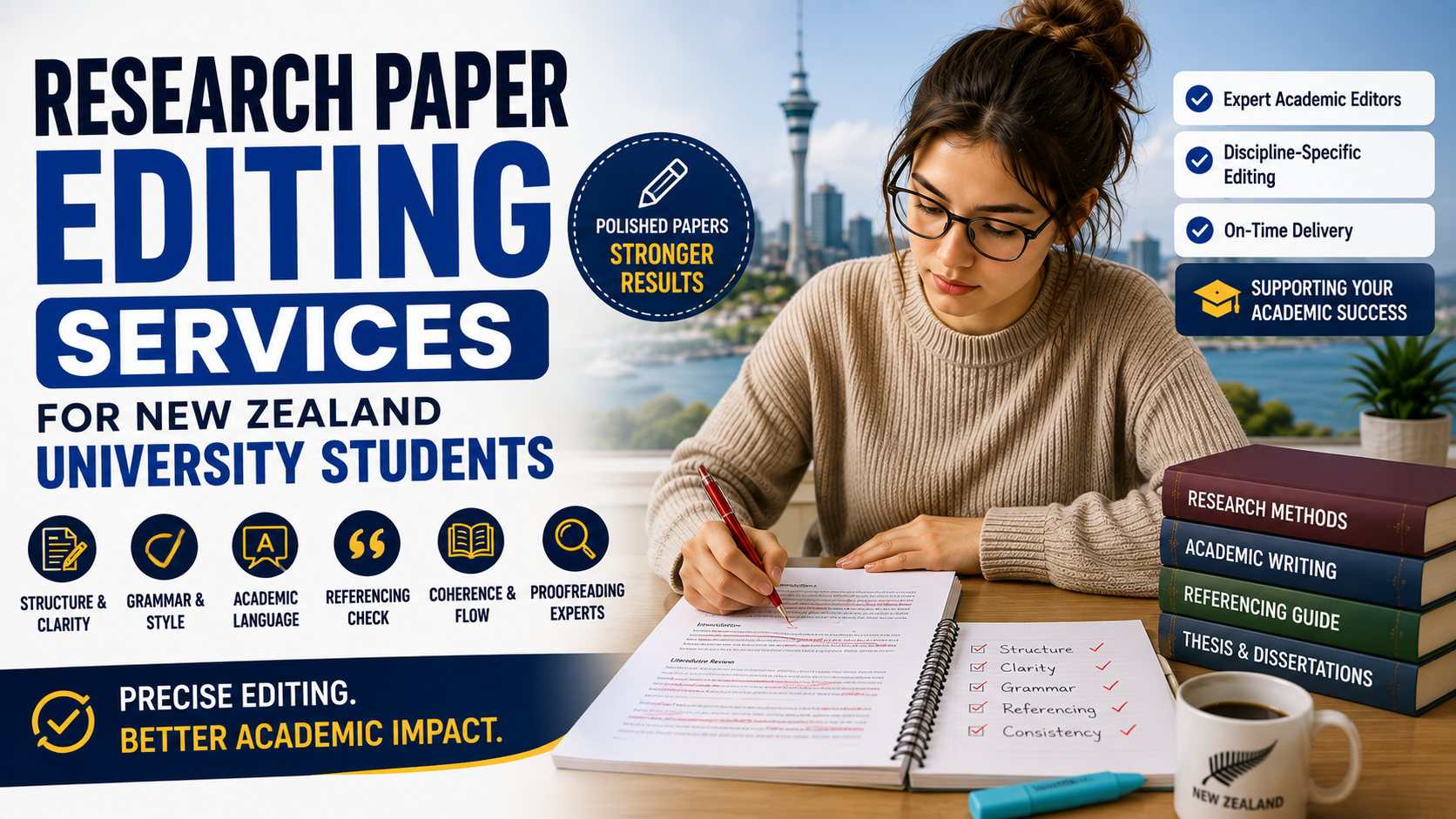
For New Zealand university students, research paper editing can be particularly useful when a completed draft needs improvement in areas such as structure, academic language, clarity, coherence, grammar, referencing and presentation.
A good editing process should strengthen the student's existing research and argument without replacing their academic judgement. Students should also check their university's assessment and academic-integrity policies before using external editing or proofreading support.
What Is a Research Paper?
A research paper is an academic document that investigates a particular question, problem or topic using evidence from relevant sources.
Depending on the subject and assignment, a research paper may include:
Research question
Introduction
Literature review
Theoretical framework
Methodology
Results or findings
Discussion
Conclusion
References
Appendices where required
The exact structure varies according to the discipline, research design, academic level and assessment requirements.
A research paper in psychology, for example, may have a substantially different structure from a business research paper, nursing research project or social science paper.
What Are Research Paper Editing Services?
Research paper editing services focus on improving an existing academic draft.
Editing may examine:
Grammar
Spelling
Sentence structure
Academic tone
Clarity
Paragraph organisation
Logical flow
Transitions
Repetition
Formatting
Citation consistency
Reference-list formatting
Overall readability
The purpose is to help make the student's existing research and argument easier to understand.
Editing is different from writing an assignment from scratch. The student should remain responsible for the research, interpretation, arguments and conclusions presented in their work.
Why Do NZ University Students Need Research Paper Editing?
Research papers can become difficult to manage when students are dealing with large amounts of academic literature and strict submission deadlines.
Common problems include:
Weak paragraph organisation
Unclear arguments
Long or complicated sentences
Repetition
Inconsistent terminology
Poor transitions
Grammar errors
Incorrect citations
Inconsistent formatting
Weak connections between evidence and arguments
Conclusions that do not clearly answer the research question
Editing can help identify these problems before submission.
Research Paper Editing vs Proofreading
Editing and proofreading are related but different processes.
Editing
Editing focuses on the overall quality of the document.
It may examine:
Structure
Argument flow
Paragraph organisation
Clarity
Academic expression
Logical connections
Repetition
Use of evidence
Proofreading
Proofreading is usually the final quality check.
It focuses on:
Spelling
Grammar
Punctuation
Typographical errors
Formatting inconsistencies
Citation presentation
Reference-list errors
A research paper may benefit from both stages.
A practical workflow is:
Research → Draft → Revise → Edit → Reference Check → Proofread → Final Review
How to Edit a Research Paper
Students can use a structured editing process rather than attempting to correct everything simultaneously.
Step 1: Recheck the Research Question
Start by reading the research question or assignment prompt again.
Ask:
Does my paper answer the question?
Is the central issue clearly defined?
Have I stayed within the required scope?
Does every major section contribute to the research objective?
A well-written paper can still receive poor feedback if it does not directly address the assignment question.
Step 2: Review the Overall Structure
Look at the paper as a complete document.
Check whether the sections appear in a logical order.
A common structure is:
Introduction → Literature Review → Methodology → Results → Discussion → Conclusion
However, this structure is not universal.
Follow the structure specified by your course, supervisor, assessment brief or research methodology.
Step 3: Improve the Introduction
A strong introduction should establish the purpose and direction of the paper.
Depending on the assignment, it may include:
Background
Research problem
Research question
Objectives
Context
Significance
Scope
Structure of the paper
Avoid filling the introduction with unnecessary background information.
The reader should understand what the research paper is investigating and why the topic matters.
Step 4: Strengthen the Literature Review
A literature review should not simply become a list of article summaries.
Students should show how sources relate to one another.
For example:
Smith (2024) identifies employee autonomy as an important factor in workplace productivity. Similarly, Patel (2025) reports that increased autonomy can improve employee engagement. However, Chen (2023) argues that the relationship depends on organisational culture and managerial support.
This creates a connection between sources rather than discussing each article separately.
A strong literature review may:
Compare studies
Identify agreements
Identify disagreements
Evaluate methodologies
Identify research gaps
Explain theoretical differences
Establish the relevance of existing research
Step 5: Check the Methodology Section
For research papers that include original research, the methodology should clearly explain how the research was conducted.
Depending on the study, this may include:
Research design
Participants
Sampling
Data collection
Instruments
Procedures
Data analysis
Ethical considerations
Research limitations
The methodology should be consistent with the research question and research design.
Students should not change methodological details simply to make a paper appear stronger. The paper should accurately represent what was actually done.
Step 6: Review Results and Findings
If your research paper contains results, make sure the findings are presented clearly.
Check:
Tables
Figures
Statistical results
Descriptive findings
Labels
Units
Captions
Explanatory text
Avoid mixing extensive interpretation into a results section if your required structure separates results from discussion.
Follow the conventions of your discipline and research methodology.
Step 7: Improve the Discussion
The discussion should explain what the findings mean.
Ask:
What do the findings suggest?
How do they relate to previous research?
Do they support or contradict earlier findings?
Why might the findings differ?
What are the implications?
What are the limitations?
What areas require further research?
This is often one of the most important sections of a research paper because it connects the findings with the broader academic literature.
Step 8: Strengthen Academic Arguments
Research papers should make arguments supported by evidence.
Instead of writing:
Social media is harmful to students.
A more academically cautious statement could be:
Existing research suggests that certain patterns of social media use may be associated with negative academic or wellbeing outcomes, although the relationship can vary according to usage patterns and individual circumstances.
The second approach avoids an unnecessarily broad claim and leaves room for evidence and evaluation.
Step 9: Check Evidence and Citations
Every major claim based on external research should be supported by an appropriate source.
During editing, ask:
Is this claim supported?
Does the cited source actually support the statement?
Is the citation placed correctly?
Have I represented the source accurately?
Is the source relevant?
Is the source credible?
Have I accidentally cited a secondary source as though I read the original?
Never invent citations or references to fill gaps.
Students should verify references against the original publications.
Step 10: Review Referencing Style
New Zealand universities and individual courses may use different referencing requirements.
Common styles include:
APA
Harvard
MLA
Chicago
OSCOLA
Discipline-specific styles
Check:
In-text citations
Reference list
Author names
Publication dates
Titles
Journal information
Volume and issue numbers
Page numbers where required
DOI or URL formatting where applicable
Alphabetical ordering
Formatting consistency
Always follow the style specified by your course or assessment instructions.
Research Paper Editing for International Students in New Zealand
International students may face additional challenges when preparing research papers in English.
These can include:
Academic vocabulary
Sentence structure
Paraphrasing
Cohesion
Formal academic tone
Critical analysis
Referencing conventions
Understanding assessment terminology
For these students, editing can be useful for improving the clarity and readability of their existing work.
However, language improvement should not change the meaning of the student's research or misrepresent their academic position.
Research Paper Editing for Undergraduate Students
Undergraduate research papers often require students to demonstrate that they can:
Find appropriate academic sources
Understand research literature
Apply relevant concepts
Present evidence
Construct an academic argument
Reference sources correctly
Reach a supported conclusion
Editing can help students identify structural and language problems before submission.
Research Paper Editing for Postgraduate Students
Postgraduate research papers generally require deeper engagement with scholarly literature.
Editing at this level may focus on:
Argument sophistication
Literature synthesis
Theoretical consistency
Methodological clarity
Research limitations
Academic positioning
Logical progression
Scholarly tone
Consistency of terminology
For master's and doctoral-level work, students may also need to demonstrate awareness of research gaps and academic debates.
Research Paper Editing for Different Subjects
Editing requirements can vary significantly by discipline.
Nursing and Healthcare
Research papers may require careful attention to:
Clinical terminology
Evidence-based practice
Research methodology
Patient outcomes
Ethical considerations
Professional standards
Psychology
Editors may need to review:
Research design
Psychological terminology
Statistical reporting
Theoretical frameworks
Methodological limitations
Business and Management
Research papers may focus on:
Business theories
Organisational evidence
Market research
Strategic analysis
Management frameworks
Education
Students may need to connect:
Educational theories
Research evidence
Teaching practices
Learning outcomes
Educational policy
Law
Legal research papers may require careful attention to:
Legislation
Case law
Legal authority
Judicial reasoning
Academic commentary
Required legal citation style
Common Research Paper Editing Mistakes
1. Editing Only Grammar
Correcting grammar does not automatically improve the research paper's argument.
Structure and reasoning should also be reviewed.
2. Overusing Complex Language
Academic writing should be precise, not unnecessarily complicated.
Clear sentences are often stronger than overly sophisticated wording.
3. Repeating the Same Point
Review each paragraph for unnecessary repetition.
4. Weak Topic Sentences
Each paragraph should have a clear purpose.
5. Poor Transitions
Readers should be able to understand how one paragraph connects to the next.
6. Unsupported Claims
Important claims should be supported by appropriate evidence.
7. Citation Errors
Incorrect or inconsistent referencing can reduce academic credibility.
8. Overusing Quotations
Research papers should demonstrate the student's understanding and synthesis of literature rather than relying excessively on direct quotations.
9. Ignoring the Research Question
Every major section should contribute to answering the research question.
10. Editing Too Close to the Deadline
Last-minute editing can make it difficult to identify deeper structural problems.
Allow enough time for revision and proofreading.
How to Make a Research Paper More Academic
Academic writing is not simply about using difficult vocabulary.
Strong academic writing is:
Clear
Precise
Evidence-based
Structured
Objective where appropriate
Cautious about unsupported claims
Consistent
Relevant to the research question
Compare:
This study proves that online learning is better.
With:
The findings indicate that online learning may provide advantages in certain learning contexts, although the results should be interpreted in light of the study's sample and methodological limitations.
The second statement is more appropriately cautious and academically precise.
Research Paper Editing Checklist
Before submitting your paper, check:
Does the paper answer the research question?
Is the purpose clearly established?
Is the structure logical?
Does the literature review synthesise sources?
Are important claims supported by evidence?
Are sources accurately represented?
Is the methodology clearly explained where applicable?
Are findings presented accurately?
Does the discussion interpret the findings?
Are limitations acknowledged?
Is the conclusion supported by the paper?
Are citations consistent?
Is the reference list complete?
Is the required referencing style followed?
Are grammar and spelling correct?
Are paragraphs logically connected?
Have unnecessary repetitions been removed?
Have tables and figures been checked?
Have all sources been verified?
Have I followed the assessment rubric?
Have I checked the university's academic-integrity requirements?
Can Someone Edit My Research Paper?
Where permitted by your university and assessment requirements, professional editing or proofreading can help identify problems with:
Grammar
Clarity
Structure
Academic language
Formatting
Referencing
Coherence
Students should remain responsible for their research, source selection, interpretation, analysis and conclusions.
Before submitting externally edited work, check the academic-integrity requirements that apply to your assessment.
Can AI Be Used to Edit a Research Paper?
AI use depends on the specific university, course and assessment.
Students should check:
Assessment instructions
University AI policies
Course guidelines
Academic-integrity requirements
Disclosure requirements
AI tools can also introduce errors, particularly with references, citations, factual claims and research interpretation.
Any AI-assisted information should therefore be checked against the original academic sources.
How to Choose Research Paper Editing Services in New Zealand
If you are considering research paper editing support, evaluate the service carefully.
Look for Relevant Academic Experience
A research paper in nursing requires different expertise from a paper in law, psychology or business.
Understand What Editing Includes
Check whether the service covers:
Academic language
Structure
Clarity
Grammar
Referencing
Formatting
Coherence
Proofreading
Check the Turnaround Time
Choose a turnaround that gives you enough time to review the edited document before submission.
Protect Your Academic Work
Understand how your document and personal information are handled.
Check Academic-Integrity Compatibility
Most importantly, make sure the service you use is permitted under your university and assessment rules.
Why Research Paper Editing Can Improve Your Final Draft
A first draft is rarely perfect.
Editing provides an opportunity to step back and examine the paper as a complete academic document.
You can identify:
Missing explanations
Weak transitions
Repeated ideas
Unsupported claims
Confusing sentences
Inconsistent terminology
Citation problems
Structural weaknesses
The goal is not simply to make the paper sound more sophisticated.
The goal is to make the student's existing research and argument clearer, more coherent and easier for the reader to evaluate.
Final Thoughts
Research paper editing is not simply about correcting grammar. A thorough review should consider the document's structure, argument, evidence, academic language, coherence, citations and overall readability.
For New Zealand university students, the most important starting point is always the assessment brief and course requirements. Different disciplines and universities may have different expectations regarding research-paper structure, referencing, methodology and academic support.
A useful editing process is:
Research → Draft → Revise → Analyse → Edit → Reference Check → Proofread → Final Review
Before submission, make sure your research is accurately represented, your sources are genuine and verifiable, your arguments are supported by evidence and your final paper follows the applicable academic-integrity and AI requirements.
The objective of editing should be simple: make your existing research clearer, more coherent and academically polished while keeping your own research, analysis and academic judgement at the centre of the paper.
Frequently Asked Questions
Everything you need to know about our services
Related Posts

Academic Proofreading Services for New Zealand University Students

Academic Writing Help for AUT Master's Students
