Academic Writing Help for AUT Master's Students
Introduction
Master's study at Auckland University of Technology (AUT) requires students to communicate ideas clearly, evaluate academic evidence critically and demonstrate a deeper level of independent thinking than is typically expected at undergraduate level.
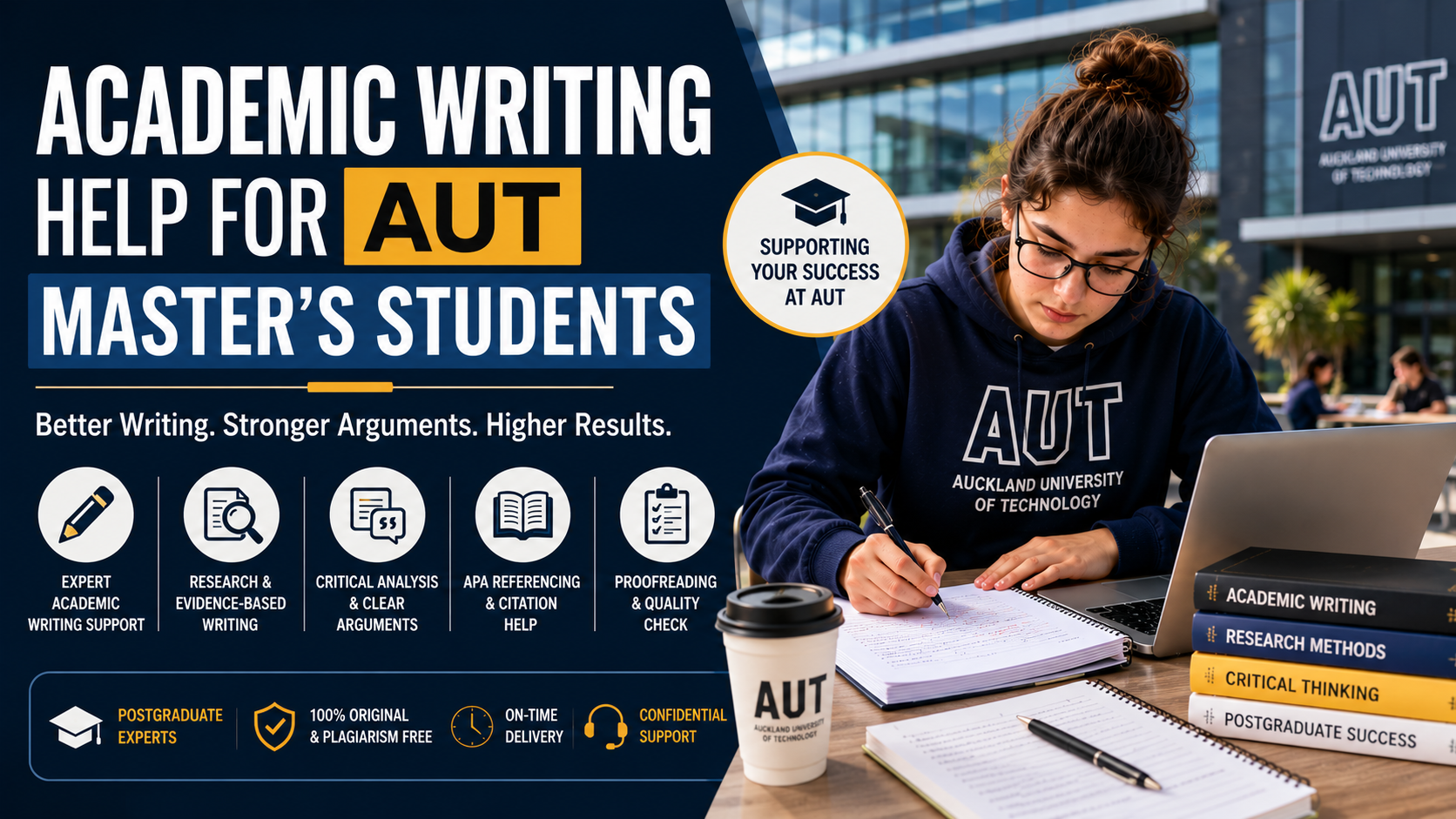
For many AUT Master's students, academic writing becomes one of the most challenging parts of postgraduate study. Assignments may involve literature reviews, research reports, critical essays, case studies, reflective writing, policy analysis, business reports or research-based projects. At the same time, students may be balancing employment, research, presentations, group projects and other academic responsibilities.
This is where academic writing help for AUT Master's students can be valuable.
Academic writing support can help students understand assessment requirements, structure their ideas, improve academic expression, develop stronger arguments, use evidence effectively, reference sources correctly and review their own drafts before submission.
AUT itself provides academic-writing and assessment support through its Library, Learning & Academic Engagement services, Studiosity and other student-support resources. AUT's Library offers workshops and assessment advice covering academic writing, paraphrasing, referencing and presenting ideas.
The goal of academic writing support should not be to replace a student's work. Instead, it should help students develop stronger academic writing skills and produce their own work in accordance with AUT's assessment and academic-integrity requirements.
What Is Academic Writing Help for AUT Master's Students?
Academic writing help is support designed to help postgraduate students understand and improve the way they communicate academic ideas.
For Master's students, this may include guidance with:
Understanding assignment questions
Interpreting marking criteria
Developing an academic argument
Structuring essays and reports
Writing literature reviews
Using scholarly evidence
Critical analysis
Paraphrasing
Academic vocabulary
Paragraph development
Referencing
Research writing
Editing and proofreading
Improving clarity and coherence
Master's-level academic writing is not simply about using complicated vocabulary.
Effective postgraduate writing should generally be:
Clear + Analytical + Evidence-Based + Structured + Precise
The emphasis should be on demonstrating understanding and evaluation rather than filling an assignment with information.
Why Is Academic Writing Difficult at Master's Level?
One of the biggest changes students experience during postgraduate study is the increased expectation for independent analysis.
At Master's level, an assignment may ask you to:
Evaluate a theory
Critically analyse research
Compare different perspectives
Identify limitations
Apply concepts to a real-world situation
Interpret evidence
Develop recommendations
Identify research gaps
Defend a particular position
This means that simply describing what researchers have said may not be enough.
Descriptive writing
Smith (2025) states that digital transformation can improve organisational efficiency.
Analytical writing
Smith (2025) associates digital transformation with improved organisational efficiency; however, the extent of this benefit may depend on organisational readiness, employee capability and the way efficiency is measured.
The second example moves beyond reporting information and begins evaluating the circumstances surrounding the claim.
Academic Writing Expectations for AUT Master's Students
Your exact requirements depend on your programme and individual assessment, but postgraduate writing commonly requires students to demonstrate:
1. Understanding
Show that you understand the subject and relevant academic concepts.
2. Application
Demonstrate how theories or concepts apply to the question or problem.
3. Analysis
Break down evidence and explain relationships between ideas.
4. Evaluation
Assess strengths, weaknesses, limitations and alternative perspectives.
5. Synthesis
Bring multiple sources together to develop a coherent academic position.
6. Communication
Present your argument clearly and logically.
These skills are particularly important when writing research-based Master's assignments.
Types of Academic Writing AUT Master's Students May Need
Academic writing requirements can vary significantly between AUT programmes.
Students may encounter several different forms of academic writing.
1. Critical Essays
A critical essay requires more than summarising academic sources.
A strong essay should:
Answer the question directly
Establish a clear argument
Use relevant academic evidence
Compare perspectives
Evaluate research
Explain limitations
Reach a reasoned conclusion
A useful structure is:
Introduction → Argument → Evidence → Critical Analysis → Evaluation → Conclusion
2. Literature Reviews
Literature reviews are particularly important for Master's students involved in research.
A literature review should not become a sequence of summaries.
Instead, it should identify relationships between studies.
For example:
Study A → Study B → Contrasting Finding → Possible Explanation → Research Gap
A strong literature review may:
Identify major themes
Compare researchers
Evaluate methodologies
Identify contradictions
Discuss limitations
Highlight gaps
Establish the relevance of your research
3. Research Reports
Master's students may need to produce research reports containing sections such as:
Introduction
Research problem
Research objectives
Literature review
Methodology
Findings
Discussion
Conclusion
Recommendations
References
The precise structure depends on the discipline and assessment requirements.
The key is maintaining a logical connection between the research question, methodology, evidence and conclusions.
4. Case Study Writing
Case studies require students to apply academic concepts to a particular organisation, industry, community or situation.
A useful process is:
Understand the Case
↓
Identify the Problem
↓
Select Relevant Theory
↓
Gather Evidence
↓
Apply Theory
↓
Evaluate Alternatives
↓
Develop Recommendations
↓
Reach a Conclusion
Case-study writing is particularly common in business, management, health, education, policy and other applied disciplines.
5. Business and Management Reports
Business Master's students may need to prepare analytical or consultancy-style reports.
These can involve:
Strategic management
Marketing
Human resources
Leadership
Organisational behaviour
Entrepreneurship
Operations
Business analytics
International business
The writing should connect academic theory with practical evidence rather than simply describing an organisation.
6. Health and Clinical Writing
Students in health-related Master's programmes may encounter:
Research reports
Evidence reviews
Clinical analyses
Case studies
Policy reports
Literature reviews
These assignments often require careful interpretation of research evidence and accurate referencing.
7. Technology and Computer Science Writing
Master's students in technology-related disciplines may need to communicate technical information through:
Research reports
Technical reports
Literature reviews
Project documentation
Research proposals
Evaluation reports
Good technical writing should remain precise while explaining complex concepts clearly to the intended audience.
8. Reflective and Professional Writing
Some postgraduate courses include reflective assignments.
A reflective assignment should go beyond describing what happened.
It may require you to explain:
What happened
What you learned
Why it matters
What evidence supports your interpretation
How your thinking changed
What you would do differently
Academic reflection combines personal experience with critical engagement with relevant literature.
How Academic Writing Help Can Improve a Master's Assignment
Academic support can be useful at different stages of the writing process.
Assignment Interpretation
Before writing, make sure you understand what the question is asking.
Identify:
The task verb
The subject
Required theories
Evidence requirements
Word count
Assessment criteria
Referencing style
Submission requirements
For example, these instruction words require different approaches:
Instruction | What it generally requires |
|---|---|
Describe | Explain what something is |
Explain | Clarify how or why something happens |
Analyse | Break information into parts and examine relationships |
Compare | Identify similarities and differences |
Evaluate | Judge evidence using criteria |
Critically evaluate | Assess strengths, weaknesses and competing perspectives |
Discuss | Explore multiple perspectives before reaching a reasoned position |
Always follow the specific wording in your assessment instructions.
Developing a Strong Academic Argument
A Master's assignment should usually have a central argument or position.
A useful process is:
Question → Position → Evidence → Analysis → Evaluation → Conclusion
For example:
Question
How does remote working influence employee productivity?
Weak approach
Describe several studies about remote working.
Stronger approach
Develop a position about when remote working can improve productivity, support it with research, evaluate contradictory findings and identify the conditions that influence the outcome.
This transforms the assignment from a collection of information into an academic argument.
Paragraph Structure for Master's Writing
A useful paragraph model is:
Point
Introduce the main idea.
Evidence
Provide an appropriate academic source.
Explanation
Explain what the evidence means.
Analysis
Connect the evidence to the assignment question.
Evaluation
Consider limitations or alternative interpretations.
Link
Connect the discussion to the next idea or overall argument.
This can be remembered as:
P → E → E → A → E → L
Not every paragraph needs to follow exactly the same pattern, but it can help students avoid writing paragraphs that merely summarise sources.
How to Write a Strong Introduction
A Master's-level introduction should quickly establish the purpose of the assignment.
A useful structure is:
Context
Introduce the broader topic.
Problem
Identify the specific issue.
Scope
Explain what the assignment will cover.
Position
Present your central argument where appropriate.
Structure
Briefly explain how the discussion will proceed.
Avoid spending hundreds of words providing general background that does not contribute to answering the question.
Writing Effective Conclusions
A conclusion should answer the assignment question based on the analysis presented.
A strong conclusion can:
Revisit the central argument
Summarise the major findings
Explain the implications
Provide recommendations if required
Avoid introducing completely new evidence or arguments in the final paragraph.
Academic Writing and Evidence
Master's-level writing should be supported by appropriate evidence.
Potential sources include:
Peer-reviewed journal articles
Academic books
Government publications
Official statistics
Professional organisations
Research reports
Reputable institutional sources
However, using a source does not automatically make an argument strong.
You should ask:
Is the source credible?
Is it relevant?
Is it current enough?
What methodology was used?
What are the limitations?
Does other research agree?
Does the evidence apply to my context?
This is the difference between using sources and critically engaging with sources.
Paraphrasing Help for AUT Master's Students
Paraphrasing means expressing an author's idea in your own words while maintaining the original meaning and providing appropriate attribution.
Simply replacing a few words with synonyms is not effective paraphrasing.
Poor paraphrasing
Changing individual words while keeping the original sentence structure.
Better paraphrasing
Read the source, understand the idea, express it independently and cite the original source.
A useful workflow is:
Read → Understand → Close Source → Explain in Your Own Words → Compare Meaning → Cite
Referencing and Academic Writing at AUT
Referencing is an important part of academic writing because it shows where information, ideas and evidence came from.
AUT's Library provides academic-writing and referencing support for students, including workshops and assessment advice.
Depending on your programme and assessment, you may need to work with particular referencing conventions.
Before submitting, check:
In-text citations
Author names
Publication dates
Reference-list entries
URLs or DOIs where required
Consistency
Formatting
Do not assume that every assessment uses exactly the same requirements. Always follow the instructions provided for your course.
Academic Writing Help for International AUT Master's Students
International students may face additional challenges when adapting to postgraduate academic writing in New Zealand.
These may include:
Academic English
Critical analysis
Referencing
Paraphrasing
Essay structure
Research terminology
Report writing
Independent argument development
AUT provides academic support specifically for international students and students who use English as an additional language. This includes help with academic writing, referencing, grammar, vocabulary and adapting to study at AUT.
Students should not feel that academic writing support means simply improving vocabulary.
The objective is to communicate ideas more effectively.
A strong academic sentence is not necessarily a complicated sentence.
It is a sentence that communicates the intended meaning clearly and accurately.
Academic Writing Support Available at AUT
Before paying for external support, Master's students should explore the academic resources already available through AUT.
AUT Library provides workshops and appointments covering academic writing, paraphrasing, referencing and assessment advice.
AUT also provides Studiosity, an online study-help service available through Canvas. Its Writing and Study Assist service provides writing feedback, while Connect Live offers one-to-one study support.
AUT's Student Hub also provides access to academic and personal support and can connect students with relevant university services.
For postgraduate research students, AUT provides dedicated research support, study spaces, researcher-development activities and academic-writing opportunities.
These university resources should be considered as part of your academic-support strategy.
Getting Feedback on Your Academic Writing
Feedback can be one of the most effective ways to improve writing.
Instead of asking only:
"Is my grammar correct?"
Ask:
Is my argument clear?
Does each paragraph support my thesis?
Have I used enough evidence?
Have I critically evaluated sources?
Are my conclusions supported?
Is my structure logical?
Have I answered the assessment question?
AUT's Library explains that its learning advisors provide assessment advice and resources, while proofreading or checking student work is subject to AUT's applicable proofreading guidelines.
This distinction matters.
Academic feedback should help you become a better writer rather than simply making the final document look polished.
Academic Writing and Proofreading Are Different
Students often use the terms interchangeably, but they are not identical.
Academic Writing Support
Focuses on:
Argument
Structure
Evidence
Critical analysis
Paragraph development
Academic expression
Editing
May focus on:
Clarity
Coherence
Sentence construction
Consistency
Language
Proofreading
Generally focuses on:
Spelling
Grammar
Punctuation
Typographical errors
Formatting inconsistencies
The appropriate type of support depends on the stage of your assignment.
Using AI for Academic Writing at AUT
Generative AI has created new opportunities and challenges for postgraduate students.
AUT provides guidance on responsible AI use and highlights the importance of academic integrity. Its student guidance encourages students to check assessment instructions, understand whether AI is permitted, be transparent about applicable AI use and ensure that AI supports rather than replaces their thinking.
AUT also provides AI-related resources and workshops for postgraduate students, including responsible AI use in research and evaluating AI-generated information.
Before using an AI tool for an assignment, ask:
Is AI permitted for this assessment?
What type of AI use is permitted?
Do I need to acknowledge or reference AI use?
Could the tool generate inaccurate information?
Have I verified every source?
Am I still responsible for the final work?
Am I protecting confidential research information?
Never assume that because an AI tool is available, it is automatically permitted for every assessment.
AI Should Support Your Thinking, Not Replace It
A useful approach is:
Your Question → Your Research → Your Analysis → Optional AI Assistance → Your Verification → Your Final Work
AI-generated information should be checked carefully.
Potential problems include:
Incorrect citations
Invented references
Misleading summaries
Outdated information
Unsupported claims
Loss of your own academic voice
AUT's AI guidance specifically encourages students to evaluate AI outputs and use AI responsibly.
For Master's-level writing, your ability to evaluate information is itself an important academic skill.
Academic Integrity and External Academic Writing Help
Academic writing support should never become a substitute for your own academic work.
A responsible support service should focus on helping you:
Understand the assignment
Improve your writing
Strengthen your structure
Learn referencing
Identify weaknesses
Develop research skills
Review your own work
Students should not submit work created by another person as their own.
Similarly, support should not involve:
Fabricating research
Creating fake references
Manipulating research data
Misrepresenting sources
Circumventing assessment rules
Guaranteeing a particular grade
The final academic responsibility remains with the student.
Academic Writing Help for Different AUT Master's Subjects
The exact writing requirements differ between disciplines.
Business and Management
You may need help with:
Case studies
Strategic analysis
Marketing reports
Leadership analysis
Organisational behaviour
Business research
Recommendations
The emphasis should be on connecting theory with evidence and practical context.
Health Sciences
Academic writing may involve:
Evidence-based practice
Literature reviews
Clinical research
Health policy
Research reports
Critical evaluations
Accuracy and appropriate use of research evidence are particularly important.
Education
Assignments may include:
Critical essays
Reflective writing
Literature reviews
Policy analysis
Research proposals
Educational case studies
Engineering and Technology
Writing may involve:
Technical reports
Research papers
Project documentation
Literature reviews
Experimental reports
System evaluations
Technical accuracy and logical presentation are essential.
Communication and Media
Students may work on:
Media analysis
Communication theory
Research reports
Critical essays
Case studies
Creative-critical projects
The writing needs to combine appropriate theory with evidence and analysis.
How to Improve Your AUT Master's Assignment
Use this checklist before submission.
Understanding
Did I answer the exact question?
Did I follow every instruction?
Did I review the marking criteria?
Structure
Is my introduction clear?
Does my argument develop logically?
Are my paragraphs connected?
Does my conclusion answer the question?
Evidence
Are my sources credible?
Have I used relevant research?
Have I evaluated the evidence?
Have I avoided relying too heavily on one source?
Critical Analysis
Have I compared perspectives?
Have I considered limitations?
Have I evaluated competing arguments?
Have I explained why the evidence matters?
Referencing
Are sources cited?
Are citations accurate?
Does the reference list match the citations?
Have I followed the required referencing style?
Language
Is the writing clear?
Are sentences concise?
Are technical terms used correctly?
Have I removed unnecessary repetition?
Academic Integrity
Is the submitted work my own?
Have I acknowledged sources?
Have I followed the assessment's AI requirements?
Have I verified information generated by AI?
Have I avoided fabricated references or data?
Academic Writing Help for AUT Master's Students Under Tight Deadlines
When a deadline is approaching, avoid immediately trying to write the entire assignment.
Instead, use a structured approach.
Step 1: Read the Brief
Identify exactly what needs to be submitted.
Step 2: Identify the Assessment Criteria
Determine how your work will be evaluated.
Step 3: Break Down the Question
Identify the key concepts and instruction words.
Step 4: Create an Outline
Decide what each section needs to accomplish.
Step 5: Gather Evidence
Find the most relevant academic sources.
Step 6: Draft
Write your argument and support it with evidence.
Step 7: Revise
Improve logic, structure and critical analysis.
Step 8: Reference
Check citations and the reference list.
Step 9: Proofread
Review grammar, spelling and presentation.
Step 10: Check Requirements
Review the word count, formatting, submission instructions and AI requirements.
This approach is generally more effective than writing continuously without a plan.
How to Choose External Academic Writing Support
If you decide to use external academic support, consider the following.
Subject Knowledge
Choose support appropriate to your discipline.
Master's-Level Experience
The provider should understand postgraduate academic writing rather than only basic essay writing.
Academic Integrity
The service should clearly distinguish academic support from completing assessed work on your behalf.
Privacy
Be careful when sharing unpublished research, participant information, proprietary data or confidential documents.
Transparent Scope
Understand exactly what support you are receiving.
Realistic Expectations
No service can legitimately guarantee a particular grade.
A Better Academic Writing Workflow for AUT Master's Students
A practical workflow is:
Assessment Brief
↓
Understand the Question
↓
Check Assessment Criteria
↓
Research
↓
Evaluate Sources
↓
Develop Argument
↓
Create Structure
↓
Write Draft
↓
Critical Review
↓
Revise
↓
Reference
↓
Proofread
↓
Check AI and Academic-Integrity Requirements
↓
Submit
This process gives you multiple opportunities to improve the assignment before the final submission.
Final Thoughts
Academic writing is one of the most important skills Master's students develop during postgraduate study.
At AUT, students have access to a range of academic-support resources, including Library workshops, assessment advice, Studiosity, Canvas resources and postgraduate research-development opportunities.
External academic writing support can also be useful when you need additional guidance with planning, structure, research, critical analysis, academic expression or proofreading, provided that the support remains consistent with your assessment requirements and academic-integrity responsibilities.
The objective should not simply be to make an assignment sound more sophisticated.
It should be to make your thinking clearer, your evidence stronger and your argument more convincing.
A strong Master's writing process can be summarised as:
Understand → Research → Evaluate → Analyse → Write → Revise → Reference → Proofread → Check Requirements → Submit
With consistent practice and appropriate academic support, AUT Master's students can develop the academic writing skills needed for assignments, research projects and future professional work.
Frequently Asked Questions
Everything you need to know about our services
Related Posts

Professional Proofreading Services That Improve Grades

How to Reduce Turnitin Similarity Before Submission
