How to Reduce Turnitin Similarity Before Submission
Introduction
Seeing a high Turnitin similarity score shortly before an assignment or dissertation deadline can be stressful.
However, a similarity score does not automatically mean that your work contains plagiarism.
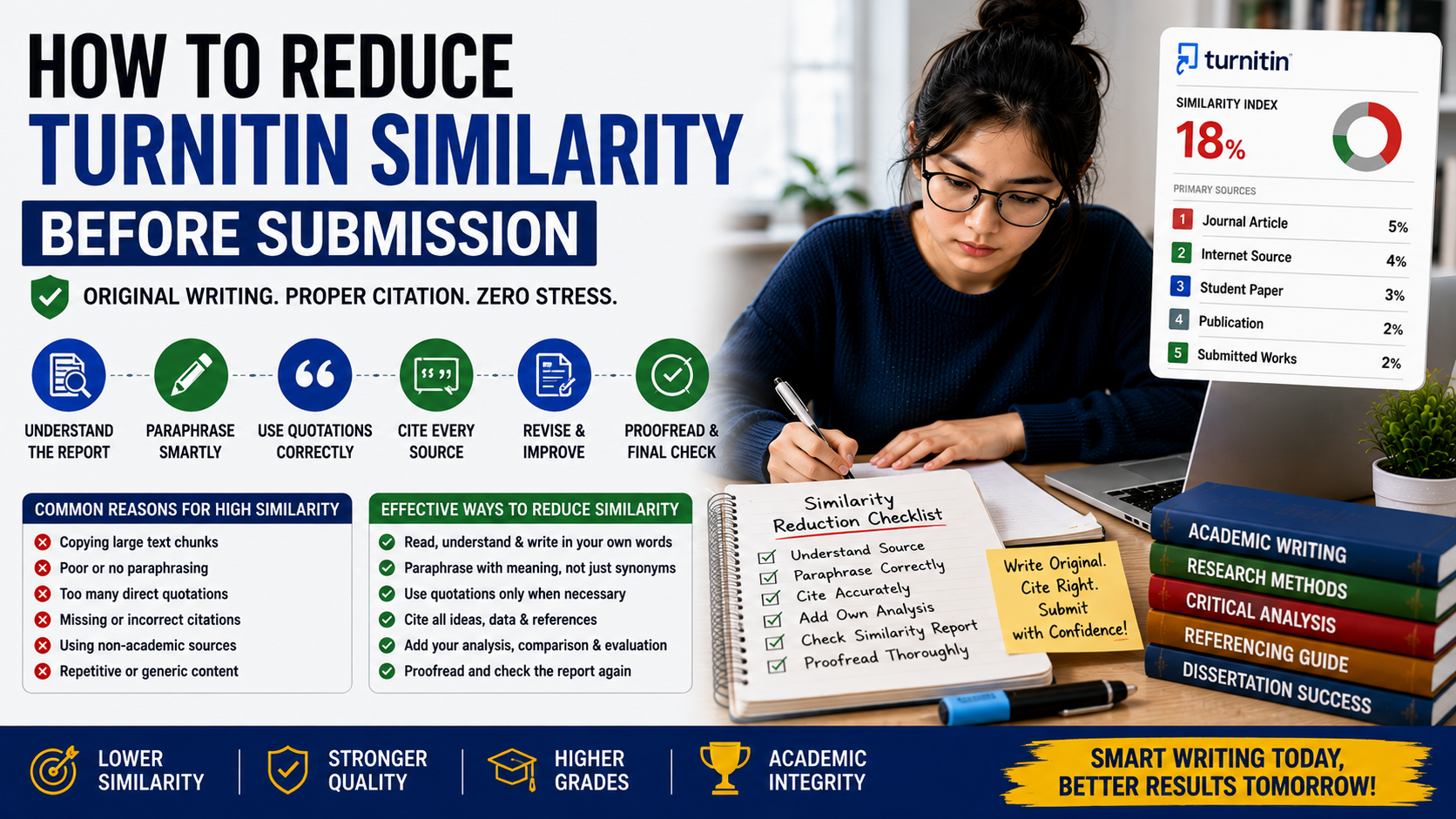
Turnitin compares submitted text against sources in its databases and highlights matching or similar passages. Some similarity can be completely legitimate, particularly when your assignment contains quotations, technical terminology, references, commonly used academic phrases, titles, or correctly cited material.
The objective should therefore not be to manipulate or "beat" Turnitin.
Instead, the goal is to make sure that your assignment contains genuinely original writing, appropriate paraphrasing, accurate citations, and properly formatted quotations.
If your similarity report identifies unnecessary matching text, you can revise the affected sections before submission.
This guide explains how to reduce unnecessary Turnitin similarity ethically and effectively.
What Is a Turnitin Similarity Score?
Turnitin's Similarity Report identifies text that matches material in its comparison databases.
Depending on the settings used by your university or instructor, Turnitin may compare your work against sources such as:
Published academic material
Websites
Student submissions
Journals
Books and other publications
Institutional repositories
The resulting similarity percentage indicates how much text has been identified as matching or similar to material in the comparison database.
It is not automatically a plagiarism percentage.
A high similarity score may contain legitimate matches, while a lower score does not automatically guarantee that an assignment is academically sound.
The report needs to be interpreted in context.
Is a High Turnitin Similarity Score Always Bad?
No.
For example, an assignment containing several properly cited quotations may generate legitimate matches.
Similarly, technical subjects may require specific terminology that cannot easily be replaced.
A dissertation may also contain:
Research questions
Standard methodological terminology
Definitions
Names of theories
Technical expressions
Statistical terminology
Proper nouns
Reference information
These can contribute to similarity without representing plagiarism.
The important question is:
Why is the text matching?
What Should You Check in a Turnitin Report?
Do not focus only on the percentage displayed at the top.
Open the Similarity Report and examine the individual highlighted passages.
For each match, ask:
Is this directly quoted?
Is it properly cited?
Is it common or technical terminology?
Have I paraphrased the source sufficiently?
Did I accidentally copy the source's sentence structure?
Does this passage need to be quoted at all?
Is the reference information creating a legitimate match?
This approach is much more useful than trying to reach an arbitrary percentage.
1. Write More of the Assignment in Your Own Words
The most effective way to reduce unnecessary similarity is to develop your own academic writing.
Instead of relying heavily on source wording, read the source, understand the idea, and then explain the concept independently.
For example, imagine a source states that:
Employee engagement can influence organisational performance through motivation, commitment, and workplace participation.
Instead of changing a few words, consider the underlying idea.
You might explain the relationship independently by discussing:
What engagement means
Which mechanisms connect engagement to performance
What evidence supports the relationship
Whether researchers disagree
How the relationship applies to your specific research context
The result becomes analytical writing rather than word substitution.
2. Avoid Changing Only Individual Words
One of the weakest approaches to paraphrasing is replacing words with synonyms.
For example:
Original idea:
Online learning provides students with greater flexibility in managing their study schedules.
Weak paraphrase:
Digital education gives learners increased flexibility in controlling their study timetables.
The sentence structure and underlying wording remain extremely similar.
This is not a strong paraphrase.
Instead, understand the idea and reconstruct the explanation using your own sentence structure and reasoning.
3. Change the Structure of Your Explanation
Good paraphrasing is about more than vocabulary.
Consider changing:
Sentence structure
Order of ideas
Focus of the explanation
Examples
Comparison
Interpretation
Relationship between concepts
However, changing sentence structure does not remove the need for citation.
If the underlying idea came from another researcher, cite that researcher even when the wording is entirely your own.
4. Understand the Source Before Paraphrasing
A common reason students produce overly similar writing is that they paraphrase while looking directly at the source.
Instead:
Step 1
Read the source carefully.
Step 2
Identify the main idea.
Step 3
Close the source or move away from the original passage.
Step 4
Explain the idea in your own academic language.
Step 5
Compare your version with the source.
Step 6
Add the appropriate citation.
This helps reduce accidental copying of sentence structures.
5. Use Direct Quotations Properly
Sometimes the exact wording of a source is important.
In those situations, use a quotation rather than disguising the source's wording as your own.
Depending on your required referencing style, quotations may require:
Quotation marks
Author
Year
Page number or other location information where applicable
Follow your university's referencing requirements.
Do not remove quotation marks simply to lower the similarity score.
6. Don't Overuse Quotations
Although quotations can be academically legitimate, excessive quotation can make an assignment appear heavily dependent on source material.
Instead of quoting every important statement, consider whether you can:
Understand the argument
Paraphrase it independently
Evaluate it
Compare it with another source
Explain its relevance to your research
Academic assignments generally benefit from demonstrating your understanding rather than presenting long blocks of other people's wording.
7. Improve Your Critical Analysis
One effective way to make your assignment more original is to increase your own analysis.
Instead of writing:
Smith (2023) argues that remote working improves employee satisfaction. Jones (2024) also suggests that flexible working benefits employees.
You could develop the discussion:
Although both studies associate workplace flexibility with improved employee outcomes, their conclusions should be interpreted in light of differences in organisational context and research design. This suggests that flexibility may not produce identical outcomes across all working environments.
The second version adds your own comparison and interpretation.
You are no longer simply reporting what sources said.
8. Compare Multiple Sources
Another useful technique is synthesis.
Instead of discussing sources separately:
Smith (2022) found X.
Jones (2023) found Y.
Lee (2024) found Z.
Compare them.
Ask:
Where do they agree?
Where do they disagree?
Why might they differ?
Which evidence is stronger?
What does the overall literature suggest?
This creates more original academic discussion while still properly acknowledging the underlying research.
9. Avoid Excessive Copying From One Source
A paragraph that follows one source too closely can create substantial similarity.
Instead, use several relevant academic sources where appropriate.
For example:
Source A → theory
Source B → supporting evidence
Source C → contrasting evidence
Your analysis → comparison and interpretation
This creates a more developed academic argument.
10. Cite Paraphrased Ideas
A common misconception is:
"If I changed the words, I don't need a citation."
This is incorrect.
If an idea, finding, argument, theory, model, statistic, or interpretation originates from another source, the source should normally be acknowledged according to your required referencing style.
Changing the wording does not make the underlying idea yours.
11. Check Your In-Text Citations
Review every section highlighted in the Similarity Report.
Ask:
Is the source cited?
Is the citation attached to the correct claim?
Does the reference exist in the reference list?
Is the referencing style correct?
Have I accidentally cited the wrong source?
Correct citations are an essential part of academic integrity.
12. Review Long Matching Passages
Long highlighted passages deserve particular attention.
If a substantial section matches a source, determine why.
It may be:
A legitimate quotation
A standard definition
A methodology description
Poor paraphrasing
Accidental copying
Template language
If the wording is unnecessarily close to the source, rewrite the passage properly.
Do not simply replace a few words.
13. Check Your Literature Review Carefully
Literature reviews can produce high similarity because students frequently describe existing research.
The solution is not to remove citations.
Instead, improve synthesis.
Rather than writing:
Smith (2021) states X.
Jones (2022) states Y.
Brown (2023) states Z.
Develop a thematic discussion.
For example:
Existing research generally associates X with improved outcomes, although the strength of this relationship varies across organisational settings. While Smith (2021) identifies X as the primary mechanism, Jones (2022) highlights Y, suggesting that the relationship may depend on contextual factors.
This demonstrates your academic interpretation.
14. Rewrite Your Introduction if It Is Generic
Introductions sometimes contain large amounts of generic text copied or closely adapted from online material.
Instead, develop an introduction specifically for your assignment.
Explain:
The topic
The academic problem
The context
Why the issue matters
The purpose of the assignment
The central argument
The structure where appropriate
A focused introduction is usually more useful than a collection of generic background statements.
15. Check Your Methodology Chapter
Methodology sections can contain legitimate standard terminology.
For example, terms such as:
Qualitative research
Quantitative research
Semi-structured interviews
Random sampling
Thematic analysis
Regression analysis
may naturally appear across many academic documents.
Do not attempt to replace necessary technical terminology simply to reduce similarity.
Instead, make sure your explanation of the methodology is specific to your research.
Explain:
Why did you choose this method?
Why is it suitable for your research question?
How was it implemented?
What are its limitations?
This produces more original methodological discussion.
16. Don't Remove Necessary Technical Terms
Trying to make every sentence unique can actually make academic writing worse.
Certain terms have established meanings.
For example:
"statistical significance"
"research methodology"
"literature review"
"thematic analysis"
"independent variable"
"dependent variable"
"ethical considerations"
Do not replace established terminology with awkward alternatives just to make text appear different.
Academic accuracy is more important than artificially lowering similarity.
17. Review Your References and Bibliography
Reference lists can sometimes generate similarity because titles, authors, journal names, and publication information naturally match existing sources.
This is generally not something you should try to disguise.
Instead, make sure your references are:
Accurate
Complete
Consistent
Properly formatted
In the required referencing style
18. Check Your Assignment Template
University templates can contain standard wording that appears in other submissions.
Examples may include:
Module titles
Assessment headings
Standard declarations
Research ethics statements
Assignment questions
Cover-page information
Do not manipulate these simply to change the similarity score.
Follow your university's required format.
19. Don't Use Synonym-Replacement Tools
Tools that automatically replace words with synonyms can produce unnatural academic writing.
They may also:
Change the meaning
Introduce incorrect terminology
Create grammatical problems
Produce awkward sentences
Fail to address the underlying similarity issue
Human understanding should drive the revision process.
20. Don't Use "AI Humanizers" to Bypass Similarity Checks
Attempting to manipulate text through automated rewriting or "humanizer" tools is not a reliable academic strategy.
Such tools can introduce:
Meaning changes
Factual errors
Grammar problems
Unnatural language
Incorrect terminology
Academic integrity concerns
The better approach is to write and revise the work yourself.
21. Don't Delete Citations Just to Lower Similarity
Removing citations can make an assignment academically weaker and may create a plagiarism problem.
A similarity report is not a competition to achieve the lowest possible percentage.
The objective is properly attributed, independently written academic work.
22. Check Whether Your Similarity Is Coming From Quotes
If a report highlights several quotations, determine whether quotation handling is correct.
Depending on the university's settings, quotations may or may not be excluded from the similarity calculation.
Even if quotations increase the percentage, that does not necessarily mean they are problematic.
Check:
Quotation marks
Citation
Page information where required
Reference-list entry
23. Check Paraphrasing Across Your Dissertation
For longer projects such as dissertations, review the document chapter by chapter.
Pay particular attention to:
Literature Review
Check source summaries and synthesis.
Methodology
Check descriptions adapted from methodological literature.
Discussion
Check whether you are interpreting sources or simply repeating them.
Introduction
Check generic background material.
This is more effective than looking only at the overall similarity percentage.
24. Use Your Own Examples and Interpretation
Where appropriate, connect academic literature to your specific research context.
For example, instead of simply explaining a theory, discuss:
How it applies to your case
Why it is relevant
Where it may not apply
What your findings suggest
How it compares with other theories
This increases the amount of original academic reasoning in your work.
25. Don't Chase a Specific Similarity Percentage
Students often ask:
"What Turnitin percentage is acceptable?"
There is no universal percentage that guarantees academic integrity.
Different assignments naturally produce different similarity levels.
A literature-heavy dissertation may produce a different score from a reflective essay or technical report.
Your university's assessment policies and the context of the matches matter more than an arbitrary number.
Turnitin Similarity vs Plagiarism
These terms should not be treated as identical.
Similarity
Turnitin identifies matching or similar text.
Plagiarism
Plagiarism involves presenting another person's work, ideas, or expression as your own without appropriate acknowledgement.
A high similarity score can contain legitimate matches.
A low similarity score does not automatically prove that an assignment is academically sound.
The actual highlighted matches need to be reviewed.
What to Do If Your Turnitin Similarity Is High
If your similarity report is higher than expected, don't panic.
Follow this process:
Step 1: Open the report
Review individual matches.
Step 2: Categorise them
Separate:
Quotations
References
Technical terms
Legitimate common phrases
Potentially problematic passages
Step 3: Review problematic sections
Identify passages that are too close to source material.
Step 4: Rewrite properly
Read the source, understand the idea, and reconstruct the explanation independently.
Step 5: Add citations
Acknowledge the source of the underlying idea.
Step 6: Improve analysis
Add comparison, evaluation, interpretation, and application.
Step 7: Proofread
Check the revised writing for clarity and accuracy.
Step 8: Review again
If your university permits students to access a draft Similarity Report, use it as a quality-control opportunity rather than attempting to manipulate the system.
Turnitin Similarity Checklist Before Submission
Use this checklist before submitting your assignment.
Writing
☐ Did I write the explanations in my own words?
☐ Did I avoid copying sentence structures from sources?
☐ Did I understand sources before paraphrasing them?
Citations
☐ Have I cited borrowed ideas?
☐ Are direct quotations clearly identified?
☐ Does every important source have the correct citation?
Literature Review
☐ Have I synthesised sources?
☐ Have I compared different perspectives?
☐ Have I added my own analysis?
References
☐ Is every citation represented in the reference list?
☐ Is the required referencing style followed?
Similarity Report
☐ Have I reviewed individual matches?
☐ Have I investigated long matching passages?
☐ Have I distinguished legitimate matches from problematic ones?
Academic Integrity
☐ Have I avoided automated synonym replacement?
☐ Have I avoided tools designed to bypass academic checks?
☐ Does my university permit the AI tools I have used?
How Professional Academic Editing Can Help
If you have already written your assignment but are concerned about similarity, an ethical academic editing service can provide an additional review.
Professional editing may help identify:
Overly close paraphrasing
Weak source integration
Unclear citations
Excessive quotations
Repetitive writing
Weak academic expression
Structural problems
Referencing inconsistencies
Grammar and proofreading issues
The purpose should be to improve the student's own work rather than to manipulate plagiarism-detection software.
Students should always ensure that external support complies with their university's academic integrity rules.
Turnitin Similarity Review With AssignmentCart
AssignmentCart provides academic editing and proofreading support for students who want to improve their existing work before submission.
Support can include:
Similarity-report review
Academic paraphrasing feedback
Assignment editing
Dissertation editing
Referencing checks
Citation review
Academic writing improvement
Structure review
Proofreading
Final quality checks
The focus is on improving the quality and originality of the student's academic writing through legitimate revision.
Students remain responsible for their research, arguments, sources, and final submission.
Final Thoughts
Reducing unnecessary Turnitin similarity is not about finding tricks to make a similarity score disappear.
It is about producing genuinely independent academic writing.
The best approach is to:
Understand your sources.
Write explanations in your own words.
Reconstruct ideas rather than replacing individual words.
Cite borrowed ideas accurately.
Use quotations only when appropriate.
Develop your own critical analysis.
Compare multiple sources.
Review highlighted matches carefully.
Check your referencing.
Proofread the final document.
Most importantly, don't assume that a high similarity percentage automatically means you have plagiarised.
Look at what is matching and why.
A similarity report should be treated as a tool for reviewing academic writing, not as a score that students must manipulate.
If you are preparing an assignment or dissertation for submission and are concerned about unnecessary similarity, a legitimate academic editing and proofreading review can help identify areas where your writing, citation practices, paraphrasing, and source integration can be improved.
The ultimate goal is not the lowest possible similarity score.
It is a submission that is accurately referenced, independently written, academically sound, and compliant with your university's academic integrity requirements.
Frequently Asked Questions
Everything you need to know about our services


