PhD Literature Review Help in Canada
Introduction
A PhD literature review is much more than a collection of summaries. It is a critical examination of existing academic research that helps establish what is already known, where disagreements or limitations exist, what gaps remain and how a doctoral research project can contribute to the field.
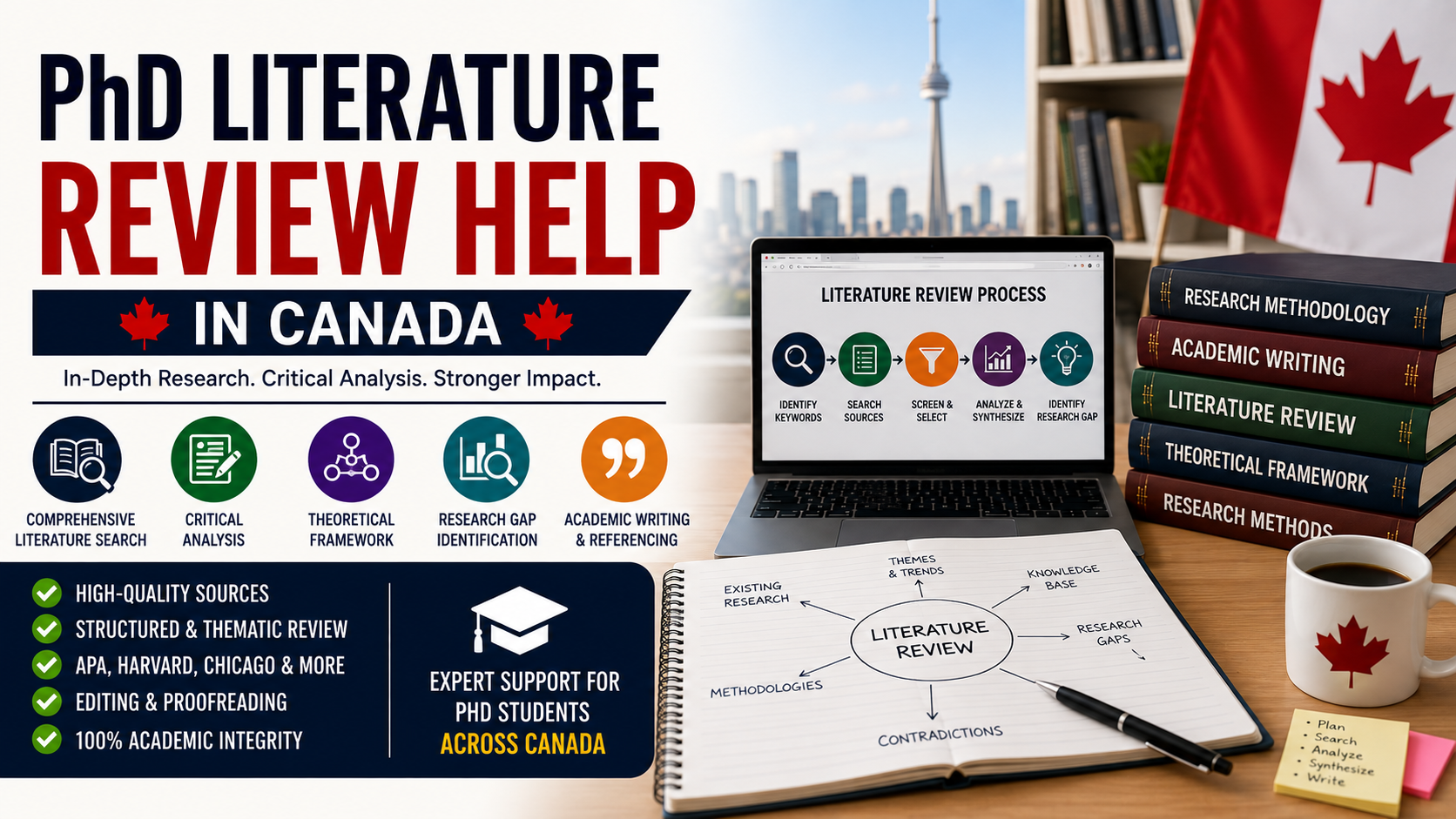
For PhD students in Canada, literature-review requirements can vary between universities, faculties and programs. Some doctoral programs may require a standalone literature review, while others integrate the review into a dissertation proposal, thesis chapters or a manuscript-based dissertation.
PhD literature review help in Canada can provide permitted academic support with literature-search strategies, review structure, source organisation, critical analysis, referencing, academic writing, editing and proofreading. The student's own scholarly judgement, source selection and intellectual contribution should remain central to the research.
This guide explains how Canadian PhD students can approach a doctoral literature review and what professional literature-review support may include.
What Is a PhD Literature Review?
A PhD literature review is a critical and structured analysis of scholarly research relevant to a doctoral research problem.
Unlike a basic summary, a doctoral literature review should examine relationships between studies and identify:
Major theories
Important concepts
Research trends
Methodological approaches
Areas of agreement
Areas of disagreement
Limitations in existing research
Contradictory findings
Under-researched populations
Research gaps
Opportunities for further investigation
The purpose is to position the proposed doctoral research within the existing academic conversation.
Why Is the Literature Review Important in a PhD?
A strong literature review helps demonstrate that the researcher understands the field.
It can establish:
1. Knowledge of Existing Scholarship
The review demonstrates familiarity with relevant research and major academic debates.
2. The Research Problem
Existing literature can help explain why a particular research problem deserves further investigation.
3. The Research Gap
Critical analysis can reveal areas that remain insufficiently studied or understood.
4. The Theoretical Foundation
The literature review can introduce theories and conceptual models relevant to the research.
5. Methodological Context
Previous studies can demonstrate how researchers have approached similar questions.
6. Original Contribution
The review provides the foundation for explaining how the proposed research could add to existing knowledge.
What Does PhD Literature Review Help in Canada Include?
Professional academic support may include different types of assistance depending on the student's requirements and university policies.
Possible support includes:
Literature-search guidance
Database-search strategies
Keyword development
Source organisation
Literature-review structure
Thematic organisation
Critical-analysis guidance
Research-gap identification
Theoretical-framework guidance
Citation management
Referencing
Academic editing
Proofreading
Formatting
Supervisor-feedback implementation
Students should remain responsible for deciding which literature is relevant and how the evidence should be interpreted within their research.
How Is a PhD Literature Review Different From a Master's Literature Review?
A PhD literature review generally requires greater depth and critical engagement.
A master's literature review may demonstrate that the student understands existing research.
A PhD literature review should typically go further by demonstrating:
Sophisticated understanding of the field
Critical comparison of scholarship
Awareness of theoretical debates
Evaluation of methodologies
Identification of limitations
Recognition of research gaps
Clear positioning of the doctoral project
Potential contribution to knowledge
The exact expectations depend on the discipline and doctoral program.
What Should a PhD Literature Review Include?
There is no single structure that applies to every Canadian PhD thesis.
However, a doctoral literature review commonly includes several elements.
1. Introduction
The introduction explains:
The topic
Scope of the review
Research context
Key concepts
Review structure
It should tell the reader what the literature review will examine and why.
2. Literature Search Strategy
For systematic, scoping or evidence-based reviews, the search process may need to be documented carefully.
A search strategy can include:
Academic databases
Search terms
Boolean operators
Inclusion criteria
Exclusion criteria
Publication dates
Geographic restrictions
Language restrictions
Screening procedures
Depending on the discipline, databases might include:
Scopus
Web of Science
PubMed
PsycINFO
ERIC
IEEE Xplore
Business Source Complete
ProQuest
The appropriate databases depend on the research field.
3. Major Themes
A literature review should generally be organised around meaningful themes rather than simply presenting studies one at a time.
For example, a literature review about AI in higher education might examine:
Theme 1: AI Adoption
Research examining why students and institutions adopt AI tools.
Theme 2: Academic Performance
Studies investigating relationships between AI use and educational outcomes.
Theme 3: Academic Integrity
Research concerning plagiarism, authorship and responsible AI use.
Theme 4: Student Experience
Research examining perceptions, concerns and attitudes toward AI.
Theme 5: Institutional Policy
Studies examining how universities respond to emerging AI technologies.
The actual themes should emerge from the literature rather than being imposed without evidence.
4. Critical Analysis
Critical analysis is one of the most important characteristics of a doctoral literature review.
Instead of simply saying:
Smith (2023) found X.
and then:
Jones (2024) found Y.
the researcher should examine why the findings differ.
For example:
Did the studies use different samples?
Did they use different methodologies?
Were the studies conducted in different countries?
Did they define the key variable differently?
Were different theoretical frameworks used?
Did the studies collect data at different times?
This comparison creates a more analytical literature review.
5. Methodological Critique
A PhD literature review can evaluate how previous research was conducted.
Questions may include:
Was the sample appropriate?
Was the research design suitable?
Were measurements reliable?
Were participants representative?
Were limitations acknowledged?
Was the analysis appropriate?
Could another methodology produce different results?
Methodological criticism should be evidence-based rather than simply describing previous research as "weak."
6. Theoretical Analysis
A doctoral literature review may need to compare different theoretical perspectives.
For example, researchers might examine:
Theory A
Theory B
Theory C
The review could discuss:
Core assumptions
Strengths
Limitations
Previous applications
Differences between theories
Relevance to the proposed research
The researcher can then explain which theoretical perspective best supports the doctoral study and why.
7. Research Gap
The literature review should ultimately establish the research gap.
A research gap may involve:
Empirical Gap
A lack of evidence about a particular population or phenomenon.
Theoretical Gap
An existing theory may not fully explain a particular issue.
Methodological Gap
Previous studies may rely heavily on one research method.
Contextual Gap
Research may exist in other countries or settings but not adequately address the Canadian context.
Conceptual Gap
Important concepts may have been defined or examined inconsistently.
A strong PhD literature review should explain the evidence behind the identified gap.
How Do You Identify a PhD Research Gap?
A practical process is:
Search → Screen → Read → Compare → Categorise → Critique → Identify Limitations → Identify Patterns → Establish Gap
While reading studies, create a literature matrix containing information such as:
Author | Year | Topic | Method | Sample | Findings | Limitations | Research Gap |
|---|
This makes comparison easier when the literature becomes extensive.
What Is a Literature Matrix?
A literature matrix is an organisational tool that allows researchers to compare academic studies systematically.
Useful columns can include:
Author
Publication year
Research question
Theory
Methodology
Sample
Location
Data source
Findings
Limitations
Research gap
Relevance to your research
For a large PhD project, a literature matrix can become an important research-management tool.
How Many Sources Should a PhD Literature Review Have?
There is no universal number of sources required for every Canadian PhD literature review.
The appropriate number depends on:
Discipline
Research topic
Scope
Doctoral program
Type of review
Availability of relevant scholarship
Supervisor expectations
A literature review should prioritise relevant, credible and influential scholarship rather than trying to reach an arbitrary source count.
Adding dozens of irrelevant papers does not automatically make a literature review stronger.
How Recent Should PhD Literature Be?
A doctoral literature review normally needs an appropriate balance between foundational scholarship and recent research.
Recent sources can demonstrate awareness of current developments.
Older sources may remain essential when they establish:
Foundational theories
Major concepts
Landmark studies
Established methodologies
Historical developments
A useful strategy is:
Foundational Research + Influential Studies + Recent Evidence + Emerging Research
The ideal balance depends on the discipline.
Should Canadian PhD Students Focus Only on Canadian Research?
Not necessarily.
The appropriate literature depends on the research question.
A Canadian doctoral project may need to examine:
Canadian scholarship
International research
Comparative studies
Regional evidence
Discipline-specific global literature
For a project specifically investigating Canadian policy or institutions, Canadian sources may be particularly important.
However, limiting the literature exclusively to Canada without methodological justification could exclude important international scholarship.
What Databases Can PhD Students Use?
The best databases depend on the discipline.
Potential resources include:
Multidisciplinary Research
Scopus
Web of Science
Google Scholar
Health Sciences
PubMed
CINAHL
Psychology
PsycINFO
Education
ERIC
Engineering and Technology
IEEE Xplore
Business
Business Source Complete
Social Sciences and Humanities
JSTOR
ProQuest
discipline-specific databases
Students should also use their university library's databases and research-support resources.
How Can Boolean Searching Improve Literature Searches?
Boolean operators can make searches more precise.
AND
Narrows a search.
"artificial intelligence" AND "higher education"
OR
Expands a search.
"doctoral students" OR "PhD students"
NOT
Excludes unwanted topics.
"artificial intelligence" AND education NOT K-12
Exact search syntax varies by database.
How Can PhD Students Organise Thousands of Sources?
Doctoral research can produce hundreds or thousands of potentially relevant results.
Useful strategies include:
Define the research question.
Develop search terms.
Search multiple databases.
Remove duplicates.
Screen titles.
Screen abstracts.
Review full texts.
Categorise sources.
Build a literature matrix.
Identify recurring themes.
Evaluate methodological quality.
Map research gaps.
Organise the final review.
Reference-management software can also help manage large collections of sources.
Can PhD Literature Review Help Include Reference Management?
Yes.
Permitted support may include checking:
Citation consistency
Reference-list formatting
Missing references
Duplicate references
Author names
Publication years
DOI formatting
In-text/reference-list matching
Students should still verify that every source actually supports the claim being made.
Can a Literature Review Service Find Sources?
Some academic-support providers may offer literature-search guidance or research assistance.
However, students should independently verify:
Source authenticity
Publication details
Relevance
Research quality
Findings
Citation information
This is particularly important when using AI-assisted research tools.
A fabricated or inaccurate reference can damage the credibility of a doctoral thesis.
Can PhD Literature Review Help With Critical Analysis?
Yes, permitted academic guidance can help a student understand how to critically analyse existing research.
For example, support can help identify questions such as:
What does this study contribute?
What assumptions does it make?
What methodology does it use?
What are its limitations?
How does it compare with other research?
Does the evidence support its conclusions?
What questions remain unanswered?
The student should make the final scholarly judgement about the literature.
Can a Literature Review Service Write My PhD Literature Review?
Students should distinguish between academic support and outsourcing substantive doctoral work.
Permitted assistance may include:
Guidance
Feedback
Editing
Proofreading
Structure review
Referencing support
Research-methodology guidance
Students should check their university's academic-integrity policies before outsourcing substantive writing.
The doctoral researcher should remain responsible for the literature selected, interpretation, critical argument and scholarly contribution.
What Does PhD Literature Review Editing Include?
Editing an existing literature review can focus on:
Grammar
Academic language
Clarity
Sentence structure
Paragraph transitions
Terminology
Consistency
Repetition
Citation presentation
Formatting
Editing should improve communication without changing the researcher's intellectual argument.
What Does PhD Literature Review Proofreading Include?
Proofreading is generally performed near the final stage.
It can check:
Spelling
Grammar
Punctuation
Typographical errors
Headings
Citations
References
Tables
Figures
Page numbers
Formatting
Cross-references
A final proofreading pass can be particularly useful after major supervisor revisions.
How Should Supervisor Feedback Be Incorporated?
Supervisor feedback should be reviewed systematically.
Create a table such as:
Supervisor Comment | Required Change | Action Taken | Location |
|---|---|---|---|
Strengthen theoretical discussion | Add comparison of theories | Revised section | Chapter 2 |
Clarify research gap | Expand critical analysis | Added evidence | Section 2.6 |
Improve source quality | Replace weaker sources | Updated references | Section 2.3 |
This approach helps ensure that important comments are not missed.
Common PhD Literature Review Mistakes
1. Writing an Annotated Bibliography Instead
Listing individual studies without connecting them does not create a strong critical literature review.
2. Using Too Many Irrelevant Sources
More sources do not automatically mean better research.
3. Relying on Outdated Research
Foundational sources are valuable, but doctoral research should generally engage with relevant current scholarship.
4. Ignoring Contradictory Findings
Conflicting research can provide some of the most valuable opportunities for critical analysis.
5. Weak Research-Gap Identification
The gap should be demonstrated through evidence.
6. Poor Structure
A literature review should have a logical progression.
7. Overusing Direct Quotations
A doctoral literature review should generally demonstrate the researcher's own synthesis and critical analysis.
8. Citation Errors
Incorrect or inconsistent references can undermine credibility.
9. Confusing Summary With Critique
Explaining what researchers found is not the same as evaluating their research.
10. Failing to Connect the Literature to the Research
The literature review should ultimately establish why the proposed doctoral study is necessary.
How Should a PhD Literature Review Be Structured?
A possible structure is:
Chapter Introduction
Explain the purpose and scope.
Conceptual Background
Define major concepts.
Theoretical Literature
Discuss relevant theories.
Empirical Literature
Evaluate existing studies.
Methodological Literature
Compare research approaches.
Major Themes
Organise the evidence thematically.
Critical Synthesis
Compare findings and identify patterns.
Research Gaps
Explain what remains unresolved.
Link to Current Research
Show how the doctoral study addresses the identified gap.
Chapter Conclusion
Summarise the key findings from the literature and establish the transition to the next chapter.
The actual structure should follow the student's discipline and university requirements.
What Is a Systematic Literature Review?
A systematic literature review uses a structured and transparent process to identify, select, evaluate and synthesise relevant research.
It may involve:
A defined research question
Search strategy
Inclusion criteria
Exclusion criteria
Database selection
Screening
Quality assessment
Data extraction
Evidence synthesis
Not every PhD literature review is a systematic review.
Students should determine the appropriate review type based on their research design and supervisor guidance.
What Is a Scoping Review?
A scoping review maps the available literature on a broad research topic.
It can help identify:
Existing evidence
Research themes
Types of studies
Knowledge gaps
Areas requiring further investigation
Whether a scoping review is appropriate depends on the research question and discipline.
Can AI Help With a PhD Literature Review?
AI tools can potentially assist with tasks such as:
Organising notes
Brainstorming search terms
Summarising text for initial orientation
Improving grammar
Creating organisational structures
However, AI-generated information and citations must be independently verified.
Students should also check their university's current rules concerning generative AI.
AI should not replace:
Critical reading
Source evaluation
Scholarly judgement
Original synthesis
Research interpretation
How Can PhD Students Avoid AI-Generated Fake References?
Before including a reference, verify:
Author
Title
Journal or publisher
Year
Volume and issue
Pages
DOI
Database record
A reference should be traceable to a legitimate academic source.
Never assume that an AI-generated citation is authentic simply because it looks academically formatted.
PhD Literature Review Help for International Students in Canada
International doctoral students may face additional challenges when preparing literature reviews.
These may include:
Canadian academic conventions
Discipline-specific terminology
Research writing expectations
Referencing systems
Graduate-school requirements
Supervisor communication
Access to university databases
Professional support can help explain academic writing conventions, organise existing research and improve the presentation of a student's own scholarly work.
The student's research judgement should remain central.
What Should Students Provide to a Literature Review Editor?
Where external editing is permitted, students can provide:
Current literature-review draft
Research questions
Research objectives
University guidelines
Supervisor feedback
Referencing style
Chapter structure
Word-count requirements
Specific areas requiring attention
This allows editing to be tailored to the actual doctoral project.
Questions to Ask Before Hiring PhD Literature Review Help
Before choosing an academic-support provider, ask:
Does the provider have PhD-level experience?
Doctoral literature reviews require advanced critical-analysis skills.
Do they understand my discipline?
Literature-review conventions differ significantly between fields.
What exactly is included?
Clarify whether the service covers:
Research guidance
Literature organisation
Editing
Proofreading
Referencing
Formatting
Will my intellectual contribution remain unchanged?
The student's research interpretation and scholarly argument should remain their own.
Can they follow my university's requirements?
University-specific requirements should take priority over generic advice.
How are references handled?
Students should understand whether the provider checks citations or merely formats them.
Is confidentiality explained clearly?
Understand how files and research materials are handled.
PhD Literature Review Final Checklist
Before submitting a literature-review chapter, check:
Research topic is clearly defined
Scope of review is clear
Relevant databases were searched
Search terms were appropriate
Important literature has been considered
Foundational studies are included where relevant
Recent research is included
Major theories are discussed
Major themes are identified
Conflicting findings are addressed
Methodologies are critically evaluated
Research gaps are supported
Literature is synthesised rather than simply summarised
Research questions are connected to the literature
The proposed research is clearly positioned
Citations are accurate
References are consistent
Tables and figures are correctly labelled
Supervisor feedback has been addressed
Academic language has been reviewed
Final proofreading has been completed
University requirements have been checked
Final Thoughts
A PhD literature review is one of the foundations of doctoral research. It demonstrates knowledge of existing scholarship while creating the intellectual context for the proposed research.
PhD literature review help in Canada can provide permitted support with literature-search strategies, source organisation, critical-analysis guidance, research-gap development, academic writing, referencing, editing and proofreading.
The most important goal is not to produce the longest literature review or collect the largest number of sources. The goal is to develop a critical, coherent and evidence-based synthesis that explains what is known, what remains uncertain and why the doctoral research is necessary.
A practical workflow is:
Research Questions → Literature Search → Source Screening → Literature Matrix → Thematic Organisation → Critical Analysis → Synthesis → Research Gap → Link to Doctoral Research → Supervisor Feedback → Editing → Proofreading → Final Submission
Canadian PhD students should always follow their own university, faculty and doctoral-program requirements when determining the appropriate structure, scope and use of external academic assistance.
Frequently Asked Questions
Everything you need to know about our services


