Literature Review Help for Canadian Graduate Students
Introduction
A literature review is one of the most important parts of a Master's thesis, doctoral dissertation or graduate research project. Yet many Canadian graduate students struggle with the same problem: they can find hundreds of academic sources, but they are unsure how to evaluate, organise, compare and synthesise them into a coherent scholarly argument.
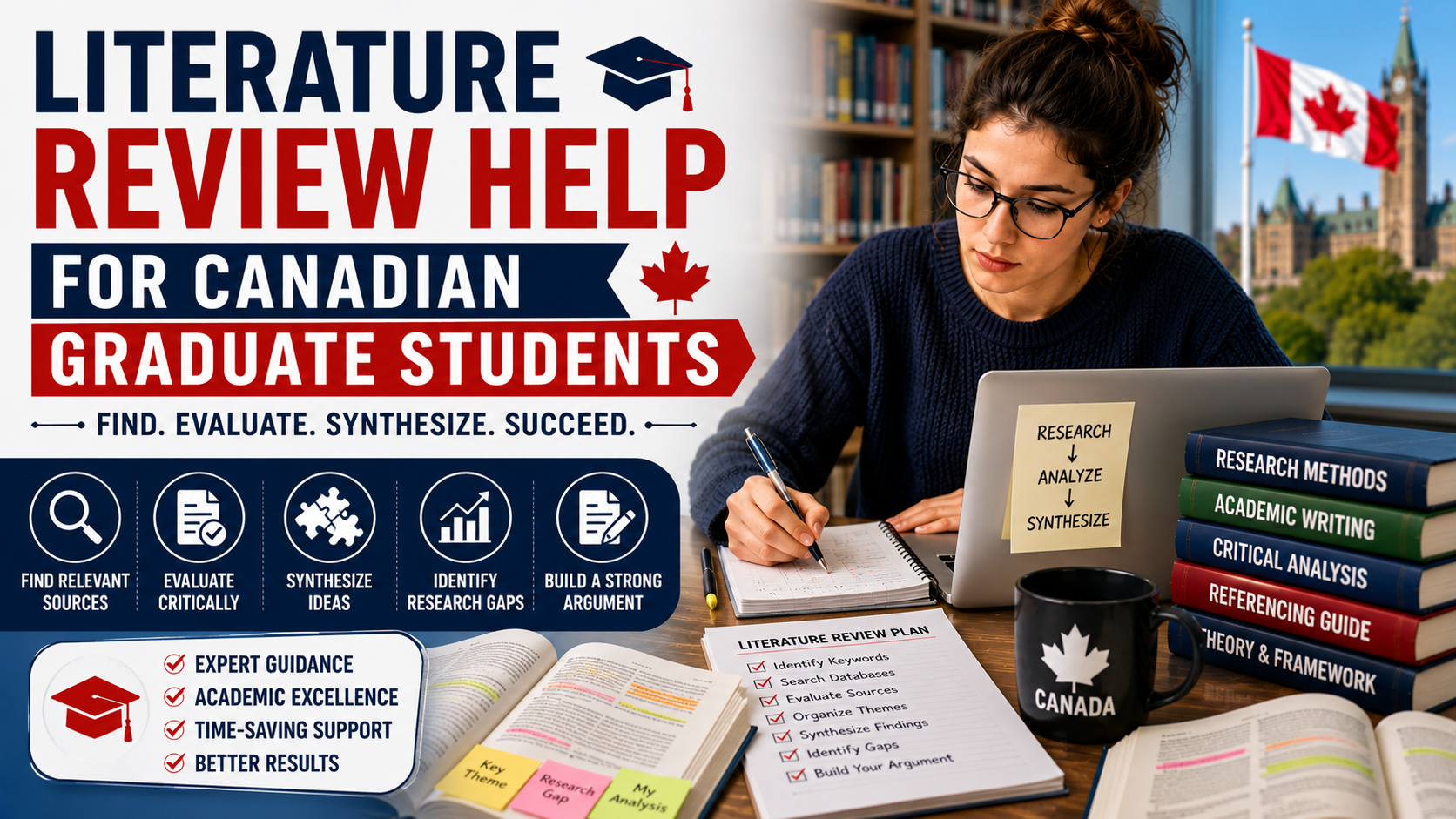
A strong literature review is not simply a collection of article summaries. It should show what researchers already know, where scholars disagree, what methodological limitations exist, what gaps remain and how those gaps connect to your own research.
The University of Toronto explains that a literature review should be organised around a guiding concept such as a research question, problem or objective, rather than functioning as a descriptive list of sources.
For Canadian Master's and PhD students, professional literature review help can be useful when you need guidance with literature searching, source evaluation, synthesis, structure, academic writing, referencing or supervisor feedback while retaining responsibility for your own research and scholarly contribution.
Quick Answer: What Is Literature Review Help?
Literature review help provides academic guidance on finding, evaluating, organising and synthesising scholarly research for a thesis, dissertation or graduate research project.
It may involve support with:
Developing a literature-search strategy
Identifying relevant academic themes
Evaluating scholarly sources
Comparing research findings
Identifying research gaps
Organising literature by themes or concepts
Improving synthesis
Strengthening critical analysis
Structuring the literature review
Checking academic language
Reviewing citations and references
Understanding supervisor feedback
The purpose should be to help the student understand and improve their own literature review rather than replacing their academic work.
What Is a Literature Review?
A literature review examines existing scholarly research related to a particular topic, research problem or question.
It can help establish:
What is already known
What remains uncertain
Which theories are commonly used
What researchers disagree about
Which methodologies have been used
What limitations exist in previous studies
Where research gaps may exist
Why further research is justified
The University of Toronto describes literature reviews as a way of synthesising and critically evaluating published scholarship rather than simply summarising individual sources.
This distinction is particularly important at graduate level.
A Master's literature review should demonstrate that you can enter an existing scholarly conversation, not merely report what other researchers have written.
Why Is Literature Review Writing Difficult for Graduate Students?
Graduate literature reviews can become challenging because the volume and complexity of academic research increase substantially.
A student may need to work with:
Journal articles
Books
Conference papers
Government publications
Policy documents
Academic reports
Theoretical literature
Empirical studies
Systematic reviews
Meta-analyses
Qualitative research
Quantitative research
The challenge is not simply finding sources.
The real challenge is deciding:
Which sources matter, how they relate to one another, and what they collectively tell us about the research problem.
UBC's graduate writing resources describe literature reviews as a way of mapping the scholarly conversation and positioning a research project within that conversation.
Literature Review vs Annotated Bibliography
These are often confused.
Literature Review | Annotated Bibliography |
|---|---|
Synthesises multiple sources | Usually discusses sources individually |
Organised around themes, arguments or questions | Often organised source-by-source |
Identifies patterns and disagreements | Summarises and evaluates each source |
Builds a scholarly argument | Provides notes about individual sources |
Connects literature to research questions | May not establish a broader research gap |
Commonly forms part of a thesis or dissertation | Often used as a research preparation tool |
An annotated bibliography can help you prepare for a literature review, but it is not automatically a substitute for one.
What Should a Graduate Literature Review Do?
A strong literature review should generally perform several functions.
1. Establish the Research Context
Introduce the broader scholarly area before narrowing the discussion.
2. Identify Major Themes
Group related studies around meaningful themes rather than discussing papers randomly.
3. Compare Researchers
Show where studies agree, disagree or reach different conclusions.
4. Evaluate Evidence
Consider the quality, relevance and limitations of existing research.
5. Identify Gaps
Explain what remains under-researched, unresolved or poorly understood.
6. Connect the Gap to Your Research
Show why your research question matters.
The University of Toronto specifically highlights synthesis, identification of controversy and formulation of questions requiring further research as important literature-review functions.
How to Start a Literature Review
One of the biggest mistakes graduate students make is opening a blank document and immediately beginning to write.
A better process is:
Plan → Search → Evaluate → Organise → Synthesise → Write → Revise
The University of Toronto's Academic Skills Hub similarly recommends planning, researching, pre-writing and writing as distinct stages in preparing a literature review.
Step 1: Define Your Research Question
Before searching databases, clarify what your literature review needs to answer.
Ask:
What is my research problem?
What is my main research question?
What are my research objectives?
Which concepts are central?
Which population or context am I studying?
What geographical boundaries matter?
What time period is relevant?
Your research question should act as a filter.
Without a clear question, literature searching can become endless.
Step 2: Develop Search Keywords
Break your research question into major concepts.
For example, suppose your research topic is:
How does remote work affect employee wellbeing among Canadian technology workers?
Possible search concepts could include:
Remote work
remote work
telework
work from home
hybrid work
Wellbeing
employee wellbeing
psychological wellbeing
workplace wellbeing
mental wellbeing
Population
technology workers
software employees
IT professionals
Location
Canada
Canadian workplaces
You can combine these concepts using database search operators such as:
AND
Narrows results.
OR
Expands results using synonyms.
NOT
Excludes unwanted results.
Step 3: Search Academic Databases
Graduate students should prioritise credible scholarly sources.
Depending on your discipline, useful resources may include:
University library databases
Google Scholar
Scopus
Web of Science
PubMed
JSTOR
ProQuest
EBSCOhost
Discipline-specific databases
Your university library can also provide subject-specific research assistance.
UBC's graduate guidance recommends conducting a comprehensive literature search early and organising publications with a citation-management tool. It also points students toward subject librarians and library research support.
Step 4: Evaluate Your Sources
Finding an article does not automatically make it a useful source.
Consider:
Relevance
Does the source directly relate to your research question?
Authority
Who conducted the research and where was it published?
Recency
Is the research sufficiently current for your topic?
Methodology
How was the study conducted?
Evidence
Are the conclusions supported by the data?
Limitations
What weaknesses did the researchers identify?
Relationship to Other Studies
Does the source support, challenge or complicate other research?
This process transforms literature searching from collecting sources into building knowledge.
Step 5: Build a Literature Matrix
A literature matrix can make a large research project much easier to manage.
Consider creating columns such as:
Author | Year | Topic | Method | Sample | Key Findings | Limitations | Relevance |
|---|---|---|---|---|---|---|---|
Author A | 2024 | Topic X | Interviews | 25 participants | Finding A | Small sample | High |
Author B | 2023 | Topic X | Survey | 500 respondents | Finding B | Self-reporting | High |
Author C | 2022 | Topic Y | Case study | 3 organisations | Finding C | Limited scope | Medium |
This allows you to identify patterns much faster.
Instead of remembering every article individually, you can begin seeing the relationships between studies.
Step 6: Identify Themes
A literature review is usually stronger when organised around meaningful themes.
Suppose your topic is artificial intelligence in higher education.
Potential themes might include:
AI adoption in universities
Student perceptions of AI
Academic integrity
Assessment redesign
AI literacy
Institutional policy
Gaps in current research
The exact themes should emerge from the literature and your research question.
Do not force every source into a predetermined category.
Step 7: Look for Agreements and Contradictions
This is where graduate-level critical analysis becomes important.
Imagine:
Study A: Finds that remote work improves employee autonomy.
Study B: Finds that remote work increases isolation.
Study C: Finds that the effect depends on managerial support.
A weak literature review might write three separate summaries.
A stronger review asks:
Why do these studies produce different findings?
Possible explanations might involve:
Different populations
Different industries
Different research designs
Different geographical contexts
Different sample sizes
Different definitions
Different time periods
This is synthesis.
What Is Synthesis in a Literature Review?
Synthesis means combining ideas from multiple sources to develop an integrated understanding of the research topic.
It is different from summarising.
Summary
Smith (2023) found that X. Jones (2024) found that Y. Brown (2025) found that Z.
Synthesis
Recent studies suggest that X and Y may be related, although evidence varies according to population and research context. While Smith (2023) identifies X as a major factor, Jones (2024) reports a different pattern, potentially because the study examined a different population. Brown (2025) further suggests that Z may influence this relationship.
The second approach shows the relationship between studies.
That is what makes a literature review analytical rather than descriptive.
Critical Analysis in Graduate Literature Reviews
Critical analysis does not mean criticising every article.
Instead, evaluate the evidence intelligently.
Ask:
What did the study do well?
What assumptions does it make?
Are the methods appropriate?
Is the sample representative?
Are the findings supported?
What limitations exist?
How transferable are the findings?
Does another study reach a different conclusion?
What does this mean for your research?
UBC's graduate literature-review guidance specifically emphasises developing a critical perspective and maintaining the researcher's own scholarly voice.
Types of Literature Reviews
Not every literature review has the same purpose.
Common types include:
Narrative Literature Review
Provides a broad scholarly discussion of research around a topic.
Critical Literature Review
Evaluates and synthesises existing research, including strengths, weaknesses and relationships between studies.
Systematic Literature Review
Uses an explicit and reproducible approach to identify, evaluate and synthesise research addressing a specific question.
Scoping Review
Maps the available research on a broad topic and can help identify the extent and nature of existing evidence.
Integrative Review
Brings together different forms of evidence to develop a broader understanding of a research problem.
Conceptual Literature Review
Focuses on concepts, theories and relationships between ideas.
The University of Toronto's OISE Academic Skills Hub distinguishes several literature-review types, including critical, scoping, systematic and conceptual reviews.
The correct type depends on your research purpose and disciplinary requirements.
How to Structure a Literature Review
There is no universal structure for every Canadian graduate program.
However, a common structure is:
1. Introduction
Explain:
Topic
Scope
Research problem
Purpose of the review
Key concepts
Organisation of the chapter
2. Background
Provide essential context.
3. Theoretical or Conceptual Framework
Discuss relevant theories or concepts where appropriate.
4. Thematic Literature Review
Organise the main research around themes, debates or concepts.
5. Critical Synthesis
Compare findings and identify patterns and contradictions.
6. Research Gap
Explain what existing research has not adequately addressed.
7. Connection to Your Research
Show how your study responds to the identified gap.
8. Chapter Conclusion
Summarise the key insights and transition toward the next part of the dissertation.
Your actual structure should follow your department's dissertation requirements and supervisor guidance.
What Is a Research Gap?
A research gap is an area where existing scholarship is incomplete, limited, contradictory or insufficient.
A gap might involve:
An understudied population
A geographic limitation
An unresolved debate
A methodological limitation
An unexplored relationship
An outdated evidence base
A theoretical gap
A practical or policy gap
Weak gap
“There is not much research on this topic.”
Stronger gap
“Existing studies have primarily examined X among population A, while comparatively less attention has been given to population B. Furthermore, previous research has largely relied on cross-sectional surveys, leaving the longitudinal dimension insufficiently explored.”
The second statement explains what is missing and why the gap matters.
Common Literature Review Mistakes
Mistake 1: Writing One Paragraph Per Source
This often creates a literature review that reads like an annotated bibliography.
Mistake 2: Too Much Description
Listing findings without analysing relationships between studies weakens critical depth.
Mistake 3: Using Irrelevant Sources
A large bibliography does not automatically mean a strong literature review.
Mistake 4: Ignoring Contradictory Evidence
Disagreement between studies can be one of the most valuable parts of your review.
Mistake 5: Using Outdated Sources Without Explanation
Older foundational studies can be valuable, but students should consider whether more recent research has changed the scholarly conversation.
Mistake 6: Making Unsupported Claims
Every important scholarly claim should be supported by appropriate evidence.
Mistake 7: Treating the Literature Review as Separate From the Dissertation
Your literature review should help establish the rationale and context for your own research.
Mistake 8: Fabricating References
Never invent academic sources, authors, findings, DOIs or quotations.
Literature Review Help for Master's Students
Master's students may seek literature review help when they are struggling with:
Finding appropriate sources
Narrowing a broad topic
Understanding academic literature
Organising hundreds of articles
Identifying themes
Developing synthesis
Finding a defensible research gap
Structuring the chapter
Improving academic writing
Responding to supervisor feedback
Checking references
Professional academic support can provide feedback, explanation, research guidance, structural review and language editing while leaving the student's research decisions and intellectual contribution intact.
Literature Review Help for PhD Students
PhD literature reviews can require a substantially deeper engagement with the scholarly field.
Doctoral students may need to demonstrate:
Comprehensive knowledge of the field
Understanding of major debates
Awareness of methodological developments
Critical evaluation of theoretical positions
Identification of significant research gaps
Clear positioning of the doctoral contribution
For example, the University of Toronto's Nursing graduate curriculum describes literature-review work as involving database searching, summarising and critiquing literature, articulating research questions and considering theoretical, methodological and ethical issues in knowledge synthesis.
Literature Review Help for International Graduate Students in Canada
International students can face additional challenges when preparing graduate literature reviews in Canada.
These may include:
Adjusting to Canadian academic conventions
Developing a critical academic voice
Understanding discipline-specific terminology
Synthesising rather than simply summarising sources
Understanding citation expectations
Evaluating Canadian research alongside international evidence
Interpreting supervisor feedback
However, academic expectations vary between programs.
Students should use their university writing centre, library, graduate school, supervisor and program handbook as important sources of guidance.
How Professional Literature Review Support Can Help
A legitimate literature review support service can potentially help students with:
Literature Search Guidance
Developing search concepts, keywords and database strategies.
Source Evaluation
Assessing whether selected studies are relevant and academically appropriate.
Literature Organisation
Grouping sources into themes, debates or theoretical categories.
Synthesis Feedback
Identifying places where the writing summarises instead of synthesising.
Structural Review
Checking whether the chapter has a logical progression.
Critical Analysis Feedback
Identifying opportunities to compare methodologies, findings and limitations.
Research-Gap Development
Helping students articulate a gap that is supported by the literature.
Academic Editing
Improving grammar, clarity, academic style and consistency in the student's existing work.
What Literature Review Help Should Not Do
Academic support should not:
Invent research sources
Fabricate findings
Create fake citations
Manufacture quotations
Invent research gaps
Falsify evidence
Write a student's assessed research as a substitute for their own work
Misrepresent sources
Guarantee a grade
Guarantee thesis or dissertation approval
The student should remain responsible for their research, source selection, interpretation, argument and final submission.
How to Choose Reliable Literature Review Help in Canada
If you are considering professional support, evaluate the provider based on more than price.
1. Academic Expertise
Look for experience with graduate-level research.
2. Subject Knowledge
A literature review in nursing is different from one in engineering, business, psychology or law.
3. Research Skills
The provider should understand scholarly searching, source evaluation and synthesis.
4. Clear Scope
Understand whether the service provides:
Consultation
Feedback
Editing
Proofreading
Research guidance
5. Confidentiality
Understand how your dissertation files and research information are handled.
6. Academic Integrity
Avoid services that offer fabricated sources, data or research.
7. Transparent Pricing
Know exactly what is included before purchasing.
8. Revision Policy
Understand how feedback or revisions are handled.
Questions to Ask Before Hiring a Literature Review Service
Before purchasing support, ask:
Does the service have graduate-level literature-review experience?
Is the adviser familiar with my subject?
Can they help evaluate my existing sources?
Can they identify synthesis problems?
Can they review my research-gap argument?
Can they help me understand supervisor feedback?
Does the service provide proofreading or academic editing?
What is included in the quoted price?
How is confidentiality handled?
Does the service follow academic-integrity principles?
Literature Review Checklist for Canadian Graduate Students
Before submitting your literature review, check:
The review has a clear purpose.
The research question is clearly connected to the review.
Sources are relevant to the research problem.
Academic sources have been critically evaluated.
Major themes have been identified.
Studies are compared rather than simply listed.
Contradictory findings are discussed.
Methodological limitations are considered.
Relevant theoretical perspectives are explained.
The literature supports the research gap.
The research gap is specific and defensible.
The review demonstrates your own scholarly voice.
Citations accurately represent the original sources.
References are complete and consistent.
The structure follows your program's requirements.
Supervisor feedback has been addressed.
No sources, quotations or findings have been fabricated.
Final Takeaway
A strong graduate literature review does more than summarise academic sources. It maps the existing scholarly conversation, evaluates evidence, identifies themes and disagreements, establishes a research gap and explains how that gap connects to the student's research.
For Canadian Master's and PhD students, the most effective approach is to:
Define the question → search systematically → evaluate sources → organise themes → synthesise evidence → identify the gap → connect the gap to your research.
If you need professional literature review support, prioritise research expertise, source accuracy, synthesis skills, confidentiality, transparent service scope and academic-integrity standards.
Your university's graduate school, library, writing centre and supervisor should remain important sources of discipline- and program-specific guidance. UBC and the University of Toronto both provide dedicated literature-review resources and graduate research support, reinforcing the importance of approaching the literature review as a scholarly research process rather than simply a writing task.
Frequently Asked Questions
Everything you need to know about our services
Related Posts

Dissertation Literature Review Editing Service for NZ Students

Literature Review Help for Master's Students
