Major Dissertation Revisions Requested? Professional Help Explained
Introduction
Receiving a message saying “major revisions required” on your dissertation can be stressful.
After months of research, writing, data collection and analysis, discovering that substantial changes are required may leave you wondering whether your dissertation is failing, whether you can still graduate on time and whether professional dissertation support could help.
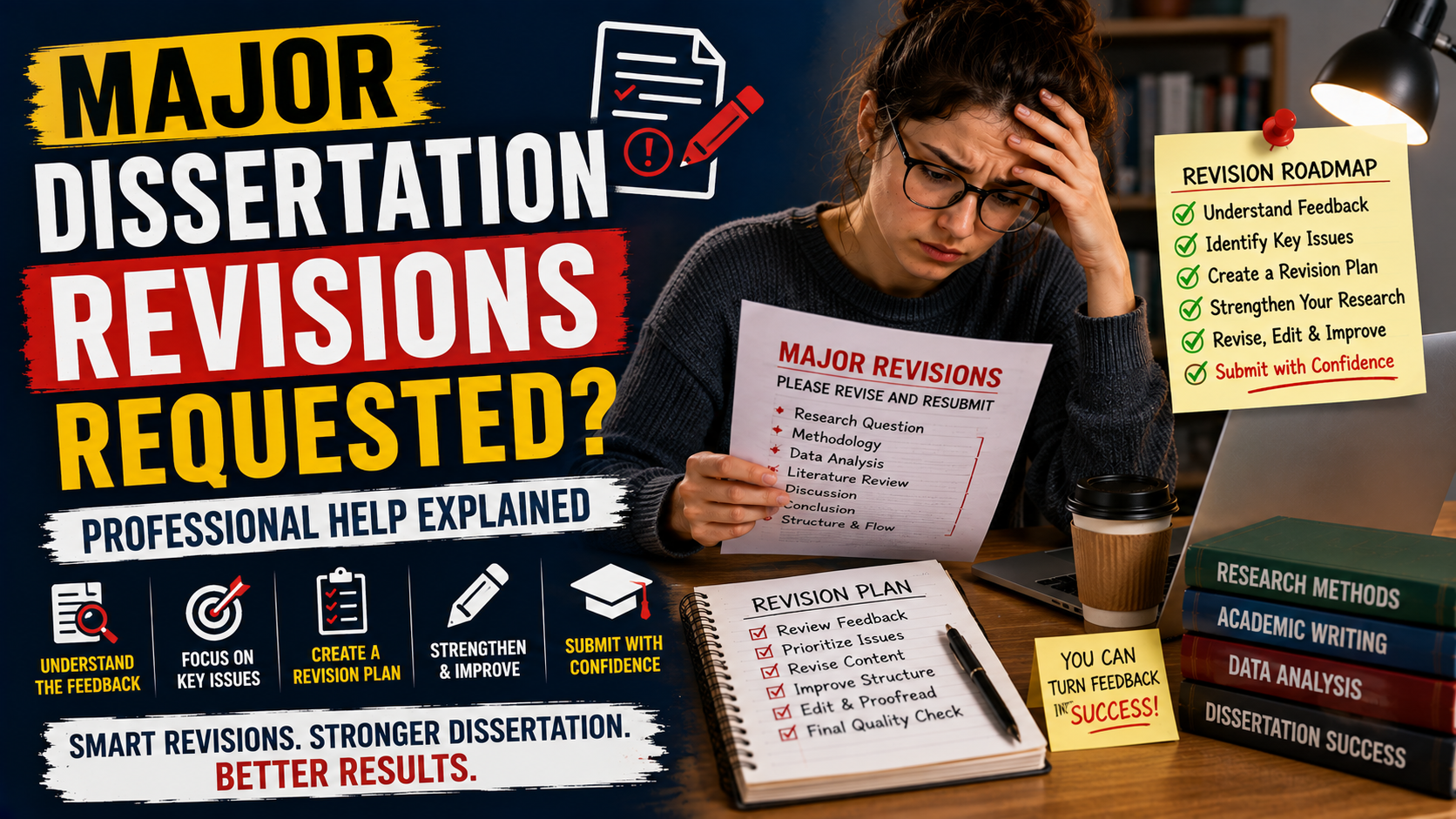
The good news is that major revisions do not automatically mean the end of your dissertation.
They usually mean that significant academic issues need to be addressed before the dissertation can move forward. The exact meaning depends on your university, program and stage of assessment.
Professional academic support can sometimes make the revision process more organised and manageable, particularly when you need help identifying writing problems, improving structure, checking references or proofreading a revised dissertation.
However, professional support should complement your own academic work—not replace your research, analysis or intellectual contribution.
This guide explains what major dissertation revisions mean, what you should do next and where professional dissertation support may fit into the process.
What Does “Major Revisions Required” Mean?
“Major revisions” generally indicates that the dissertation requires substantial changes rather than minor corrections.
The specific requirements vary between universities and programs.
Major revisions can involve issues such as:
Research questions
Research objectives
Literature review
Theoretical framework
Research methodology
Data analysis
Results
Discussion
Academic argument
Conclusions
Dissertation structure
Referencing
Academic writing
Formatting
A dissertation requiring major revisions may still contain valuable research.
The key issue is identifying which problems are fundamental and which are relatively straightforward to correct.
Major Revisions vs Minor Corrections
Understanding the difference helps you prioritise your work.
Minor Corrections
These may include:
Typographical errors
Spelling mistakes
Grammar problems
Formatting inconsistencies
Minor referencing errors
Small wording changes
Major Revisions
These may involve:
Reworking a research question
Restructuring chapters
Expanding the literature review
Revising the methodology
Reanalysing data
Strengthening the discussion
Reinterpreting findings
Revising conclusions
Conducting additional research where required
The distinction matters because you should not spend several hours correcting commas while your research methodology still has a major unresolved problem.
Does Major Revision Mean Your Dissertation Has Failed?
Not necessarily.
The meaning of a major-revision decision depends on the stage of your dissertation and your institution's regulations.
A supervisor may request major revisions because the current draft is not ready for submission.
An examiner may request revisions following formal assessment.
These are different situations.
If you are unsure what your decision means, check your university's official regulations or ask your supervisor, graduate program or relevant academic office.
Never assume that a phrase such as “major revisions” has exactly the same meaning at every university.
Step 1: Read Every Piece of Feedback
Your first task is not rewriting.
It is diagnosis.
Read:
Supervisor comments
Examiner comments
Assessment criteria
Marking rubric
Dissertation guidelines
Previous feedback
Submission instructions
If the feedback is extensive, read it several times.
During the first reading, understand the overall message.
During the second reading, identify individual problems.
During the third reading, begin grouping those problems into revision categories.
Step 2: Separate Critical Problems From Minor Problems
Create three categories.
Critical Issues
These can affect the academic foundation of your dissertation.
Examples:
Research question is unsuitable
Methodology does not answer the research question
Data analysis is inappropriate
Major evidence is missing
Conclusions are unsupported
Major Issues
These substantially affect dissertation quality.
Examples:
Weak literature synthesis
Poor critical analysis
Weak discussion
Inadequate theoretical connection
Poor alignment between chapters
Minor Issues
These can usually be addressed later.
Examples:
Grammar
Spelling
Formatting
Referencing inconsistencies
Sentence-level clarity
Work through the categories in that order.
Step 3: Build a Dissertation Revision Matrix
A revision matrix is one of the most useful tools for managing extensive feedback.
Create a table like this:
Feedback | Problem | Required Action | Chapter | Status |
|---|---|---|---|---|
Research question too broad | Scope unclear | Refine research question | Introduction | Pending |
Literature review descriptive | Limited synthesis | Reorganise around themes | Literature Review | Pending |
Methodology insufficiently justified | Weak rationale | Explain methodological choices | Methodology | Pending |
Findings poorly interpreted | Limited analysis | Strengthen interpretation | Results/Discussion | Pending |
Discussion repeats results | Weak critical engagement | Compare findings with literature | Discussion | Pending |
Conclusion does not answer objectives | Poor alignment | Rewrite conclusion | Conclusion | Pending |
This changes the task from:
“I have to fix my entire dissertation.”
into:
“I have 23 specific revision tasks.”
That difference can make the process much less overwhelming.
Step 4: Check Your Research Question
Your research question controls the direction of the dissertation.
Review whether your:
Research Question → Objectives → Methodology → Results → Discussion → Conclusion
are aligned.
For example, suppose your research question investigates the impact of remote working on employee productivity.
Your methodology should collect evidence capable of addressing productivity.
Your results should answer the research objectives.
Your discussion should interpret those results.
Your conclusion should directly answer the research question.
If these elements are disconnected, adding more words will not necessarily solve the problem.
Step 5: Rework the Literature Review
A common reason for major dissertation revisions is a literature review that is too descriptive.
Consider the difference.
Descriptive
Smith (2021) examined employee engagement and found that flexible working increased satisfaction.
Jones (2022) investigated remote working and reported similar findings.
Brown (2023) studied productivity and found mixed results.
This tells the reader what individual researchers found.
But critical academic writing goes further.
Critical and Analytical
You might compare:
Where studies agree
Where they disagree
Why their results differ
Differences in research design
Differences in populations
Theoretical explanations
Methodological limitations
Research gaps
The purpose is not simply to demonstrate that you have read many papers.
It is to demonstrate that you understand the research landscape surrounding your question.
Step 6: Revisit Your Methodology
If methodology revisions have been requested, determine exactly what the problem is.
Your supervisor or examiner may have concerns about:
Research design
Sampling
Participants
Data collection
Research instruments
Variables
Ethical considerations
Reliability
Validity
Qualitative coding
Statistical analysis
Methodological justification
Do not make major methodological changes blindly.
If the proposed change affects your research design, data collection or analysis, discuss it with your supervisor before proceeding.
Step 7: Review Your Data Analysis
If your feedback says that your analysis requires major revision, determine what specifically needs improvement.
For quantitative research, this might involve:
Choice of statistical test
Variable definitions
Data preparation
Statistical assumptions
Interpretation
Presentation of results
Connection to research questions
For qualitative research, concerns may involve:
Coding
Theme development
Interpretation
Evidence supporting themes
Connection between participant data and conclusions
The goal should be academically appropriate analysis—not changing the analysis simply to produce a preferred outcome.
Step 8: Strengthen Your Discussion Chapter
A weak discussion often repeats the results.
For example:
“The results showed that 70% of participants preferred flexible working.”
That is a finding.
The discussion needs to explain what the finding means.
Ask:
Why did this result occur?
Does it support previous research?
Does it contradict previous research?
Why might the difference exist?
What theoretical implications does it have?
What practical implications exist?
What limitations affect interpretation?
A useful question after every important finding is:
So what?
If the dissertation cannot answer that question, the discussion may require further development.
Step 9: Revisit Your Conclusion
Your conclusion should provide closure.
Check whether it:
Answers the research question
Addresses the objectives
Summarises major findings
Explains the contribution
Acknowledges limitations
Provides appropriate recommendations
Avoids unsupported claims
Do not introduce completely new arguments or evidence in the conclusion unless your discipline's conventions require it.
Step 10: Check Chapter-to-Chapter Alignment
Major revisions may reveal that individual chapters were written independently.
Look for contradictions.
For example:
Introduction
Research objective says the study will investigate three factors.
Methodology
Only two factors are actually measured.
Results
Four factors are discussed.
Discussion
The analysis focuses on different variables.
Conclusion
A completely different question is answered.
This creates an alignment problem.
Review the dissertation as a complete research project rather than as separate chapters.
Step 11: What Can Professional Dissertation Help Actually Do?
Professional academic support can cover different services.
These should not all be confused with dissertation writing.
Depending on the service and your university's rules, professional support may include:
Dissertation Proofreading
Focuses on:
Spelling
Grammar
Punctuation
Typographical errors
Basic consistency
Academic Editing
Can address:
Clarity
Sentence structure
Academic tone
Paragraph flow
Coherence
Repetition
Structural Review
Can help identify:
Weak chapter organisation
Poor transitions
Repeated arguments
Missing connections
Inconsistent structure
Referencing Review
Can check:
In-text citations
Reference lists
Citation consistency
Formatting
Missing references
Dissertation Quality Review
A review may examine whether the dissertation appears logically aligned across:
Research question
Objectives
Literature
Methodology
Findings
Discussion
Conclusion
The exact scope depends on the service.
What Professional Help Cannot Replace
Professional editing should not replace your academic responsibility.
A legitimate support process should not involve:
Fabricating research
Inventing participants
Creating fake references
Manipulating findings
Hiding academic misconduct
Impersonating a student
Guaranteeing a particular grade
You should remain responsible for your:
Research
Data
Analysis
Arguments
Findings
Conclusions
Intellectual contribution
Always check your institution's rules before using external academic support.
When Is Professional Dissertation Editing Most Useful?
Professional editing may be particularly useful when:
Your research is substantially complete
You understand the feedback
You have made the major academic revisions
Your writing needs improvement
English-language clarity is affecting readability
Your dissertation has inconsistent formatting
You have extensive referencing problems
You need a final quality check
For example, if your supervisor says:
“The argument is difficult to follow because the writing lacks clarity.”
academic editing may be useful.
But if the feedback says:
“The methodology does not answer the research question.”
editing alone is unlikely to solve the problem.
The academic issue needs to be addressed first.
Should You Get Editing Before or After Major Revisions?
In most cases, substantive academic revisions should come first.
A practical sequence is:
Supervisor Feedback → Diagnosis → Research Revisions → Analysis → Discussion → Structure → Academic Editing → Proofreading → Final Review
There is little value in paying someone to perfect paragraphs that you are going to completely rewrite.
How to Choose Professional Dissertation Support
If you decide that external support is appropriate and permitted, evaluate the provider carefully.
Look for:
Clear Service Scope
You should know exactly what you are paying for.
Is it:
Proofreading?
Academic editing?
Structural review?
Referencing?
Methodology feedback?
Formatting?
Avoid vague promises.
Transparent Process
A professional provider should explain:
What will be reviewed
What will not be reviewed
Expected turnaround
How feedback is delivered
What information they require
Academic Integrity
Avoid providers that promote:
Guaranteed grades
Fake research
Plagiarism
Fabricated references
Complete ghostwritten dissertations for submission
Exam impersonation
Confidentiality
Students should understand how their documents and personal information are handled.
Appropriate Expertise
If your dissertation involves advanced statistics, qualitative methodology, engineering modelling or another specialist area, general proofreading may not be enough.
The appropriate support should match the actual problem.
What If Your Dissertation Is Due Soon?
If the revision deadline is approaching, don't attempt to fix everything simultaneously.
Use a priority system.
First Priority
Fix problems that could affect whether the research is academically acceptable.
Examples:
Research question
Methodology
Data
Analysis
Major theoretical problems
Second Priority
Fix problems that significantly affect the argument.
Examples:
Literature synthesis
Discussion
Chapter alignment
Conclusions
Third Priority
Fix presentation.
Examples:
Grammar
Formatting
Referencing
Proofreading
This prevents you from spending your final hours fixing minor formatting while critical academic problems remain unresolved.
What If You Are an International Student?
Major dissertation revisions can be particularly stressful for international students because academic delays may affect broader plans.
You may be concerned about:
Graduation
Registration
Funding
Employment
Future study
Family commitments
Immigration or visa matters
Do not assume that a dissertation revision automatically creates a particular immigration consequence.
Academic and immigration requirements are separate.
If your academic timeline changes, speak with the relevant university office about your individual circumstances.
Create a Dissertation Revision Timeline
Your timeline should reflect the amount of work required.
A possible structure is:
Stage 1: Feedback Analysis
1–2 days
Read feedback
Categorise problems
Build revision matrix
Identify urgent issues
Stage 2: Supervisor Discussion
1–3 days
Prepare questions
Confirm priorities
Clarify ambiguous feedback
Confirm major methodological changes
Stage 3: Substantive Revision
1–4+ weeks
Research question
Literature
Methodology
Analysis
Results
Discussion
Conclusion
Stage 4: Structural Review
2–4 days
Chapter alignment
Logical flow
Repetition
Transitions
Stage 5: Academic Editing
Several days
Clarity
Coherence
Academic language
Sentence structure
Stage 6: Final Proofreading
1–3 days
Grammar
Spelling
References
Formatting
Tables
Figures
Appendices
The actual timeline depends heavily on the dissertation's length and the extent of revisions requested.
A Major Dissertation Revision Checklist
Feedback
Read every supervisor/examiner comment
Categorised feedback
Identified critical problems
Identified major problems
Identified minor problems
Research
Research question reviewed
Objectives aligned
Literature gap clear
Methodology appropriate
Data collection reviewed
Data analysis checked
Findings aligned with objectives
Discussion
Findings interpreted
Previous research compared
Theoretical implications addressed
Practical implications addressed
Limitations discussed
Conclusion
Research question answered
Objectives addressed
Contribution explained
Recommendations appropriate
No unsupported claims
Presentation
Structure reviewed
References checked
Formatting checked
Tables checked
Figures checked
Appendices checked
Grammar reviewed
Proofreading completed
Compliance
University guidelines checked
Dissertation template followed
Academic-integrity rules checked
AI-use policy checked
External editing permitted
Final Takeaway
A request for major dissertation revisions can be overwhelming, but it also gives you something valuable: a clear indication of what needs improvement.
Don't respond by simply adding more pages.
Don't assume that professional editing can solve every academic problem.
And don't panic and compromise academic integrity because you have a deadline.
Instead:
Understand the feedback → Diagnose the problems → Speak with your supervisor → Build a revision matrix → Fix the research → Strengthen analysis and discussion → Improve structure → Edit → Proofread → Complete your final quality check.
Professional dissertation support can be useful when you need help making your existing academic work clearer, more coherent and professionally presented—provided that the support complies with your university's rules.
The objective is not merely to make your dissertation look better.
The objective is to produce a stronger, clearer and academically defensible piece of research that responds directly to the concerns raised during the revision process.
Frequently Asked Questions
Everything you need to know about our services
Related Posts

Supervisor Revision Support for New Zealand Master's Dissertations

Dissertation Literature Review Editing Service for NZ Students
