King's College London Harvard Referencing Guide (2026): Examples & Tips
Introduction
Harvard referencing is one of the most widely used citation styles in UK universities. If you're studying at King's College London (KCL), understanding how to reference correctly is essential for producing high-quality academic work, avoiding plagiarism, and demonstrating academic integrity. While individual departments may have specific referencing requirements, many courses use Harvard or a closely related author-date referencing system.
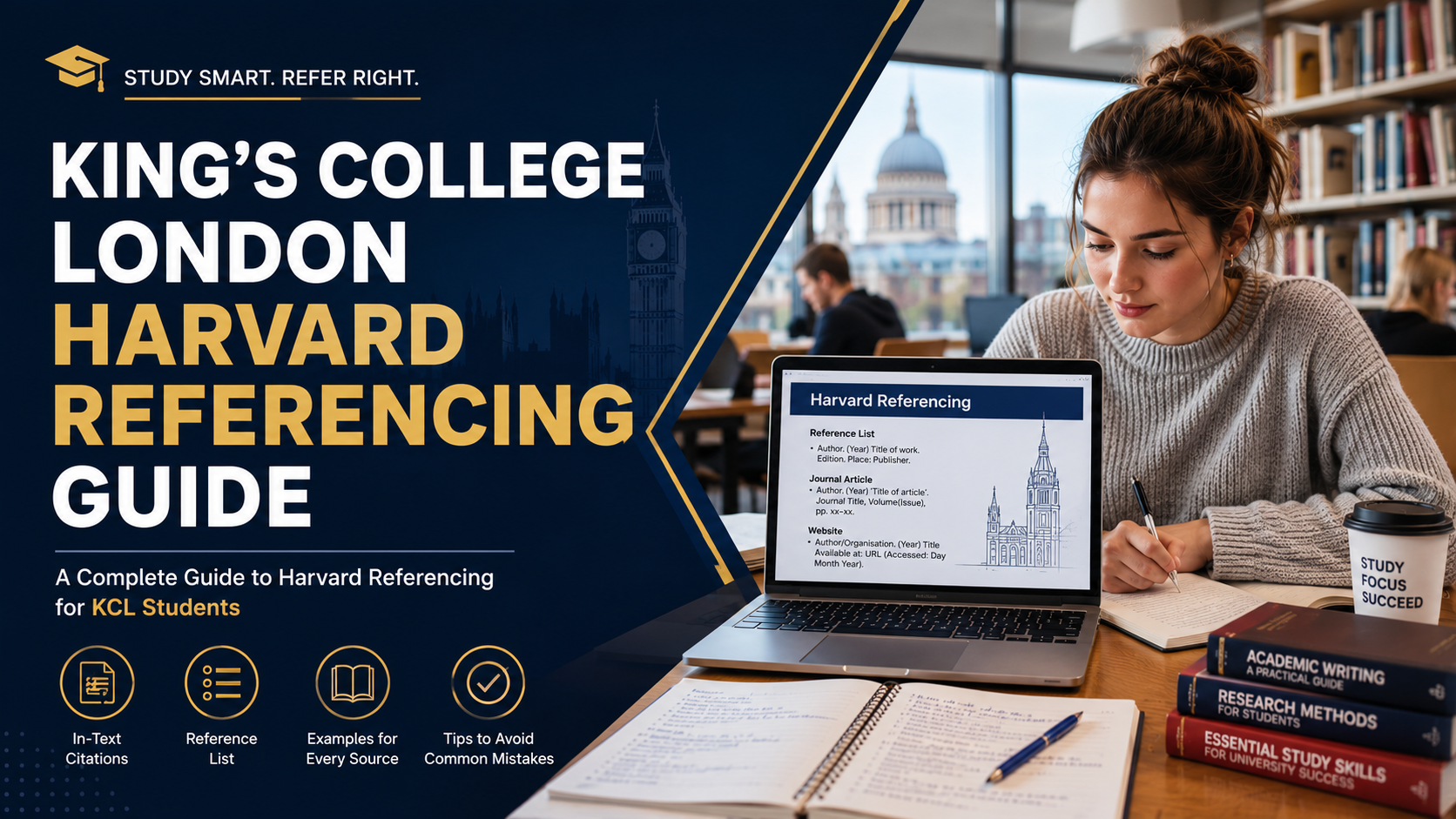
This guide explains the basics of Harvard referencing, including in-text citations, reference lists, common examples, and practical tips to help you reference your assignments confidently.
What Is Harvard Referencing?
Harvard referencing is an author-date citation system. Whenever you use someone else's ideas, research, statistics, or direct quotations, you should acknowledge the original source within your text and include the full reference in your reference list.
A complete Harvard reference consists of:
In-text citation within your assignment.
Reference list entry at the end of your work.
How to Use In-Text Citations
An in-text citation usually includes the author's surname and the publication year.
Example (Paraphrasing):
Academic writing requires critical analysis rather than simple description (Smith, 2023).
Example (Direct Quote):
"Critical thinking is central to academic success" (Smith, 2023, p. 45).
Always include the page number when using direct quotations, where applicable.
Creating a Reference List
Your reference list should appear at the end of your assignment and include every source cited in the text. Arrange entries alphabetically by the author's surname and ensure the formatting is consistent throughout.
Harvard Referencing Examples
Book
Reference List
Brown, T. (2022) Academic Writing Essentials. London: Sage.
In-Text Citation
(Brown, 2022)
Journal Article
Reference List
Wilson, J. and Taylor, P. (2024) 'The role of critical thinking in higher education', Journal of Academic Studies, 18(2), pp. 45–60.
In-Text Citation
(Wilson and Taylor, 2024)
Website
Reference List
Office for Students (2025) Student guidance on academic success. Available at: https://www.officeforstudents.org.uk (Accessed: 7 July 2026).
In-Text Citation
(Office for Students, 2025)
Common Referencing Mistakes
Many students lose marks because they:
Forget to include in-text citations.
Use inconsistent formatting.
Omit publication dates or author names.
Include sources in the reference list that are not cited in the assignment.
Rely on unreliable online sources.
Checking your references before submission can help improve the overall quality of your work.
Tips for Accurate Harvard Referencing
Keep a record of every source you use during research.
Follow the referencing guidance provided by your module or department.
Be consistent with punctuation and formatting.
Double-check author names, publication years, and page numbers.
Use reference management software such as Zotero or Mendeley to organise your sources.
Conclusion
Harvard referencing is an essential academic skill for university students. By understanding how to create accurate in-text citations and reference lists, you can strengthen your academic writing, give proper credit to original authors, and reduce the risk of plagiarism. Before submitting your assignment, always check your module's referencing requirements, proofread your citations carefully, and ensure your references are complete and consistent.
Frequently Asked Questions
Everything you need to know about our services
Related Posts

University of Birmingham Assignment Writing Guide (2026)

How to Write an Assignment at the University of Manchester (2026 Guide)
