How to Incorporate Supervisor Comments Into Your Dissertation
Introduction
Receiving supervisor comments on your dissertation can feel overwhelming, especially when the feedback covers several chapters at once.
You may see comments such as:
“Clarify this argument.”
“Strengthen the literature review.”
“Add more evidence.”
“Explain your methodology.”
“This section is too descriptive.”
“Connect this finding to the research question.”
“Improve the discussion.”
“Reduce repetition.”
“Rewrite this paragraph for clarity.”
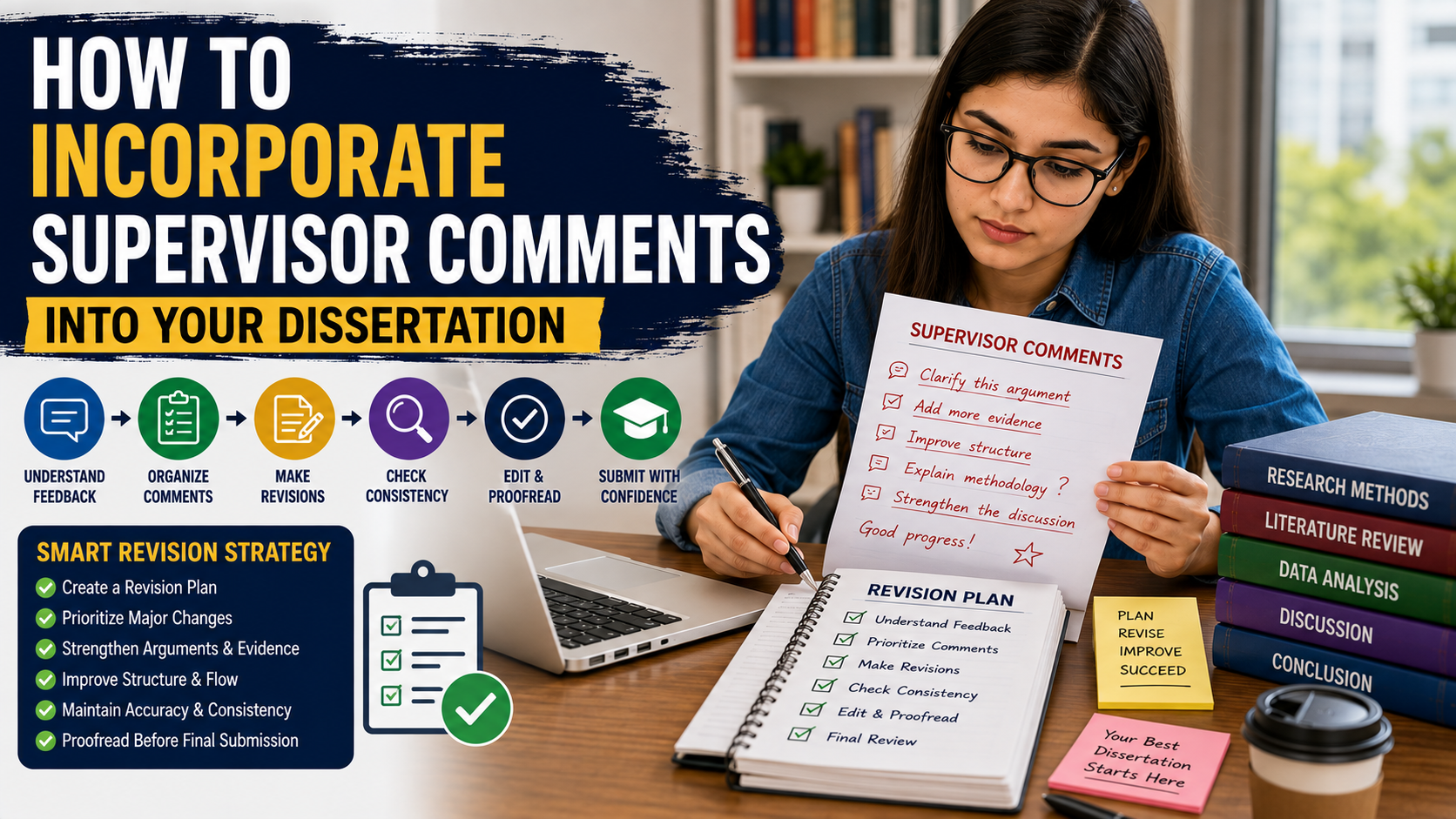
The challenge is not simply responding to individual comments. You need to incorporate the feedback without creating contradictions, repetition or structural problems elsewhere in your dissertation.
The most effective approach is to treat supervisor feedback as a revision plan rather than a collection of isolated corrections.
This guide explains how to read, organise, prioritise and incorporate supervisor comments into your dissertation.
What Does It Mean to Incorporate Supervisor Comments?
Incorporating supervisor comments means reviewing the feedback, deciding what changes are academically appropriate, implementing those changes in your dissertation and checking that the revised document remains coherent.
Depending on the feedback, incorporation may involve:
Rewriting sentences
Restructuring paragraphs
Revising sections
Strengthening arguments
Adding relevant evidence
Improving literature synthesis
Clarifying methodology
Reinterpreting findings
Expanding the discussion
Removing unnecessary repetition
Correcting references
Improving transitions
Updating the conclusion
Not every comment requires a direct change to the text.
Sometimes a supervisor comment is a question designed to make you reconsider your reasoning.
Step 1: Read All Supervisor Comments Before Editing
One of the biggest mistakes students make is responding to comments individually as soon as they encounter them.
Instead, read the entire feedback first.
This helps you identify recurring themes.
For example, your supervisor may comment:
“Clarify this concept.”
Later:
“Define this term earlier.”
And later:
“The reader may not understand what you mean by this terminology.”
These comments may represent one larger problem with terminology and conceptual clarity, rather than three separate problems.
Reading all feedback first allows you to identify patterns.
Step 2: Create a Supervisor Feedback Matrix
A feedback matrix turns comments into manageable tasks.
You can create a simple table like this:
Chapter | Supervisor Comment | Required Action | Priority | Status |
|---|---|---|---|---|
Introduction | Research gap unclear | Clarify research gap | High | Pending |
Literature Review | Too descriptive | Improve synthesis | High | Pending |
Methodology | Sampling needs explanation | Add methodological justification | High | Pending |
Results | Table needs clarification | Revise presentation | Medium | Pending |
Discussion | Findings need interpretation | Strengthen analysis | High | Pending |
Conclusion | Contribution unclear | Clarify contribution | High | Pending |
References | Formatting inconsistent | Standardise references | Low | Pending |
This matrix becomes your revision roadmap.
Step 3: Categorise the Feedback
Not all supervisor comments require the same type of response.
A useful classification system is:
Language Feedback
Examples:
Improve grammar
Clarify sentence
Avoid repetition
Improve academic tone
Structural Feedback
Examples:
Reorganise this section
Move this discussion earlier
Add a new subsection
Improve chapter flow
Evidence Feedback
Examples:
Add supporting literature
Provide evidence
Cite this claim
Compare with previous research
Argument Feedback
Examples:
Explain this conclusion
Strengthen the argument
Justify this interpretation
Address the counterargument
Methodology Feedback
Examples:
Explain participant selection
Justify research design
Clarify data collection
Explain analytical approach
Findings and Discussion Feedback
Examples:
Interpret the result
Connect findings to previous research
Explain unexpected findings
Discuss implications
Formatting and Referencing Feedback
Examples:
Correct citation style
Fix reference-list formatting
Update table numbering
Correct headings
Once comments are categorised, the revision process becomes much easier.
Step 4: Separate Major Revisions From Minor Corrections
Do not spend two hours correcting commas while your supervisor is asking you to restructure an entire chapter.
Prioritise the feedback.
A practical order is:
1. Research and argument issues
2. Structural issues
3. Evidence and literature issues
4. Chapter consistency
5. Language editing
6. Referencing
7. Formatting and proofreading
Major changes should happen before detailed proofreading.
Otherwise, you may proofread a paragraph today and completely rewrite it tomorrow.
Step 5: Understand What Your Supervisor Actually Means
Some comments are straightforward.
For example:
“Correct this citation.”
The required action is obvious.
Other comments require interpretation.
For example:
“This section needs more critical analysis.”
Do not immediately add several paragraphs.
First ask yourself:
What is currently missing?
Am I only describing previous studies?
Am I comparing sources?
Am I evaluating their strengths and limitations?
Am I explaining disagreements?
Am I connecting the literature to my research question?
A supervisor comment often identifies a problem, not the exact wording you should add.
Step 6: Respond to Comments at the Right Level
Supervisor comments can operate at different levels.
Sentence-Level Comment
“Clarify this sentence.”
Make a local edit.
Paragraph-Level Comment
“The argument is unclear.”
Review the entire paragraph.
Section-Level Comment
“This section needs restructuring.”
Review the order and logic of the section.
Chapter-Level Comment
“The discussion does not adequately address the research questions.”
Review the entire chapter.
Dissertation-Level Comment
“The contribution is not sufficiently clear.”
Check whether the introduction, literature review, discussion and conclusion communicate the same contribution.
The larger the comment, the less useful a single sentence-level edit will be.
Step 7: Address Supervisor Comments Systematically
Work through your feedback matrix one item at a time.
For each comment:
1. Locate the Relevant Passage
Find the chapter, section, paragraph or page affected.
2. Read the Surrounding Context
Do not edit only the highlighted sentence.
Read the paragraphs before and after it.
3. Identify the Underlying Problem
Ask what the supervisor wants you to improve.
4. Decide What Change Is Required
Determine whether you need to:
Rewrite
Add
Remove
Reorganise
Explain
Cite
Compare
Clarify
5. Make the Revision
Update the dissertation.
6. Check Nearby Sections
Make sure the revision does not create contradictions.
7. Mark the Feedback as Complete
Update your revision matrix.
Step 8: How to Incorporate “Add More Evidence”
When your supervisor asks for more evidence, do not simply add citations.
Start by identifying the claim.
For example:
“Online learning improves student engagement.”
Ask:
What evidence supports this claim?
Then consider:
Is the claim too broad?
Does recent research support it?
Are there conflicting findings?
Does the evidence apply to your population?
Does it apply to your geographical context?
Is the source academically credible?
The goal is not to increase the number of references.
The goal is to improve the relationship between claim, evidence and interpretation.
Step 9: How to Incorporate “Strengthen the Literature Review”
A weak literature review is not necessarily a short literature review.
Your supervisor may want you to improve:
Synthesis
Critical comparison
Theoretical discussion
Research-gap identification
Source relevance
Connection to the research question
Instead of writing:
Study A found X. Study B found Y. Study C found Z.
You may need to explain:
Why the findings differ
Which explanations are more convincing
What limitations exist
What patterns emerge
What remains unknown
How your research addresses the gap
Supervisor feedback asking for a stronger literature review often requires better analysis rather than simply more sources.
Step 10: How to Incorporate “Improve the Methodology”
Methodology feedback should be handled carefully because it concerns the actual research process.
A supervisor may ask you to clarify:
Research design
Sampling strategy
Participant selection
Data collection
Data analysis
Ethical considerations
Reliability
Validity
Limitations
Theoretical framework
For each comment, explain the research decision based on what you actually did.
Do not invent methodological details simply to satisfy a comment.
If you are unsure how to respond to a substantive methodology question, discuss it with your supervisor or supervisory committee.
Step 11: How to Incorporate “Strengthen the Discussion”
A common supervisor comment is:
“The discussion is too descriptive.”
This often means the chapter reports findings without sufficiently explaining what they mean.
A stronger discussion can connect:
Finding → Previous research → Interpretation → Implication
For example:
State the important finding.
Compare it with relevant literature.
Explain why it may have occurred.
Discuss what it means for the research question.
Explain the relevant theoretical, practical or research implications.
The exact structure will depend on your discipline and dissertation requirements.
Step 12: Check Your Research Questions After Revising
This is one of the most important steps.
After making major revisions, return to your research questions.
Ask:
Does the introduction still reflect the research questions?
Does the methodology explain how they were investigated?
Do the results address them?
Does the discussion interpret them?
Does the conclusion answer them?
A dissertation should tell one coherent story.
If supervisor feedback changes one chapter significantly, other chapters may also need updating.
Step 13: Check for Cross-Chapter Consistency
Suppose your supervisor asks you to change your research objectives.
You should not only change them in the introduction.
Check:
Abstract
Introduction
Literature review
Methodology
Results
Discussion
Conclusion
Tables
Figures
Appendices
Similarly, if you change the name of a key variable or theoretical concept, search the entire document for the old terminology.
This prevents inconsistencies.
Step 14: Search for Repeated Problems
After incorporating feedback, perform a document-wide search.
Look for:
Old terminology
Previous research questions
Outdated objectives
Incorrect chapter references
Duplicate arguments
Old statistics
Incorrect table numbers
Incorrect figure numbers
Outdated citations
This is particularly important after substantial revisions.
Step 15: Keep Track of Every Major Change
For significant revisions, maintain a change log.
For example:
Supervisor Feedback | Change Made |
|---|---|
Clarify research gap | Reworked final section of literature review |
Strengthen methodology | Added explanation of sampling rationale |
Improve discussion | Added comparison with previous studies |
Clarify contribution | Revised contribution statement in introduction and conclusion |
Reduce repetition | Removed overlapping discussion from Chapter 4 |
This is especially useful if your supervisor asks:
“What changes have you made since the previous draft?”
You can answer clearly.
Step 16: Do Not Assume Every Comment Requires Agreement
Supervisor feedback is valuable, but you may occasionally have legitimate academic reasons for approaching a suggestion differently.
If you believe a suggested change would conflict with:
Your research design
Your data
Your theoretical framework
Your research question
Your methodology
Your evidence
do not silently ignore the comment.
Discuss it with your supervisor.
Explain:
What you understood from the feedback.
What change you considered.
Why you believe another approach may be more appropriate.
What evidence supports your position.
Academic revision is a dialogue, not simply a process of mechanically changing every sentence.
Step 17: Ask for Clarification When Necessary
Some comments are too broad to implement confidently.
For example:
“This chapter needs significant improvement.”
Instead of guessing, ask your supervisor what aspect requires the most attention.
You might ask:
Is the main issue the structure?
Does the argument need strengthening?
Is more literature required?
Is the interpretation of findings unclear?
Does the chapter need to be shortened?
Clarifying the priority can save considerable revision time.
Step 18: Revise the Abstract Last
The abstract summarises the entire dissertation.
If you change:
Research objectives
Methodology
Findings
Conclusions
Contribution
then your abstract may become outdated.
Therefore, after major supervisor revisions, revisit the abstract.
Check that it accurately reflects the final dissertation.
Step 19: Update the Conclusion
The conclusion should reflect the revised dissertation.
After incorporating supervisor comments, check whether the conclusion still accurately communicates:
Research purpose
Main findings
Contribution
Implications
Limitations
Recommendations
A revised discussion may change what needs to appear in the conclusion.
Step 20: Perform Language Editing After Major Revisions
Once substantive revisions are complete, begin detailed editing.
Check:
Sentences
Grammar
Sentence length
Clarity
Academic tone
Paragraphs
Topic sentences
Logical progression
Transitions
Repetition
Chapters
Consistent terminology
Chapter introductions
Chapter conclusions
Cross-references
This is the appropriate stage for professional proofreading or permitted editing support.
How Professional Dissertation Editing Can Help
If your university permits external editing, a professional editor may help improve the presentation of your existing revisions.
Possible support includes:
Grammar correction
Academic language editing
Clarity improvements
Sentence restructuring
Paragraph flow
Structural consistency
Reference formatting
Citation consistency
Formatting
Final proofreading
The student should remain responsible for the intellectual content and academic decisions.
Always check your institution's policies before using external dissertation editing.
Supervisor Comments vs Editing Comments
These are not the same thing.
Supervisor Feedback | Editing Support |
|---|---|
“Explain why this method was chosen.” | Improve clarity of the student's explanation |
“Strengthen your theoretical argument.” | Improve presentation of an existing argument |
“Add evidence for this claim.” | Check citation formatting after the student selects appropriate evidence |
“Restructure this chapter.” | Help improve consistency after the student determines the new structure |
“Correct the grammar.” | Correct grammar and sentence structure |
“Clarify this paragraph.” | Improve readability and flow |
This distinction helps maintain academic responsibility.
Common Mistakes When Incorporating Supervisor Feedback
Mistake 1: Editing Comments in Isolation
A local change may create a problem elsewhere.
Mistake 2: Treating Every Comment as a Grammar Issue
Some comments concern research logic rather than language.
Mistake 3: Adding Too Many References
More sources do not automatically create stronger academic analysis.
Mistake 4: Making Major Changes Without Updating Other Chapters
Changes to objectives or methodology may affect the entire dissertation.
Mistake 5: Ignoring Repeated Comments
Repeated feedback may indicate a dissertation-wide issue.
Mistake 6: Proofreading Too Early
Do substantive revisions first.
Mistake 7: Removing Content Without Understanding It
Cutting text can create gaps in your argument.
Mistake 8: Failing to Ask for Clarification
Guessing what your supervisor means can result in unnecessary revisions.
Mistake 9: Not Keeping a Revision Record
Without a record, it becomes difficult to determine which comments have been addressed.
Mistake 10: Forgetting the Final Document Check
After all revisions, review the complete dissertation rather than assuming individual edits are enough.
A Practical Dissertation Revision Workflow
Use this sequence:
Supervisor feedback received
↓
Read all comments
↓
Create feedback matrix
↓
Categorise comments
↓
Prioritise major issues
↓
Address research and argument problems
↓
Revise structure
↓
Update evidence and references
↓
Check cross-chapter consistency
↓
Revise abstract and conclusion
↓
Complete language editing
↓
Proofread
↓
Check formatting
↓
Review final dissertation
↓
Submit according to university requirements
This workflow prevents students from jumping directly from supervisor comments to proofreading.
Final Supervisor Feedback Checklist
Before submitting your revised dissertation, check:
Feedback Management
Every supervisor comment has been reviewed.
Comments have been categorised.
A revision matrix has been created.
Major issues have been prioritised.
Clarification has been requested where necessary.
Academic Revision
Research questions are clear.
Objectives are consistent.
Literature review addresses supervisor feedback.
Methodology explanations are clear.
Results address the research questions.
Discussion interprets the findings.
Research contribution is clear.
Conclusion reflects the revised dissertation.
Consistency
Terminology is consistent.
Chapter references are accurate.
Tables are updated.
Figures are updated.
Appendices are consistent.
Citations reflect the revised content.
Final Editing
Grammar has been checked.
Academic language has been reviewed.
Repetition has been reduced.
References have been checked.
Formatting has been reviewed.
Table of contents is updated.
Final PDF has been reviewed.
Final Takeaway
Supervisor feedback is an essential part of the dissertation revision process.
The goal is not to change sentences randomly until every comment disappears.
Instead, treat the feedback as a roadmap:
Read → Categorise → Prioritise → Revise → Cross-check → Edit → Proofread → Review
Most importantly, look for connections between comments.
A request to improve the research question may affect the methodology, results, discussion and conclusion. A request to strengthen the literature review may affect the research gap and theoretical framework. A change to the methodology may require updates throughout the dissertation.
By managing supervisor comments systematically, you can turn a long list of corrections into a clear revision plan and produce a more coherent, polished dissertation.
Frequently Asked Questions
Everything you need to know about our services
Related Posts

Dissertation Supervisor Feedback? Here's How to Respond

Dissertation Corrections After Supervisor Review
