How to Choose a Reliable Dissertation Writing Service in Canada
Introduction
Choosing a dissertation writing service can feel overwhelming, especially when dozens of websites promise expert writers, fast delivery, low prices and guaranteed results.
For Canadian Master's and PhD students, however, the cheapest or most impressive-looking website is not necessarily the safest choice.
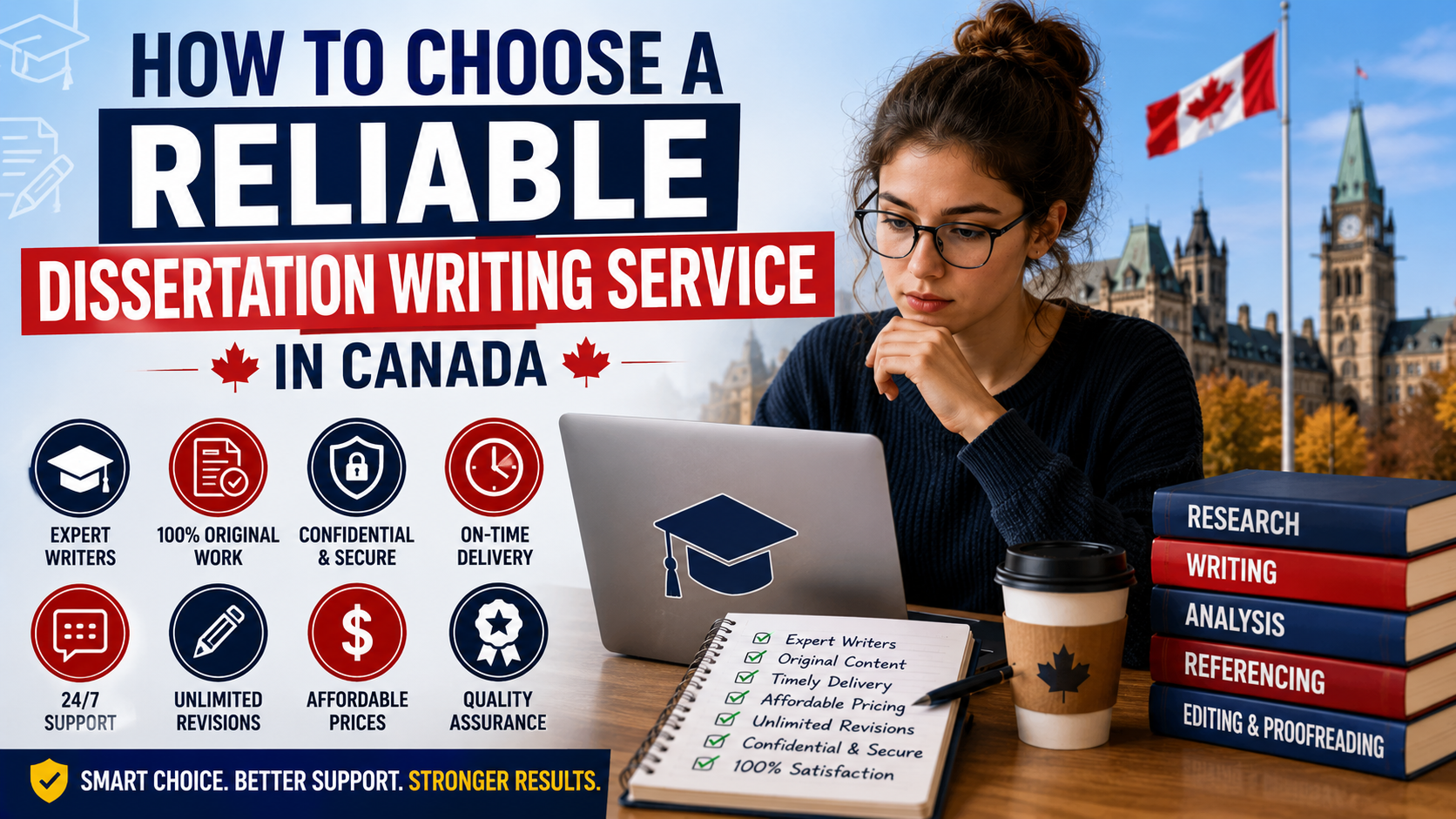
A reliable dissertation service should be evaluated on expertise, transparency, confidentiality, editing standards, communication, originality and academic-integrity practices.
Students should also understand an important distinction: professional support can include legitimate services such as proofreading, language editing, structural feedback, research guidance and formatting assistance, while submitting work produced by someone else as your own may violate university rules.
For example, the University of British Columbia advises students and supervisors to discuss whether professional editing is appropriate and to agree on the specific editing tasks before hiring an editor. Its guidance also states that the student's research and intellectual contribution must remain their own.
This guide explains how Canadian students can assess dissertation support providers before paying for a service.
What Makes a Dissertation Service Reliable?
A reliable dissertation service should be transparent about:
Who provides the service
What qualifications or subject expertise they have
What the service actually includes
How revisions are handled
How files are protected
How pricing is calculated
What turnaround times are realistic
What academic-integrity boundaries apply
Whether the service guarantees unrealistic outcomes
A professional-looking website alone is not enough.
Before placing an order, students should investigate the provider's process and policies, not just its marketing claims.
1. Check the Service's Academic Expertise
Dissertations are specialised academic documents.
A provider working on a nursing dissertation may need very different knowledge from someone editing a computer-science, business, engineering or psychology dissertation.
Look for evidence that the provider understands your academic area.
Relevant expertise may include:
Research methodology
Academic writing
Literature reviews
Qualitative research
Quantitative research
Statistical analysis
Referencing
Academic structure
Discipline-specific terminology
A reliable provider should be able to explain what type of support it can provide for your subject rather than simply claiming to have “experts in everything.”
2. Look for Clear Information About the Service
One of the biggest warning signs is a vague service description.
Before purchasing, find out exactly what you are paying for.
For example, does the service provide:
Proofreading?
Academic editing?
Structural feedback?
Referencing correction?
Formatting?
Research guidance?
Literature-review feedback?
Data-analysis guidance?
Supervisor-feedback interpretation?
These are very different services.
A student who needs proofreading should not necessarily pay for a comprehensive dissertation package.
Similarly, proofreading cannot solve a fundamentally weak methodology.
3. Understand the Difference Between Editing and Writing
The phrase “dissertation writing service” can cover very different forms of assistance.
A legitimate academic-support provider may help students with:
Planning
Structure
Academic writing skills
Understanding feedback
Editing
Proofreading
Referencing
Research guidance
But students should be cautious about services that offer to secretly produce an entire assessed dissertation for submission under the student's name.
Your university's policies should take priority.
UBC, for example, states that a thesis or dissertation represents the graduate student's own original scholarship and that external editing should not replace the student's intellectual contribution.
A useful rule
Choose a provider that helps you improve and communicate your own academic work rather than one that encourages you to outsource responsibility for the work you submit.
4. Check Your University's Rules First
This step should happen before you purchase any dissertation service.
Canadian universities do not necessarily have identical policies.
UBC advises students and supervisors to discuss whether professional editing is appropriate and to agree on the tasks an editor may perform.
The Editors Association of Canada guidelines hosted by UBC also emphasise that permitted editing should have clearly defined limits and should not affect the content or structure of the student's thesis.
Therefore, check:
Your graduate-school regulations
Your department's dissertation handbook
Academic-integrity policies
External editing policies
AI policies
Supervisor instructions
Thesis submission requirements
If the rules are unclear, ask your supervisor or graduate program.
5. Avoid Services That Guarantee Grades
A legitimate dissertation service cannot guarantee that your university will award:
A distinction
An A grade
A first-class result
A pass
A specific GPA
Academic assessment is performed by your institution.
A provider can improve aspects of your document, but it cannot control the examiner's decision.
Therefore, claims such as:
“Guaranteed 90% grade”
or
“100% guaranteed pass”
should be treated as major warning signs.
6. Be Suspicious of Unrealistically Cheap Prices
Price alone does not determine quality.
However, extremely cheap dissertation offers deserve closer investigation.
A provider promising a full specialist dissertation package at an unusually low price may have limitations involving:
Writer expertise
Editing quality
Communication
Research quality
Originality
Revision support
Customer service
Instead of asking only:
“What is the cheapest option?”
ask:
“What exactly am I receiving for this price?”
7. Look for Transparent Pricing
A trustworthy provider should explain how its price is determined.
Pricing may depend on:
Word count
Service type
Academic level
Subject
Complexity
Turnaround time
Editing depth
You should know whether the quoted price includes:
Revisions
Formatting
Referencing checks
Proofreading
Additional pages
Urgent delivery
VAT or other applicable charges
Avoid providers that reveal unexpected charges only after payment.
8. Check the Revision Policy
Dissertation projects often change after supervisor feedback.
A useful service should explain what happens if you need corrections.
Ask:
How many revisions are included?
Is there a revision deadline?
Are supervisor comments accepted?
Is the revision policy written down?
What happens if the requested change is outside the original scope?
For editing services, revisions should normally relate to the agreed editorial scope.
A provider that refuses to explain its revision process before payment may create problems later.
9. Examine the Provider's Communication
Communication is particularly important for postgraduate research.
You may need to explain:
Your methodology
Supervisor feedback
Formatting requirements
Referencing style
Research terminology
Specific sections requiring attention
Look for providers that offer a clear communication process.
Good signs include:
Clear response times
Named support channels
Written project instructions
Order tracking
Documented revision requests
Accessible customer support
If a company takes days to answer basic questions before you purchase, communication may become more difficult after payment.
10. Check Whether the Provider Understands Canadian Academic Requirements
Canada does not have one universal dissertation format.
Requirements can vary by:
University
Faculty
Department
Degree
Discipline
Thesis format
For example, McGill provides detailed thesis guidelines covering preparation, examination and final submission, while noting that academic units may provide additional discipline-specific requirements.
A reliable provider should therefore ask about your specific institution and requirements rather than assuming every Canadian dissertation follows the same format.
11. Look for Originality and Proper Referencing
Academic writing requires careful handling of sources.
Ask how the provider approaches:
Citation consistency
Reference lists
Paraphrasing
Source verification
Plagiarism prevention
Direct quotations
Self-plagiarism
Never accept fabricated references.
Never accept invented research.
Never allow a provider to fabricate:
Survey responses
Interview participants
Experimental results
Statistical results
Research findings
UBC treats plagiarism in theses and dissertations as an academic-misconduct matter, illustrating why originality and proper attribution should be taken seriously.
12. Ask Whether Data Is Fabricated or Supplied
This is especially important for quantitative and qualitative dissertations.
A reliable academic-support provider should never encourage you to submit fabricated research.
If you need help understanding your existing data, legitimate support might include guidance on:
Statistical methods
Data presentation
Interpretation
Tables
Charts
Qualitative coding concepts
Research methodology
But your actual research data must be authentic.
If a provider offers to “create realistic survey responses” or “generate participants so you can finish your dissertation,” do not proceed.
13. Be Careful With AI-Based Dissertation Services
Artificial intelligence has introduced another layer of complexity.
AI tools can potentially help with certain editorial tasks, but university rules vary.
For example, UBC says graduate students may use editorial AI tools in some circumstances but should discuss their use with their supervisor. It also states that substantive GenAI use requires transparency and approval from the appropriate academic authority.
Before using an AI-powered dissertation service, check:
Whether AI use is permitted
Whether disclosure is required
Whether citations are required
Whether your program has additional restrictions
Whether confidential research data can be entered into the tool
Do not upload sensitive research information to an AI system without understanding the privacy implications and your institution's requirements.
14. Check Confidentiality and Data Protection
Your dissertation may contain valuable research information.
Depending on your subject, it could include:
Participant information
Interview transcripts
Survey data
Clinical information
Business data
Proprietary information
Unpublished research
Research instruments
Before uploading files, check:
Where files are stored
Who can access them
How long they are retained
Whether they are used for training
Whether files are deleted after completion
Whether third parties receive access
Confidentiality should be explained clearly rather than assumed.
15. Look at Reviews Carefully
Reviews can provide useful information, but they should not be your only decision factor.
Look for patterns involving:
Communication
Editing quality
Deadline reliability
Revision handling
Customer service
Transparency
Be cautious when every review uses identical language or makes extraordinary claims.
Also remember that testimonials supplied directly by a provider are not the same as independently verified reviews.
16. Ask for Relevant Samples
If samples are available, examine whether they demonstrate:
Clear academic writing
Logical organisation
Appropriate referencing
Professional formatting
Discipline-specific understanding
Do not judge a provider solely by a generic sample written about an unrelated subject.
A high-quality sample in business studies does not automatically demonstrate expertise in engineering or nursing.
17. Check Whether the Service Offers a Quality Review
A useful provider should be able to assess what you actually need.
For example, if you upload a completed dissertation and request proofreading, the provider should not automatically sell you a full writing package.
A quality assessment can help determine whether you need:
Proofreading → Editing → Structural Review → Research Guidance
This can prevent students from purchasing unnecessary services.
18. Understand What Professional Editing Can and Cannot Do
Professional editing can potentially improve:
Grammar
Clarity
Academic tone
Sentence structure
Coherence
Formatting
Referencing consistency
Presentation
It cannot ethically replace:
Your research
Your data
Your intellectual contribution
Your academic judgement
Your responsibility for conclusions
UBC's guidance makes the student's responsibility for clear writing explicit while recommending discussion with supervisors about the appropriate scope of professional editing.
19. Check Whether You Can Contact the Same Support Team
Large dissertation projects can involve many questions.
Ask whether you will have:
A dedicated editor
A subject specialist
A project manager
A revision team
A consistent point of contact
Constantly transferring your project between different people can create inconsistencies.
For complex dissertations, continuity can be particularly valuable.
20. Don't Choose Based Only on “Urgent” Delivery
Many students search for dissertation help because their deadline is approaching.
Urgent services can be useful for legitimate editing or proofreading when time is limited, but speed should not automatically outweigh quality.
McGill's thesis-writing guidance recommends establishing realistic timelines because students often underestimate the time required for organisational decisions, objectives and arguments.
If you have only a few days remaining, prioritise:
Essential academic corrections
Supervisor-requested revisions
Methodology and analysis issues
Structural problems
Referencing
Proofreading
Formatting
Do not spend your final hours correcting minor punctuation while major research problems remain unresolved.
21. Use a Dissertation Service Comparison Checklist
Before choosing a provider, score each option against these criteria.
Factor | What to Check |
|---|---|
Subject expertise | Does the provider understand your discipline? |
Service scope | Is the exact service clearly explained? |
Academic integrity | Does the provider respect university rules? |
Pricing | Are costs transparent? |
Revisions | Is the revision policy clear? |
Communication | Can you reach support easily? |
Confidentiality | How are documents handled? |
Originality | Are references and content handled responsibly? |
Turnaround | Is the deadline realistic? |
Samples | Are relevant examples available? |
Support | Can you communicate requirements clearly? |
Transparency | Are limitations clearly explained? |
A provider that performs well across these areas is generally more worthy of consideration than one that simply advertises the lowest price.
22. Questions to Ask Before Ordering
You can send a prospective provider these questions:
What type of dissertation support do you provide?
Do you offer editing and proofreading separately?
Does the service preserve my original research and intellectual contribution?
What qualifications or subject expertise does the assigned specialist have?
What referencing styles can you support?
What is included in the quoted price?
How many revisions are included?
How is my dissertation stored?
Are my files deleted after completion?
How do you handle confidential research data?
Do you guarantee grades?
What is your academic-integrity policy?
Can you work from my supervisor's feedback?
What happens if my university requires approval for external editing?
What happens if I need changes after the first review?
A trustworthy provider should be comfortable answering these questions.
23. Red Flags You Should Never Ignore
Walk away if a provider:
Guarantees Your Grade
No provider controls your examiner's decision.
Offers Fake Research
Fabricated data can create severe academic and research-integrity problems.
Promises “Undetectable” Work
Claims about bypassing university plagiarism or AI-detection systems should be treated as a serious warning sign.
Offers Fake References
References must be genuine and verifiable.
Encourages You to Hide External Assistance
If your university requires disclosure or approval, concealing assistance can create unnecessary risk.
Refuses to Explain Its Process
You should know what you are purchasing.
Has Unclear Pricing
Unexpected charges are a major customer-service warning sign.
Pushes You to Pay Immediately
A professional provider should allow you to understand the service before committing.
24. What Should Master's Students Look For?
Master's students should look for support appropriate to their dissertation stage.
You might need:
Literature-review editing
Methodology feedback
Data-analysis guidance
Academic language editing
Referencing correction
Dissertation proofreading
Formatting support
Supervisor-feedback interpretation
McGill's general thesis requirements state that a Master's thesis should demonstrate familiarity with previous work and the ability to conduct research, organise results and defend the approach and conclusions according to scholarly norms.
That means the service should complement your academic development rather than replace it.
25. What Should PhD Students Look For?
PhD students should be particularly careful when selecting dissertation support.
A doctoral dissertation normally requires original scholarship and a contribution to knowledge. McGill's general requirements explicitly state that a doctoral thesis must constitute original scholarship and a distinct contribution to knowledge.
Professional assistance may therefore be most appropriate for:
Language editing
Structural clarity
Formatting
Proofreading
Referencing consistency
Presentation
Complex research decisions should remain under the student's academic responsibility and supervisory process.
A Reliable Dissertation Service: Final Checklist
Before paying, ask yourself:
✓ Does the provider clearly explain its services?
✓ Does it have relevant subject expertise?
✓ Are prices transparent?
✓ Is the revision policy clear?
✓ Does it explain confidentiality?
✓ Does it respect academic-integrity requirements?
✓ Does it avoid grade guarantees?
✓ Does it avoid fabricated research?
✓ Does it distinguish editing from writing?
✓ Can it work with your supervisor's feedback?
✓ Have you checked your university's rules?
If several answers are “no,” look for another provider.
Final Takeaway
Choosing a reliable dissertation writing service in Canada should not be based on price, flashy advertising or promises of guaranteed grades.
Instead, evaluate the provider based on:
Expertise + Transparency + Academic Integrity + Confidentiality + Communication + Clear Scope + Fair Pricing + Reliable Revisions
Most importantly, check your university's current rules before using external assistance.
A good dissertation-support provider should help you communicate, review and improve your own academic work rather than encourage you to surrender responsibility for the research you submit.
Your dissertation represents your scholarship.
Your research data should remain authentic.
Your arguments should remain your own.
And any professional support you use should fit within the academic and ethical requirements of your Canadian university.
Frequently Asked Questions
Everything you need to know about our services


