AI Dissertation Help for Computer Science Students
Introduction
Artificial intelligence has become one of the most rapidly developing areas of computer science research. From machine learning and natural language processing to computer vision, generative AI, robotics, cybersecurity, and intelligent software systems, students have an increasingly wide range of potential dissertation topics.
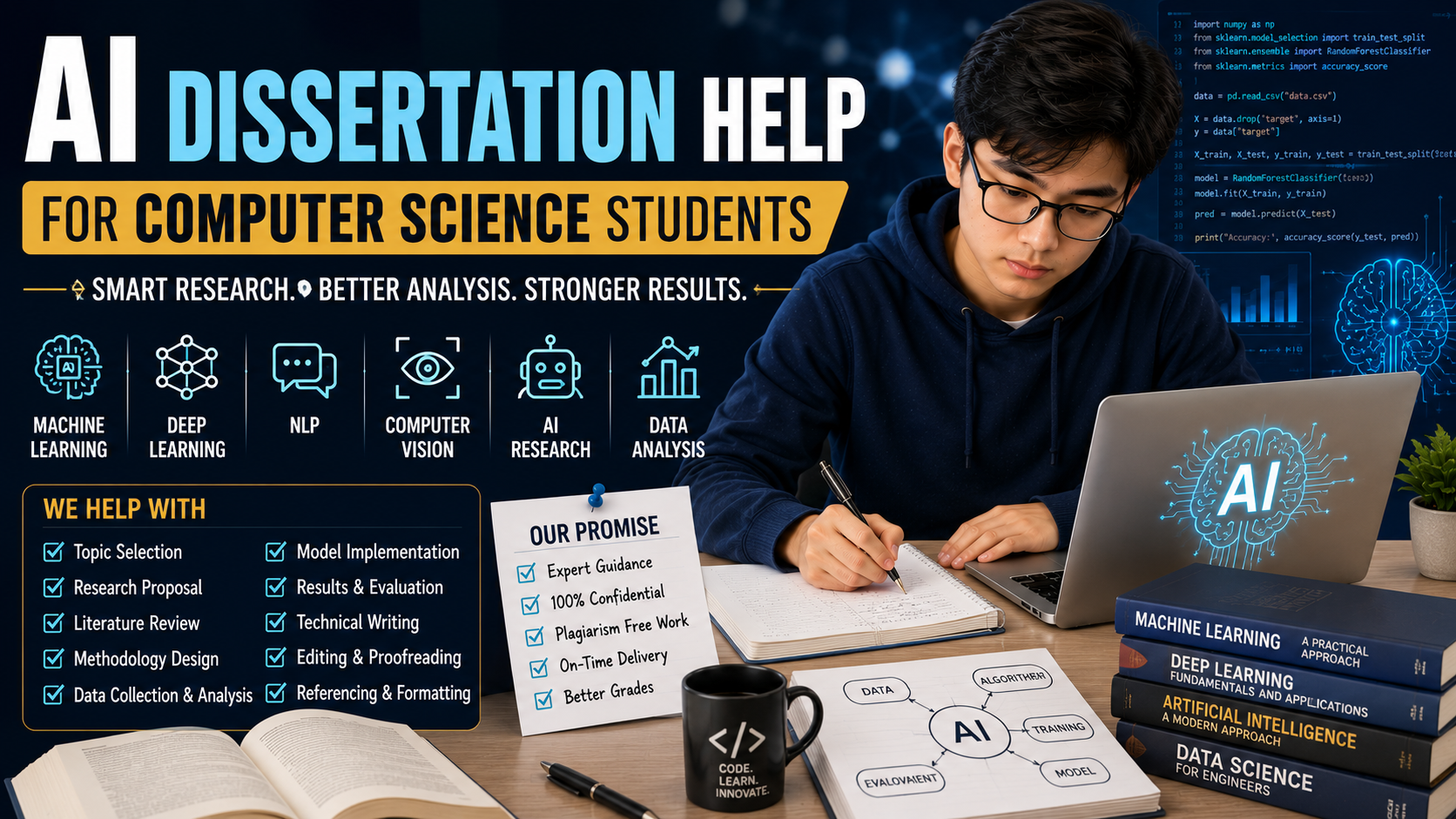
However, an AI-focused computer science dissertation involves much more than building a model or writing code.
Students may need to identify a research problem, review existing literature, develop a methodology, collect or prepare data, implement an algorithm, evaluate performance, discuss limitations, and communicate technical findings in an academically rigorous way.
For students managing a major dissertation alongside coursework, programming projects, internships, examinations, and other responsibilities, professional academic support can help improve the structure, clarity, documentation, presentation, and proofreading of their own research.
What Is an AI Dissertation?
An AI dissertation investigates a research question related to artificial intelligence or one of its associated technologies.
Potential areas include:
Machine learning
Deep learning
Generative AI
Natural language processing
Computer vision
Reinforcement learning
Robotics
AI cybersecurity
Explainable AI
AI ethics
Recommender systems
Speech recognition
Intelligent agents
AI in healthcare
AI in finance
Large language models
A dissertation normally requires more than implementing an existing technique. The research should establish a meaningful problem and explain how the investigation contributes to understanding, evaluating, or solving that problem.
Why AI Dissertations Are Challenging
AI dissertation projects can be technically and academically demanding.
Students may need to combine:
Computer science theory
Programming
Mathematics
Statistics
Data analysis
Machine learning concepts
Research methodology
Experimental design
Technical documentation
Academic writing
A project can also involve substantial experimentation.
For example, a student may need to compare several machine learning models, tune hyperparameters, evaluate different datasets, analyse performance metrics, and explain why one approach performed differently from another.
Popular AI Dissertation Topics for Computer Science Students
AI provides many potential dissertation directions.
Machine Learning
Research may investigate:
Classification algorithms
Regression models
Ensemble learning
Feature selection
Model optimisation
Predictive analytics
Model comparison
Deep Learning
Possible areas include:
Convolutional neural networks
Recurrent neural networks
Transformer architectures
Neural network optimisation
Transfer learning
Representation learning
Generative AI
Generative AI has created numerous research opportunities.
Potential dissertation topics include:
Large language models
AI-generated text
Retrieval-augmented generation
Prompt engineering
AI-assisted programming
Generative AI evaluation
Hallucination detection
AI safety
Human-AI interaction
Natural Language Processing
NLP dissertations may explore:
Text classification
Sentiment analysis
Named entity recognition
Machine translation
Text summarisation
Question answering
Information retrieval
Document classification
Computer Vision
Potential research areas include:
Image classification
Object detection
Facial recognition
Image segmentation
Medical image analysis
Video analysis
Visual recognition systems
Choosing an AI Dissertation Topic
Choosing the right topic is one of the most important stages of the dissertation process.
A suitable topic should be:
Specific
Avoid topics that attempt to investigate the entire field of artificial intelligence.
Researchable
You should have access to appropriate literature, data, tools, and computational resources.
Technically Feasible
Consider whether you have sufficient time, computing power, programming knowledge, and data.
Academically Relevant
The project should connect to an identifiable research problem or academic discussion.
Evaluatable
You should be able to define measurable criteria for assessing your proposed approach.
AI Dissertation Research Questions
A strong research question gives direction to the entire project.
For example, instead of:
How can artificial intelligence be used in healthcare?
A more focused research question might investigate whether a particular machine learning approach can improve prediction performance for a defined healthcare dataset.
A good research question should help determine:
What you will investigate
Which data you need
Which methodology you will use
Which models you will compare
How performance will be measured
What conclusions you can reasonably draw
AI Dissertation Proposal Help
A research proposal establishes the foundation of the dissertation.
Depending on your university requirements, it may include:
Proposed title
Research background
Research problem
Research question
Research objectives
Literature overview
Methodology
Dataset
Proposed technologies
Evaluation approach
Expected contribution
Limitations
Research timeline
Preliminary references
Your proposal should demonstrate that the project is realistic and academically worthwhile.
Literature Review for AI Dissertations
The literature review is particularly important in fast-moving fields such as artificial intelligence.
Students should demonstrate awareness of:
Established approaches
Recent developments
Competing methodologies
Important datasets
Evaluation methods
Limitations of previous research
Unresolved research problems
A weak literature review simply describes papers.
A stronger literature review compares them.
For example, consider:
Which models did researchers use?
What datasets were evaluated?
Which metrics were selected?
What assumptions were made?
How large were the datasets?
What limitations were reported?
Are findings consistent across studies?
This type of comparison helps establish a research gap.
How to Find a Research Gap in AI
Finding a research gap does not necessarily mean discovering an entirely new area of artificial intelligence.
A research gap could involve:
Testing an existing method on a different dataset
Comparing models under specific conditions
Addressing a limitation identified in previous research
Improving computational efficiency
Investigating model interpretability
Evaluating performance across demographic groups
Examining robustness
Studying a specific application area
The research gap should be realistic for the scope of a student dissertation.
AI Dissertation Methodology
The methodology explains how the research will be conducted.
An AI dissertation methodology may include:
Research design
Dataset selection
Data collection
Data preprocessing
Feature engineering
Model selection
Model training
Hyperparameter optimisation
Evaluation
Comparative analysis
The exact methodology depends on the research question.
Data Collection and Preparation
Data quality can have a major impact on AI research.
Students may need to consider:
Dataset size
Data quality
Missing values
Duplicate observations
Outliers
Class imbalance
Data bias
Feature selection
Data leakage
Training and testing splits
A dissertation should explain how these issues were handled rather than treating the dataset as automatically reliable.
Machine Learning Model Evaluation
Model evaluation should be connected to the research question.
Depending on the task, students may use metrics such as:
Classification
Accuracy
Precision
Recall
F1-score
ROC-AUC
Regression
Mean absolute error
Mean squared error
Root mean squared error
R²
Other AI Tasks
Different applications may require specialised evaluation measures.
The dissertation should explain why particular metrics were selected.
AI Dissertation Coding and Implementation
Computer science dissertations often contain substantial programming work.
Depending on the project, students may use:
Python
Java
JavaScript
C++
R
TensorFlow
PyTorch
Scikit-learn
Other machine learning libraries
The dissertation should document the implementation clearly.
Instead of placing large amounts of source code directly into the main chapters, students can generally explain the architecture, algorithms, implementation decisions, and important code components while placing appropriate supporting material in appendices when required.
AI Dissertation Results Chapter
The results chapter presents the outcomes of your experiments.
It may include:
Model performance
Accuracy metrics
Comparison tables
Confusion matrices
Training curves
Performance graphs
Ablation results
Error analysis
Computational performance
Results should be presented objectively.
Avoid making unsupported claims based on small performance differences.
AI Dissertation Discussion Chapter
The discussion explains what the results mean.
Consider:
Did the results support your hypothesis?
Which model performed best?
Why might it have performed better?
Were the findings consistent with previous studies?
What limitations affected performance?
Was the dataset representative?
Were there computational constraints?
Could the model generalise to other datasets?
A strong discussion connects experimental results with the literature reviewed earlier.
AI Dissertation Ethics
AI research can involve important ethical considerations.
Depending on your topic, these may include:
Privacy
Data protection
Algorithmic bias
Fairness
Transparency
Explainability
Security
Consent
Intellectual property
Copyright
Responsible AI use
For projects involving human participants or sensitive datasets, students should follow their institution's research ethics requirements.
Using Generative AI in a Dissertation
Generative AI tools can assist students with certain academic tasks, but their use must follow university policies.
Depending on institutional rules, AI tools may be useful for:
Brainstorming research questions
Explaining difficult concepts
Generating study ideas
Improving grammar
Identifying unclear writing
Reviewing structure
Exploring alternative explanations
However, students should not assume that AI-generated information is accurate.
AI systems can produce:
Incorrect claims
Fabricated references
Misleading explanations
Outdated information
Inaccurate technical details
Any AI-assisted information should therefore be independently verified.
AI Dissertation Help With Coding
Students working on AI dissertations may need support understanding or documenting their own code.
Academic support can help with:
Code documentation
Technical explanations
Algorithm descriptions
Software architecture
Methodology presentation
Debugging guidance
Results interpretation
Code organisation
Students should ensure that submitted code complies with their university's rules regarding AI assistance, collaboration, and academic integrity.
AI Dissertation Data Analysis Help
Data analysis is often one of the most challenging parts of an AI dissertation.
Academic support can help students understand how to present their own analysis clearly.
This may involve reviewing:
Tables
Graphs
Statistical results
Model comparisons
Evaluation metrics
Error analysis
Experimental findings
The goal should be to help the student understand and communicate their research rather than simply inserting unexplained outputs into the dissertation.
AI Dissertation Editing and Proofreading
Technical dissertations can become difficult to read when explanations are overly complex or poorly structured.
Academic editing can help identify:
Long or unclear sentences
Repetitive explanations
Poor transitions
Inconsistent terminology
Weak paragraph structure
Formatting issues
Grammar errors
Referencing problems
Unclear technical explanations
Proofreading should ideally happen after the substantive content has been finalised.
Common AI Dissertation Mistakes
Computer science students commonly encounter problems such as:
Choosing an overly broad topic
Building a project without a clear research question
Failing to establish a research gap
Using an unsuitable dataset
Poor data preprocessing
Data leakage
Weak evaluation methodology
Reporting results without interpretation
Comparing models unfairly
Ignoring limitations
Overclaiming results
Poor technical documentation
Weak literature synthesis
Inconsistent referencing
Excessive use of unexplained technical terminology
A structured review can help identify these issues before submission.
How to Improve an AI Dissertation
Before submission, ask yourself:
Research Question
Does the entire project answer the research question?
Literature
Have you critically evaluated relevant research?
Methodology
Have you explained why your methods were selected?
Implementation
Is the technical approach sufficiently documented?
Evaluation
Are your evaluation metrics appropriate?
Results
Are the findings presented clearly?
Discussion
Have you explained what the results mean?
Limitations
Have you acknowledged weaknesses honestly?
Conclusion
Does the conclusion answer the research question?
Presentation
Is the dissertation clear, consistent, and properly referenced?
AI Dissertation Submission Checklist
Before submitting your dissertation, check:
✔ Is the research question clearly defined?
✔ Are the research objectives aligned with it?
✔ Does the literature review establish a research gap?
✔ Is the methodology justified?
✔ Is the dataset appropriate?
✔ Have you explained data preprocessing?
✔ Is the implementation documented?
✔ Are experiments reproducible where appropriate?
✔ Are evaluation metrics clearly explained?
✔ Are results presented accurately?
✔ Have you avoided unsupported claims?
✔ Does the discussion connect findings with previous research?
✔ Have limitations been acknowledged?
✔ Does the conclusion answer the research question?
✔ Are all sources properly referenced?
✔ Have you checked your university's AI-use requirements?
✔ Have you completed a final proofreading review?
How AssignmentCart Can Help Computer Science Students
AssignmentCart provides ethical academic support for computer science students working on AI dissertations.
Support can include:
AI dissertation proofreading
Academic editing
Research proposal feedback
Literature review editing
Methodology review
Technical writing improvement
Results chapter editing
Data presentation review
Referencing checks
Dissertation formatting
Academic writing feedback
The focus is on helping students improve the clarity, structure, documentation, and presentation of their own research.
Why Choose AssignmentCart for AI Dissertation Support?
Students looking for academic support can benefit from:
Computer science-focused academic specialists
Experienced academic editors
Technical writing support
Confidential document handling
Flexible turnaround options
Detailed proofreading
Referencing reviews
Formatting assistance
Constructive academic feedback
Responsive customer support
Whether you're preparing an AI research proposal, literature review, methodology chapter, results chapter, or complete dissertation draft, an academic review can help identify areas that need improvement.
Ethical AI Dissertation Support
Academic support should complement your own research and technical work.
AssignmentCart can help students:
Improve academic writing
Clarify technical explanations
Review dissertation structure
Strengthen literature discussions
Improve results presentation
Check referencing
Identify unclear sections
Improve formatting
Receive constructive feedback
Students remain responsible for their research, code, data analysis, conclusions, and final submission.
You should also check your institution's rules regarding generative AI, coding assistance, authorship, citations, and academic integrity before using AI tools in your dissertation.
Final Thoughts
An AI dissertation combines computer science research, programming, data analysis, experimentation, and academic writing. Developing a technically interesting system is only one part of the process.
A strong dissertation should clearly explain the research problem, establish a gap in existing knowledge, justify the methodology, document the implementation, evaluate the results, acknowledge limitations, and connect the findings with previous research.
If you need support with AI dissertation editing, research proposal feedback, literature review organisation, methodology review, technical writing, results presentation, referencing, or proofreading, AssignmentCart provides ethical academic support designed to help computer science students improve their own research.
Frequently Asked Questions
Everything you need to know about our services
Related Posts

AI Policy Guide for University Assignments in Ireland

AI and Data Science Dissertation Help in Ireland
