Dissertation Results Chapter Help for Canadian Students
Introduction
Writing the results chapter can be one of the most demanding stages of a Master's or PhD dissertation. By this point, you may have completed your literature review, methodology and data collection, but you still need to turn your analysis into a clear academic chapter.
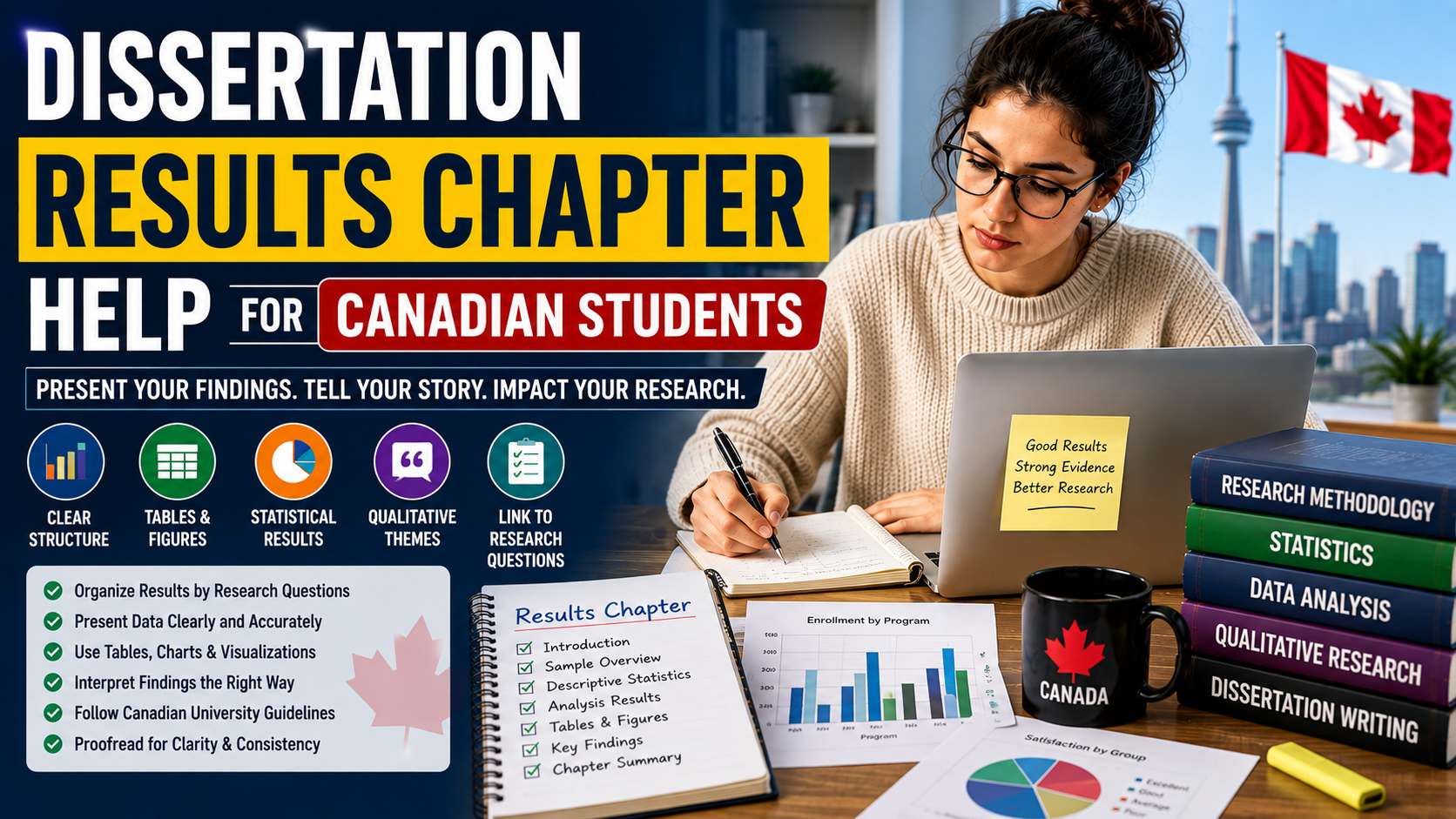
For Canadian students, the exact format of a dissertation results chapter depends on the university, department, discipline, methodology and supervisor. A quantitative dissertation may require statistical results, tables and figures, while a qualitative dissertation may present themes, categories and supporting evidence.
Dissertation results chapter help provides academic guidance with organising, presenting, reporting and reviewing research findings without replacing the student's responsibility for the research and intellectual interpretation.
Quick Answer: What Is a Dissertation Results Chapter?
The dissertation results chapter presents the findings produced by the research analysis. It should show the evidence relevant to the research questions without unnecessarily repeating the methodology or turning the chapter into a second literature review.
Depending on the research design, it may contain:
Quantitative statistical results
Qualitative themes
Tables
Figures
Charts
Participant characteristics
Descriptive statistics
Statistical test results
Coded qualitative evidence
Research-question-specific findings
Short interpretations needed to clarify results
The exact structure varies between academic disciplines.
What Is the Purpose of a Results Chapter?
The primary purpose is to answer:
What did the research find?
A good results chapter allows the reader to understand the evidence generated by the study.
It should make clear:
What was analysed?
What were the major findings?
Which findings answer each research question?
What patterns appeared?
What differences or relationships were identified?
What themes emerged?
What evidence supports the findings?
The results chapter should generally avoid making claims that go beyond the evidence.
Results Chapter vs Findings Chapter
You may see universities and disciplines use different terminology.
Some dissertations use:
Results
Others use:
Findings
Some use:
Results and Discussion
These labels are not necessarily interchangeable in every academic context.
Before writing the chapter, check your:
Program handbook
Dissertation guidelines
Department instructions
Supervisor feedback
Previous approved dissertations from your program
Your university's requirements should take priority over generic online advice.
What Should a Dissertation Results Chapter Include?
There is no universal Canadian template, but a results chapter commonly contains:
Chapter introduction
Research-question or objective reminder
Data/sample overview where appropriate
Results organised by research question or analytical theme
Tables and figures
Statistical or qualitative findings
Relevant supporting evidence
Brief interpretation where necessary
Chapter summary
A quantitative chapter and qualitative chapter may look substantially different.
How Long Should a Dissertation Results Chapter Be?
There is no universal word count for a Canadian dissertation results chapter.
The appropriate length depends on:
Dissertation length
Research methodology
Number of research questions
Dataset
Discipline
Number of analyses
University requirements
Supervisor expectations
A chapter should be long enough to communicate the important findings but should not be padded with unnecessary output.
A 50-page results chapter is not automatically stronger than a 20-page chapter.
Quality, relevance and clarity matter more than length alone.
How to Structure a Quantitative Results Chapter
A quantitative results chapter may follow a structure such as:
Chapter 4: Results
4.1 Introduction
Briefly explain what the chapter presents.
4.2 Sample Characteristics
Present relevant demographic or descriptive information.
4.3 Preliminary Analysis
Report relevant data-screening or assumption checks where appropriate.
4.4 Research Question 1
Present the analysis addressing the first research question.
4.5 Research Question 2
Present the analysis addressing the second question.
4.6 Research Question 3
Present the analysis addressing the third question.
4.7 Summary of Findings
Briefly summarise the major results.
This structure is only an example. Your discipline may require a different organisation.
How to Structure a Qualitative Results Chapter
Qualitative results chapters often organise findings around:
Themes
Subthemes
Categories
Research questions
Cases
Participant groups
For example:
Chapter 4: Findings
4.1 Introduction
4.2 Theme One: Academic Pressure
4.2.1 Time Constraints
4.2.2 Assessment Expectations
4.3 Theme Two: Supervisor Relationships
4.3.1 Communication
4.3.2 Feedback
4.4 Theme Three: Student Adaptation
4.5 Summary of Findings
The themes should come from a defensible analytical process rather than being chosen simply because they sound interesting.
Should Results Be Organised Around Research Questions?
Organising results around research questions can be an effective approach when it fits the research design.
For example:
RQ1: What factors influence...?
followed by the evidence answering that question.
This approach helps readers see the relationship between:
Research Question → Analysis → Finding
However, qualitative dissertations may sometimes be better organised around themes, while experimental or discipline-specific research may use another structure.
How to Start a Dissertation Results Chapter
The opening should be concise.
A results chapter introduction can explain:
What the chapter contains
Which research questions are addressed
How findings are organised
Whether results are presented by research question, hypothesis, theme or another structure
Avoid repeating the entire dissertation introduction.
Example of a Results Chapter Opening
A typical structure might be:
This chapter presents the findings of the study in relation to the research questions outlined in Chapter 1. The results are organised according to the analytical framework described in the methodology chapter. The first section presents the characteristics of the research sample, followed by the findings associated with each research question.
The exact wording should be adapted to the student's own research and university requirements.
How to Report Quantitative Results
Quantitative results should be presented accurately and consistently.
Depending on your research, you may report:
Sample size
Means
Standard deviations
Frequencies
Percentages
Correlations
Regression coefficients
Confidence intervals
Test statistics
Degrees of freedom
p-values
Effect sizes
The reporting format depends on your discipline and required style guide.
Don't Dump Statistical Output Into Your Dissertation
One common mistake is copying large blocks of SPSS, R or other software output directly into the results chapter.
Raw software output can contain information that the reader does not need.
Instead:
Identify the result relevant to the research question.
Select the appropriate information.
Present it using academic reporting conventions.
Explain what the result demonstrates.
Refer the reader to the appropriate table or figure.
Your results chapter should communicate findings—not reproduce the entire contents of your statistical software.
How to Report P-Values
If hypothesis testing is part of your research design, p-values may be included in the results.
However, a p-value should not be presented without context.
A results paragraph may need to communicate:
What was tested
Which statistical procedure was used
The relevant result
Statistical significance where appropriate
Effect size or confidence interval where relevant
Relationship to the research question
Avoid treating:
p < .05
as automatically meaning that a finding is important or practically meaningful.
Statistical significance and practical significance are not necessarily the same.
What Are Effect Sizes?
Effect sizes provide information about the magnitude of an observed effect or relationship.
Depending on the analysis, researchers may report measures such as:
Cohen's d
Pearson's r
Odds ratios
Eta squared
Partial eta squared
Regression coefficients
Other discipline-specific measures
Whether an effect size should be reported depends on the statistical method and disciplinary expectations.
How to Present Tables in a Results Chapter
Tables can make complex findings easier to understand.
A useful table might present:
Variable | Mean | SD | N |
|---|---|---|---|
Academic engagement | 3.82 | 0.71 | 180 |
Study confidence | 3.54 | 0.82 | 180 |
Technology confidence | 3.91 | 0.65 | 180 |
The actual statistics should come from your research dataset.
Do not create artificial results simply to make a dissertation appear complete.
How to Present Figures
Figures can show:
Trends
Relationships
Group differences
Distributions
Experimental outcomes
Conceptual patterns
Every figure should have:
Appropriate numbering
A descriptive title or caption
Clear labels
Appropriate units where applicable
A reference in the text
Do not include a figure without explaining why it matters.
Tables vs Figures
Tables | Figures |
|---|---|
Show precise values | Show visual patterns |
Useful for detailed statistics | Useful for trends |
Good for comparisons | Good for relationships |
Allow exact numbers | Make patterns easier to see |
Choose the format that communicates the finding most clearly.
How to Write a Qualitative Findings Chapter
Qualitative results require more than inserting interview quotations.
A strong qualitative findings section generally connects:
Data → Code → Category/Theme → Finding
For example:
Theme: Academic Time Pressure
Participants repeatedly described difficulty balancing coursework, employment and dissertation research.
A short quotation could then be used as supporting evidence.
The quotation should support your analytical point rather than replace the analysis.
How Many Quotes Should You Include?
There is no universal number.
The appropriate amount depends on:
Number of participants
Research questions
Themes
Methodology
Dissertation length
Analytical approach
Avoid filling pages with quotations.
A useful principle is:
Analyse the evidence; do not simply display it.
Each quotation should have a clear purpose.
How to Introduce Interview Quotes
Instead of presenting a quotation without context, explain:
Who is speaking, using the approved participant identifier
What issue the quotation illustrates
Why the quotation is relevant
For example:
Several participants described difficulty balancing employment with dissertation research. One participant explained that managing competing deadlines was a persistent challenge: “[participant quotation].”
The quotation then provides evidence for the analytical claim.
How to Organise Qualitative Themes
A useful structure is:
Theme → Subtheme → Evidence → Analysis
For example:
Theme 1: Academic Pressure
Subtheme 1.1: Time Management
Evidence from participants demonstrates...
Subtheme 1.2: Assessment Expectations
Participants described...
This structure creates a clear analytical hierarchy.
Results Chapter vs Discussion Chapter
This distinction is extremely important.
Results Chapter
Primarily answers:
What did you find?
It presents evidence generated by the research.
Discussion Chapter
Primarily answers:
What do those findings mean?
It connects findings with:
Previous research
Theoretical frameworks
Research questions
Academic debates
Practical implications
Limitations
Some dissertations combine these sections.
Always follow your program's structure.
Can You Discuss Literature in the Results Chapter?
The answer depends on your dissertation structure.
If your university requires separate results and discussion chapters, extensive comparison with previous literature is generally more appropriate in the discussion.
However, some brief contextual or interpretive comments may be necessary to make a result understandable.
If your dissertation uses a combined:
Results and Discussion
chapter, the literature may be integrated directly into the findings.
Follow your supervisor's instructions.
Common Dissertation Results Chapter Mistakes
1. Repeating the Methodology
Do not rewrite your entire methodology chapter.
Brief reminders may be appropriate, but the results chapter should focus on findings.
2. Repeating the Literature Review
The results chapter should not become another literature-review chapter.
3. Presenting Every Statistical Test
Only include analyses relevant to the research questions and methodology.
4. Overusing Tables
Tables should clarify information rather than overwhelm the reader.
5. Using Unexplained Acronyms
Define technical terms where necessary.
6. Adding Unsupported Conclusions
Do not claim that your findings prove something that the research design cannot establish.
7. Confusing Results With Discussion
Keep the structure consistent with your dissertation requirements.
8. Including Raw Software Output
Select and report relevant findings rather than dumping software output.
9. Using Too Many Quotations
Qualitative analysis requires interpretation, not quotation volume.
10. Inventing or Manipulating Findings
Never create data, participants, statistical results or quotations.
How to Improve a Weak Results Chapter
If your supervisor says your results chapter is weak, review these areas.
Is the chapter logically organised?
Can the reader easily identify which findings answer each research question?
Are results clearly presented?
Are tables and figures understandable?
Is the analysis sufficiently explained?
Does the reader understand what the statistical or qualitative results demonstrate?
Are claims appropriately cautious?
Do your conclusions match the evidence?
Are unnecessary results removed?
A results chapter often becomes stronger when irrelevant material is removed.
Are the findings connected to the research questions?
Every major result should have a clear purpose.
Dissertation Results Chapter Help for Canadian Students
Canadian Master's and PhD students may seek dissertation results chapter support when they need help with:
Structuring the chapter
Organising findings by research question
Presenting statistical results
Creating tables and figures
Reporting qualitative themes
Selecting supporting quotations
Interpreting analytical output
Improving academic clarity
Reviewing supervisor feedback
Checking consistency between methodology and results
Editing and proofreading the chapter
Professional academic support can take different forms, including:
Tutoring
Consultation
Results-review services
Methodology guidance
Academic editing
Proofreading
Students should retain responsibility for their research findings and academic interpretation.
Dissertation Results Chapter Help for International Students in Canada
International graduate students may face additional challenges when writing a results chapter in an unfamiliar academic environment.
Common difficulties can include:
Understanding Canadian graduate-level expectations
Academic English
Statistical terminology
Qualitative-analysis terminology
Supervisor feedback
Dissertation structure
Referencing conventions
Presenting evidence appropriately
University writing centres, libraries, supervisors and graduate programs may provide useful academic resources.
External support can supplement these resources when permitted by the institution.
How to Choose Dissertation Results Chapter Help in Canada
If you are considering professional academic support, evaluate the provider carefully.
1. Look for Graduate Research Experience
Results chapters require more than general proofreading.
2. Check Methodology Knowledge
The provider should understand the difference between quantitative and qualitative reporting.
3. Ask for Transparent Services
Determine whether the service includes:
Chapter review
Editing
Proofreading
Results presentation guidance
Statistical-reporting feedback
Qualitative-theme feedback
4. Check Academic Integrity
Avoid services offering fabricated results or writing that misrepresents your research.
5. Protect Your Research Data
Ask how datasets, transcripts and dissertation files are stored and handled.
6. Avoid Guaranteed Outcomes
No legitimate service can guarantee:
Dissertation approval
Publication
A specific grade
Supervisor approval
Questions to Ask Before Ordering Results Chapter Help
Before choosing a provider, ask:
Do you have Master's or PhD dissertation experience?
Can you review a quantitative results chapter?
Can you review qualitative findings?
Can you check whether results answer my research questions?
Can you review statistical reporting?
Can you check tables and figures?
Can you review qualitative themes and quotations?
Can you help me understand supervisor feedback?
Is proofreading included?
How is my research data handled?
Does the service follow academic-integrity requirements?
What exactly is included in the price?
Dissertation Results Chapter Checklist
Before submitting your chapter, check:
The chapter follows your university's requirements.
The introduction clearly explains the chapter's purpose.
Findings are organised logically.
Research questions are addressed.
Relevant analyses are reported.
Statistical results are accurate.
Qualitative themes are clearly defined.
Supporting quotations are relevant.
Tables are correctly numbered.
Figures are correctly labelled.
Tables and figures are referenced in the text.
Raw software output has been appropriately filtered.
Findings are not exaggerated.
Unsupported causal claims have been avoided.
Results and discussion are separated where required.
Statistical terminology is used correctly.
Participant confidentiality is protected.
Results match the methodology.
Findings are consistent with the research questions.
Supervisor feedback has been addressed.
References and citations are accurate.
The chapter has been proofread.
Final Takeaway
A strong dissertation results chapter clearly communicates what the research found and demonstrates how those findings answer the research questions.
For Canadian Master's and PhD students, the exact format depends on the university, department and discipline. Some programs use separate results and discussion chapters, while others combine them.
The most useful framework is:
Research Question → Analysis → Evidence → Finding → Appropriate Interpretation
For quantitative research, this may involve statistical results, tables and figures. For qualitative research, it may involve themes, subthemes, participant evidence and analytical interpretation.
Before submitting your chapter, check your university guidelines and supervisor feedback carefully. If you seek professional dissertation results chapter help, prioritise support focused on methodological understanding, accurate reporting, academic editing, proofreading and research guidance rather than fabricated results or guaranteed outcomes.
Frequently Asked Questions
Everything you need to know about our services
Related Posts

Affordable Dissertation Proofreading Services in Canada

Best Dissertation Editing Services for Canadian Universities
