Dissertation Rejected by Your Supervisor? Here's How to Recover
Introduction
Having your dissertation rejected by your supervisor can be one of the most stressful moments of postgraduate study.
After months of research, reading, data collection and writing, hearing that your dissertation is not ready for submission can feel like everything has gone wrong.
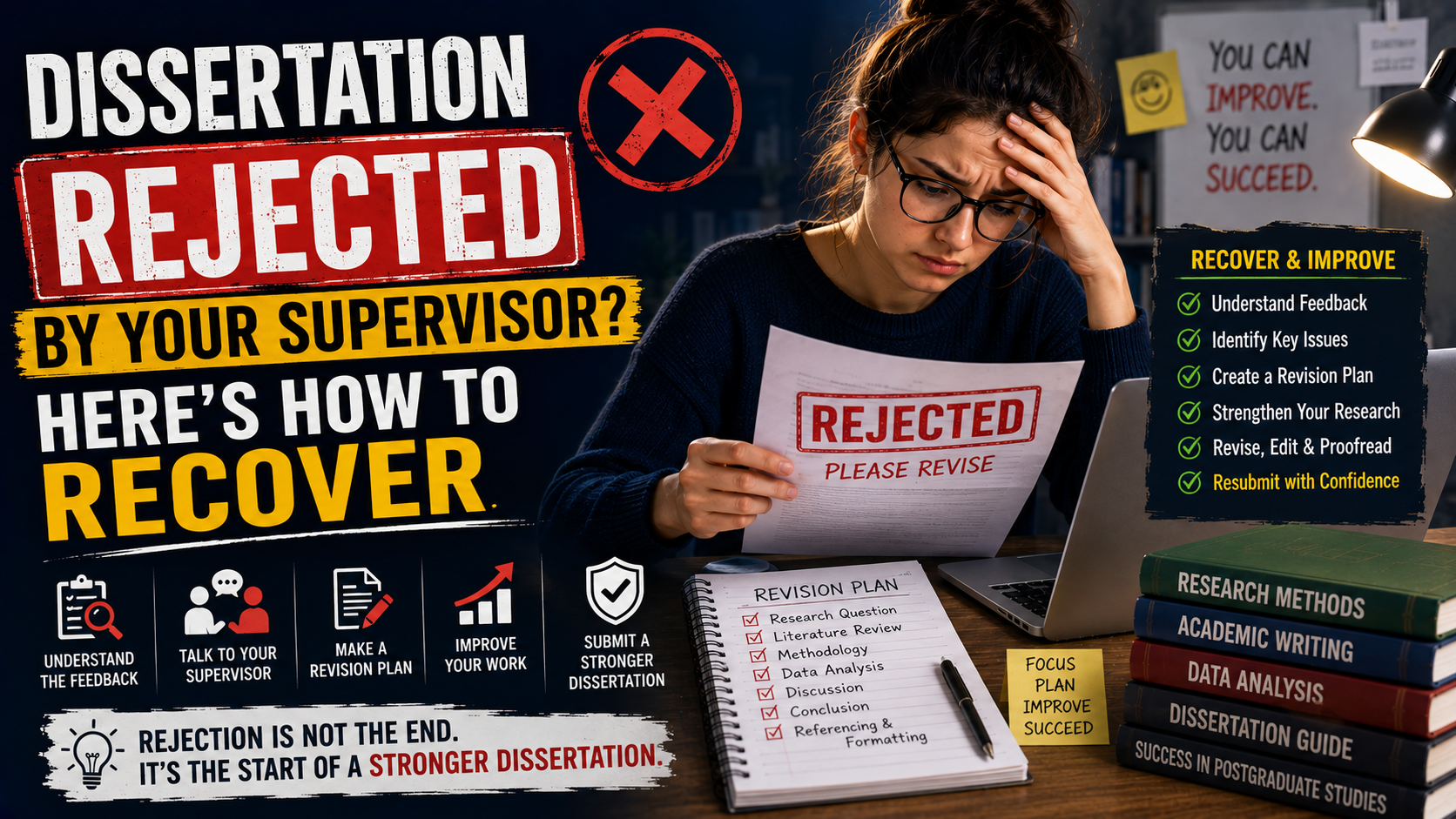
But a supervisor rejecting a dissertation draft does not necessarily mean your degree is over.
In many cases, a rejection means that your supervisor believes the current version is not yet ready to proceed to the next stage. The important question is not simply, “Why did they reject it?”
The better question is:
“What exactly needs to change before my dissertation can move forward?”
This guide explains how to respond to a rejected dissertation, how to interpret supervisor feedback, how to create a recovery plan and when academic editing or proofreading may help.
What Does It Mean When a Supervisor Rejects Your Dissertation?
A supervisor may reject or return a dissertation draft for several reasons.
For example, the dissertation may have:
An unclear research question
Weak research objectives
An inadequate literature review
A poorly justified methodology
Insufficient analysis
Weak discussion
Poor academic structure
Unsupported conclusions
Referencing problems
Major formatting issues
Significant language or clarity problems
Failed to address previous supervisor feedback
Importantly, supervisor rejection is not necessarily the same thing as a formal thesis or dissertation examination failure.
A supervisor may be telling you:
“This version is not ready yet.”
That is very different from an examining committee making a final academic decision.
Your university's regulations determine the formal consequences of any academic decision.
Step 1: Don't Immediately Rewrite Everything
Your first instinct may be to open your document and start changing sentences.
Don't.
First understand the problem.
If your supervisor has said:
“The methodology is not sufficiently justified.”
rewriting the introduction may not solve anything.
If they said:
“The discussion does not engage sufficiently with the literature.”
changing your font or formatting will not address the underlying issue.
Before making changes, identify the academic problem behind the feedback.
Step 2: Read Your Supervisor's Feedback Carefully
Go through every comment.
Don't only focus on the comments that seem easy to fix.
Separate the feedback into categories.
Research
Research question
Research objectives
Research gap
Research design
Methodology
Data collection
Data analysis
Academic Argument
Literature synthesis
Theoretical framework
Interpretation
Critical analysis
Discussion
Contribution
Structure
Chapter organisation
Paragraph structure
Logical flow
Transitions
Repetition
Presentation
Grammar
Academic language
Referencing
Formatting
Tables
Figures
This immediately gives you a clearer picture of the recovery process.
Step 3: Identify the Most Serious Problem
Not every supervisor comment has equal importance.
For example:
“There are some grammar mistakes.”
is usually less serious than:
“The research methodology does not adequately address the research question.”
Create a priority system.
Critical
Issues that could undermine the dissertation academically.
Examples:
Research question is unsuitable
Methodology does not answer the research question
Data analysis is inappropriate
Major sections are missing
Findings are unsupported
Major
Issues that significantly affect quality.
Examples:
Weak literature synthesis
Poor discussion
Limited critical analysis
Weak connection between findings and objectives
Minor
Issues that should be fixed later.
Examples:
Grammar
Spelling
Formatting
Minor referencing inconsistencies
Always work from critical → major → minor.
Step 4: Create a Dissertation Recovery Matrix
One of the most effective ways to recover from a rejected draft is to convert feedback into specific tasks.
For example:
Supervisor Feedback | Problem | Action | Status |
|---|---|---|---|
Research question is too broad | Scope is unclear | Narrow research question | Pending |
Literature review is descriptive | Limited critical analysis | Reorganise around themes | Pending |
Methodology needs justification | Research design insufficiently explained | Strengthen methodological rationale | Pending |
Results are disconnected from objectives | Poor alignment | Reorganise findings | Pending |
Discussion repeats results | Limited interpretation | Add critical interpretation | Pending |
References inconsistent | Formatting issue | Complete referencing audit | Pending |
This turns an emotional problem into a practical project.
Step 5: Meet Your Supervisor Again
If the feedback is extensive or unclear, request a meeting.
Don't approach the meeting with:
“Can you tell me what to write?”
Instead, prepare specific questions.
For example:
Which issue should I address first?
Is my research question still viable?
Does my methodology need to change?
Do I need additional data?
Which chapters require major restructuring?
Is my literature review sufficiently critical?
Does my discussion answer the research objectives?
What should the revised dissertation demonstrate?
What would make the next draft ready for review?
This makes the meeting much more productive.
Step 6: Check Whether the Research Question Still Works
Your research question is the foundation of the dissertation.
If your supervisor says the dissertation is not working, check the alignment between:
Research Question → Objectives → Literature → Methodology → Results → Discussion → Conclusion
These elements should work together.
For example:
Research Question
What factors influence employee retention in remote technology companies?
Objective
To examine the relationship between workplace flexibility and employee retention.
Methodology
A quantitative survey of employees.
Results
Statistical analysis of flexibility and retention measures.
Discussion
Interpretation of the relationship in relation to previous research.
Conclusion
Direct answer to the research question.
If your research question asks one thing but your methodology investigates something completely different, the dissertation has a structural problem that proofreading cannot solve.
Step 7: Reassess Your Literature Review
A common problem with postgraduate dissertations is a literature review that becomes a collection of summaries.
For example:
Smith (2021) found X.
Jones (2022) found Y.
Brown (2023) found Z.
This may demonstrate reading, but it does not necessarily demonstrate critical engagement.
A stronger literature review asks:
How do studies agree?
Where do they disagree?
Why might their findings differ?
What limitations exist?
What theoretical perspectives are being used?
What remains unknown?
How does your research address the gap?
Your supervisor may reject a literature review not because you have too few sources, but because the sources are not being synthesised critically.
Step 8: Revisit Your Methodology
If your supervisor has concerns about methodology, don't simply add more paragraphs.
First determine what the concern actually is.
Your methodology should explain and justify relevant aspects such as:
Research approach
Research design
Participants
Sampling
Data sources
Data collection
Research instruments
Data analysis
Ethical considerations
Reliability or validity
Trustworthiness
Limitations
The exact requirements depend on your research design and discipline.
A strong methodology explains not only what you did, but also why you did it.
Step 9: Check Your Data Analysis
If your supervisor says the analysis is weak, determine whether the problem is:
Data preparation
Choice of analytical method
Statistical technique
Coding
Theme development
Interpretation
Presentation
Connection to research questions
For quantitative research, check whether the statistical methods are appropriate for the research question and data.
For qualitative research, check whether the coding, themes and interpretation are sufficiently supported by the data.
Do not manipulate data simply to obtain a preferred result.
If the analysis needs to be changed substantially, discuss the proposed approach with your supervisor before proceeding.
Step 10: Strengthen Your Discussion
A weak discussion often repeats the results.
For example:
“The survey showed that 65% of participants preferred flexible working.”
That is a result.
The discussion should go further.
You might need to explain:
Why the finding matters
How it compares with previous research
Why it may have occurred
Whether it supports existing theory
What its implications are
What limitations affect interpretation
A useful question is:
“So what?”
After presenting an important finding, explain why the reader should care about it.
Step 11: Rebuild the Conclusion
Your conclusion should answer the research question rather than simply repeat the introduction.
Check whether your conclusion:
Answers the research question
Addresses the objectives
Summarises the most important findings
Explains the contribution
Acknowledges limitations
Provides appropriate recommendations
Avoids introducing unsupported new evidence
If the conclusion makes claims that your research does not support, revise it.
Step 12: Don't Ignore Previous Feedback
One reason a supervisor may reject a later dissertation draft is that earlier feedback was not properly addressed.
If your supervisor previously said:
“The literature review needs more critical synthesis.”
and the next version contains the same structure with a few additional sources, they may conclude that the feedback was not understood.
Keep a record of previous feedback.
For each comment, ask:
What did I change?
Where did I change it?
Why does the change address the concern?
Step 13: Don't Add Hundreds of Sources Just Because Your Supervisor Criticised the Literature Review
More references do not automatically create a better literature review.
Adding 50 papers without synthesis may make the chapter longer while leaving the underlying problem untouched.
Instead, prioritise:
Relevant sources
High-quality research
Recent scholarship where appropriate
Foundational literature
Contrasting perspectives
Studies directly connected to your research question
Then synthesise them.
Step 14: Check Your Dissertation Structure
After making major revisions, review the entire dissertation.
Ask whether each chapter has a clear purpose.
A common structure may include:
Introduction
Literature Review
Methodology
Results / Findings
Discussion
Conclusion
Your actual structure depends on your discipline and university.
The important thing is that the chapters connect logically.
The reader should understand:
Why the research matters → What previous research says → How you investigated the problem → What you found → What the findings mean → What you conclude
Step 15: Review Academic Writing Quality
Once the academic problems are addressed, review the writing.
Look for:
Long or confusing sentences
Repetition
Informal language
Weak transitions
Unclear terminology
Poor paragraph structure
Unsupported claims
Excessive passive voice where clarity suffers
Inconsistent terminology
Each paragraph should have a clear purpose.
A useful paragraph structure is:
Point → Evidence → Analysis → Connection
Don't simply place citations at the end of paragraphs without explaining their relevance.
Step 16: Fix Your Referencing
A rejected dissertation may also contain referencing problems.
Check:
In-text citations
Reference list
Author names
Publication years
Titles
DOI information where required
URLs where required
Citation-reference matching
Referencing style
Your university or department may require APA, Harvard, MLA, Chicago, IEEE, Vancouver or another style.
Follow the official requirements.
Step 17: Review Tables and Figures
Tables and figures should contribute to the argument.
Check:
Numbering
Captions
Titles
Labels
Sources
References in the main text
Consistent formatting
Accurate data
Don't include a table simply because it looks professional.
Explain why it matters.
Step 18: Check Your University's Requirements
Your supervisor's feedback is important, but it is not the only source of requirements.
Check your:
Dissertation handbook
Graduate-school regulations
Program guidelines
Thesis template
Formatting requirements
Word-count rules
Referencing requirements
Submission instructions
Academic-integrity policy
AI-use policy
If your supervisor's instructions and formal university requirements appear inconsistent, ask the appropriate program or graduate-school representative for clarification.
Step 19: Don't Assume Supervisor Rejection Means Final Failure
This distinction is extremely important.
A supervisor returning or rejecting a draft may simply mean:
“This draft needs substantial revision before I am comfortable with it proceeding.”
That is not necessarily the same as:
“Your final dissertation has formally failed examination.”
The formal status of your degree depends on your university's procedures.
If you are uncertain, ask your graduate program directly.
Step 20: Consider Permitted Academic Editing
If your dissertation's research is substantially complete but the writing needs improvement, permitted academic editing or proofreading may be useful.
Depending on institutional rules, editing can help with:
Grammar
Academic English
Clarity
Coherence
Structure
Sentence flow
Referencing consistency
Formatting
Proofreading
However, editing should not replace your academic contribution.
You should remain responsible for:
Research
Analysis
Arguments
Findings
Conclusions
Intellectual contribution
Always check your university's rules before using external academic assistance.
Step 21: Don't Hire Someone to “Fix” the Research
Be extremely careful when searching for urgent dissertation help.
Avoid anyone offering to:
Fabricate data
Invent sources
Create fake participants
Manufacture research results
Manipulate statistical findings
Guarantee a pass
Write an entire assessed dissertation for submission
Impersonate you
Hide academic misconduct
A supervisor rejecting your dissertation is a reason to improve the research, not a reason to compromise academic integrity.
Step 22: If You Are an International Student
A rejected dissertation can be especially stressful if you are an international student.
You may be worried about:
Graduation dates
Tuition
Visa or immigration status
Employment plans
Future study
Family expectations
Don't assume that a dissertation rejection automatically changes your immigration or academic status.
Speak to the relevant university offices about your individual situation.
Depending on your circumstances, these may include:
Graduate program
Supervisor
International student office
Registrar
Academic advisor
Graduate school
Step 23: Build a Realistic Recovery Timeline
Don't promise yourself that you will “fix everything this weekend.”
Create a realistic schedule.
Week 1: Understand the Feedback
Read every comment
Categorise problems
Meet supervisor
Confirm priorities
Week 2: Research Question and Literature
Refine research question
Review objectives
Strengthen literature synthesis
Clarify research gap
Week 3: Methodology
Address methodological concerns
Strengthen justification
Review ethical considerations
Discuss any required research changes
Week 4: Results and Analysis
Recheck data
Correct analysis
Improve findings presentation
Align results with objectives
Week 5: Discussion
Interpret findings
Connect findings to literature
Strengthen critical analysis
Explain implications
Week 6: Conclusion and Structure
Rewrite conclusion
Check chapter connections
Verify research-question alignment
Week 7: Editing
Academic language
Clarity
Coherence
Paragraph structure
Week 8: Final Proofreading
Grammar
Spelling
Referencing
Formatting
Tables
Figures
Appendices
Your actual timeline should depend on the deadline and the amount of revision required.
Step 24: Prepare for the Next Supervisor Review
Before sending the revised dissertation, perform your own quality check.
Ask:
Research
Is the research question clear?
Are objectives addressed?
Is the methodology appropriate?
Is the analysis accurate?
Literature
Is the literature relevant?
Is it synthesised critically?
Is the research gap clear?
Results
Are findings accurate?
Are they clearly presented?
Do they answer the research objectives?
Discussion
Are findings interpreted?
Are they connected to previous research?
Are implications explained?
Conclusion
Does it answer the research question?
Is the contribution clear?
Presentation
Is the dissertation coherent?
Are references consistent?
Are formatting requirements followed?
A Dissertation Recovery Checklist
Supervisor Feedback
Every supervisor comment has been reviewed
Critical issues identified
Major issues identified
Minor issues identified
Follow-up meeting completed
Research
Research question reviewed
Objectives aligned
Literature gap clarified
Methodology reviewed
Data analysis checked
Results aligned with objectives
Discussion strengthened
Conclusion revised
Academic Writing
Structure improved
Paragraphs are coherent
Arguments are clear
Repetition reduced
Academic tone consistent
Terminology consistent
References
In-text citations checked
Reference list checked
Citation-reference matching checked
Required referencing style followed
Presentation
Headings consistent
Table of contents updated
Page numbers correct
Tables checked
Figures checked
Appendices checked
Formatting requirements followed
Final Review
Previous feedback addressed
Major revisions complete
Supervisor's key concerns addressed
University requirements checked
Academic-integrity requirements checked
AI-use requirements checked
Final proofreading completed
Final Takeaway
Having your dissertation rejected by your supervisor can feel like a major setback, but it can also provide a clear opportunity to identify weaknesses before the work reaches its final stage.
Don't panic.
Don't immediately rewrite everything.
Don't ignore the feedback.
And don't compromise academic integrity because you are under pressure.
Instead:
Read the feedback → Identify the core problems → Meet your supervisor → Check university requirements → Build a revision matrix → Fix research problems → Strengthen analysis and discussion → Improve structure → Edit → Proofread → Submit the revised work.
The most important thing is to understand why your supervisor rejected the dissertation.
If the problem is your research question, fix the research question.
If the problem is your methodology, address the methodology.
If the problem is your analysis, revisit the analysis.
If the problem is your discussion, strengthen the interpretation.
If the research is sound but the presentation is weak, permitted academic editing and proofreading may help improve the final document.
A rejected dissertation draft is not the end of your postgraduate journey.
Treat the feedback as a roadmap, work through the problems systematically and use your supervisor's guidance to produce a substantially stronger dissertation.
Frequently Asked Questions
Everything you need to know about our services
Related Posts

Supervisor Revision Support for New Zealand Master's Dissertations

Dissertation Corrections After Supervisor Review
