Dissertation Editing Before Final Submission: What to Check Before You Submit
Introduction
Completing a dissertation is a major academic milestone, but writing the final chapter does not necessarily mean the dissertation is ready for submission.
Before uploading the final document, students should conduct a detailed review of the dissertation's structure, arguments, academic writing, references, formatting, methodology, and overall consistency. Even a well-researched dissertation can contain avoidable issues that become noticeable during the final assessment.
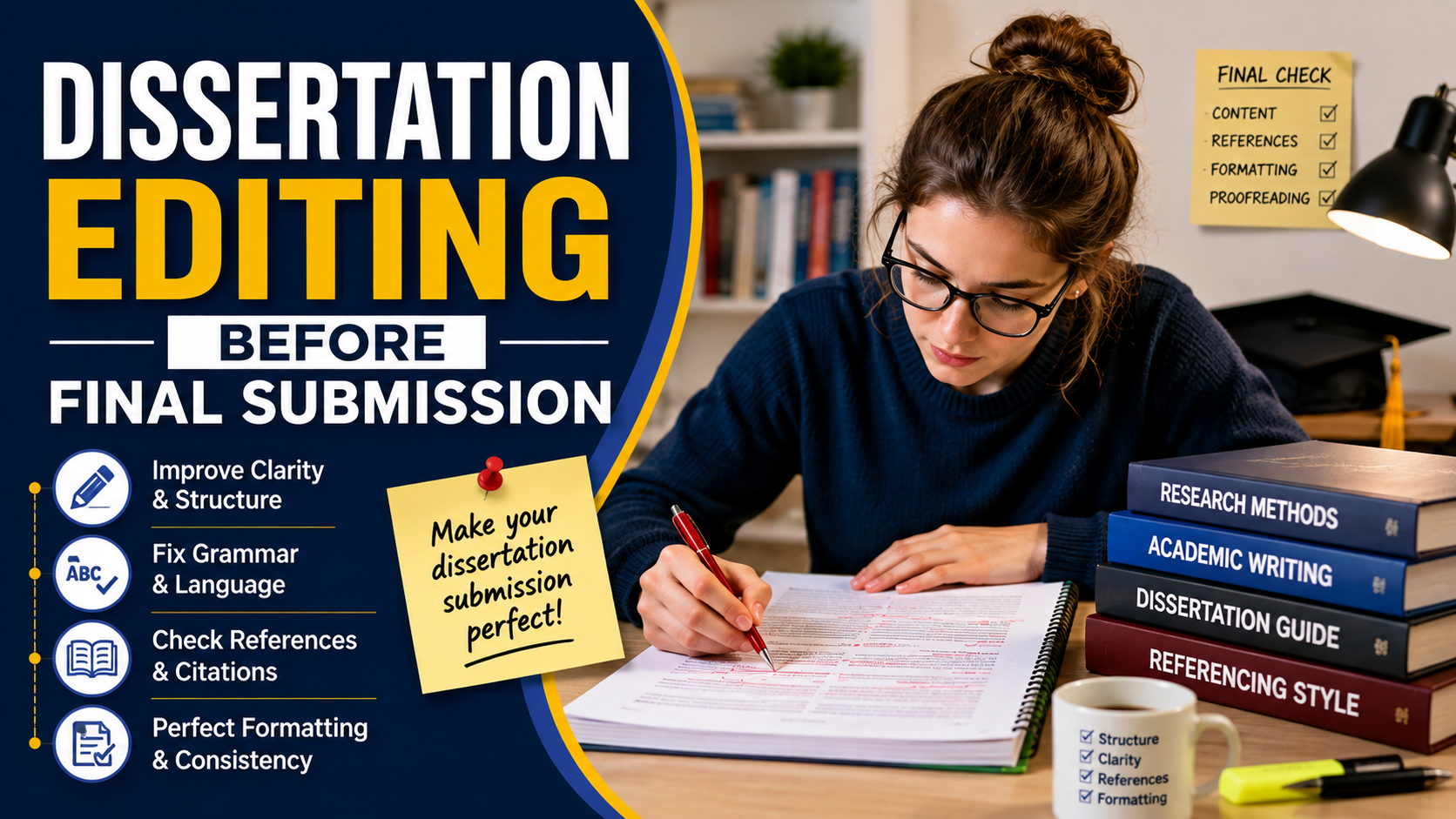
This is where dissertation editing before final submission can be particularly valuable.
Professional dissertation editing can help identify weaknesses in an existing draft, improve clarity and academic presentation, correct language issues, and ensure that the document is consistent with the required academic standards.
Why Is Dissertation Editing Important Before Submission?
A dissertation typically contains thousands of words spread across multiple chapters. After working on the same document for weeks or months, it can become difficult for the writer to notice repetitive sentences, unclear explanations, inconsistent terminology, or structural problems.
A final editing process provides an opportunity to review the dissertation from a fresh perspective.
Editing can help identify:
Grammar and spelling errors
Awkward or unclear sentences
Repetition
Weak transitions between sections
Inconsistent terminology
Poor paragraph structure
Citation inconsistencies
Formatting problems
Inconsistent headings
Problems with tables and figures
References that do not match citations
Sections that require greater clarity
The purpose is not simply to correct grammar. Effective dissertation editing should improve the overall readability, coherence, and academic presentation of the existing work.
What Does Dissertation Editing Include?
The exact editing process depends on the dissertation and the student's requirements. A comprehensive final review can cover several areas.
1. Grammar and Language Editing
Academic writing needs to be clear and precise.
A dissertation editor can review:
Grammar
Spelling
Punctuation
Sentence construction
Word choice
Verb tense
Academic vocabulary
Unnecessary filler words
For example, a long sentence containing several separate ideas may be difficult to follow. Editing can break complex sentences into clearer units while preserving the original meaning.
2. Academic Tone
A dissertation should maintain an appropriate academic tone throughout.
The final review can identify language that is:
Too informal
Overly conversational
Ambiguous
Excessively repetitive
Unsupported by evidence
Unnecessarily complicated
The objective is to make the writing sound academically appropriate without making it unnecessarily difficult to understand.
3. Dissertation Structure
A dissertation normally follows a logical progression from the research problem through methodology, findings, discussion, and conclusion.
During final editing, check whether each chapter has a clear purpose.
A typical dissertation may contain:
Introduction
Literature Review
Research Methodology
Results or Findings
Discussion
Conclusion
References
Appendices
The exact structure varies by discipline and university.
Your dissertation editor should not assume that every university uses the same structure. Always compare your document with your institution's dissertation guidelines.
Dissertation Editing Chapter by Chapter
A final dissertation review is more effective when each chapter is assessed individually as well as in relation to the entire research project.
Introduction
Check whether the introduction clearly establishes:
The research topic
Research problem
Research aim
Research objectives
Research questions
Research significance
Scope of the research
Dissertation structure
A common problem is introducing objectives or research questions that are not properly addressed later in the dissertation.
Literature Review
The literature review should do more than summarise individual sources.
Check whether you have:
Connected studies to your research problem
Compared different perspectives
Identified relevant themes
Evaluated existing research
Identified a research gap
Connected the literature to your research questions
Editing can improve the transitions between studies and make the overall argument easier to follow.
Methodology
The methodology chapter should clearly explain how the research was conducted.
Depending on your research design, check:
Research approach
Research design
Participants or sample
Data collection
Data analysis
Ethical considerations
Research limitations
The methodology should be consistent with the research questions and the methods actually used.
Results or Findings
The findings chapter should present the results clearly.
Check whether:
Results are presented logically
Tables and figures are labelled correctly
Text accurately describes the results
Statistical information is presented consistently
Findings are not mixed unnecessarily with interpretation
If your university requires separate findings and discussion chapters, make sure the distinction is maintained.
Discussion
The discussion is often one of the most important chapters because it connects the findings back to the research questions and existing literature.
Check whether you:
Interpret the findings
Compare them with previous research
Explain similarities and differences
Address unexpected findings
Discuss theoretical or practical implications
Connect the discussion to the research objectives
Simply repeating the findings is generally not enough for a strong discussion chapter.
Conclusion
The conclusion should provide a clear ending to the research.
Check whether it:
Answers the research questions
Summarises the main findings
Addresses the research objectives
Explains the significance of the research
Acknowledges limitations
Provides appropriate recommendations
Suggests areas for future research
Avoid introducing completely new arguments or evidence in the conclusion unless your university specifically expects this.
Dissertation Editing vs Dissertation Proofreading
These terms are sometimes used interchangeably, but they can involve different levels of review.
Proofreading
Proofreading generally focuses on surface-level errors such as:
Spelling
Grammar
Punctuation
Typographical errors
Formatting inconsistencies
Editing
Editing can involve a broader review of:
Sentence clarity
Paragraph flow
Academic tone
Logical progression
Repetition
Argument presentation
Consistency
Chapter-level coherence
For a dissertation that is already complete, students may benefit from both editing and proofreading before submission.
What Should You Check in Your Dissertation References?
Referencing errors are easy to overlook in a long dissertation.
Before submission, check that:
Every in-text citation appears in the reference list
Every reference-list entry is cited where appropriate
Author names are consistent
Publication dates are correct
Titles are formatted consistently
DOI or URL information is accurate where required
Referencing style is applied consistently
References follow your university's requirements
Different institutions and departments may require different referencing styles, so use the official guidelines for your programme.
Check Your Dissertation Formatting
Formatting problems can make a polished dissertation look unfinished.
Before submitting, review:
Headings
Make sure chapter headings and subheadings use consistent formatting.
Page Numbers
Check that page numbers appear correctly and correspond with your table of contents.
Table of Contents
Update the table of contents after making final changes.
Tables and Figures
Check:
Numbering
Captions
References in the text
Placement
Formatting
Fonts and Spacing
Follow your university's dissertation template or formatting requirements.
Appendices
Make sure appendices are correctly labelled and referenced within the dissertation where necessary.
Check Whether Your Chapters Connect
One of the most valuable final editing checks is to read the dissertation as one complete research project rather than as separate chapters.
Ask yourself:
Does the research question introduced in the first chapter remain central throughout the dissertation?
Do the methodology and research questions align?
Do the findings answer the research questions?
Does the discussion interpret the findings rather than simply repeat them?
Does the conclusion reflect what was actually established by the research?
These connections are important because a dissertation can contain individually strong chapters while still having weaknesses in its overall coherence.
Dissertation Editing for Master's and PhD Students
The level of editing required can vary significantly depending on the academic level.
Master's Dissertation Editing
Master's students may require support with:
Academic language
Critical analysis
Literature integration
Research structure
Referencing
Methodology presentation
Discussion and conclusion
Final proofreading
PhD Thesis Editing
Doctoral research generally requires a more advanced level of academic presentation.
Editing may focus on:
Argument coherence
Terminology consistency
Chapter integration
Research contribution
Literature positioning
Methodological explanation
Complex sentence structures
Consistency across a long thesis
PhD students should ensure that any external editing complies with their institution's rules concerning permitted assistance and authorship.
When Should You Get Your Dissertation Edited?
Ideally, dissertation editing should not be left until the final few hours.
A practical approach is to complete your substantive revisions first and then conduct a final editing pass.
Consider professional editing when:
Your dissertation is substantially complete
Your supervisor has provided feedback
You have incorporated major revisions
You are struggling to identify errors in your own writing
English is not your first language
You are concerned about academic clarity
Your dissertation contains extensive references
You want an independent review before submission
The earlier you complete the editing process, the more time you have to make meaningful changes.
What If Your Supervisor Has Already Given Feedback?
Supervisor feedback should generally be addressed before the final editing stage.
For example, your supervisor may have recommended:
Strengthening the literature review
Clarifying the methodology
Improving critical analysis
Revising the research questions
Expanding the discussion
Improving the conclusion
Once those substantive changes have been made, editing can focus on improving the presentation and consistency of the revised dissertation.
This prevents you from spending significant time polishing sections that may later need to be rewritten.
Common Dissertation Editing Mistakes to Avoid
Editing Too Early
If major sections are still being rewritten, extensive proofreading may need to be repeated.
Only Checking Grammar
Grammar is important, but dissertation editing should also consider structure, clarity, consistency, and academic presentation.
Ignoring the References
A dissertation with excellent writing can still contain referencing inconsistencies.
Forgetting the Research Questions
The final review should confirm that the research questions remain properly addressed.
Making Unnecessary Changes
Editing should improve the document rather than change the researcher's intended argument or meaning.
Relying on Automated Tools Alone
Grammar and spelling tools can identify many surface-level issues, but they may not understand the research context, argument, methodology, or discipline-specific requirements.
How Professional Dissertation Editing Can Help
Professional dissertation editing provides an additional layer of review between completing your draft and submitting the final document.
A suitable editing service may help you identify issues that are difficult to notice after spending months working on the same research.
Depending on the service, support may include:
Academic language editing
Structural feedback
Grammar and proofreading
Citation consistency checks
Reference formatting
Chapter-level review
Formatting checks
Feedback implementation
Final submission review
The goal should be to improve your existing dissertation rather than replace your academic contribution.
Dissertation Editing Before Final Submission with AssignmentCart
AssignmentCart offers academic support for students who want their existing dissertations reviewed before final submission.
If you are considering dissertation editing, provide the relevant details such as:
Academic level
Subject
Word count
University requirements
Referencing style
Dissertation guidelines
Supervisor feedback
Current draft
Submission deadline
This information helps determine the appropriate level of editing and review.
Students should also check their university's academic integrity and external assistance policies before requesting dissertation editing services.
Final Dissertation Submission Checklist
Before clicking the final submission button, work through this checklist:
Content
Research questions are clearly addressed
Research objectives are covered
Main arguments are supported by evidence
Findings are clearly presented
Discussion connects findings with literature
Conclusion reflects the research
Writing
Grammar has been checked
Spelling has been checked
Academic tone is consistent
Paragraphs flow logically
Repetition has been reduced
Terminology is consistent
References
In-text citations have been checked
Reference list has been reviewed
Citation and reference details match
Required referencing style has been followed
Formatting
Table of contents is updated
Page numbers are correct
Headings are consistent
Tables and figures are labelled
Appendices are correctly organised
University formatting requirements are followed
Final Submission
Correct file has been selected
File opens correctly
Required file format is used
Submission portal requirements have been checked
Final deadline and time zone have been confirmed
Submission confirmation has been saved
Conclusion
Finishing your dissertation draft is a major achievement, but the final editing stage should not be overlooked.
Before submission, review the dissertation for academic clarity, logical structure, consistency, referencing, formatting, language quality, and alignment between the research questions, findings, discussion, and conclusion.
A careful final review can help you identify problems that are easy to miss when you have been working on the same document for months.
If your dissertation is substantially complete and you want an additional review before submission, professional dissertation editing can provide useful feedback and help you present your existing research more clearly and consistently.
Most importantly, allow enough time for editing rather than treating it as something that can be completed in the final few minutes before the submission deadline.
Frequently Asked Questions
Everything you need to know about our services


