Dissertation Corrections Service for Canadian Students
Introduction
Submitting a dissertation is often the final stage of years of research, writing and revision. However, many Canadian Master's and PhD students discover that their dissertation still requires corrections after receiving feedback from a supervisor, supervisory committee or examiner.
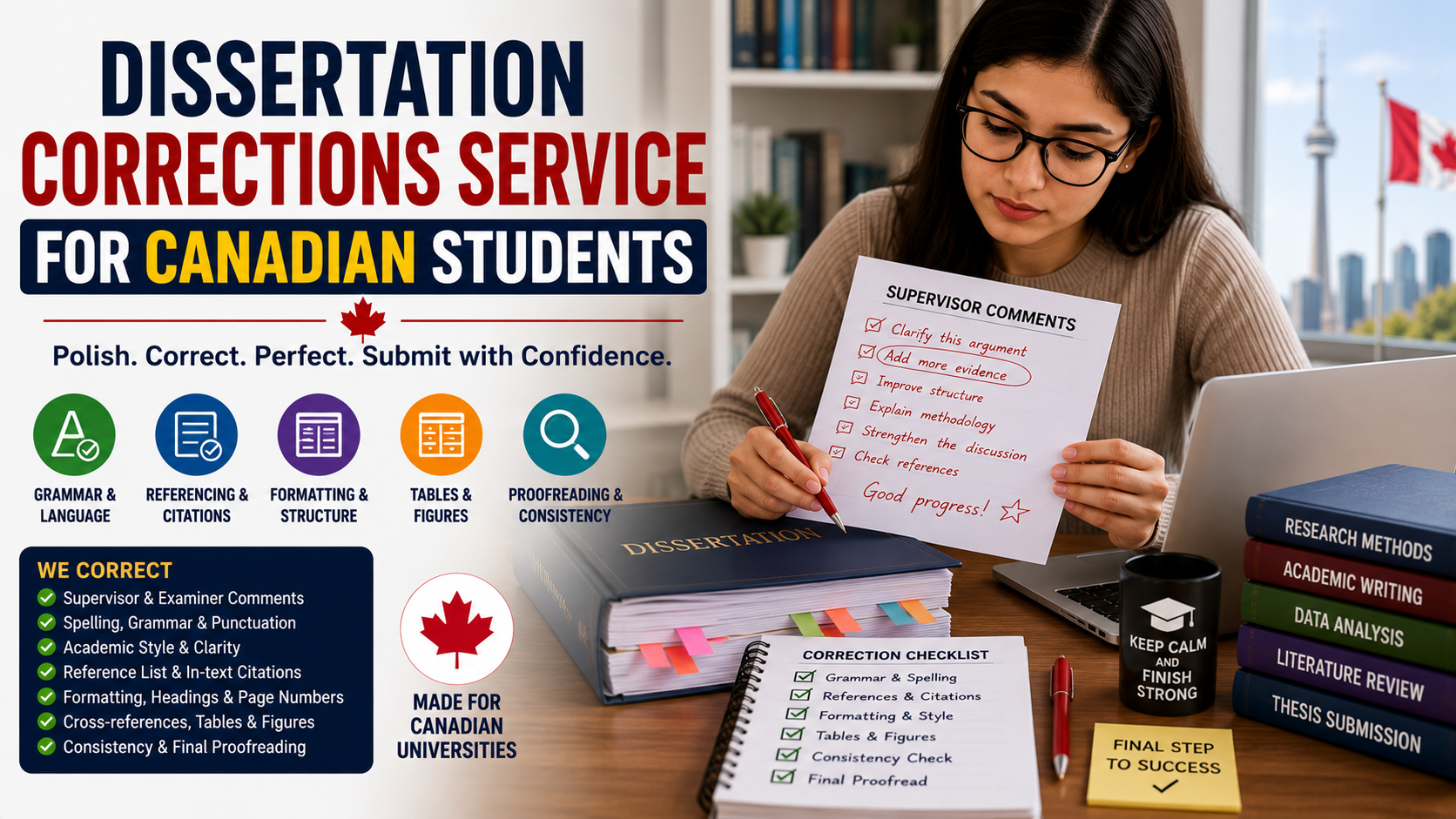
These corrections can range from simple grammar and formatting issues to substantial revisions involving methodology, analysis, discussion and academic argument.
A dissertation corrections service for Canadian students can help with the presentation, organisation and proofreading of an existing dissertation, provided the work remains consistent with the student's university requirements and academic-integrity policies.
The key is understanding what needs to be corrected, what the student must revise personally, and what type of professional editing support is appropriate.
What Is a Dissertation Corrections Service?
A dissertation corrections service helps students identify and correct problems in an existing dissertation before final submission or resubmission.
Depending on the agreed scope, corrections may include:
Grammar and spelling
Sentence clarity
Academic language
Formatting
Referencing consistency
Citation formatting
Table and figure numbering
Headings and subheadings
Page numbering
Table of contents
Cross-references
Structural consistency
Supervisor-requested editorial corrections
Proofreading of revised chapters
More substantial academic corrections may involve changes to:
Research arguments
Methodology
Data analysis
Interpretation
Literature review
Discussion
Conclusions
These substantive changes should be made by the student in accordance with the feedback and requirements of their university.
Why Do Canadian Students Need Dissertation Corrections?
A dissertation may go through several rounds of feedback before it is ready for submission.
Students may receive comments about:
Weak arguments
Missing evidence
Poor chapter organisation
Methodological explanations
Literature gaps
Inconsistent terminology
Referencing errors
Grammar
Formatting
Discussion and interpretation
Conclusions
Research limitations
It is common for corrections to accumulate across multiple chapters.
A student who fixes each comment independently may accidentally introduce inconsistencies elsewhere.
For example, changing a research objective in the introduction may require corresponding changes to the methodology, results, discussion and conclusion.
That is why a whole-document correction review can be useful after major revisions.
Dissertation Corrections vs Dissertation Editing
The terms "corrections" and "editing" are sometimes used interchangeably, but they can refer to different levels of support.
Dissertation Corrections | Dissertation Editing |
|---|---|
Fix identified problems | Improve overall presentation |
Correct grammar | Improve sentence clarity |
Fix formatting | Improve academic language |
Correct citation errors | Improve paragraph flow |
Update references | Improve structural consistency |
Correct headings | Reduce unnecessary repetition |
Fix tables and figures | Review broader readability |
Address specified editorial comments | Conduct a more comprehensive language review |
A dissertation corrections service may therefore be narrow or comprehensive depending on the student's requirements.
Dissertation Corrections vs Dissertation Writing
This distinction is particularly important.
Dissertation Corrections
Corrections work with the student's existing dissertation and focus on improving or fixing identified issues.
Dissertation Writing
Writing involves producing academic content, research arguments, analysis or other substantive work.
Students should remain responsible for their own research, arguments, analysis and academic decisions.
Professional editing support should not replace the student's intellectual contribution.
What Types of Dissertation Corrections Are Common?
1. Grammar Corrections
Grammar problems can make an otherwise strong dissertation difficult to read.
Common issues include:
Subject-verb agreement
Incorrect tense
Sentence fragments
Run-on sentences
Incorrect articles
Punctuation
Spelling
Word choice
A final grammar review can improve readability and professionalism.
2. Academic Language Corrections
Dissertations generally require precise and formal academic communication.
Corrections may involve:
Removing unnecessary informal language
Improving sentence precision
Reducing vague wording
Eliminating unnecessary repetition
Improving transitions
Correcting awkward constructions
The objective should be to improve the student's existing ideas rather than change their intended meaning.
3. Referencing Corrections
Referencing errors are common during dissertation revisions.
Students may need to check:
In-text citations
Reference lists
Author names
Publication years
Titles
Journal information
DOI formatting
URLs where required
Alphabetical order
Citation consistency
The required referencing style depends on the student's university and discipline.
Common styles include:
APA
MLA
Chicago
Harvard
Vancouver
OSCOLA
IEEE
Students should follow the specific style required by their department or program.
4. Dissertation Formatting Corrections
Formatting requirements can vary considerably between Canadian universities and programs.
Formatting corrections may include:
Margins
Font
Line spacing
Page numbering
Chapter headings
Section headings
Tables
Figures
Captions
Footnotes
Appendices
Table of contents
List of figures
List of tables
A dissertation can contain excellent research and still require formatting corrections before submission.
5. Table and Figure Corrections
Tables and figures should be checked carefully after major revisions.
Look for:
Incorrect numbering
Missing captions
Incorrect references in the text
Inconsistent formatting
Tables mentioned but not included
Figures included but not discussed
Outdated data labels
Incorrect cross-references
If a table or figure changes, search the dissertation for every place where it is referenced.
6. Citation and Reference Corrections
A dissertation may contain hundreds of citations.
After revisions, some references can become outdated or disconnected from the text.
Check:
Citation → Reference list → Source details
Make sure that sources cited in the dissertation appear in the reference list where required, and that unnecessary or outdated references are removed according to the applicable style guide.
7. Supervisor-Requested Corrections
Students may receive specific instructions such as:
"Clarify this paragraph."
"Correct the citation."
"Explain this terminology."
"Remove repetition."
"Add a reference."
"Move this section."
"Correct the table numbering."
"Improve the transition."
"Update this reference."
These comments can be converted into a structured correction checklist.
8. Examiner Corrections
Dissertations may also require corrections following examination or defence processes.
The exact procedure depends on the institution and program.
Some corrections may be minor editorial changes, while others may involve substantial academic revisions.
Students should follow the formal instructions provided by their university, supervisor and examination committee.
Do not assume that a procedure used by one Canadian university applies to every other university.
How to Organise Dissertation Corrections
The easiest way to manage corrections is to create a dissertation correction matrix.
For example:
Location | Problem | Required Correction | Priority | Status |
|---|---|---|---|---|
Introduction | Research objective inconsistent | Update wording | High | Pending |
Literature Review | Citation missing | Add appropriate source | Medium | Complete |
Methodology | Paragraph unclear | Clarify existing explanation | High | Pending |
Results | Figure numbering incorrect | Renumber figures | Medium | Complete |
Discussion | Repetition | Remove duplicated material | Medium | Pending |
References | Formatting inconsistent | Correct reference style | Low | Pending |
Conclusion | Outdated wording | Align with final findings | High | Pending |
This prevents corrections from becoming scattered across emails, Word comments and handwritten notes.
How to Prioritise Dissertation Corrections
Not every correction has the same importance.
A useful priority system is:
High Priority
Research question problems
Methodology issues
Major analytical problems
Incorrect findings
Major examiner corrections
Contradictions between chapters
Medium Priority
Weak transitions
Literature-review improvements
Discussion improvements
Repetition
Citation inconsistencies
Low Priority
Typographical errors
Minor punctuation
Formatting details
Spacing issues
Always address substantive academic issues before spending significant time on cosmetic corrections.
Should You Correct Your Dissertation Chapter by Chapter?
Chapter-by-chapter editing can work, but it should be followed by a whole-document review.
For example:
Chapter 1 — Introduction
Check:
Research problem
Objectives
Research questions
Scope
Structure
Chapter 2 — Literature Review
Check:
Relevant literature
Critical analysis
Research gap
Theoretical framework
Chapter 3 — Methodology
Check:
Research design
Sampling
Data collection
Analysis
Ethics
Chapter 4 — Results
Check:
Findings
Tables
Figures
Research questions
Chapter 5 — Discussion
Check:
Interpretation
Literature connections
Implications
Limitations
Chapter 6 — Conclusion
Check:
Research purpose
Main findings
Contribution
Recommendations
The number and structure of chapters will vary by discipline and university.
How to Check Dissertation Corrections Across Chapters
This is one of the most important parts of the final correction process.
Suppose you change your research question from:
RQ1: How does X affect Y?
to:
RQ1: How does X influence Y among Z?
You should search the complete dissertation for the old wording.
Check:
Abstract
Introduction
Methodology
Results
Discussion
Conclusion
Tables
Appendices
The same principle applies to:
Research objectives
Variables
Key terminology
Theoretical concepts
Participant numbers
Dates
Statistical values
Chapter references
Dissertation Corrections Checklist
Before submitting your corrected dissertation, review the following.
Academic Content
Supervisor comments have been reviewed.
Examiner comments have been addressed where applicable.
Research questions are consistent.
Research objectives are consistent.
Methodology reflects the actual research conducted.
Results accurately represent the research findings.
Discussion reflects the final results.
Conclusion reflects the revised dissertation.
Language
Grammar has been checked.
Spelling has been checked.
Sentence structure is clear.
Academic terminology is consistent.
Repetition has been reduced.
Transitions are clear.
References
In-text citations have been checked.
Reference list has been checked.
Citation style is consistent.
Author names are correct.
Publication details are accurate.
Required DOI or URL information is included.
Formatting
Margins follow requirements.
Page numbers are correct.
Headings are consistent.
Table of contents is updated.
List of figures is updated.
List of tables is updated.
Figures are numbered correctly.
Tables are numbered correctly.
Appendices are correctly labelled.
Final Document
All supervisor comments have been reviewed.
Correction matrix is complete.
Old terminology has been removed.
Cross-references work.
Tables and figures match the final text.
Abstract reflects the final dissertation.
Conclusion reflects the final findings.
Final PDF has been checked.
When Should You Use a Dissertation Corrections Service?
A corrections service may be worth considering when you have already completed the substantive academic work but need help reviewing the final document.
For example, you may benefit from professional editing support if:
Your supervisor has provided extensive editorial feedback.
You have completed several rounds of revisions.
Your dissertation contains numerous formatting inconsistencies.
You need a final proofreading review.
Your references require consistency checks.
Your tables and figures need a presentation review.
You want another person to identify obvious language errors.
However, students should always verify whether external editing is permitted by their institution.
What Can a Dissertation Corrections Service Do?
Depending on the service and institutional requirements, professional support may include:
Language
Grammar
Spelling
Punctuation
Sentence clarity
Academic language
Presentation
Formatting
Headings
Tables
Figures
Page numbering
Contents pages
Referencing
Citation consistency
Reference-list formatting
Style compliance
Quality Checks
Terminology consistency
Cross-references
Repetition
Formatting consistency
The student remains responsible for deciding how substantive academic feedback should be addressed.
What Should a Dissertation Corrections Service Not Do?
A responsible corrections service should not:
Fabricate research findings
Invent participants
Create fake data
Fabricate references
Misrepresent research
Guarantee a particular grade
Guarantee supervisor approval
Replace the student's academic judgement
Students should also avoid sharing confidential research information unless they understand how the material will be handled.
Dissertation Corrections for Canadian Master's Students
Master's dissertations may require corrections involving:
Research questions
Literature review
Methodology
Results
Discussion
Conclusion
Referencing
Formatting
Students should first identify whether each correction is:
Academic → Structural → Editorial → Formatting
This classification makes the revision process much easier to manage.
Dissertation Corrections for Canadian PhD Students
PhD dissertations can involve more complex correction processes because students may receive feedback from:
Supervisors
Supervisory committees
Internal examiners
External examiners
Defence committees
The correction process can therefore involve multiple rounds of academic and editorial changes.
PhD students should carefully distinguish between:
Examiner-required academic revisions
and
Editorial or proofreading corrections.
The procedures and deadlines will depend on the student's institution and program.
How Much Do Dissertation Corrections Services Cost in Canada?
There is no single standard price for dissertation corrections.
The cost can depend on:
Word count
Number of chapters
Deadline
Editing depth
Subject complexity
Formatting requirements
Referencing style
Number of correction rounds
Amount of supervisor or examiner feedback
A simple proofreading project will generally require less work than a dissertation requiring extensive structural editing and document-wide consistency checks.
Students should request a clear scope of work before purchasing an editing service.
How to Choose a Dissertation Corrections Service in Canada
Before choosing a provider, ask:
1. What Does the Service Include?
Confirm whether the service covers proofreading, formatting, referencing or structural editing.
2. Can They Work From Supervisor Feedback?
If you have detailed comments, explain exactly what type of corrections you need.
3. Is the Editing Scope Clear?
Avoid vague promises such as "complete dissertation improvement."
4. Are Academic Integrity Boundaries Clear?
The student should retain responsibility for the research and intellectual content.
5. Is Confidentiality Explained?
Understand how your dissertation files and research information are stored and handled.
6. Are Deadlines Realistic?
Do not choose a service solely because it promises an unrealistically short turnaround.
7. Do They Guarantee Results?
Be cautious of services promising guaranteed grades, guaranteed approval or guaranteed examination outcomes.
Dissertation Corrections After a Successful Defence
Even after a successful defence, some students may have corrections to complete.
These could include:
Minor wording changes
Formatting corrections
Reference corrections
Table or figure changes
Clarifications requested by examiners
Specific amendments documented by the committee
The exact procedure varies by institution.
Students should follow their university's official instructions for post-defence corrections and final submission.
Dissertation Corrections After a Failed or Unsuccessful Examination
If a dissertation does not pass an examination, the process can be significantly different from ordinary proofreading.
A student may be required to make substantial academic revisions and resubmit the dissertation.
Such revisions could involve:
Methodology
Analysis
Literature
Argument
Interpretation
Research contribution
These are not simply proofreading corrections.
Students should follow the formal instructions issued by their university and examination committee.
Common Mistakes Students Make With Dissertation Corrections
Mistake 1: Fixing Only Word Comments
Some comments identify larger problems that affect multiple sections.
Mistake 2: Correcting Grammar Before Major Revisions
Major revisions may make early proofreading unnecessary.
Mistake 3: Ignoring Cross-Chapter Changes
A correction in one chapter may affect several others.
Mistake 4: Treating All Feedback as Equal
Prioritise academic and structural problems.
Mistake 5: Adding Random References
Every source should be relevant and academically appropriate.
Mistake 6: Changing Research Details Without Evidence
Do not invent information simply to satisfy feedback.
Mistake 7: Forgetting the Abstract
The abstract should reflect the final version.
Mistake 8: Forgetting the Conclusion
The conclusion should correspond to the final research questions and findings.
Mistake 9: Not Checking the Final PDF
Word-processing files can look different after conversion to PDF.
Mistake 10: Choosing a Service Based Only on Price
The cheapest option may not provide the scope or quality you actually require.
A Simple Dissertation Corrections Workflow
Use this process:
Receive feedback
↓
Collect all comments
↓
Create correction matrix
↓
Categorise corrections
↓
Prioritise major academic issues
↓
Complete substantive revisions
↓
Update affected chapters
↓
Check cross-document consistency
↓
Correct references
↓
Fix formatting
↓
Complete language editing
↓
Proofread
↓
Generate final document
↓
Check university submission requirements
↓
Submit
Final Takeaway
A dissertation corrections service is most useful when you understand exactly what needs to be corrected.
Start by separating academic revisions from editorial corrections.
Academic revisions may require you to reconsider arguments, methodology, evidence or interpretation. Editorial corrections can focus on language, formatting, referencing, consistency and presentation.
For Canadian students, university requirements should always come first. The rules governing external editing, thesis corrections, examination revisions and final submission can differ between institutions and programs.
The safest approach is therefore:
Understand the feedback → Prioritise substantive revisions → Make academic decisions yourself → Check the entire dissertation for consistency → Complete permitted editing and proofreading → Follow your university's final submission requirements.
With a structured correction matrix and a whole-document review, you can turn a long list of dissertation corrections into a manageable final revision process.
Frequently Asked Questions
Everything you need to know about our services
Related Posts

Academic Referencing Correction Service for New Zealand Students

Dissertation Corrections After Supervisor Review
