Dissertation Conclusion Editing Services for Canadian Students
Introduction
The conclusion is one of the most important parts of a dissertation. It gives the reader a final understanding of what the research established, why the findings matter and how the study contributes to the broader academic discussion.
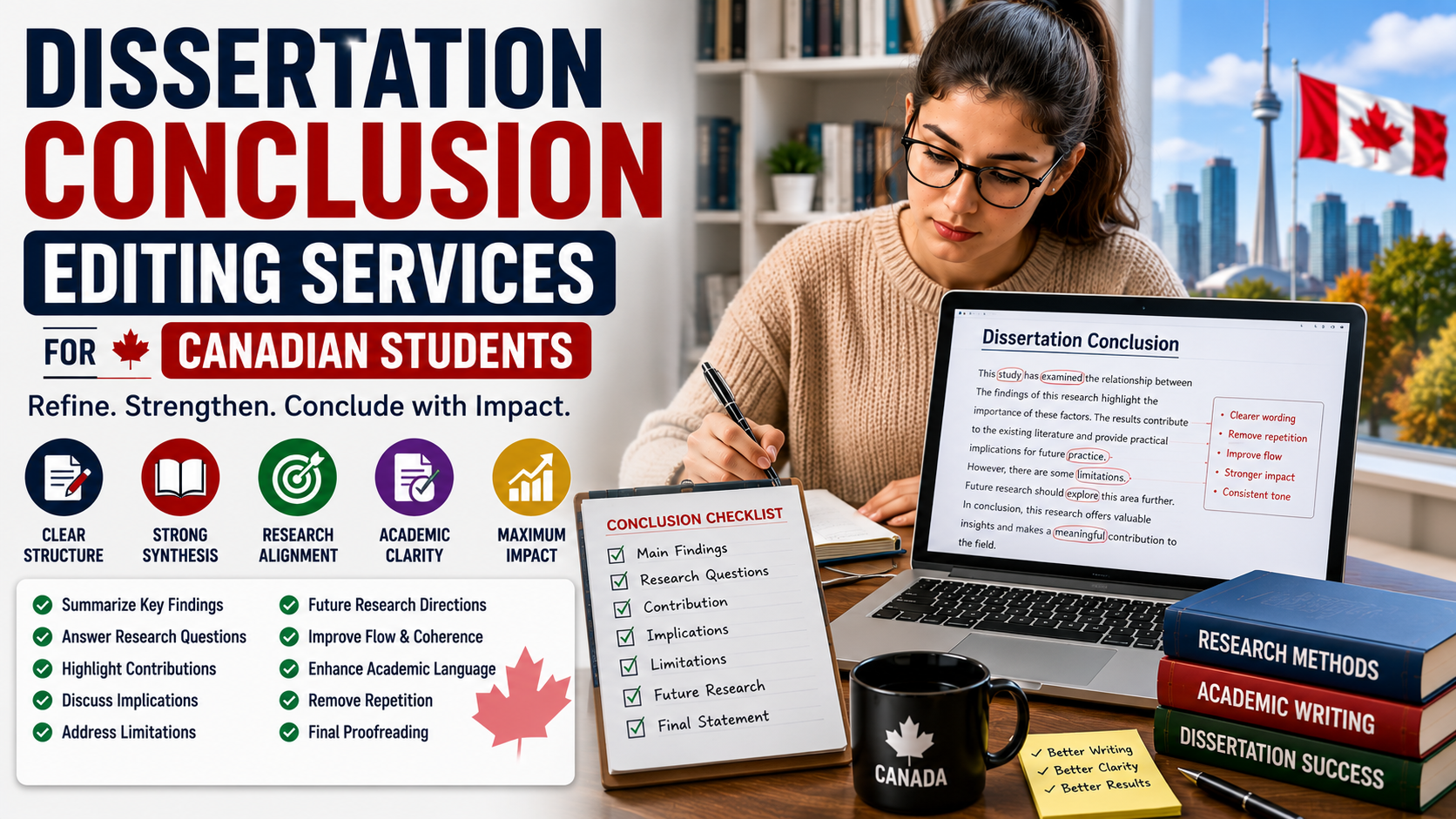
For Canadian Master's and PhD students, writing a strong dissertation conclusion can be challenging. After months of research, data collection, analysis and chapter revisions, it can be difficult to summarise the entire study without simply repeating earlier chapters.
Dissertation conclusion editing services for Canadian students can help improve the structure, clarity, academic language, coherence and overall presentation of a completed conclusion while keeping the student's original research contribution intact.
This guide explains what a dissertation conclusion should contain, common mistakes to avoid and what students should consider when choosing professional conclusion editing support in Canada.
What Is a Dissertation Conclusion?
A dissertation conclusion is the final substantive section that brings the research together.
It normally reminds the reader of the research purpose, summarises the most important findings, answers the research questions, highlights the study's contribution, acknowledges limitations where appropriate and identifies relevant directions for future research.
A strong conclusion answers a simple question:
What should the reader take away from this dissertation?
The conclusion should not introduce an entirely new argument or a new body of evidence.
What Should a Dissertation Conclusion Include?
There is no single structure used by every Canadian university or academic discipline. However, a dissertation conclusion commonly includes:
Restatement of the research purpose
Summary of major findings
Answers to research questions or objectives
Overall research contribution
Theoretical contribution where relevant
Practical implications where relevant
Key limitations
Recommendations for future research
Final concluding statement
The exact requirements should always be checked against your university, department and supervisor's instructions.
How Long Should a Dissertation Conclusion Be?
There is no universal Canadian word count for a dissertation conclusion.
Its length depends on factors such as:
Degree level
Overall dissertation length
Research methodology
Number of research questions
Discipline
Number of major findings
University requirements
Supervisor expectations
A conclusion should contain enough detail to synthesise the research without becoming a repetition of the entire dissertation.
A concise, well-integrated conclusion is generally more effective than a long chapter containing repeated information.
Dissertation Conclusion vs Dissertation Discussion
Students often confuse the conclusion with the discussion chapter.
They have different purposes.
Discussion Chapter | Conclusion Chapter |
|---|---|
Interprets findings | Synthesises the dissertation |
Compares findings with literature | Summarises the overall contribution |
Explores theoretical meaning | Provides final research takeaways |
Explains unexpected findings | Answers the research questions |
Develops detailed implications | Brings the research to a close |
Evaluates findings in depth | Gives the reader a final perspective |
In simple terms:
Discussion = What do the findings mean?
Conclusion = What does the dissertation ultimately establish?
How to Start a Dissertation Conclusion
The opening should immediately signal that the dissertation is being brought together.
A useful introduction can briefly:
Restate the research problem
Remind the reader of the research purpose
State the central conclusion
Introduce the organisation of the final chapter
For example:
This dissertation examined the relationship between X and Y among [population/context]. Drawing on [methodology], the study found that...
The wording should be adapted to the actual research rather than copied as a generic template.
Should You Repeat the Dissertation Introduction?
You should not copy your introduction into the conclusion.
However, returning to the original research problem is useful because it demonstrates that the dissertation has come full circle.
A good conclusion can briefly connect:
Original problem → Research approach → Findings → Contribution
This creates a strong sense of completion.
How to Summarise Dissertation Findings
The conclusion should focus on the findings that matter most.
Avoid copying paragraphs from the results or discussion chapters.
Instead, synthesise the major findings.
For example:
Overall, the findings indicate that X is associated with Y, while the qualitative evidence suggests that Z may influence this relationship.
The conclusion should give the reader a concise understanding of the study's overall outcome.
How to Answer Research Questions in the Conclusion
One of the most important functions of the conclusion is demonstrating that the research questions have actually been answered.
A useful approach is:
Research Question 1
State the overall answer.
Research Question 2
State the overall answer.
Research Question 3
State the overall answer.
You do not need to reproduce every statistic, quotation or analytical detail.
The conclusion should provide the synthesised answer, while the results and discussion chapters provide the detailed evidence and interpretation.
How to Explain the Contribution of a Dissertation
The conclusion should make the dissertation's contribution clear.
Depending on the research, the contribution could be:
Empirical Contribution
The study provides new evidence about a particular population, phenomenon or relationship.
Theoretical Contribution
The research supports, challenges or extends an existing theoretical perspective.
Practical Contribution
The findings provide useful implications for professionals, organisations or institutions.
Methodological Contribution
The study provides insight into a particular research method or analytical approach.
Contextual Contribution
The research provides evidence from a particular geographical, institutional or social context.
For a Master's dissertation, the contribution does not necessarily need to transform the entire field.
It should be appropriate to the scope and level of the research.
How to Write a Strong Dissertation Conclusion
A useful structure is:
Research Purpose → Major Findings → Research Questions → Contribution → Implications → Limitations → Future Research → Final Statement
Each section should contribute something meaningful.
The conclusion should feel like a synthesis rather than a list.
How to Discuss Limitations in the Conclusion
Some dissertations include limitations primarily in the discussion chapter, while others revisit them in the conclusion.
If limitations are included, focus only on the most significant ones.
Common examples include:
Limited sample size
Restricted geographical scope
Cross-sectional research design
Self-reported data
Sampling limitations
Measurement limitations
Limited access to participants
Time constraints
Researcher positionality
Do not introduce a completely new limitation at the end of the dissertation that has never been discussed.
Instead, briefly explain how the most important limitations affect the interpretation or scope of the research.
How to Write Future Research Recommendations
Future research recommendations should emerge naturally from your findings and limitations.
Weak recommendation:
More research should be conducted on this topic.
Stronger recommendation:
Future research could examine whether the relationship identified in this study remains consistent across a larger and more diverse sample of postgraduate students.
Useful recommendations may involve:
Larger samples
Different populations
Longitudinal studies
Comparative research
Different geographical settings
Alternative methodologies
Mixed-methods approaches
Different theoretical perspectives
Recommendations should be realistic and connected to the actual research.
Should You Introduce New Evidence in a Dissertation Conclusion?
Generally, the conclusion should not introduce major new evidence or findings.
The evidence supporting your conclusions should already have been presented and analysed earlier in the dissertation.
The conclusion should synthesise the research rather than create a new research argument.
If you discover an important new finding while writing the conclusion, consider whether it belongs in an earlier results or discussion section.
Common Dissertation Conclusion Mistakes
1. Repeating the Abstract
The conclusion should synthesise the entire research rather than simply reproduce the abstract.
2. Repeating the Results Chapter
Avoid copying statistical findings or long descriptions of results.
3. Introducing New Arguments
Major new arguments should not suddenly appear in the final chapter.
4. Ignoring Research Questions
A conclusion that does not clearly answer the research questions may feel incomplete.
5. Overstating the Contribution
Avoid claiming that a small study completely changes an academic field.
6. Making Unsupported Recommendations
Future research recommendations should follow from the study.
7. Using Excessive Detail
The conclusion should not become another lengthy discussion chapter.
8. Ending Without a Clear Takeaway
The reader should understand the central contribution of the dissertation by the end.
9. Using Informal Language
The conclusion should maintain the academic tone used throughout the dissertation.
10. Failing to Address Supervisor Feedback
If your supervisor has requested specific revisions to the conclusion, make sure these have been addressed before submission.
Dissertation Conclusion Editing vs Dissertation Writing
These services are not the same.
Dissertation Conclusion Editing
Editing generally works with a student's existing conclusion and may focus on:
Grammar
Academic language
Sentence structure
Clarity
Coherence
Paragraph organisation
Repetition
Logical flow
Transitions
Consistency
Referencing or formatting where requested
Dissertation Conclusion Writing
Writing involves producing substantial new content.
Students should understand their university's academic-integrity rules before using external writing assistance.
For many students, editing and proofreading an independently written conclusion is a more appropriate form of academic support.
What Can Dissertation Conclusion Editing Services Help With?
Professional editing support may be useful for students who already have a completed conclusion but want another review before submission.
Possible areas include:
Structure
Does the conclusion move logically from the research purpose to the final contribution?
Clarity
Can the reader understand the central conclusion without rereading earlier chapters?
Academic Tone
Is the writing appropriately formal and precise?
Coherence
Do individual paragraphs connect logically?
Repetition
Does the conclusion unnecessarily repeat earlier chapters?
Research Question Alignment
Does the conclusion clearly answer the original research questions?
Contribution
Is the significance of the study clearly communicated?
Language
Are grammar, punctuation, vocabulary and sentence structures appropriate?
Consistency
Are terminology, concepts and key claims consistent with the rest of the dissertation?
Dissertation Conclusion Editing for Canadian Master's Students
Master's dissertations often require students to demonstrate:
Knowledge of the research area
Appropriate research design
Critical engagement
Understanding of findings
Academic argumentation
A clear research contribution
The conclusion should therefore demonstrate that the research objectives have been achieved.
For Master's students, a strong conclusion does not need to make exaggerated claims.
Instead, it should clearly explain what the study found and what those findings contribute within its defined scope.
Dissertation Conclusion Editing for Canadian PhD Students
PhD dissertations generally require a more substantial demonstration of original contribution.
The conclusion may therefore need to articulate:
Original contribution to knowledge
Theoretical significance
Methodological contribution
Practical implications
Relationship to the wider research field
Limitations
Future research
The exact expectations vary considerably between disciplines and institutions.
PhD students should work closely with their supervisor and doctoral program requirements when finalising the conclusion.
Dissertation Conclusion Editing for International Students in Canada
International students may face additional challenges when writing an academic conclusion in English.
Common difficulties include:
Academic vocabulary
Concise synthesis
Critical writing
Hedging
Formal academic tone
Connecting paragraphs
Avoiding repetition
Expressing research contributions precisely
For example, there is an important difference between:
This research proves that X causes Y.
and:
The findings provide evidence of an association between X and Y.
The appropriate statement depends on the research design and strength of the evidence.
Professional editing can help improve language and clarity without changing the underlying research claims.
How to Choose Dissertation Conclusion Editing Services in Canada
If you are considering professional editing support, look beyond basic grammar correction.
1. Check Academic Editing Experience
Look for experience with Master's and PhD dissertations rather than only general proofreading.
2. Check Subject Knowledge
A conclusion in psychology may use different conventions from one in engineering, nursing, business or education.
3. Ask What Is Included
Clarify whether the service includes:
Structural editing
Academic language editing
Proofreading
Coherence review
Repetition checks
Supervisor-feedback implementation
Formatting checks
4. Protect Your Research
Dissertations can contain confidential participant information and unpublished research.
Ask how documents and research data are stored and protected.
5. Review Academic-Integrity Requirements
Your university may have specific policies regarding external academic assistance.
Always check those policies before using an editing service.
6. Avoid Guaranteed Outcomes
A legitimate editing provider cannot guarantee:
A particular grade
Dissertation approval
Supervisor approval
Publication
Successful defence
Editing can improve presentation, but academic outcomes depend on many factors.
Questions to Ask Before Ordering Dissertation Conclusion Editing
Before choosing a service, consider asking:
Do you edit Master's and PhD dissertations?
Do you provide structural as well as language editing?
Can you review the conclusion against the research questions?
Can you identify unnecessary repetition?
Can you check the clarity of the research contribution?
Can you review supervisor-requested revisions?
Do you edit quantitative and qualitative dissertations?
Can you check academic tone and coherence?
How is confidential research information handled?
What academic-integrity policies should students consider?
Does the service provide proofreading after editing?
Is there a clear revision process?
Dissertation Conclusion Editing Checklist
Before submitting your final chapter, check:
The research purpose is clearly revisited.
The main findings are concisely synthesised.
The research questions are clearly answered.
The conclusion aligns with the results and discussion.
The main contribution is clearly stated.
The contribution is proportional to the research scope.
Important theoretical implications are addressed where relevant.
Practical implications are included where appropriate.
Major limitations are acknowledged where required.
Future research recommendations follow from the study.
No major new findings have been introduced.
No unsupported claims have been added.
Repetition has been removed.
The conclusion does not simply reproduce the abstract.
Academic language is clear and precise.
Terminology is consistent throughout.
Supervisor feedback has been addressed.
Formatting follows university requirements.
Grammar and punctuation have been checked.
The final paragraph provides a clear closing statement.
Final Takeaway
A dissertation conclusion should leave the reader with a clear understanding of the research and its contribution.
The strongest conclusions do not simply repeat previous chapters. They bring the dissertation together by connecting:
Research Purpose → Major Findings → Research Questions → Contribution → Implications → Limitations → Future Research
For Canadian Master's and PhD students, the precise requirements vary between universities, departments and disciplines. Always follow your institution's dissertation guidelines and supervisor feedback.
If you choose professional dissertation conclusion editing services, prioritise support that improves clarity, academic language, structure, coherence, research-question alignment and presentation without fabricating findings, changing the researcher's conclusions or compromising academic integrity.
Frequently Asked Questions
Everything you need to know about our services
Related Posts

Best Dissertation Editing Services for Canadian Universities

Dissertation Editing vs Dissertation Writing: Which Canadian Students Need?
