Dissertation Editing vs Dissertation Writing: Which Canadian Students Need?
Introduction
Choosing between dissertation editing and dissertation writing help can be confusing for Canadian university students.
You may already have a complete dissertation but feel that the writing is unclear. Perhaps your supervisor has requested revisions, your methodology needs explanation, your literature review feels weak, or your deadline is approaching quickly.
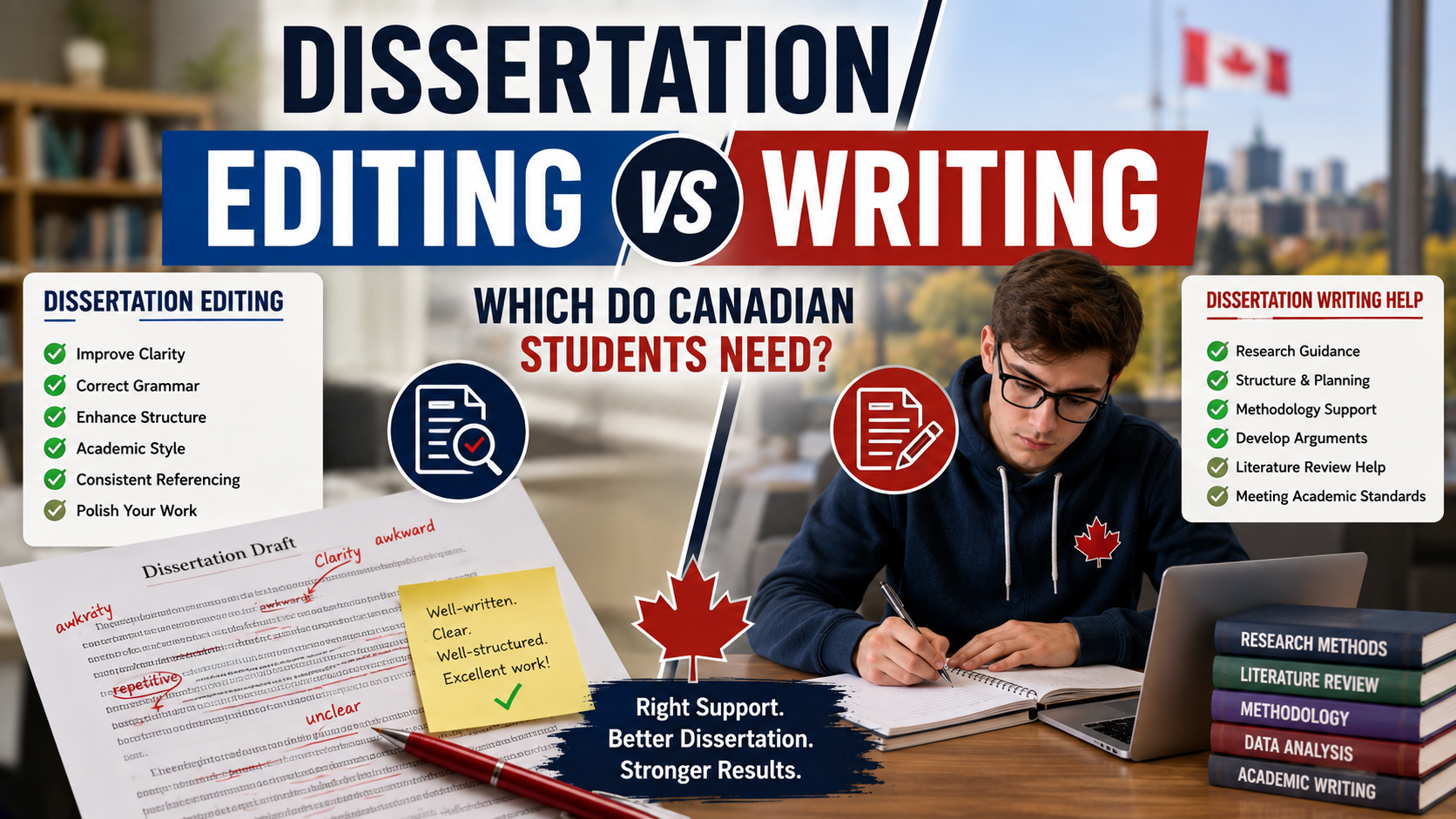
Alternatively, you may still be at the planning stage and need support understanding how to structure a dissertation, develop your research approach or organise your ideas.
These situations require different types of support.
The biggest mistake is assuming that every dissertation problem requires a dissertation writing service.
Sometimes, what you actually need is editing, proofreading or structural feedback. In other cases, you may need legitimate academic guidance to understand how to improve your research.
This guide explains the difference between dissertation editing and dissertation writing, what Canadian students should consider before choosing either type of support, and how to select assistance that respects university academic-integrity requirements.
What Is Dissertation Editing?
Dissertation editing involves improving an existing piece of academic work without replacing the student's original research and intellectual contribution.
Depending on the service, editing may address:
Academic language
Grammar
Sentence structure
Clarity
Coherence
Paragraph organisation
Logical flow
Repetition
Academic tone
Transitions
Referencing consistency
Formatting
For example, you may have written:
“The results are showing that many students have problems with online learning and this could be because there are many different factors that influence their experience.”
An editor may help improve the clarity and academic presentation of the sentence while preserving the underlying meaning.
The purpose is to make your work easier to understand and more professionally presented.
What Is Dissertation Writing Help?
The phrase “dissertation writing help” can mean different things.
Some legitimate academic-support services may help students understand:
How to structure a dissertation
How to develop a research question
How to organise a literature review
How to understand methodology
How to interpret supervisor feedback
How to improve academic arguments
How to plan chapters
How to improve writing skills
However, there is an important distinction between academic guidance and having someone produce assessed work for submission on your behalf.
Canadian students should always check their university's academic-integrity policies before using external dissertation assistance.
A service that promises to secretly write your entire assessed dissertation for you, fabricate research or guarantee a grade creates serious academic-integrity risks.
Dissertation Editing vs Dissertation Writing: The Main Difference
The simplest distinction is:
Editing improves your existing academic work. Writing assistance helps you develop or understand the work, but should not replace your responsibility for assessed academic content.
Consider the following comparison.
Dissertation Editing | Dissertation Writing Support |
|---|---|
Improves existing text | May provide academic guidance |
Corrects language problems | Can help with planning |
Improves clarity | Can explain academic concepts |
Improves coherence | Can help understand feedback |
Checks structure | Can provide writing guidance |
Checks referencing consistency | Can help organise ideas |
Improves presentation | Should not replace your intellectual contribution |
Student remains author | Student remains responsible for submitted work |
The exact scope varies between providers.
When Should a Canadian Student Choose Dissertation Editing?
Editing is usually more appropriate when you have already completed substantial research and writing.
You may benefit from editing if:
Your Dissertation Is Complete but Difficult to Read
Perhaps your research is strong but your writing is:
Repetitive
Unclear
Overly complicated
Grammatically inconsistent
Poorly structured
An editor can focus on improving the presentation of your existing work.
English Is Affecting Your Academic Writing
International students studying in Canada may have strong research ideas but struggle to communicate them clearly in academic English.
Editing can help identify:
Awkward phrasing
Grammar mistakes
Word-choice problems
Sentence-level ambiguity
Inconsistent terminology
The goal is to make your own ideas clearer rather than replacing them.
Your Supervisor Says Your Writing Needs Improvement
If feedback includes comments such as:
“Improve clarity”
“Strengthen academic expression”
“Improve paragraph flow”
“Reduce repetition”
“Improve coherence”
editing may be relevant.
However, if your supervisor says your methodology is inappropriate, editing alone will not solve the problem.
When Is Dissertation Proofreading Enough?
Sometimes students do not need comprehensive editing.
They may simply need a final proofreading review.
Proofreading typically focuses on surface-level errors such as:
Spelling
Grammar
Punctuation
Typographical mistakes
Formatting inconsistencies
Citation presentation
Headings
Page numbers
Tables and figures
Proofreading is most useful when your dissertation is already academically sound and you are preparing the final version.
A useful sequence is:
Research → Revision → Editing → Proofreading → Final Submission
When Might You Need Structural Editing?
Structural editing sits between basic proofreading and substantive academic revision.
You may need structural feedback if your dissertation contains good research but the organisation is difficult to follow.
Potential issues include:
Chapters don't connect logically
Arguments appear in the wrong sections
Repetition across chapters
Weak transitions
Literature review lacks thematic organisation
Discussion does not clearly connect to findings
Conclusion does not clearly answer the research question
A structural review can help identify these problems.
When Do You Need Academic Revision Rather Than Editing?
This is an important distinction.
Suppose your supervisor says:
“Your literature review requires greater critical synthesis.”
That is more than a grammar problem.
Or:
“The methodology does not adequately address the research question.”
That is a substantive research issue.
Or:
“Your discussion repeats the findings without interpreting them.”
That requires analytical improvement.
In these situations, you need to understand and address the academic feedback, not simply hire someone to rewrite sentences.
What Does a Dissertation Editor Usually Check?
A professional editing review may examine several levels of writing.
Sentence Level
Grammar
Spelling
Punctuation
Sentence clarity
Word choice
Paragraph Level
Topic sentences
Evidence
Explanation
Logical progression
Transitions
Chapter Level
Organisation
Flow
Repetition
Connections between sections
Dissertation Level
Consistency
Terminology
Structure
Referencing
Presentation
The exact scope should be agreed before work begins.
What Does Dissertation Writing Support Usually Involve?
Legitimate academic guidance can involve helping you understand how to approach a dissertation.
For example, a student might need help understanding how to structure a literature review.
A support provider could explain:
Identify major themes.
Group relevant research.
Compare findings.
Evaluate limitations.
Identify gaps.
Connect the gap to your research question.
The student then applies that approach to their own research.
Similarly, academic guidance may help you understand supervisor feedback and convert it into a revision plan.
What Canadian Students Should Avoid
The dissertation-support market includes services with very different standards.
Be cautious of providers promising:
Guaranteed Grades
No legitimate provider can guarantee that a university will award a particular grade.
Guaranteed Passes
A dissertation's outcome depends on academic assessment.
Fake Research
Never use fabricated:
Participants
Survey responses
Interviews
Data
Results
Fake References
Never use invented academic sources.
Plagiarised Content
Submitting someone else's work as your own can create serious academic consequences.
Complete Ghostwritten Dissertations
Having another person produce assessed academic work for submission under your name may conflict with your institution's academic-integrity requirements.
Impersonation
Never allow someone else to participate in academic assessments or communications while pretending to be you.
How Canadian University Students Can Decide What They Need
Ask yourself five questions.
Question 1: Have I Already Written the Dissertation?
If yes, editing or proofreading may be appropriate.
If no, you may need planning or academic guidance rather than editing.
Question 2: Is My Problem Academic or Linguistic?
Linguistic problem
Your research is sound but the writing is difficult to understand.
Potential solution: Editing or proofreading.
Academic problem
Your methodology, analysis or argument is weak.
Potential solution: Discuss the issue with your supervisor and undertake substantive academic revisions.
Question 3: What Did My Supervisor Say?
Supervisor feedback provides valuable clues.
Feedback such as:
“Improve grammar.”
Consider proofreading or editing.
Feedback such as:
“Improve logical flow.”
Consider structural editing.
Feedback such as:
“Strengthen critical analysis.”
You need substantive academic revision.
Feedback such as:
“Your methodology needs to be reconsidered.”
Discuss the methodology with your supervisor before making major changes.
Question 4: What Stage Are You At?
Your needs change throughout the dissertation process.
Early Stage
You may need:
Topic development
Research-question guidance
Proposal feedback
Literature-search guidance
Methodology planning
Middle Stage
You may need:
Chapter feedback
Data-analysis guidance
Structure review
Academic writing support
Final Stage
You may need:
Academic editing
Proofreading
Referencing review
Formatting review
Final quality check
Question 5: What Does Your University Allow?
This should always be part of your decision.
Check your university's:
Academic-integrity policy
Dissertation handbook
Graduate-school regulations
Assessment rules
AI-use policy
External editing guidelines
Policies differ between institutions and programs.
If you are uncertain whether a particular type of assistance is allowed, ask your department or graduate program before using it.
Dissertation Editing for International Students in Canada
International students may face additional writing challenges.
For example, you may understand your research extremely well but struggle with:
Canadian academic writing conventions
Sentence structure
Academic vocabulary
Referencing requirements
Concise writing
Critical analysis
Thesis-style argumentation
Editing can help improve the presentation of your existing ideas.
However, editing should not change your research conclusions or invent arguments that you did not develop yourself.
What About Master's Students?
Master's dissertations often require students to demonstrate:
Independent research
Understanding of relevant literature
Appropriate methodology
Critical thinking
Analysis
Academic argument
Clear conclusions
If your problem is writing quality, editing may be appropriate.
If your research design or analysis is weak, you need to address those issues academically.
A polished dissertation with a fundamentally weak research design is still a weak dissertation.
What About PhD Students?
PhD-level research involves an even greater emphasis on:
Original contribution
Research methodology
Theoretical contribution
Advanced analysis
Scholarly argument
Research significance
Editing can improve the presentation of a PhD thesis, but it cannot substitute for the candidate's original research contribution.
For complex methodological or theoretical issues, academic supervision remains essential.
Can Dissertation Editing Improve Your Grade?
Editing can potentially improve readability and presentation, but no editing service can guarantee a higher grade.
A dissertation grade depends on many factors, including:
Research quality
Methodology
Analysis
Critical thinking
Literature engagement
Originality or contribution
Structure
Academic writing
Assessment criteria
Editing addresses only some of these elements.
How Much Dissertation Editing Do You Need?
Not every dissertation requires the same level of support.
Basic Proofreading
Best when:
Dissertation is already strong
Only surface errors remain
Deadline is close
Academic Copyediting
Best when:
Writing needs substantial language improvement
Sentences are unclear
Academic tone is inconsistent
Structural Editing
Best when:
Chapters lack flow
Arguments are poorly organised
Sections are repetitive
Comprehensive Dissertation Review
Best when:
Supervisor has provided extensive feedback
Several chapters require improvement
You want a broad quality assessment
Before purchasing a service, ask exactly what is included.
A Simple Decision Tree
Use this quick decision process.
Have you written most of your dissertation?
No → Consider academic planning and guidance.
Yes → Continue.
Is the research academically sound?
No / Unsure → Discuss research problems with your supervisor.
Yes → Continue.
Is the main problem structure and argument flow?
Yes → Consider structural or academic editing.
No → Continue.
Is the main problem grammar and clarity?
Yes → Consider academic editing.
No → Continue.
Are only small errors remaining?
Yes → Proofreading may be enough.
This approach helps prevent students from paying for a service that does not actually address their problem.
How to Choose a Dissertation Editing Service in Canada
If you decide to use professional editing and your university permits it, look for a provider that offers:
Clear Scope
You should know whether the service covers:
Grammar
Academic style
Structure
Referencing
Formatting
Coherence
Transparent Pricing
Understand whether pricing is based on:
Word count
Page count
Service level
Turnaround time
Appropriate Expertise
If your dissertation involves:
Statistics
Qualitative research
Engineering
Nursing
Business
Psychology
Law
Computer science
choose support appropriate to the writing problem and your academic discipline.
Confidentiality
Understand how your dissertation and personal information will be handled.
Academic-Integrity Awareness
A responsible provider should not encourage students to submit work they did not create or claim authorship over.
How to Prepare Your Dissertation for Editing
You can make the editing process more useful by preparing your document first.
Provide:
Latest dissertation version
Supervisor feedback
University formatting guidelines
Referencing style
Specific areas of concern
Submission deadline
Required scope of editing
You can also identify sections where you already know you need help.
For example:
“Please focus on academic clarity and paragraph flow in Chapters 2 and 5.”
This is more useful than simply asking someone to “make my dissertation better.”
What Should You Do Before Paying for Professional Help?
Use this checklist.
Step 1
Read your supervisor's feedback.
Step 2
Identify the exact problem.
Step 3
Check your university's policy.
Step 4
Decide whether you need:
Guidance → Editing → Structural Review → Proofreading
Step 5
Compare service scopes.
Step 6
Ask questions before purchasing.
Step 7
Keep responsibility for your own academic work.
Final Takeaway: Editing or Writing Help?
The decision becomes much easier when you identify the actual problem.
Need help improving existing writing? → Dissertation editing.
Need to remove grammar and formatting errors? → Proofreading.
Need help with chapter organisation? → Structural editing.
Need to understand supervisor feedback? → Academic guidance.
Need to fix a methodology or research problem? → Discuss it with your supervisor and undertake substantive revisions.
Need someone to secretly produce your assessed dissertation? → Do not take that route; check your university's academic-integrity requirements.
For Canadian university students, the safest approach is to choose support based on the specific academic problem, not simply the phrase “dissertation help.”
Your dissertation remains your research.
Your analysis remains your responsibility.
Your academic contribution remains your own.
Professional editing is most valuable when it helps you communicate that work more clearly, accurately and effectively while keeping you responsible for the scholarship behind it.
Frequently Asked Questions
Everything you need to know about our services
Related Posts

Dissertation Editing Services for NUS Master's Students

Dissertation Proofreading Before Submission in Singapore
