Coursework Editing Guide: How to Improve Your University Coursework
Introduction
Completing the first draft of your coursework is only part of the academic writing process. The highest-scoring assignments are rarely perfect on the first attempt. Careful editing helps improve clarity, strengthen arguments, eliminate errors, and ensure your work meets university assessment criteria.
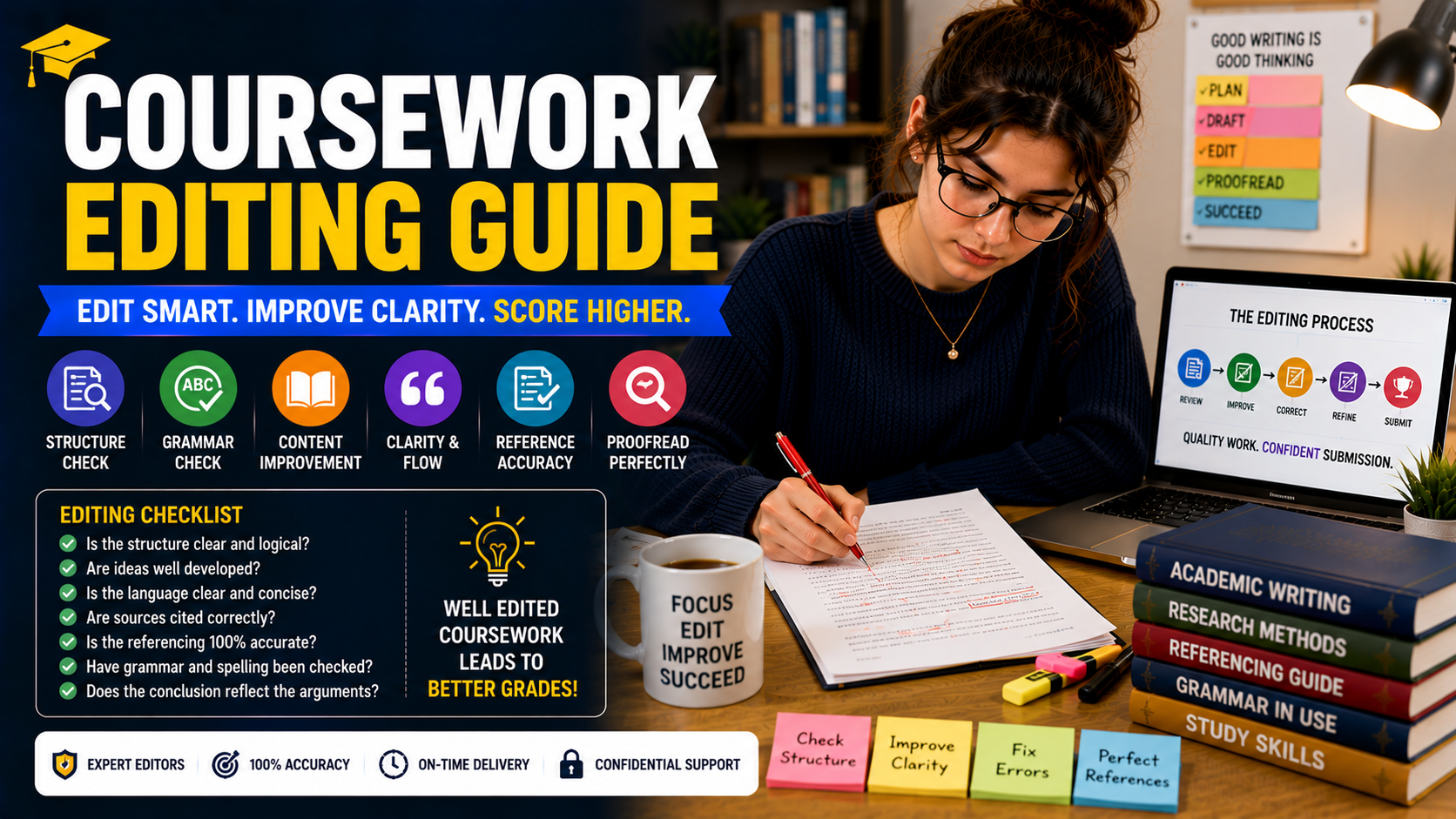
Many students underestimate the importance of editing, focusing only on finishing before the deadline. However, reviewing your coursework critically can significantly improve its overall quality and help you communicate your ideas more effectively.
This Coursework Editing Guide explains how to edit coursework step by step, what to check before submission, common mistakes to avoid, and how ethical academic support can help you improve your writing while maintaining academic integrity.
What Is Coursework Editing?
Coursework editing is the process of reviewing and improving your assignment after completing the first draft.
Editing goes beyond correcting spelling mistakes. It involves improving:
Structure
Clarity
Logical flow
Academic tone
Grammar
Referencing
Evidence
Consistency
The goal is to make your coursework easier to read, more persuasive, and academically stronger.
Why Is Editing Important?
Editing helps you:
Improve readability
Strengthen academic arguments
Remove repetition
Correct grammar mistakes
Ensure logical organisation
Improve referencing accuracy
Meet marking criteria
Increase overall presentation quality
Even well-researched coursework can lose marks because of poor editing.
Step 1: Take a Short Break
Before editing, leave your coursework aside for several hours—or ideally a day.
Returning with fresh eyes makes it easier to spot:
Awkward sentences
Missing information
Repetition
Typographical errors
A short break often improves your ability to evaluate your own writing objectively.
Step 2: Review the Assignment Brief
Before making changes, revisit:
Assignment instructions
Word count
Learning outcomes
Marking rubric
Referencing requirements
Ask yourself:
Have I answered every part of the question?
Have I met the assessment objectives?
Does my coursework stay focused on the topic?
Step 3: Check the Structure
Your coursework should follow a logical progression.
Typical sections include:
Introduction
Main discussion
Critical analysis
Conclusion
References
Ensure each section contributes to your overall argument and flows naturally into the next.
Step 4: Improve Paragraphs
Each paragraph should contain:
A clear topic sentence
Supporting evidence
Critical analysis
A link back to the main argument
Avoid paragraphs that are too short or excessively long.
Step 5: Strengthen Academic Writing
Look for opportunities to improve:
Clarity
Precision
Formal language
Sentence variety
Conciseness
Replace vague expressions with specific academic language.
For example:
Instead of:
Many people think...
Write:
Several studies suggest...
Evidence-based writing is more persuasive than unsupported generalisations.
Step 6: Evaluate Your Evidence
Review every claim and ask:
Is it supported by credible research?
Is the evidence current?
Have I cited the source correctly?
Could stronger evidence improve this section?
Use peer-reviewed journals, academic books, government publications, and professional organisations whenever possible.
Step 7: Check Referencing
Incorrect referencing can lead to lost marks or plagiarism concerns.
Verify:
In-text citations
Reference list formatting
Author names
Publication years
Page numbers (where required)
Consistency with your required citation style
Common referencing styles include:
Harvard
APA
MLA
OSCOLA
Chicago
IEEE
Step 8: Proofread Carefully
Proofreading focuses on technical accuracy.
Check for:
Spelling mistakes
Grammar errors
Punctuation
Typographical errors
Formatting inconsistencies
Capitalisation
Number formatting
Reading your coursework aloud often helps identify awkward wording.
Common Coursework Editing Mistakes
Students often:
Edit while writing
Skip proofreading
Ignore feedback from previous assignments
Overuse passive voice
Leave unsupported claims
Forget to update references after revisions
Depend solely on spelling checkers
A systematic editing process produces stronger results.
Can AI Help with Coursework Editing?
AI tools can assist with:
Grammar suggestions
Sentence clarity
Readability improvements
Identifying repetition
Formatting assistance
However, students should:
Review every AI suggestion carefully.
Verify factual accuracy.
Maintain their own writing style.
Check citations independently.
Follow university AI policies.
AI should support editing—not replace critical review.
How Coursework Editing Support Can Help
Ethical editing services may assist with:
Grammar correction
Academic language improvement
Structural feedback
Readability enhancement
Referencing checks
Formatting review
Proofreading
Constructive feedback
The aim is to improve your coursework while ensuring you remain the original author.
Why Choose AssignmentCart?
AssignmentCart provides ethical academic support through:
Coursework editing guidance
Academic proofreading
Referencing review
Grammar improvement
Structural feedback
Formatting assistance
Confidential communication
Our goal is to help students submit clearer, more organised, and academically polished coursework while maintaining originality and academic integrity.
Final Thoughts
Editing is an essential stage of coursework preparation. Careful revision improves organisation, strengthens arguments, enhances readability, and reduces avoidable errors that can affect grades. By reviewing your coursework systematically and allowing sufficient time for proofreading, you can submit assignments with greater confidence.
Ethical coursework editing support—including grammar review, proofreading, referencing checks, structural feedback, and readability improvements—can help you present your ideas more effectively while ensuring your work remains original, authentic, and aligned with university academic integrity standards.
Frequently Asked Questions
Everything you need to know about our services
Related Posts

Essay Editing Services: A Complete Guide for University Students

Dissertation Editing Services: Improve Your Dissertation Before Submission
