Best Editing Services for Master's Dissertations
Introduction
Completing a master's dissertation can take months of research, reading, analysis and writing.
By the time the final draft is finished, many students face one more challenge:
How do I know my dissertation is actually ready for submission?
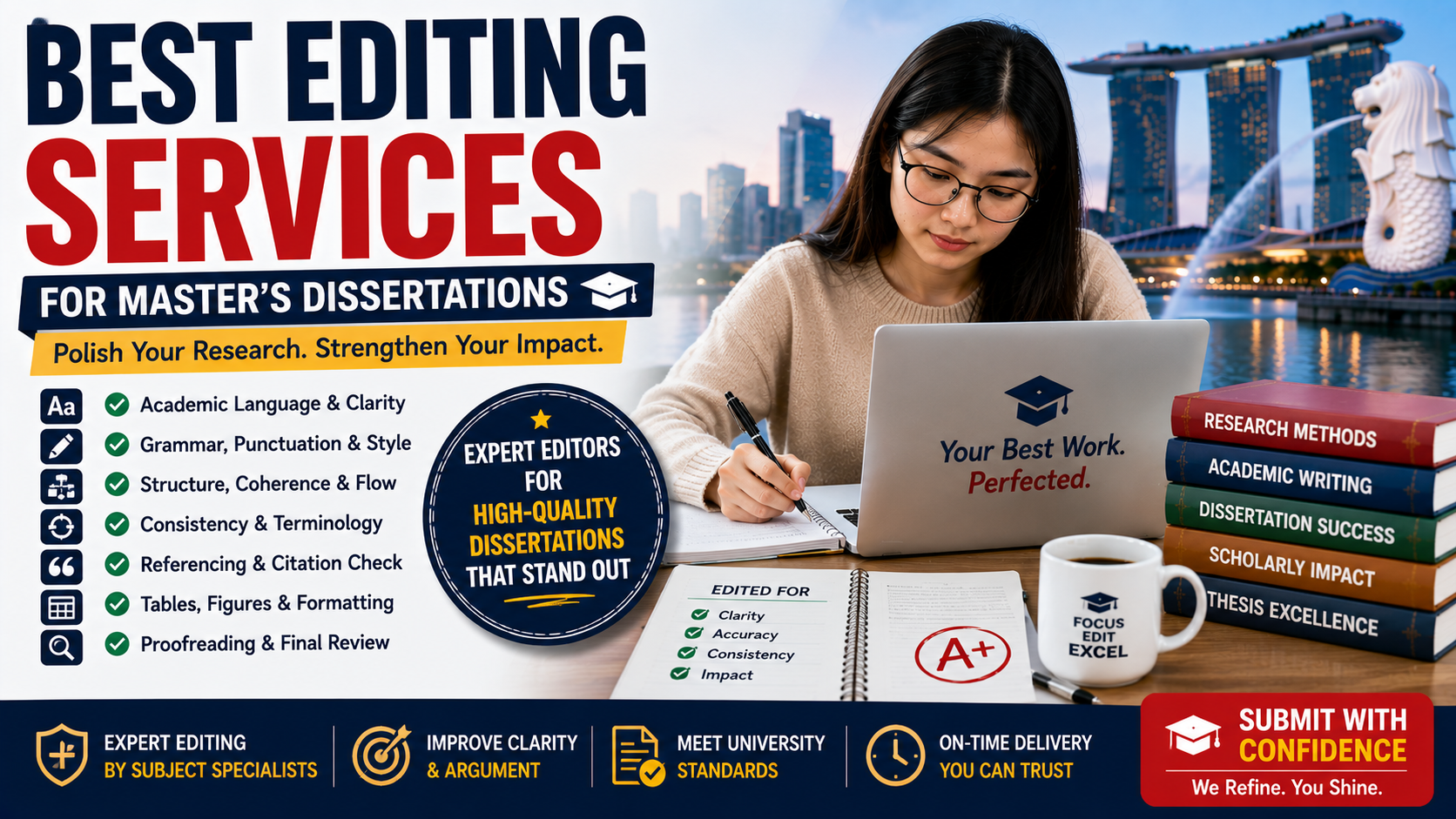
A dissertation may contain strong research but still need improvements in academic language, structure, clarity, consistency, referencing and presentation.
This is where professional master's dissertation editing services can be useful.
The right editing service should not simply "rewrite" your dissertation. It should help improve the quality and presentation of your existing academic work while respecting your university's academic-integrity requirements.
For master's students in Singapore and other international study destinations, choosing the right editor can make the final review process considerably easier.
What Is Master's Dissertation Editing?
Dissertation editing is a detailed review of an existing dissertation to improve its:
Clarity
Academic language
Structure
Logical flow
Grammar
Sentence construction
Consistency
Referencing presentation
Overall readability
Editing can be particularly valuable after you have completed the main research and writing.
An editor can identify issues that are difficult to notice when you have been working on the same document for weeks or months.
Editing vs Proofreading: What's the Difference?
Students often use these terms interchangeably, but they are not exactly the same.
Dissertation Proofreading
Proofreading generally focuses on surface-level errors such as:
Spelling
Grammar
Punctuation
Typographical mistakes
Formatting inconsistencies
Incorrect capitalisation
Dissertation Editing
Editing can go deeper and examine:
Paragraph structure
Argument clarity
Academic tone
Logical progression
Repetition
Transitions
Sentence construction
Consistency of terminology
Overall readability
A master's dissertation may require both.
A final proofreading pass is especially useful after substantive editing has been completed.
Why Do Master's Students Use Dissertation Editing Services?
Writing a dissertation is mentally demanding.
You may have spent months:
Reviewing literature
Developing a methodology
Collecting data
Conducting analysis
Writing chapters
Responding to supervisor feedback
After repeatedly reading your own work, it becomes easy to overlook obvious problems.
Professional editing provides another perspective.
An editor can help identify issues such as:
"This paragraph is difficult to follow."
"This term is used inconsistently."
"This claim needs clearer support."
"This section repeats an argument made earlier."
"The transition between these two sections is weak."
The goal is not to change your research into someone else's work.
The goal is to help your own ideas communicate more clearly.
What Should the Best Dissertation Editing Service Include?
Not every editing service offers the same level of support.
Before choosing one, check exactly what is included.
1. Academic Language Editing
Master's dissertations require an appropriate academic tone.
An editor can help identify:
Informal expressions
Ambiguous sentences
Unnecessarily complicated wording
Repetitive language
Weak transitions
Grammar problems
The objective should be clear academic communication rather than making the writing unnecessarily complicated.
2. Grammar and Sentence-Level Editing
A dissertation can contain hundreds of sentences.
Even strong writers may make mistakes when working under deadline pressure.
Common problems include:
Subject-verb agreement
Incorrect tense
Missing articles
Comma errors
Run-on sentences
Sentence fragments
Incorrect prepositions
Inconsistent terminology
A professional editing review can identify these issues throughout the document.
3. Structure and Organisation
A dissertation should have a logical structure.
A typical master's dissertation may contain:
Introduction
Literature Review
Methodology
Results or Findings
Discussion
Conclusion
References
Appendices
The exact structure depends on the discipline and university.
Editing can help identify whether the sections connect logically.
For example:
Research Problem → Research Questions → Literature Gap → Methodology → Findings → Discussion → Conclusion
If these relationships are unclear, the dissertation may feel fragmented even when each individual chapter contains good material.
4. Literature Review Editing
The literature review is often one of the most demanding sections of a master's dissertation.
An editor can help improve:
Paragraph organisation
Thematic structure
Transitions
Repetition
Academic language
Comparison between studies
Clarity of research gaps
However, editing should not involve inventing literature or creating unsupported claims.
The student remains responsible for the sources and academic argument.
5. Methodology Editing
The methodology chapter needs to explain how the research was conducted.
Depending on the project, it may discuss:
Research philosophy
Research approach
Research design
Sampling
Data collection
Data analysis
Ethical considerations
Reliability and validity
Editing can improve the clarity and consistency of the explanation.
It should not fabricate:
Participants
Data
Ethics approval
Research procedures
Statistical analyses
6. Results and Findings Editing
Results chapters need to communicate findings clearly.
Editing support can help with:
Table introductions
Figure descriptions
Statistical terminology
Paragraph structure
Consistency
Transitions
For quantitative dissertations, the editor should not invent or alter statistical results.
For qualitative dissertations, participant quotations and research findings should remain authentic.
7. Discussion Chapter Editing
The discussion chapter often requires careful academic reasoning.
It may need to connect:
Findings → Previous Research → Research Questions → Theory → Implications
Editing can help make those relationships clearer.
An editor can identify places where the discussion:
Repeats the results
Introduces unsupported claims
Moves away from the research question
Uses inconsistent terminology
Needs clearer transitions
8. Conclusion Editing
The conclusion should bring the dissertation together.
A strong conclusion typically addresses the research objectives and explains the overall contribution of the study.
Editing can help check whether the conclusion:
Reflects the findings
Answers the research questions
Avoids introducing completely new arguments
Clearly communicates implications
Includes appropriate limitations
Provides relevant recommendations where required
9. Referencing and Citation Consistency
A dissertation may contain hundreds of citations.
Small inconsistencies can easily appear.
An editing service may check the presentation of:
Author names
Publication years
In-text citations
Reference entries
Capitalisation
Italics
Hanging indentation
DOI or URL presentation
The required referencing style should always be based on the university or programme requirements.
Common styles include:
APA 7
Harvard
IEEE
Vancouver
Chicago
MLA
OSCOLA
10. Table and Figure Editing
Tables and figures should be easy to understand and consistently presented.
Editing and formatting support can identify:
Missing captions
Inconsistent numbering
Poor placement
Unclear references
Formatting inconsistencies
Tables extending beyond margins
For example:
Table 4.1: Regression Analysis Results
should be referenced consistently in the main text.
11. Dissertation Formatting
Editing and formatting are separate services, but many students benefit from both.
Formatting may include:
Margins
Fonts
Headings
Page numbers
Table of contents
Lists of tables
Lists of figures
Chapter breaks
Appendices
Headers and footers
If your university provides a dissertation template, provide it to the editor or formatter.
12. Supervisor Feedback Integration
Many master's students seek editing support after receiving supervisor comments.
This can be particularly useful when feedback includes comments such as:
"Improve clarity."
"Strengthen the argument."
"Reorganise this section."
"More critical analysis is needed."
"Clarify your methodology."
"Improve academic language."
"Explain this finding further."
An editor can help you work through the presentation and language aspects of these comments.
However, the academic decisions and substantive revisions should remain your responsibility.
13. Dissertation Chapter Editing
You do not necessarily need to edit the entire dissertation at once.
Some students request help with individual chapters.
For example:
Literature review editing
Methodology editing
Results editing
Discussion editing
Conclusion editing
Chapter-by-chapter editing can be useful when a supervisor has identified problems in a specific section.
14. Academic Tone
Master's-level writing should generally be:
Formal
Precise
Evidence-based
Clear
Objective where appropriate
Editing can help remove unnecessarily conversational language.
For example:
Less suitable:
"A lot of people think social media is really bad for students."
More academic:
"Previous research has identified several potential negative effects of social-media use among university students."
The second sentence communicates the idea more precisely and provides a clearer basis for evidence.
15. Improving Conciseness
Long sentences do not automatically make writing more academic.
Sometimes a dissertation becomes difficult to read because the same idea is expressed repeatedly.
An editor can identify:
Repetition
Unnecessary phrases
Overly long sentences
Redundant explanations
Excessive passive constructions
The objective is to make the writing more precise without changing the student's intended meaning.
16. Improving Academic Coherence
A dissertation should not feel like a collection of independent paragraphs.
Each section should connect to the next.
For example:
Problem
↓
Research Gap
↓
Research Objective
↓
Research Questions
↓
Methodology
↓
Findings
↓
Discussion
↓
Conclusion
Editing can help identify gaps in these connections.
17. Choosing an Editor for a Singapore Master's Dissertation
Students studying in Singapore should look beyond generic promises such as "100% perfect dissertation."
Instead, evaluate the service based on practical factors.
Look for:
Relevant academic experience
Does the editor understand postgraduate academic writing?
Subject familiarity
Does the editor have experience with your discipline?
Clear scope
Does the service explain what will actually be edited?
University requirements
Can the editor work from your programme's guidelines?
Confidentiality
Are appropriate measures in place to protect your document?
Transparent pricing
Is the price explained clearly?
Realistic turnaround
Can the provider meet your deadline without compromising the quality of the review?
Best Editing Services for Different Master's Subjects
Different disciplines can require different editing approaches.
MBA and Business
Business dissertations may require attention to:
Case-study analysis
Business terminology
Strategic frameworks
Market analysis
Recommendations
Data interpretation
Nursing and Healthcare
Healthcare dissertations may require careful attention to:
Clinical terminology
Evidence-based writing
Research methodology
Ethical considerations
Referencing
Patient confidentiality
Engineering
Engineering dissertations may contain:
Technical terminology
Mathematical expressions
Experimental results
Figures
Technical tables
Methodology descriptions
Computer Science
Computer Science dissertations may require attention to:
Technical explanations
Algorithms
System architecture
Experimental methodology
Results
Code references
Psychology
Psychology dissertations may require careful presentation of:
Psychological terminology
Research methodology
Statistical results
Theoretical frameworks
Ethical considerations
Social Sciences
Social-science dissertations often require strong attention to:
Theoretical frameworks
Literature synthesis
Qualitative or quantitative methodology
Critical discussion
Research implications
How Much Do Master's Dissertation Editing Services Cost?
There is no single standard price.
Cost can depend on:
Word count
Subject
Editing depth
Dissertation complexity
Number of tables and figures
Referencing requirements
Turnaround time
Number of chapters
Formatting requirements
For example, proofreading a 10,000-word dissertation is a very different task from performing a detailed academic edit of a 30,000-word thesis containing multiple statistical tables.
A reputable provider should clarify the scope before giving a final quotation.
How Long Does Dissertation Editing Take?
Turnaround depends on:
Word count
Editing level
Subject complexity
Deadline
Number of revisions
Formatting requirements
If your deadline is approaching, tell the editor the exact submission date.
Avoid waiting until the final few hours if your dissertation requires a substantial review.
What Should You Send to a Dissertation Editor?
To receive a useful quotation, provide:
1. Your latest dissertation draft
Send the most complete version available.
2. University guidelines
Include official formatting or submission requirements.
3. Supervisor feedback
If your supervisor has provided comments, include them where relevant.
4. Referencing style
Specify whether you need APA, Harvard, IEEE or another style.
5. Deadline
State your exact submission date and time if relevant.
6. Specific concerns
For example:
"Please focus on academic language and clarity."
or:
"My supervisor asked me to improve the discussion chapter."
This allows the editor to understand what you actually need.
What a Good Dissertation Editing Report Should Show
If tracked changes or comments are provided, they can help you understand what was improved.
Depending on the service, you may receive:
Edited document
Track Changes version
Comments
Formatting notes
Referencing notes
General feedback
A transparent editing process is preferable to simply receiving a heavily rewritten document without explanation.
Should You Choose Full Dissertation Editing or Chapter Editing?
It depends on your situation.
Choose full dissertation editing if:
The entire dissertation needs language improvement.
You want consistency across chapters.
You have enough time for a complete review.
You want a final document-level check.
Choose chapter editing if:
Your supervisor identified problems in one chapter.
Your deadline is close.
Most of the dissertation is already polished.
You need targeted assistance.
When Should You Hire a Dissertation Editor?
The best time is usually after your substantive writing is substantially complete.
A practical workflow is:
Step 1
Complete your research.
Step 2
Write the dissertation.
Step 3
Respond to supervisor feedback.
Step 4
Complete major revisions.
Step 5
Run your own quality check.
Step 6
Send the document for editing.
Step 7
Review the editor's suggestions.
Step 8
Make the final changes.
Step 9
Check formatting and submission requirements.
Step 10
Submit the final version.
This approach avoids paying for extensive editing before major content changes are complete.
Academic Integrity and Dissertation Editing
This is one of the most important considerations when choosing an editing service.
Students should understand the difference between:
Editing your own academic work
and
Having someone produce assessed academic work for submission.
A legitimate editing service can improve:
Grammar
Clarity
Academic language
Structure
Consistency
Formatting
But students remain responsible for:
Their research
Their data
Their analysis
Their arguments
Their sources
Their final submission
Always check your university's rules concerning external academic assistance.
What About AI-Assisted Dissertation Editing?
AI tools can be useful for some language-editing tasks, but students should still check their university's rules.
Before using AI on dissertation material, consider:
Is AI use permitted?
Does the university require disclosure?
Does the programme prohibit AI for this assessment?
Does the document contain confidential research data?
Are participant details included?
Can AI-generated suggestions be verified?
Never upload sensitive or confidential research material to an external system without understanding the applicable privacy and university requirements.
How AssignmentCart Can Help With Master's Dissertation Editing
If you have already completed your master's dissertation but want a professional review before submission, AssignmentCart offers academic editing and proofreading support focused on improving your existing work.
Depending on your requirements, support can include:
Master's dissertation editing
Dissertation proofreading
Chapter editing
Academic language improvement
Grammar correction
Structure and coherence review
Citation and reference formatting
Dissertation formatting
Table and figure consistency
Supervisor-feedback review
Final submission checks
You can provide your dissertation, university requirements, feedback and deadline to receive a tailored quotation.
The purpose of the service is to help improve the presentation and clarity of your own academic work.
Students should always confirm that the specific type of external support is permitted under their university's academic-integrity rules.
Final Checklist Before Submitting Your Master's Dissertation
Before you upload the final document, check:
Academic Content
☐ Research questions are clearly addressed.
☐ Objectives are addressed.
☐ Findings are accurately reported.
☐ Conclusions reflect the research.
☐ Limitations are discussed where required.
Academic Writing
☐ Grammar has been checked.
☐ Academic tone is consistent.
☐ Paragraphs are logically organised.
☐ Repetition has been reduced.
☐ Key terminology is consistent.
Referencing
☐ Every borrowed idea is cited.
☐ Direct quotations are correctly identified.
☐ Citations match the reference list.
☐ Required referencing style has been followed.
Formatting
☐ Headings are consistent.
☐ Table of contents is updated.
☐ Page numbers are correct.
☐ Tables are numbered.
☐ Figures are numbered.
☐ Appendices are labelled.
Academic Integrity
☐ Research data is genuine.
☐ Sources have been verified.
☐ AI use follows university requirements.
☐ External editing assistance is permitted.
☐ The final submission accurately represents your own academic contribution.
Final Thoughts
The best editing service for a master's dissertation is not necessarily the one promising the biggest transformation.
It is the service that understands the difference between editing and rewriting, works carefully with your existing research, follows your university requirements and helps you communicate your own academic work more effectively.
Before choosing a provider, compare:
Editing scope
Subject experience
Academic expertise
Turnaround
Confidentiality
Pricing
Formatting support
Referencing support
Feedback process
Academic-integrity approach
If your dissertation is already written but needs a final professional review, targeted editing can help identify issues that are difficult to notice when you have been working on the same document for months.
Your research is your work.
The purpose of a good editing service is to help you present that work clearly, consistently and professionally.
Frequently Asked Questions
Everything you need to know about our services


