Assignment Tips for Healthcare Professionals Studying While Working (2026 Guide)
Introduction
Balancing a healthcare career with university studies is one of the most demanding challenges students can face. Nurses, healthcare assistants, paramedics, pharmacists, physiotherapists, medical technicians, and other healthcare professionals often work long shifts, including nights and weekends, while completing assignments and preparing for assessments.
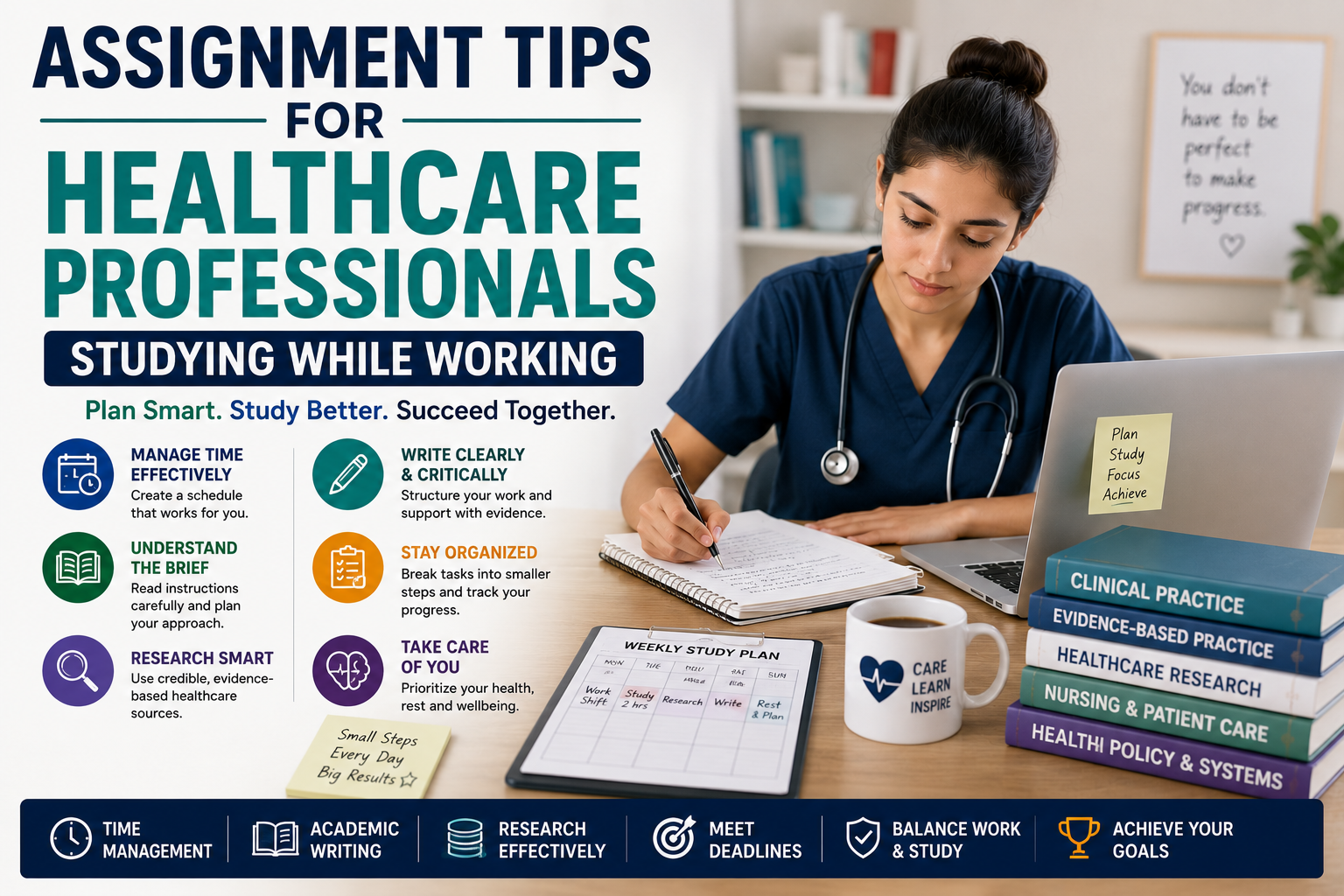
Unlike traditional students, healthcare professionals must balance academic responsibilities with patient care, professional standards, continuing education, and personal commitments. Effective planning, strong study habits, and efficient time management are essential for academic success.
This guide shares practical assignment tips designed specifically for healthcare professionals who are studying while working. Whether you are completing an undergraduate degree, postgraduate qualification, CPD course, or professional certification, these strategies can help you produce high-quality assignments while maintaining a healthy work–study balance.
Why Healthcare Professionals Face Unique Challenges
Healthcare is a demanding profession.
Working students often experience:
Rotating shifts.
Long working hours.
Physical fatigue.
Emotional stress.
Family responsibilities.
Limited study time.
Tight assignment deadlines.
Recognising these challenges allows you to develop realistic study strategies that fit your schedule.
Understand the Assignment Requirements
Before beginning any assignment, read the assessment brief carefully.
Identify:
Assignment question.
Learning outcomes.
Word count.
Submission deadline.
Referencing style.
Assessment criteria.
Highlight directive words such as:
Analyse
Evaluate
Discuss
Critically assess
Compare
Reflect
Understanding exactly what is being assessed helps you focus your research and writing.
Plan Your Assignment Early
One of the biggest mistakes working healthcare professionals make is delaying assignments until days before the deadline.
Instead:
Week 1
Read the assignment brief.
Review marking criteria.
Begin research.
Week 2
Organise references.
Create an outline.
Week 3
Write the first draft.
Week 4
Edit, proofread, and submit.
Breaking assignments into smaller tasks reduces stress and improves quality.
Create a Flexible Study Schedule
Healthcare work rarely follows a regular routine.
Instead of creating a rigid timetable, develop a flexible weekly study plan.
Include:
Work shifts.
Study sessions.
Family commitments.
Exercise.
Rest.
Assignment milestones.
Adjust your schedule whenever shift patterns change.
Make the Most of Short Study Sessions
You do not always need several uninterrupted hours to make progress.
Use short periods effectively by:
Reading journal articles during breaks.
Reviewing lecture notes while commuting.
Organising references after work.
Planning assignment sections before writing.
Even 30-minute study sessions can be highly productive.
Use Evidence-Based Sources
Healthcare assignments require reliable evidence.
Prioritise:
Peer-reviewed journal articles.
Clinical guidelines.
Government publications.
Professional healthcare organisations.
Evidence-based practice resources.
University library databases.
Avoid relying on unsupported online information.
High-quality evidence strengthens academic arguments.
Apply Critical Thinking
Healthcare assignments often require critical analysis rather than simple description.
Instead of asking:
"What happened?"
Consider:
Why did it happen?
What evidence supports this approach?
Are there alternative interventions?
What are the strengths and limitations?
How does current research compare?
Critical thinking demonstrates higher-level academic skills.
Connect Theory with Professional Practice
One advantage healthcare professionals have is practical experience.
Where appropriate, relate academic concepts to professional practice while maintaining confidentiality and following your institution's guidance.
Always avoid sharing identifiable patient information.
Using professional experience appropriately can strengthen reflective and analytical assignments.
Organise Research Efficiently
Keep research materials organised.
Create folders for:
Journal articles.
Clinical guidelines.
Assignment instructions.
Lecture notes.
Draft versions.
Reference lists.
Good organisation saves valuable time during writing.
Develop a Clear Assignment Structure
A logical structure improves readability.
Most assignments include:
Introduction
Explain the purpose of the assignment.
Main Body
Present evidence, analyse research, compare viewpoints, and answer the assessment question.
Conclusion
Summarise key findings without introducing new information.
References
List all cited sources using the required referencing style.
Write One Section at a Time
Many students struggle because they try to complete an entire assignment in one sitting.
Instead:
Complete the introduction.
Finish one section.
Take a break.
Continue later.
Small achievements maintain motivation.
Learn to Manage Fatigue
Healthcare work can be physically demanding.
Avoid studying immediately after exhausting shifts if concentration is low.
Instead:
Study before work when possible.
Use lighter tasks after long shifts.
Schedule demanding writing sessions on days off.
Working with your energy levels improves productivity.
Avoid Procrastination
Busy professionals sometimes delay assignments because they feel overwhelmed.
Reduce procrastination by:
Setting personal deadlines.
Completing one task at a time.
Breaking assignments into manageable sections.
Celebrating completed milestones.
Progress is built through consistency rather than perfection.
Take Care of Your Wellbeing
Academic success depends on good physical and mental health.
Prioritise:
Sleep.
Healthy meals.
Exercise.
Hydration.
Regular breaks.
Burnout reduces both academic performance and workplace effectiveness.
Seek Support When Needed
Do not hesitate to ask for help.
Support may be available through:
University tutors.
Academic skills centres.
Librarians.
Student support services.
Workplace mentors.
Fellow students.
Seeking guidance early often prevents larger problems later.
Common Assignment Mistakes
Healthcare students frequently lose marks by:
Starting assignments too late.
Using outdated evidence.
Failing to answer the assignment question.
Writing descriptively instead of critically.
Incorrect referencing.
Weak assignment structure.
Poor proofreading.
Avoiding these mistakes improves assignment quality significantly.
Weekly Study Example
Day | Study Focus |
|---|---|
Monday | Read journal articles |
Tuesday | Organise notes and references |
Wednesday | Write assignment sections |
Thursday | Continue drafting |
Friday | Edit and improve arguments |
Saturday | Proofread and check referencing |
Sunday | Review progress and prepare for the following week |
Adjust this schedule according to your work shifts.
Practical Productivity Tips
Study at your most productive time.
Keep assignment resources organised.
Turn off unnecessary notifications.
Complete difficult tasks first.
Use university library databases.
Review tutor feedback regularly.
Back up assignments using cloud storage.
Final Thoughts
Studying while working in healthcare is challenging, but it is also rewarding. Success comes from careful planning, consistent study habits, effective time management, and a commitment to continuous learning. Rather than relying on last-minute effort, successful healthcare professionals break assignments into manageable stages, use evidence-based research, and develop strong academic writing skills over time.
Remember that every assignment is an opportunity to strengthen both your academic knowledge and professional practice. By staying organised, managing your workload realistically, and maintaining your wellbeing, you can achieve excellent academic results while continuing to provide high-quality care in your healthcare role.
Frequently Asked Questions
Everything you need to know about our services
Related Posts

Balancing Work and University Assignments (2026 Guide for Busy Students)

Time Management for Part-Time Students (2026 Guide to Balance Work, Study & Life)
