Assignment Help for Toronto Metropolitan University Students: A Responsible Academic Support Guide
Introduction
University assignments can be challenging because they often require students to understand course concepts, conduct research, evaluate evidence, develop arguments and communicate ideas according to academic standards. When students need additional support, the best approach is to seek guidance that helps them learn and improve while ensuring that submitted work remains their own.
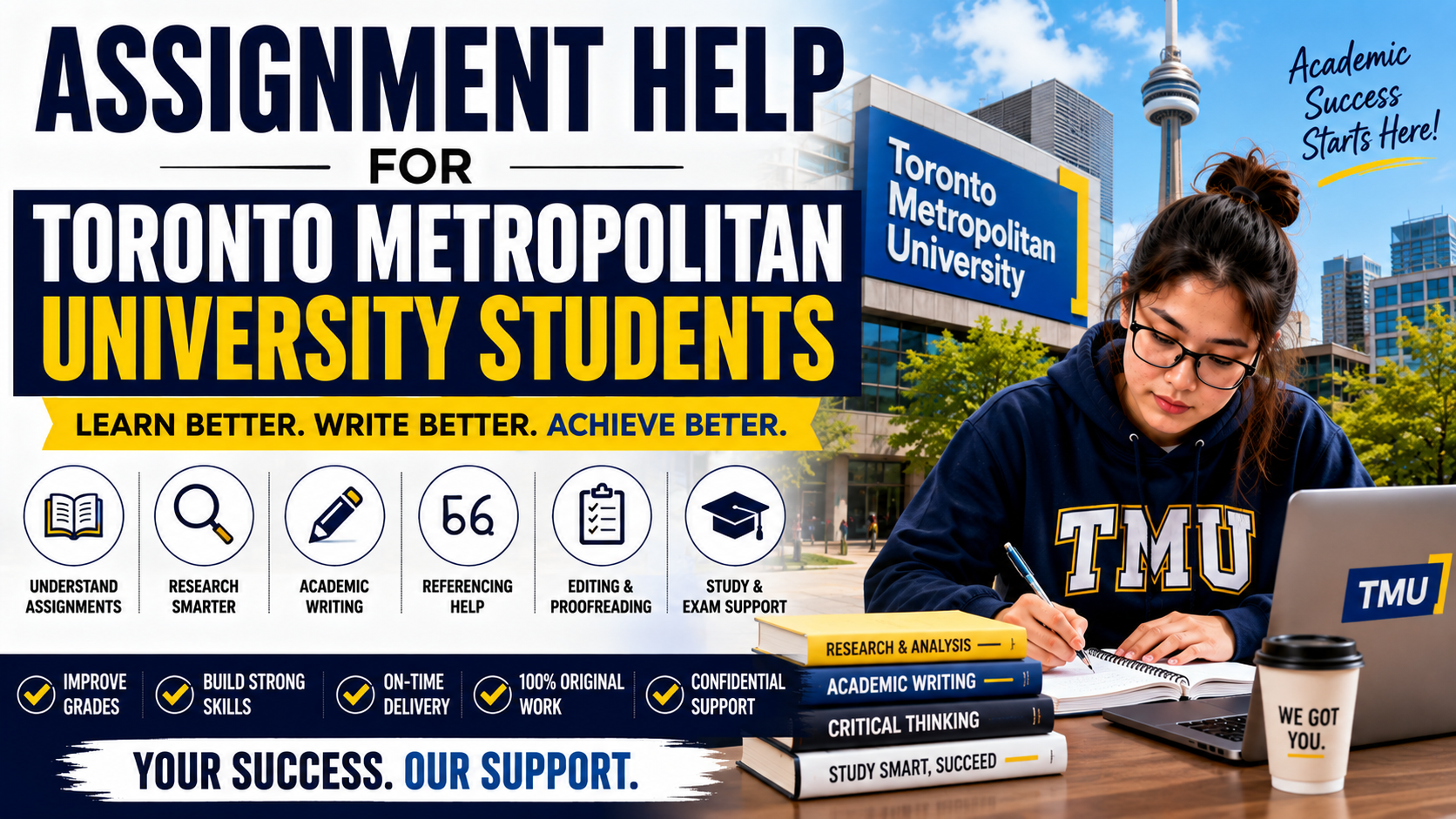
Assignment help for Toronto Metropolitan University (TMU) students can include legitimate support with understanding assignment requirements, research skills, academic writing, citation practices, tutoring, study strategies and feedback on their own work. Students should remain responsible for completing assessed work and follow their instructor's and TMU's academic-integrity requirements.
Toronto Metropolitan University offers academic-support services through Student Life and Learning Support, including academic writing appointments, grammar and supported self-editing, tutoring and academic skills workshops. TMU's academic-integrity guidance also encourages students to use legitimate university support services when they need help.
This guide explains what responsible assignment help can include and how TMU students can seek support while protecting academic integrity.
What Is Assignment Help for Toronto Metropolitan University Students?
Assignment help is educational support that helps students understand academic requirements and develop their own skills without completing assessed work on their behalf.
Depending on course requirements, legitimate support may include:
Understanding assignment instructions
Interpreting marking criteria
Research guidance
Finding and evaluating academic sources
Academic writing development
Essay planning and structure
Citation and referencing guidance
Grammar and self-editing skills
Study strategies
Time-management support
Feedback on the student's own work
The type and scope of assistance permitted can vary by course and assessment.
What Academic Support Is Available at TMU?
Toronto Metropolitan University provides a range of academic-support resources to help students develop the knowledge and skills needed for academic success.
TMU's Student Life and Learning Support offers services such as:
Academic writing appointments
Grammar and supported self-editing appointments
Writing workshops
Academic skills workshops
Study and time-management support
Math and computer science tutoring
Peer academic support
TMU's official resources emphasize skill development and student learning rather than completing academic work for students.
Can TMU Students Get Help With Assignments?
Yes. TMU students can seek legitimate academic support, but they should not submit work completed by someone else as their own.
TMU's Academic Integrity Office advises students to understand the expectations for each assignment and to use instructors and legitimate university resources when they need help developing their own ideas and solutions.
A useful principle is:
Academic support should help you learn how to complete an assignment—not complete the assessed assignment for you.
If you are uncertain whether a specific type of assistance is allowed, ask your instructor before using it.
How Can TMU Writing Support Help Students?
TMU's Writing and English Language Support services provide individual appointments and other opportunities to help students develop academic writing skills and improve their approach to the writing process.
Students can access support related to:
Academic writing
Grammar
Usage
Word choice
Style
Self-editing skills
English language development
TMU describes grammar appointments as supported self-editing, where students learn to identify and address issues in their own writing.
What Makes Academic Writing Support Useful?
Writing support can help students learn how to:
Develop a clear argument
Organise paragraphs
Improve clarity
Integrate evidence
Use an appropriate academic tone
Edit their own work more effectively
The goal is to strengthen independent writing skills over time.
How Can Students Understand Assignment Requirements?
Before starting an assignment, students should carefully review:
The assignment question
Learning objectives
Marking criteria or rubric
Required format
Word count
Source requirements
Citation style
Submission deadline
Ask yourself:
What exactly am I being asked to do?
Am I expected to analyse, evaluate, compare or describe?
What evidence do I need?
How will my work be assessed?
Understanding the assignment before beginning research can save significant time later.
Assignment Research Help for TMU Students
Research guidance can help students develop the skills needed to find and evaluate information independently.
Possible areas of support include:
Developing effective search terms
Finding scholarly sources
Understanding databases
Evaluating source credibility
Reading research critically
Taking research notes
Organising evidence
A practical research workflow is:
Understand the Question → Identify Key Concepts → Search for Sources → Evaluate Evidence → Read Critically → Take Notes → Organise Research
Students should read and interpret their own sources and remain responsible for the evidence they include in their assignments.
Academic Writing Help for TMU Students
Academic writing involves more than correct grammar. Students often need to communicate ideas logically and support arguments with appropriate evidence.
Writing development can focus on:
Essay structure
Thesis statements
Topic sentences
Paragraph development
Critical analysis
Transitions
Evidence integration
Academic tone
Conclusions
What Makes an Academic Paragraph Effective?
A strong academic paragraph often includes:
A clear main point
Explanation or development
Relevant evidence
Analysis of the evidence
A connection to the wider argument
Disciplinary expectations can differ, so students should also follow course-specific guidance.
Can Students Get Help With Citations and Referencing?
Yes. Students can seek guidance to understand citation and referencing practices.
Support may help students learn about:
In-text citations
Reference lists
Quoting sources
Paraphrasing
Summarising
Source attribution
TMU's Academic Integrity Office advises students to keep track of sources and accurately cite intellectual property they use. Students should always verify citations and ensure that their submitted work accurately represents the original sources.
Why Is Accurate Referencing Important?
Referencing helps students:
Give credit to original authors
Support academic arguments
Demonstrate research engagement
Allow readers to locate sources
Distinguish their own ideas from information obtained elsewhere
What Is the Difference Between Editing and Supported Self-Editing?
Understanding this distinction can help students seek appropriate assistance.
Type of Support | Purpose |
|---|---|
Writing guidance | Helps students develop academic writing skills |
Supported self-editing | Helps students identify and correct issues in their own writing |
Tutoring | Helps students understand course concepts |
Research guidance | Helps students develop research skills |
Feedback | Helps students understand areas for improvement |
TMU's learning-support guidelines state that its support programs generally focus on helping students develop editing skills rather than editing or proofreading student work for them.
Can TMU Students Get Help With Math, Statistics or Programming?
Students may seek legitimate educational support to understand course concepts and strengthen their problem-solving skills.
Appropriate support may include:
Explaining concepts
Understanding methods
Reviewing examples
Learning debugging strategies
Developing study skills
Discussing how to approach problems
TMU offers academic support resources, including tutoring in areas such as mathematics and computer science. However, students should follow the rules established for each assignment, examination or assessment.
Can Students Get Help With Group Assignments?
Group assignments can have additional academic-integrity considerations because collaboration may be permitted within specific boundaries.
Students should:
Follow the instructor's group-work instructions
Understand individual responsibilities
Keep track of their contributions
Avoid unauthorised assistance
Ensure that all submitted work follows course requirements
TMU's writing-support services note that group assignment support may require participation from group members to ensure that support is appropriately provided.
How Should Students Use Instructor Feedback?
Instructor feedback can help students identify specific areas for improvement.
Step 1: Read All Feedback Carefully
Understand what the comments are asking you to reconsider.
Step 2: Categorise the Feedback
Group comments into areas such as:
Content
Research
Structure
Analysis
Evidence
Writing
Referencing
Step 3: Prioritise Major Changes
Address substantive issues before focusing on minor grammar or formatting details.
Step 4: Make Your Own Revisions
Students should remain responsible for the academic decisions and revisions they make.
Step 5: Review the Complete Assignment
Ensure that changes improve the overall argument and consistency of the work.
What Is Contract Cheating?
Contract cheating occurs when a third party completes academic work for a student and the student submits it as their own where such assistance is not permitted.
TMU identifies contract cheating as a form of academic misconduct. Its academic-integrity resources encourage students who need help to use legitimate learning supports instead of having someone else complete their work.
Students should avoid providers that offer to write assignments for submission.
What Should TMU Students Avoid?
Students should avoid services or practices that:
Complete assignments for them
Write assessed work for submission
Encourage plagiarism
Impersonate students
Fabricate data
Fabricate references
Provide unauthorised answers
Guarantee grades
Request university passwords
Claim special access to instructors
Legitimate academic support focuses on developing the student's knowledge and skills.
Can Toronto Metropolitan University Students Use AI for Assignment Help?
AI use depends on the rules established for the specific course and assessment.
TMU's Academic Integrity Office advises students that, unless an instructor explicitly states otherwise, students should assume that using AI to complete assessments is prohibited. TMU also states that instructors determine permissible uses of AI for their courses and that students should consult course materials and assignment instructions.
Before using AI, check:
Your course outline
Assignment instructions
Instructor guidance
Assessment-specific requirements
TMU guidance notes that, with instructor permission, AI may potentially support activities such as brainstorming, study preparation, research support or recommendations for improvement. Students remain responsible for the accuracy and integrity of their submitted work.
Never assume AI use is permitted simply because a tool is publicly available.
How Can Students Choose Responsible Assignment Support?
Before seeking external academic assistance, consider the following.
1. Academic Integrity
Does the support respect the requirement that you complete your own assessed work?
2. Learning Focus
Does the support help you understand the subject and improve your skills?
3. Type of Support
Is it tutoring, research guidance, writing support or feedback?
4. Transparency
Is the scope of assistance clearly explained?
5. Course Requirements
Have you checked what assistance is permitted for the assessment?
6. Subject Knowledge
Is the guidance appropriate for your discipline?
7. Privacy
How will your documents and personal information be handled?
When uncertain, consult your instructor or an official TMU academic-support resource.
Assignment Help Checklist for TMU Students
Before seeking academic support, ask yourself:
Understanding
Do I understand the assignment question?
Have I reviewed the marking criteria?
Do I know the required format and citation style?
Research
Have I found appropriate sources?
Have I read and understood them myself?
Can I explain how my evidence supports my argument?
Writing
Does my assignment answer the question?
Is my argument clear?
Are my paragraphs logically organised?
Have I explained my evidence?
Academic Integrity
Is the submitted work genuinely my own?
Have I cited sources accurately?
Have I followed the assessment rules?
Have I checked whether AI use is permitted?
Can I explain the work I am submitting?
Final Review
Have I addressed relevant feedback?
Have I checked formatting?
Have I proofread my work?
Have I followed submission instructions?
When Should Students Seek Assignment Help?
Students should ideally seek appropriate support before an assignment deadline becomes urgent.
Early guidance can help students:
Understand requirements
Improve research planning
Develop writing skills
Strengthen study strategies
Learn from feedback
A practical workflow is:
Understand the Assignment → Plan → Research → Draft → Seek Permitted Guidance → Revise → Self-Edit → Submit
Seeking support early gives students time to develop skills and make meaningful improvements.
Assignment Help for International Students at TMU
International and multilingual students may seek academic support while adapting to:
Canadian academic expectations
Academic writing conventions
Referencing practices
Classroom expectations
Independent learning requirements
TMU offers writing and English language support designed to help students develop communication and academic writing skills. Students can use these resources to build confidence while maintaining ownership of their academic work.
Can Assignment Help Guarantee Better Grades?
No. Legitimate academic-support providers cannot guarantee a particular grade.
Academic outcomes depend on factors including:
Understanding of the course material
Research quality
Analysis
Assignment requirements
Assessment criteria
The student's independent performance
Academic support can help students develop skills, but no ethical service can guarantee a specific result.
Final Thoughts
University assignments are opportunities to develop critical thinking, research ability, subject knowledge and communication skills. Seeking support can be a positive part of learning when that support helps students develop their own abilities.
Assignment help for Toronto Metropolitan University students can include responsible support with research, academic writing, citation practices, tutoring, study skills and feedback. Students should follow TMU and course-specific academic-integrity requirements and remain responsible for the work they submit.
A responsible approach is:
Understand → Research → Write → Seek Permitted Guidance → Revise → Self-Edit → Submit
By using legitimate academic support and official university resources, TMU students can strengthen their skills while maintaining academic integrity and ownership of their academic work.
Frequently Asked Questions
Everything you need to know about our services
Related Posts

Overwhelmed by University Assignments? When Professional Help Makes Sense

Working Full-Time and Studying? Assignment Help for Canadian Students
