Why Nursing Dissertations Often Require More Evidence Than Students Think
Introduction
Writing a nursing dissertation is very different from completing a standard university assignment. While essays often focus on discussing theories or explaining concepts, a dissertation requires students to investigate a healthcare issue using high-quality evidence, evaluate research critically, and demonstrate how findings relate to clinical practice.
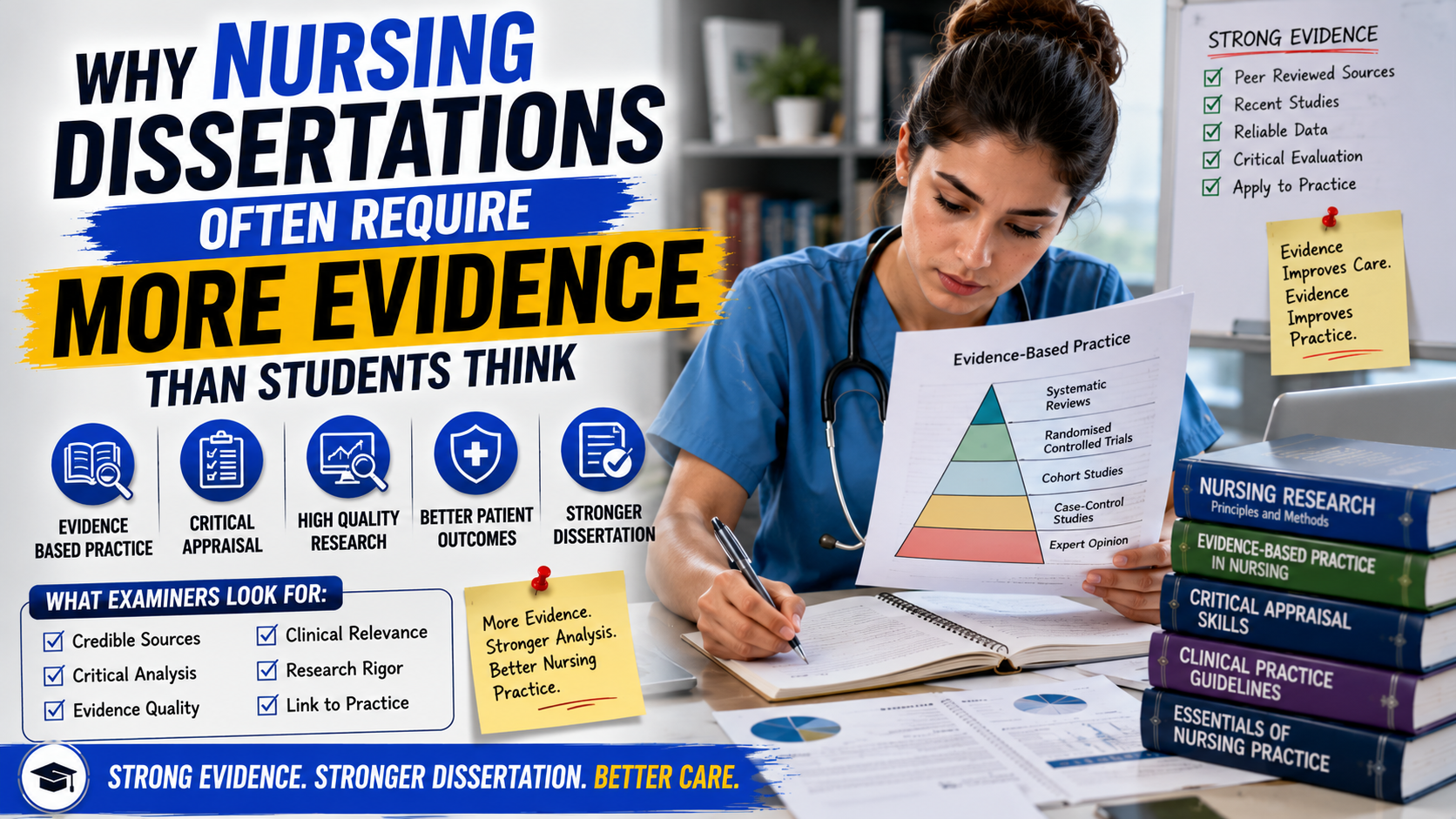
Many nursing students underestimate the level of evidence expected. They may believe that citing a handful of journal articles is enough to support their arguments. However, nursing is an evidence-based profession, and universities expect dissertations to reflect that standard.
A well-written nursing dissertation does more than describe healthcare problems. It evaluates research quality, compares clinical evidence, justifies recommendations, and demonstrates how evidence can improve patient outcomes.
Why Evidence Matters in Nursing
Modern nursing practice is based on evidence-based practice (EBP).
Healthcare professionals are expected to make decisions using:
Best available research evidence
Clinical expertise
Professional guidelines
Patient preferences where appropriate
A nursing dissertation should reflect this same approach by supporting every major argument with credible evidence rather than opinion.
What Counts as Strong Evidence?
Not all sources carry the same academic value.
High-quality nursing evidence often includes:
Peer-reviewed nursing journals
Systematic reviews
Meta-analyses
Randomised controlled trials (when appropriate)
Clinical practice guidelines
Government health reports
Professional healthcare organisation publications
Using stronger evidence improves the credibility of your dissertation.
Why Students Underestimate the Evidence Required
Many students assume that collecting references is the same as building evidence.
In reality, examiners assess:
Quality of sources
Relevance
Currency
Critical evaluation
Application to the research question
Twenty carefully selected high-quality studies are often more valuable than dozens of weaker references.
Nursing Is an Evidence-Based Profession
Unlike some academic disciplines, nursing directly influences patient care.
Because healthcare decisions can affect safety and wellbeing, universities expect students to justify recommendations using reliable research rather than personal opinions.
Evidence-based reasoning demonstrates professional competence.
Critical Appraisal Is Just as Important
Finding research is only the first step.
Students must also evaluate:
Research design
Sample size
Bias
Reliability
Validity
Ethical considerations
Clinical relevance
Critical appraisal demonstrates analytical thinking rather than simple literature summary.
Why Recent Evidence Matters
Healthcare evolves rapidly.
Clinical guidelines, treatment recommendations, and nursing practices change as new research becomes available.
Whenever appropriate, students should prioritise recent, high-quality evidence while recognising that classic studies may still be important in some areas.
Balancing Different Types of Evidence
Strong nursing dissertations often combine:
Quantitative research
Qualitative research
Clinical guidelines
Policy documents
Professional standards
Systematic reviews
Using different evidence types provides a more balanced discussion.
Common Mistakes Nursing Students Make
Many nursing dissertations lose marks because students:
Rely heavily on textbooks.
Use outdated research.
Summarise articles instead of evaluating them.
Ignore conflicting evidence.
Use unreliable websites.
Include unsupported opinions.
Fail to justify recommendations.
Reference inconsistently.
Avoiding these mistakes strengthens academic quality.
Linking Evidence to Clinical Practice
One feature that distinguishes excellent nursing dissertations is their ability to connect research with practice.
Rather than simply explaining findings, students should discuss:
Clinical implications
Patient safety
Healthcare quality
Professional decision-making
Future practice improvements
This demonstrates an understanding of evidence-based nursing.
The Importance of a Strong Literature Review
The literature review is more than a collection of summaries.
It should:
Compare studies.
Identify research gaps.
Evaluate strengths and weaknesses.
Discuss conflicting findings.
Build a logical argument supporting your research.
A critical literature review forms the foundation of the dissertation.
What Nursing Examiners Look For
Although marking criteria vary between universities, examiners generally assess:
Evidence quality
Critical analysis
Literature synthesis
Research methodology
Academic writing
Logical organisation
Ethical awareness
Referencing accuracy
Clinical relevance
Evidence-based recommendations
Strong dissertations integrate these elements throughout every chapter.
Practical Tips for Strengthening Your Evidence
Start Your Literature Search Early
High-quality evidence takes time to locate and evaluate.
Use Academic Databases
Search trusted healthcare databases recommended by your university.
Compare Multiple Studies
Avoid relying on a single source.
Comparing evidence demonstrates stronger critical thinking.
Evaluate Research Quality
Discuss strengths, weaknesses, limitations, and applicability.
Follow Professional Guidelines
Where relevant, integrate recognised healthcare guidelines into your discussion.
Keep References Organised
Reference management software can reduce citation errors and save time.
Self-Assessment Checklist
Before submitting your dissertation, ask yourself:
✅ Have I used recent, high-quality evidence?
✅ Have I critically evaluated my sources?
✅ Have I linked evidence to nursing practice?
✅ Have I discussed conflicting research?
✅ Are my recommendations supported by evidence?
✅ Is my referencing accurate and consistent?
If several answers are "no," additional revision may improve your dissertation.
Maintaining Academic Integrity
Many universities permit students to receive guidance on:
Academic writing
Structure
Grammar
Referencing
Formatting
Presentation
Students remain responsible for all original research, interpretations, analysis, and conclusions. Any assistance should comply with institutional academic integrity policies and professional nursing standards.
Final Thoughts
Nursing dissertations demand more evidence than many students initially expect because nursing is built on evidence-based practice. Universities assess not only your ability to gather research but also your ability to evaluate its quality, interpret findings critically, and apply evidence to real healthcare challenges.
A successful nursing dissertation demonstrates far more than knowledge of clinical concepts. It shows that you can make informed, evidence-based judgements, critically appraise research, and communicate recommendations that are supported by credible academic and professional sources.
By focusing on high-quality evidence, maintaining a critical approach, and linking research to clinical practice, you can produce a dissertation that reflects the analytical and professional standards expected of future nursing practitioners.
Frequently Asked Questions
Everything you need to know about our services


