Why Many Students Use Editing Before Submission
Introduction
After months of research, planning, writing, and revising, many students assume their dissertation is finally complete.
However, experienced researchers know that finishing the first complete draft is rarely the final step.
Before submission, dissertations often benefit from one final stage: careful academic editing.
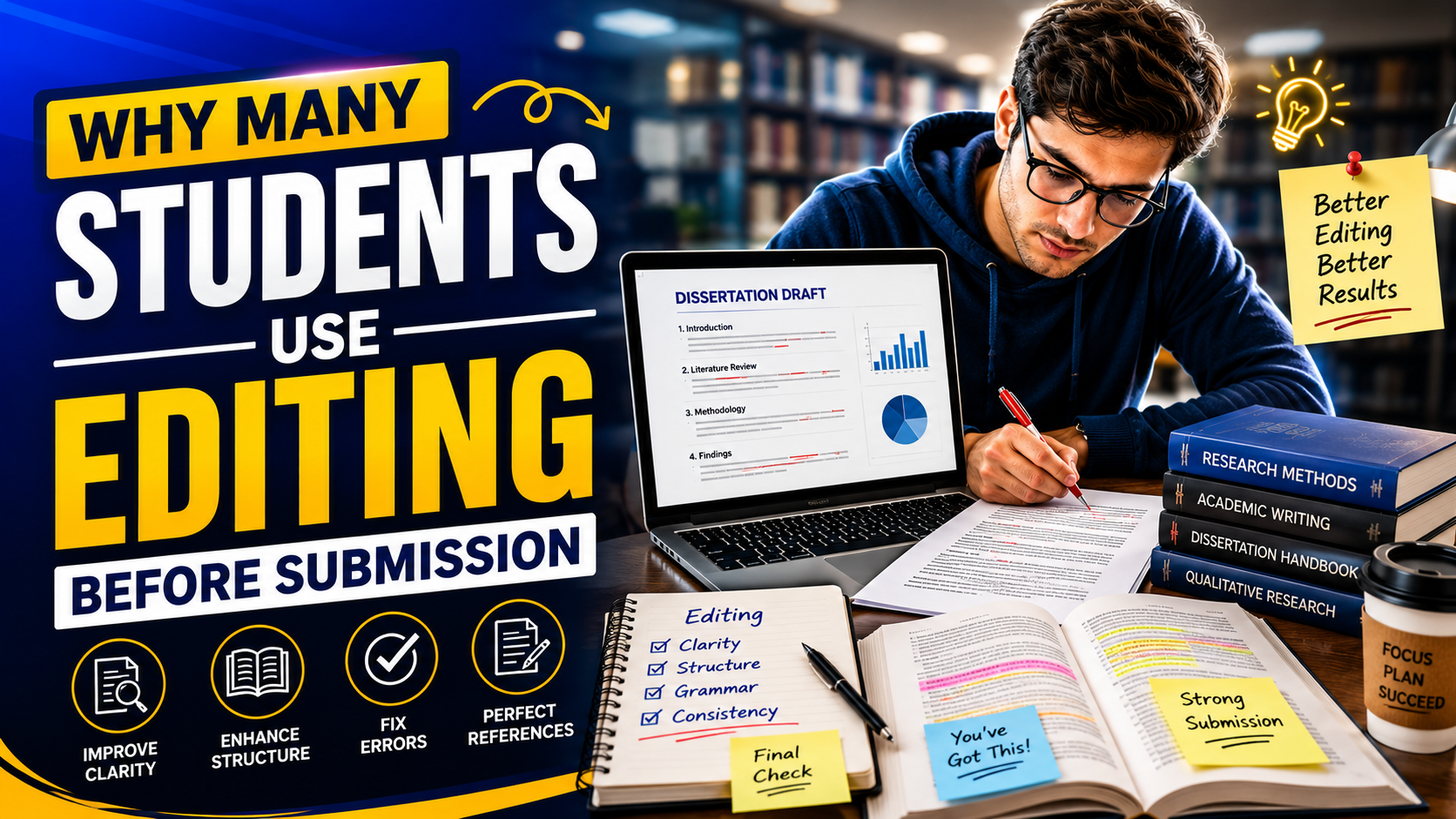
Editing is not about changing the student's ideas or rewriting the research. Instead, it focuses on improving clarity, organisation, consistency, and presentation so that the dissertation communicates the student's original work as effectively as possible.
Universities routinely encourage students to revise and edit their work before submission. Many institutions even recommend using writing centres, academic skills services, or proofreading guidance to improve presentation while maintaining academic integrity.
In this guide, we'll explore why many students choose editing before submission and how ethical academic editing can strengthen the overall quality of a dissertation.
What Does Dissertation Editing Mean?
Editing goes beyond correcting spelling mistakes.
A comprehensive dissertation edit may examine:
Academic writing clarity
Sentence structure
Paragraph organisation
Logical flow
Chapter consistency
Grammar and punctuation
Referencing consistency
Formatting
Readability
The objective is to present the student's own research as clearly and professionally as possible.
Why Students Edit Before Submission
1. Months of Writing Create Familiarity Bias
After reading the same dissertation repeatedly, students become highly familiar with their own writing.
This familiarity makes it difficult to notice:
Missing words
Repeated ideas
Awkward phrasing
Weak transitions
Inconsistent terminology
Fresh editing helps identify these issues objectively.
2. Clarity Matters
Strong research can lose impact if readers struggle to follow the argument.
Editing improves:
Sentence flow
Paragraph coherence
Logical progression
Academic tone
Small improvements in clarity can significantly improve readability.
3. Improving Chapter Consistency
Dissertations are usually written over several months.
As a result, writing style often changes between chapters.
Editing checks for consistency across:
Terminology
Headings
Formatting
Writing style
Referencing
Tone
4. Strengthening Academic Writing
Academic writing should be:
Clear
Objective
Concise
Logical
Formal
Editing removes unnecessary repetition while improving precision and readability.
5. Checking Referencing
Referencing errors remain one of the most common issues identified before submission.
Editing may identify:
Missing citations
Incorrect reference formatting
Inconsistent citation styles
Incomplete bibliography entries
Proper referencing supports academic credibility.
6. Formatting Review
Presentation influences professionalism.
Editing often includes reviewing:
Heading hierarchy
Tables
Figures
Page numbering
Margins
Spacing
Appendices
A consistently formatted dissertation is easier for examiners to read.
7. Improving Confidence
Many students seek editing simply for reassurance.
Common questions include:
Have I overlooked mistakes?
Is the dissertation easy to follow?
Does the structure make sense?
Is everything presented professionally?
Editing provides an opportunity to identify areas for improvement before submission.
Editing vs Proofreading
Although the terms are sometimes used interchangeably, they serve different purposes.
Editing focuses on:
Clarity
Structure
Flow
Consistency
Readability
Academic style
Proofreading focuses on:
Grammar
Spelling
Punctuation
Typographical errors
Formatting consistency
Many students benefit from both services before submission.
Does Editing Change Your Work?
Ethical academic editing does not change the student's research findings or ideas.
Instead, editors help improve how those ideas are communicated.
The student remains responsible for:
Conducting research
Analysing findings
Developing arguments
Writing the dissertation
Making final revisions
Submitting the completed work
Can AI Replace Dissertation Editing?
AI writing tools can assist with:
Grammar correction
Readability
Sentence suggestions
Basic editing
However, AI cannot reliably assess:
Logical flow
Chapter coherence
Research quality
Academic reasoning
University marking criteria
Human academic judgement remains valuable throughout the editing process.
How AssignmentCart Can Help
AssignmentCart provides ethical academic support designed to help students improve the quality of their dissertations before submission.
Our services include:
Dissertation editing
Dissertation feedback
Professional proofreading
Literature review guidance
Research methodology support
Referencing checks (Harvard, APA, OSCOLA, MLA, Chicago & IEEE)
Formatting review
Chapter-by-chapter academic guidance
Confidential student support
Our goal is to help students present their own original research clearly while respecting university academic integrity policies.
Why Editing Can Be One of the Final Steps Towards Success
After investing months into a dissertation, it makes sense to spend time refining the final version before submission.
Editing doesn't replace independent research—it helps ensure that your research is communicated clearly, professionally, and consistently.
If you're approaching your submission deadline, AssignmentCart's Dissertation Help service offers ethical academic guidance designed to help you strengthen your dissertation before you submit it.
Why Students Choose AssignmentCart
Experienced dissertation specialists.
Ethical academic guidance.
Professional dissertation editing.
Expert proofreading.
Referencing assistance.
Research methodology guidance.
Confidential communication.
Fast turnaround options for eligible requests.
👉 Visit our services page today and prepare your dissertation for submission with confidence.
Final Thoughts
Editing is often one of the most valuable stages of dissertation preparation. It allows students to refine their writing, improve consistency, and present their research with greater clarity and professionalism.
Combining independent research, supervisor guidance, and ethical academic editing can help ensure that your dissertation reflects the quality of the work you've invested throughout your postgraduate journey.
Frequently Asked Questions
Everything you need to know about our services
Related Posts

When Extra Guidance Can Make the Biggest Difference in Your Dissertation

Five Signs Independent Study Isn't Solving Your Dissertation Problems
