Psychology Assignment Help for Singapore Students
Introduction
Psychology assignments require students to combine theoretical knowledge, research evidence, critical thinking, and academic writing. Whether you're studying cognitive psychology, social psychology, developmental psychology, clinical psychology, organisational psychology, or another specialised area, assignments can involve extensive reading and detailed analysis.
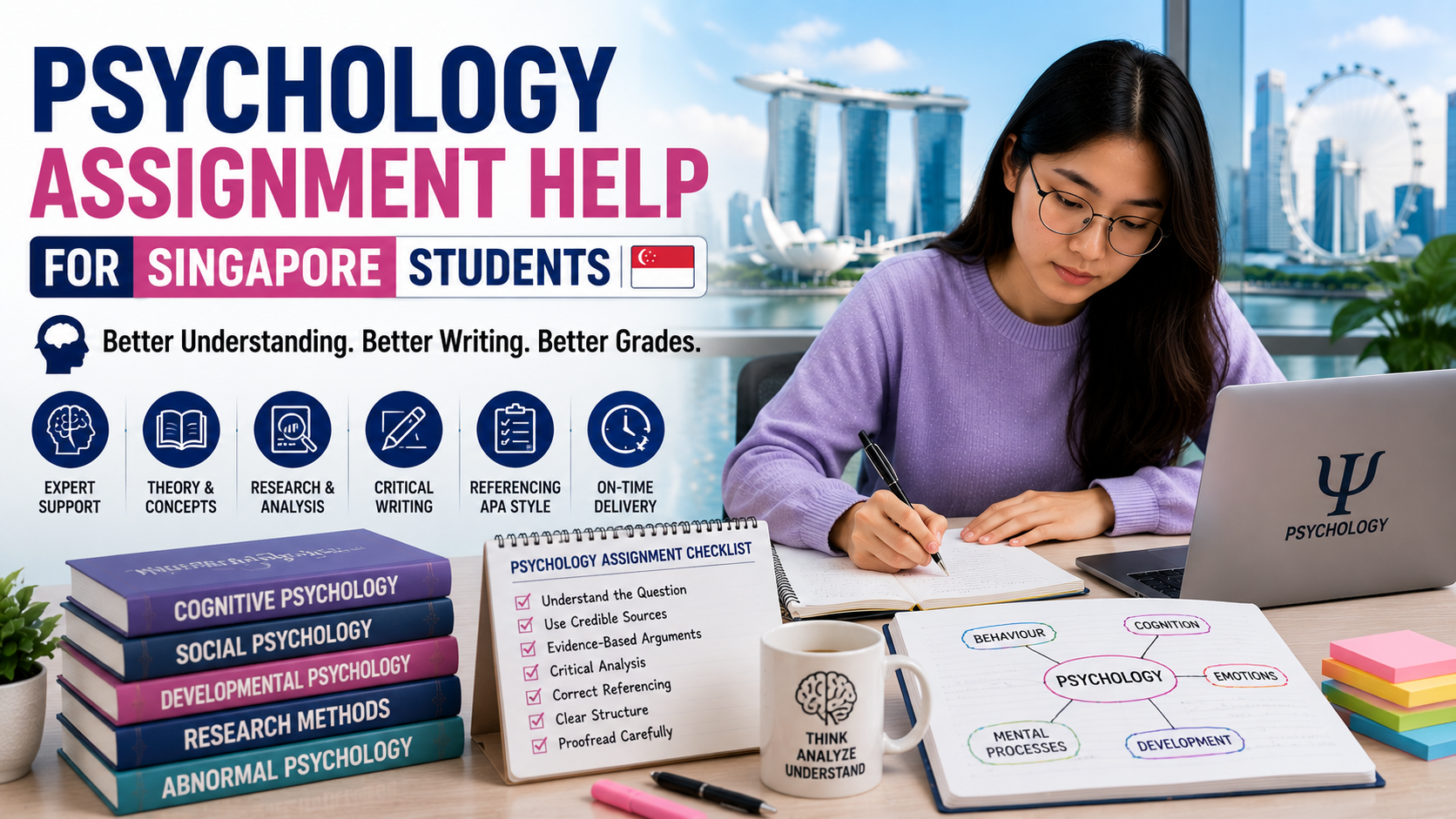
Students in Singapore may also need to balance psychology coursework with presentations, examinations, research projects, internships, and other academic responsibilities. Tight deadlines can make it difficult to give every assignment the attention it deserves.
This guide explains the most common types of psychology assignments, how to approach them effectively, common mistakes that can cost marks, and how AssignmentCart provides ethical academic support to help students improve the clarity, structure, referencing, and presentation of their own work.
What Makes Psychology Assignments Challenging?
Psychology is both a theoretical and research-driven discipline.
A strong assignment may require you to:
Explain psychological theories
Evaluate research studies
Compare different perspectives
Interpret research findings
Analyse psychological behaviour
Discuss methodological limitations
Apply theories to real-world situations
Use peer-reviewed evidence
Demonstrate critical thinking
Follow a specific referencing style
Simply describing a theory or summarising research is usually not enough. Students often need to demonstrate how evidence supports, challenges, or extends an argument.
Common Psychology Assignments in Singapore
Psychology students may encounter several different types of coursework.
Common assignments include:
Psychology essays
Case studies
Research reports
Literature reviews
Critical evaluations
Reflective assignments
Experimental reports
Research proposals
Behavioural analysis
Psychological theory comparisons
Statistics-based assignments
Dissertation projects
Each assignment requires a different approach, so students should carefully review the assessment criteria before beginning.
Psychology Essay Help
Psychology essays generally require students to develop a clear argument supported by academic evidence.
A strong psychology essay typically includes:
Introduction
Introduce the psychological topic and establish the central argument or focus.
Theoretical Background
Explain the relevant theories, concepts, or models needed to understand the topic.
Research Evidence
Use credible academic studies to support the discussion.
Critical Analysis
Compare findings, identify limitations, discuss alternative explanations, and evaluate the strength of the evidence.
Conclusion
Summarise the main argument and directly address the essay question.
The strongest essays connect theory, research evidence, and critical evaluation rather than treating each as a separate section.
Psychology Case Study Assignments
Case studies require students to apply psychological concepts to a particular individual, group, organisation, or scenario.
Depending on the assignment, students may need to examine:
Behaviour
Cognitive processes
Emotional factors
Social influences
Developmental factors
Environmental influences
Relevant psychological theories
Evidence-based interventions
Students should avoid making unsupported psychological diagnoses or claims. Where clinical or sensitive topics are involved, terminology and evidence must be used carefully.
Literature Review Help for Psychology Students
Literature reviews are an important part of psychology coursework and research.
A literature review should not simply provide a list of studies.
Instead, it should:
Identify relevant research
Organise studies into themes
Compare findings
Evaluate research quality
Identify disagreements
Discuss methodological limitations
Identify gaps in existing research
Explain why further research may be needed
For example, instead of summarising ten studies one after another, organise them around themes such as age differences, methodology, theoretical perspectives, or conflicting findings.
Research Report Writing
Psychology research reports often follow a structured academic format.
Depending on the requirements, this may include:
Abstract
Introduction
Literature review
Method
Results
Discussion
Conclusion
References
Appendices
The Method section should explain how the research was conducted, while the Results section should report findings without unnecessarily interpreting them.
The Discussion section is where students generally interpret the findings, connect them to previous research, discuss limitations, and consider implications.
Psychology Statistics Assignments
Psychology students may encounter quantitative analysis as part of research methods modules.
Assignments can involve concepts such as:
Descriptive statistics
Correlation
Regression
t-tests
ANOVA
Chi-square tests
Reliability
Validity
Effect sizes
Statistical significance
Software such as SPSS may also be used in some psychology programmes.
When presenting statistical results, students should understand what the analysis means rather than simply copying software output into an assignment.
SPSS and Psychology Research
SPSS can help researchers organise and analyse quantitative datasets.
However, software output alone does not constitute analysis.
Students may need to explain:
Why a particular test was selected
Whether assumptions were considered
What the statistical output indicates
Whether findings are statistically significant
The practical meaning of the results
Limitations of the analysis
Always follow the statistical and reporting requirements provided by your module.
Evidence-Based Psychology Writing
Psychology assignments should rely on credible academic evidence.
Useful sources may include:
Peer-reviewed journal articles
Academic books
Systematic reviews
Meta-analyses
Government publications
Professional organisations
Established research databases
Avoid relying heavily on anonymous websites, unsupported blogs, or social media posts when making academic claims.
The quality of your sources directly affects the credibility of your arguments.
APA Referencing for Psychology Students
APA referencing is widely associated with psychology and other social science disciplines.
Depending on your institution and module, you may be required to use APA 7th Edition.
A typical APA in-text citation includes the author's surname and publication year.
Example:
Cognitive development is influenced by both biological and environmental factors (Tan, 2024).
For a direct quotation, additional location information may be required.
Always follow the specific referencing instructions provided by your university or lecturer.
Common Psychology Assignment Mistakes
Students frequently lose marks by:
Describing instead of analysing
Using outdated research
Relying on weak sources
Making unsupported claims
Failing to evaluate studies
Ignoring alternative explanations
Using psychological terminology incorrectly
Poorly integrating research evidence
Mixing referencing styles
Copying statistical software output without explanation
Failing to answer the actual assignment question
Submitting without proofreading
Identifying these issues before submission can improve the overall quality of your coursework.
How to Improve Critical Analysis in Psychology
Critical analysis is one of the most important skills in psychology writing.
Instead of simply writing:
Research suggests that social media affects mental wellbeing.
Ask:
Which research supports this claim?
What methodology was used?
Was the sample representative?
Was the study correlational or experimental?
Are there alternative explanations?
Were there methodological limitations?
Do other studies report different findings?
What does the evidence actually demonstrate?
This approach transforms a descriptive assignment into a more analytical academic discussion.
Psychology Assignment Structure Checklist
Before submitting your assignment, check:
Introduction
✔ Have you clearly introduced the topic?
✔ Have you answered the question or established your argument?
Main Discussion
✔ Are psychological theories explained accurately?
✔ Have you used relevant research?
✔ Have you compared different perspectives?
✔ Have you demonstrated critical analysis?
Evidence
✔ Are your sources credible?
✔ Are research findings interpreted accurately?
✔ Have you considered limitations?
Referencing
✔ Are in-text citations included?
✔ Does the reference list match the citations?
✔ Have you followed the required referencing style?
Final Review
✔ Is the assignment within the word count?
✔ Is the structure logical?
✔ Have you checked grammar and spelling?
✔ Have you proofread the final document?
How AssignmentCart Can Help Singapore Psychology Students
AssignmentCart provides ethical academic support for psychology students across Singapore.
Support can include:
Psychology assignment proofreading
Academic editing
Essay structure reviews
Literature review guidance
Research report editing
APA referencing checks
SPSS results presentation reviews
Research proposal editing
Dissertation proofreading
Academic writing improvement
The aim is to help students improve the clarity, organisation, academic presentation, and referencing of their own work while respecting university academic integrity requirements.
Why Students Choose AssignmentCart
Students looking for academic support can benefit from:
Subject-focused academic specialists
Experienced academic editors
Confidential document handling
Flexible turnaround options
Detailed proofreading
Referencing checks
Formatting assistance
Constructive academic feedback
Responsive customer support
Whether you're working on a psychology essay, research report, case study, literature review, or dissertation, a careful academic review can help identify areas that need improvement before submission.
Ethical Academic Support for Psychology Students
Academic support should complement your learning rather than replace it.
AssignmentCart can help students:
Improve academic language
Strengthen essay structure
Review their own arguments
Improve evidence integration
Check referencing
Improve formatting
Identify unclear sections
Receive constructive feedback
Students remain responsible for ensuring that submitted work reflects their own learning and complies with their university's academic integrity policies.
Final Thoughts
Psychology assignments require more than memorising theories. Strong coursework combines accurate psychological concepts, credible research evidence, critical analysis, clear academic writing, and appropriate referencing.
For students in Singapore managing demanding psychology modules and competing deadlines, reviewing an assignment carefully before submission can make a meaningful difference.
If you need support with psychology assignment proofreading, essay editing, literature review guidance, APA referencing, research report presentation, or improving the academic quality of your own work, AssignmentCart provides ethical academic support for psychology students in Singapore.
Frequently Asked Questions
Everything you need to know about our services
Related Posts

Engineering Assignment Help for University of Limerick Students

Computer Science Assignment Help for Irish Universities
