PhD Thesis Formatting and Proofreading Help Canada
Introduction
A PhD thesis represents years of research, analysis and scholarly work. Before submission, however, even a strong thesis can require careful formatting and proofreading to ensure that the document is clear, consistent and aligned with the requirements of the relevant Canadian university and doctoral program.
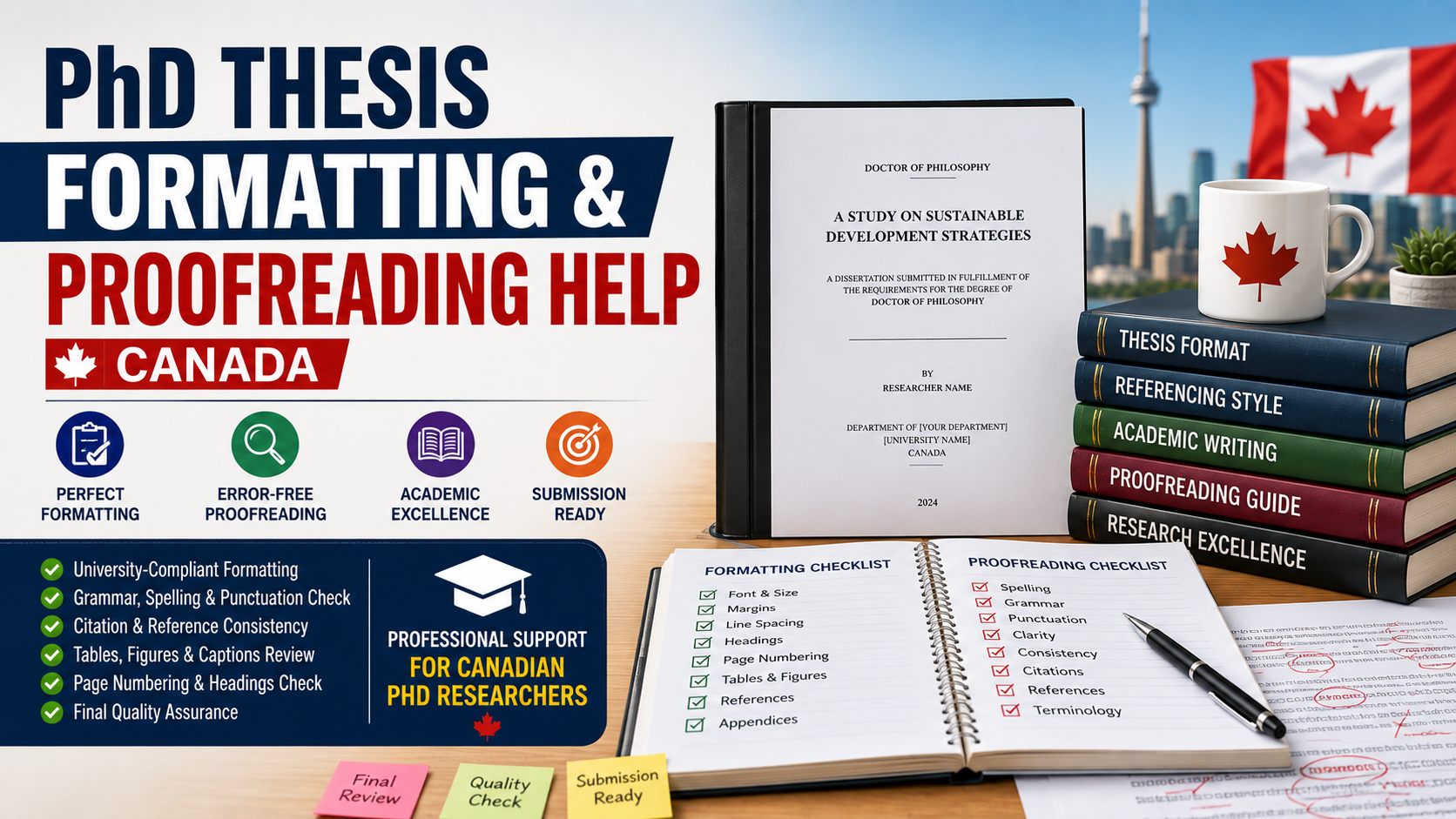
PhD thesis formatting and proofreading help in Canada can support doctoral researchers with document presentation, academic language, consistency, references, headings, tables, figures, pagination and final quality checks.
Formatting and proofreading are not the same as rewriting a researcher's intellectual contribution. The researcher remains responsible for the research, arguments, analysis, interpretation and final thesis.
This guide explains what PhD thesis formatting and proofreading involve, what researchers should check before submission and how professional support can fit into the final stages of doctoral research.
What Is PhD Thesis Formatting?
PhD thesis formatting is the process of preparing a doctoral thesis according to the presentation and submission requirements of the relevant university, faculty or graduate program.
Formatting can involve:
Page size
Margins
Font
Font size
Line spacing
Paragraph formatting
Headings
Subheadings
Page numbers
Chapter numbering
Tables
Figures
Captions
Equations
References
Appendices
Table of contents
Lists of figures
Lists of tables
Front matter
Headers and footers
PDF preparation
Exact requirements can vary between Canadian universities and programs, so researchers should always check their current institutional guidelines.
What Is PhD Thesis Proofreading?
PhD thesis proofreading is the final review of an existing thesis to identify errors and inconsistencies before submission.
Proofreading may identify:
Spelling errors
Grammar errors
Punctuation mistakes
Typographical errors
Missing words
Repeated words
Inconsistent terminology
Inconsistent capitalisation
Formatting inconsistencies
Citation inconsistencies
Reference-list errors
Heading inconsistencies
Table and figure issues
Proofreading is generally performed after substantial writing and revision have been completed.
What Is the Difference Between Formatting and Proofreading?
Formatting and proofreading address different aspects of a thesis.
Formatting | Proofreading |
|---|---|
Focuses on document presentation | Focuses on language and errors |
Checks margins | Checks spelling |
Checks fonts | Checks grammar |
Checks headings | Checks punctuation |
Checks pagination | Checks typographical errors |
Checks tables and figures | Checks consistency |
Checks contents pages | Checks references |
Checks front matter | Checks citations |
A final thesis review may require both.
What Does PhD Thesis Formatting Help in Canada Include?
Depending on the university and researcher's requirements, formatting support may include:
Document formatting
Page dimensions
Margins
Fonts
Line spacing
Paragraph spacing
Indentation
Page breaks
Thesis structure
Title page
Abstract
Acknowledgements
Dedication where applicable
Table of contents
List of tables
List of figures
Abbreviations
Chapters
References
Appendices
Visual consistency
Heading hierarchy
Table formatting
Figure placement
Caption formatting
Equation formatting
Numbering systems
Cross-references
Final document preparation
Page-number verification
Contents-page updates
PDF conversion
Hyperlink checks
Final layout inspection
What Does PhD Thesis Proofreading Help Include?
Professional proofreading may cover several levels of consistency.
Grammar
The proofreader can identify grammatical errors that remain after drafting and revision.
Spelling
This includes obvious spelling mistakes as well as inconsistent spelling conventions.
Punctuation
Checks may include:
Commas
Full stops
Colons
Semicolons
Quotation marks
Apostrophes
Hyphens
Academic Language
Proofreading may identify awkward or unclear sentences while preserving the researcher's intended meaning.
Terminology
Technical terms should be used consistently throughout the thesis.
For example, if a researcher uses two different terms for the same concept, the terminology should be reviewed.
Why Is Thesis Formatting Important for Canadian PhD Students?
Formatting is not simply a cosmetic exercise.
A thesis is a formal academic document, and universities may establish specific requirements for how dissertations and theses should be presented.
Formatting can affect:
Professional presentation
Document navigation
Readability
Accessibility
Consistency
Submission readiness
More importantly, institution-specific requirements take priority.
A formatting style that works for one Canadian university may not satisfy another university's requirements.
What Should a PhD Thesis Formatting Checklist Include?
A comprehensive formatting review can include the following.
Page Setup
Correct paper size
Correct margins
Consistent page orientation
Correct page numbering
Appropriate section breaks
Typography
Approved font
Consistent font size
Consistent line spacing
Consistent paragraph spacing
Consistent indentation
Headings
Chapter titles are consistent
Heading hierarchy is logical
Heading numbering is consistent
Heading styles are applied consistently
Contents page matches headings
Tables
Table numbers are sequential
Table titles are consistent
Table captions follow requirements
Tables fit within page boundaries
Tables are referenced in the text
Figures
Figure numbers are sequential
Figure captions are consistent
Figures are readable
Figures are correctly positioned
Figures are referenced in the text
References
Citation style is consistent
Reference formatting is consistent
In-text citations appear in the reference list where required
Reference-list entries are complete
URLs or DOIs are presented consistently where required
Appendices
Appendices are correctly labelled
Appendix titles are consistent
Appendices are referenced in the main text
Appendix pagination is correct
How Should a PhD Thesis Be Structured?
The exact structure varies by discipline and university.
A traditional doctoral thesis may contain:
Title page
Abstract
Acknowledgements
Table of contents
List of tables
List of figures
Abbreviations or glossary where applicable
Introduction
Literature review
Methodology
Results or findings
Discussion
Conclusion
References
Appendices
Some doctoral programs use alternative formats, including thesis-by-publication or manuscript-based dissertations.
Researchers should follow their specific doctoral-program requirements.
How Can a Proofreader Improve a PhD Thesis?
A proofreader can help identify problems that are easy to overlook after months or years of working on the same document.
Common examples include:
A chapter heading that uses different capitalisation
A figure referenced using the wrong number
A missing comma
A duplicated word
An inconsistent abbreviation
A citation with inconsistent formatting
A reference missing publication information
An incorrect page number
A heading missing from the table of contents
These small inconsistencies can become difficult to identify when researchers are focused primarily on their research argument.
What Is Final Thesis Proofreading?
Final proofreading is the last detailed review performed after major revisions are complete.
A final proofreading pass should ideally check the thesis as a complete document rather than treating every chapter as an isolated file.
This matters because errors can occur between chapters.
For example:
Chapter 2 calls something "Table 4.1"
Chapter 4 contains the actual table
The table is numbered differently
The contents page contains an outdated heading
A reference is cited differently in different chapters
A complete final review can identify these cross-document inconsistencies.
What Should Be Checked in the Table of Contents?
The table of contents should be reviewed carefully.
Check:
Chapter titles
Section titles
Subsection titles
Heading levels
Page numbers
Indentation
Numbering
Spacing
The contents page should correspond to the final thesis rather than an earlier version.
If Word or another document editor is being used, researchers should update the table of contents after major structural changes.
What Should Be Checked in Tables and Figures?
Tables and figures deserve special attention because formatting mistakes can easily affect readability.
Check:
Numbering
Captions
Positioning
Size
Font
Alignment
Referencing
Cross-references
Page breaks
Source notes where applicable
A figure should not be accidentally separated from its caption or rendered too small to read.
How Important Is Reference Formatting?
Reference consistency is particularly important in a PhD thesis because doctoral research typically involves a substantial body of scholarly literature.
A final reference review can check:
Author names
Publication years
Titles
Journal names
Volume and issue information
Page ranges
Publishers
DOI information
URLs where applicable
In-text citations
Reference-list consistency
The required citation style may vary by discipline and university.
Researchers should use the style specified by their doctoral program.
What Is Citation Checking?
Citation checking involves comparing citations in the thesis against the reference list.
A review can identify:
Missing references
A source cited in the thesis but absent from the reference list.
Unused references
A reference listed at the end but apparently not cited in the thesis.
Inconsistent names
For example, an author's name may be spelled differently in different locations.
Incorrect dates
The year in the citation may not match the reference entry.
Formatting inconsistencies
Different references may follow different formatting conventions.
Citation checking should complement, not replace, the researcher's responsibility to verify sources.
Can PhD Thesis Formatting Help Include LaTeX Formatting?
Yes. Researchers working with LaTeX may need help checking:
Chapter structure
Section hierarchy
Bibliography formatting
Figure placement
Table formatting
Equation numbering
Cross-references
Page layout
Contents generation
Appendix structure
LaTeX formatting requirements can differ from those of Microsoft Word or other document editors.
The final output should follow the relevant university requirements.
Can PhD Thesis Proofreading Help With Academic English?
Yes.
Researchers whose first language is not English may particularly benefit from a final language review.
Possible areas include:
Grammar
Sentence structure
Academic vocabulary
Clarity
Conciseness
Transitions
Terminology
Consistency
The objective should be to improve the presentation of the researcher's existing ideas rather than replace the researcher's intellectual voice.
Can International PhD Students in Canada Use Thesis Proofreading Services?
International PhD students may seek proofreading or editing assistance where permitted by their university and doctoral program.
However, researchers should check:
Academic-integrity policies
Thesis guidelines
Program requirements
Supervisor expectations
Rules regarding external editing
Rules concerning AI-assisted editing
University policies can change, so researchers should rely on current institutional guidance.
Can Someone Rewrite My Entire PhD Thesis?
Researchers should distinguish between proofreading/editing and substantive rewriting.
Proofreading generally focuses on correcting errors.
Editing can improve clarity and consistency.
Substantive rewriting may alter the researcher's argument, interpretation or intellectual contribution.
Before using extensive external writing assistance, researchers should verify what their university permits.
The researcher should retain responsibility for:
Research
Arguments
Analysis
Interpretation
Conclusions
Intellectual contribution
What Is PhD Thesis Formatting and Proofreading Help?
PhD thesis formatting and proofreading help is academic support designed to improve the presentation, consistency and language of an existing doctoral thesis before submission.
It may include:
Formatting
Proofreading
Citation checking
Reference checking
Table and figure review
Heading consistency
Pagination
Contents-page checking
Academic-language editing
Final document review
The exact scope should be agreed upon before work begins.
How Should Canadian Researchers Choose a PhD Thesis Proofreading Service?
Before choosing a service, consider the following.
1. PhD-Level Experience
A doctoral thesis is substantially more complex than a standard essay.
2. Subject Expertise
A technical thesis may require familiarity with discipline-specific terminology.
3. Formatting Experience
Ask whether the provider has experience working with lengthy academic documents.
4. Citation Knowledge
Confirm that the provider understands the required citation style.
5. Editing Scope
Clarify whether the service provides proofreading, copy editing, structural feedback or another type of support.
6. University Requirements
The provider should be able to work from the researcher's official formatting guidelines.
7. Confidentiality
Researchers should understand how their thesis files are stored and handled.
8. Revision Policy
Clarify whether revisions following supervisor comments are included.
9. Academic Integrity
Ensure that the service does not encourage plagiarism, fabricated sources or misrepresentation of authorship.
What Should Researchers Give a Thesis Formatter or Proofreader?
Where external support is permitted, useful materials may include:
Current thesis draft
University thesis guidelines
Faculty formatting requirements
Referencing style
Supervisor feedback
Previous corrections
Formatting templates
List of required changes
Specific sections requiring proofreading
Providing the official guidelines can reduce the risk of applying an inappropriate formatting style.
When Should You Get Your PhD Thesis Proofread?
Ideally, proofreading should not be left until the final few hours before submission.
A practical workflow is:
Complete Draft → Supervisor Feedback → Major Revisions → Structural Review → Formatting → Editing → Proofreading → Final Citation Check → PDF Review → Submission
Starting earlier provides time to correct problems that require more than simple proofreading.
How Many Proofreading Passes Should a PhD Thesis Have?
There is no universal number.
A useful approach is to perform several different checks rather than expecting one proofreading pass to identify every possible problem.
Pass 1: Structural Review
Check:
Chapter order
Headings
Contents
Tables
Figures
Appendices
Pass 2: Language Review
Check:
Grammar
Spelling
Punctuation
Clarity
Terminology
Pass 3: Citation Review
Check:
In-text citations
References
Citation consistency
Pass 4: Formatting Review
Check:
Margins
Fonts
Page numbers
Tables
Figures
Headings
Pass 5: Final PDF Review
Inspect the actual PDF that will be submitted.
This final step is important because formatting can change during PDF generation.
What Are Common PhD Thesis Formatting Mistakes?
Common issues include:
Incorrect margins
Inconsistent fonts
Incorrect heading levels
Missing page numbers
Incorrect chapter numbering
Broken table of contents
Inconsistent figure captions
Incorrect table numbering
Poor page breaks
Figures extending beyond margins
Inconsistent reference formatting
Missing citations
Incorrect appendix labels
Blank pages appearing unexpectedly
Broken hyperlinks
Incorrect PDF bookmarks
What Are Common PhD Proofreading Mistakes?
Common language problems include:
Typographical errors
Repeated words
Inconsistent spelling
Sentence fragments
Incorrect punctuation
Long or unclear sentences
Inconsistent terminology
Incorrect abbreviations
Subject-verb agreement errors
Inconsistent capitalisation
A final proofreading process should also check consistency across the entire thesis.
How Can Supervisor Feedback Affect Formatting and Proofreading?
Supervisor feedback can introduce additional changes to a thesis.
For example, a supervisor may request:
New sections
Revised headings
Additional tables
New figures
Reordered content
Additional references
Changes to terminology
After these changes, the contents page, numbering, citations and formatting may need another review.
A useful workflow is:
Supervisor Feedback → Revision → Formatting Update → Citation Check → Proofreading → Final Review
PhD Thesis Submission Checklist for Canadian Researchers
Before submitting, review the following.
Academic Content
All required chapters are included
Research questions are consistent
Objectives are consistent
Tables and figures are complete
Conclusions correspond to the research
Supervisor feedback has been addressed
Formatting
Correct margins
Correct font
Correct spacing
Correct page numbers
Correct heading styles
Correct chapter numbering
Contents page updated
List of figures updated
List of tables updated
Appendices formatted correctly
References
Citations are consistent
References are complete
Citation style is correct
DOI/URL formatting is consistent where required
References have been checked against citations
Proofreading
Spelling checked
Grammar checked
Punctuation checked
Terminology checked
Abbreviations checked
Tables checked
Figures checked
Cross-references checked
Final File
PDF generated correctly
Pages display correctly
No unexpected blank pages
Figures remain readable
Tables fit correctly
Links work where required
File name follows requirements
Submission instructions have been followed
Can AI Be Used for PhD Thesis Proofreading?
AI tools can potentially assist with tasks such as:
Identifying grammatical errors
Suggesting clearer wording
Creating checklists
Detecting repeated phrases
Organising formatting tasks
However, researchers should check their university's current rules regarding generative AI.
AI-generated suggestions should be reviewed carefully because automated systems can:
Change intended meaning
Introduce inaccurate terminology
Create incorrect citations
Remove important qualifications
Misinterpret technical language
AI should therefore supplement, rather than replace, the researcher's final review.
How Can Researchers Protect Their Thesis When Using External Support?
Researchers should avoid sharing unnecessary sensitive information.
Before using an external service, consider:
Confidentiality policy
File-storage practices
Data-security procedures
Deletion policies
Staff access
Use of third-party tools
AI processing
Research-participant information
If a thesis contains confidential research data or personally identifiable information, researchers should follow the relevant institutional requirements before sharing files externally.
Can Thesis Proofreading Guarantee PhD Approval?
No legitimate proofreading or formatting service can guarantee PhD approval, thesis acceptance or a particular academic outcome.
Thesis outcomes depend on factors such as:
Research quality
Original contribution
Methodology
Analysis
Scholarly argument
Academic standards
Supervisor and committee expectations
Examination requirements
Formatting and proofreading can improve presentation, but they cannot guarantee the academic quality or outcome of a doctoral thesis.
Final Thoughts
A PhD thesis is the culmination of substantial research and scholarly work. Formatting and proofreading are therefore important final-stage processes that help ensure the document communicates that work clearly and consistently.
PhD thesis formatting and proofreading help in Canada can support researchers with document formatting, academic language, citation consistency, references, tables, figures, headings, pagination and final submission preparation.
However, requirements vary across Canadian universities and doctoral programs. Researchers should always follow their institution's current thesis guidelines and academic-integrity policies.
The most practical final workflow is:
Complete Thesis → Supervisor Feedback → Major Revisions → Structural Review → Formatting → Editing → Proofreading → Citation Check → Final PDF Inspection → University Submission
The researcher remains responsible for the thesis's research, analysis, interpretation, arguments and original intellectual contribution.
Frequently Asked Questions
Everything you need to know about our services


