NVivo Analysis Help for Qualitative Research
Introduction
Qualitative research can produce rich and detailed data, but analysing that data can become challenging when your dissertation includes dozens of interviews, focus groups, documents, observations, or open-ended survey responses.
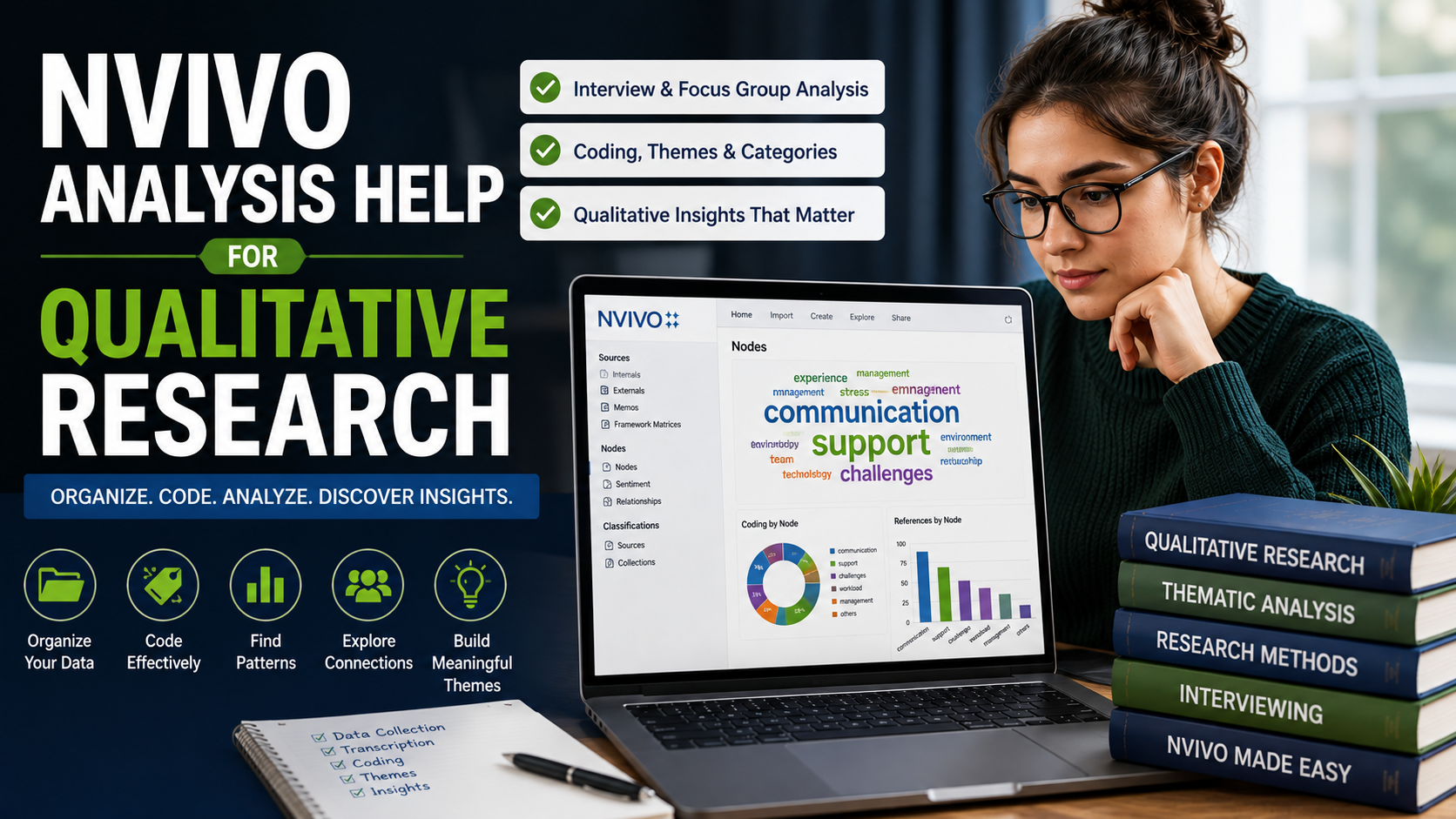
You may have collected excellent data but still be unsure how to organise it, identify meaningful themes, develop codes, compare participant responses, or explain your findings academically.
This is where NVivo analysis help for qualitative research can be valuable.
NVivo is qualitative data analysis software designed to help researchers organise, code, explore, and analyse different types of qualitative data. However, NVivo does not automatically perform the intellectual work of qualitative research. The researcher still needs to make decisions about coding, themes, interpretation, methodology, and theoretical meaning.
This guide explains how NVivo can support qualitative dissertation research, how to approach coding and thematic analysis, common mistakes to avoid, and how appropriate academic support can help you strengthen your research.
What Is NVivo?
NVivo is qualitative data analysis software used by researchers to organise and analyse non-numerical or unstructured data.
Depending on the research project and software capabilities, researchers may use NVivo to work with materials such as:
Interview transcripts
Focus-group transcripts
Open-ended questionnaire responses
Documents
Reports
Articles
Field notes
Audio or video materials
Images
Web-related research materials
NVivo can help researchers organise large amounts of information and systematically examine patterns within their data.
It can be particularly useful when a dissertation involves substantial qualitative material that would be difficult to manage manually.
However, software should support the research process rather than replace qualitative interpretation.
Why Is Qualitative Data Analysis Difficult?
Qualitative data is often detailed, contextual, and open to interpretation.
An interview may contain hundreds of statements, but not every statement has equal relevance to your research questions.
A researcher may need to determine:
Which sections of the data are relevant?
What concepts appear repeatedly?
Which ideas are connected?
Are participants expressing similar experiences?
Are there meaningful differences between groups?
What themes are emerging?
How do the findings relate to previous research?
How should the findings be interpreted?
This requires careful reading and methodological judgement.
Simply importing transcripts into NVivo does not automatically produce valid research findings.
What Can NVivo Be Used For?
NVivo can support several stages of qualitative research.
Common uses include:
Data organisation
Keeping transcripts, documents, notes, and other research materials organised.
Coding
Assigning codes to relevant sections of qualitative data.
Categorisation
Grouping related codes into broader categories or concepts.
Theme development
Identifying broader patterns or themes within the dataset.
Data comparison
Comparing responses across participants or groups where appropriate.
Querying
Exploring relationships, word patterns, coding patterns, or other features of the dataset using appropriate NVivo functions.
Data visualisation
Creating certain diagrams, models, charts, or visual representations to help explore qualitative data.
The specific features available can depend on the NVivo version and research workflow.
What Is Coding in Qualitative Research?
Coding is the process of assigning labels or concepts to relevant sections of qualitative data.
Suppose a participant says:
"I often feel that my manager doesn't listen when I raise concerns."
A researcher might initially assign a code such as:
Lack of managerial responsiveness
Another participant might say:
"When I have a problem, I don't feel comfortable approaching my supervisor."
This could potentially be coded as:
Reluctance to communicate with management
Later, these codes might contribute to a broader category or theme related to:
Barriers to workplace communication
The exact coding depends on your research question, methodology, theoretical framework, and interpretation.
There is no universal rule that determines the "correct" code for every piece of qualitative data.
What Is a Node in NVivo?
In NVivo terminology, researchers commonly use nodes to organise coded material.
A node can represent a:
Concept
Topic
Theme
Category
Participant characteristic
Research question
Analytical idea
For example, a qualitative study about remote working might contain nodes such as:
Work-life balance
Communication
Productivity
Isolation
Managerial support
Technology challenges
Researchers can organise these nodes into broader structures where appropriate.
The exact node structure should reflect the methodology and analytical strategy rather than simply creating as many nodes as possible.
What Is Thematic Analysis?
Thematic analysis is a common approach to identifying and interpreting patterns or themes within qualitative data.
A simplified thematic-analysis workflow might involve:
Familiarising yourself with the data
Generating initial codes
Searching for potential themes
Reviewing themes
Defining and naming themes
Producing the final analysis
NVivo can assist with the organisation and management of coding throughout this process.
However, the software does not decide what a theme means.
The researcher remains responsible for interpreting the data and explaining why particular patterns are meaningful.
NVivo and Thematic Analysis
NVivo can be particularly useful when your dissertation uses thematic analysis and contains a large qualitative dataset.
For example, imagine that you conduct 20 semi-structured interviews examining how postgraduate students experience academic pressure.
Your transcripts may contain references to:
Assignment deadlines
Financial concerns
Employment
Family responsibilities
Academic expectations
Supervisor relationships
Sleep
Time management
Social support
You could begin by coding relevant sections of each transcript.
After reviewing the codes, you might identify broader patterns such as:
Theme 1: Managing competing responsibilities
Potential codes:
Employment
Family commitments
Time pressure
Scheduling difficulties
Theme 2: Academic expectations
Potential codes:
Performance pressure
Fear of failure
Assessment expectations
Supervisor feedback
Theme 3: Sources of support
Potential codes:
Friends
Family
Supervisors
University services
These themes should emerge from a systematic analytical process rather than being created simply because they sound logical.
Step 1: Understand Your Research Questions
Before coding your data, return to your research questions.
For example:
How do postgraduate students experience academic pressure during their degree?
Your analysis should remain connected to this question.
You may find interesting information in the interviews that is unrelated to your research objectives.
Not every interesting statement needs to become a major analytical theme.
A useful question to ask is:
How does this piece of data help answer my research question?
This keeps your analysis focused.
Step 2: Familiarise Yourself With the Data
Before creating hundreds of codes, become familiar with your dataset.
Read your transcripts carefully.
Look for:
Repeated ideas
Important experiences
Contradictions
Unexpected findings
Differences between participants
Significant events
Language participants use repeatedly
Connections with your research questions
Make analytical notes where appropriate.
Qualitative analysis is not simply a software task.
It begins with close engagement with the data.
Step 3: Import and Organise Your Data
Once your data is prepared, organise the relevant files within your NVivo project.
Depending on your research design, you may organise data according to:
Participant
Interview
Location
Date
Organisation
Demographic characteristics
Research group
Data source
A clear structure makes later analysis easier.
Before importing data, check that your transcripts are accurate and appropriately anonymised where required.
Step 4: Create Initial Codes
Start coding relevant sections of your data.
Codes should capture something meaningful about the content.
For example, an interview about workplace experiences might contain codes such as:
Workplace autonomy
Managerial support
Job insecurity
Communication problems
Career progression
Workload
Employee recognition
Don't worry about creating a perfect final codebook immediately.
Qualitative coding is often iterative.
Your codes may change as your understanding of the dataset develops.
Step 5: Develop a Coding Framework
As coding progresses, you may notice that some codes overlap.
You can review your coding framework and consider whether certain codes should be:
Combined
Separated
Renamed
Moved
Reorganised
Removed
For example:
Initial codes
Email problems
Video-call problems
Software problems
Internet problems
could potentially contribute to a broader category such as:
Technology barriers
However, whether these should be combined depends on your research question and analytical approach.
Don't merge codes simply to make your NVivo project look simpler.
Step 6: Develop Categories
Categories can help organise related codes.
For example:
Category: Workplace Support
Possible codes:
Managerial support
Peer support
Training
Feedback
Recognition
Category: Workplace Challenges
Possible codes:
Workload
Communication problems
Technology difficulties
Job insecurity
Categories can help you move from individual pieces of data toward broader analytical patterns.
Step 7: Identify Potential Themes
Themes represent broader patterns that are meaningful to your research question.
A theme should generally communicate more than a topic label.
For example:
Technology
may simply identify a topic.
A more analytical theme might be:
Technology as a source of both flexibility and workplace frustration
The second formulation begins to communicate an interpretation of the data.
Your themes should be supported by evidence from the dataset and connected to your research objectives.
Step 8: Review Your Themes
Don't assume that your first set of themes is final.
Review each theme and ask:
Does this theme have enough supporting data?
Are the coded extracts coherent?
Is the theme distinct from other themes?
Does it answer the research question?
Is it too broad?
Is it too narrow?
Does it represent the dataset accurately?
Is there contradictory evidence?
You may need to merge, split, rename, or remove themes.
This is an important part of qualitative analysis.
Step 9: Interpret the Data
Coding tells you what sections of data are related to particular concepts.
Interpretation asks:
What does this mean?
Suppose multiple participants report that they rarely communicate with their supervisors.
A basic description might be:
Participants reported limited communication with supervisors.
A deeper interpretation might consider:
Limited supervisor communication appeared to influence participants' perceptions of academic uncertainty and their ability to seek timely guidance.
The second statement requires evidence and careful interpretation.
Do not make claims that go beyond what your data can support.
Step 10: Compare Participants and Groups
Depending on your research design, you may want to compare qualitative data across groups.
For example, you might compare:
Undergraduate vs postgraduate participants
Junior vs senior employees
Different age groups
Different organisations
Different geographic locations
Different professional roles
NVivo can help organise and retrieve coded material associated with different participant characteristics.
However, comparisons should be theoretically and methodologically justified.
Not every difference between participants represents a meaningful research finding.
Step 11: Use Memos and Analytical Notes
Analytical memos can help you record your thinking during the research process.
You might note:
Why a code was created
Why two codes were merged
Why a theme was changed
Emerging interpretations
Contradictory evidence
Questions for further investigation
Connections with academic literature
Keeping an analytical record can help make your research process more transparent and easier to explain later.
Step 12: Maintain an Audit Trail
An audit trail documents important decisions made during the research process.
It can include information about:
Coding decisions
Changes to the codebook
Theme development
Analytical decisions
Methodological changes
Data-management decisions
The exact requirements depend on your qualitative methodology.
An audit trail can also help you explain your analytical process when writing your methodology chapter.
NVivo Does Not Replace the Researcher
One of the most important principles to understand is:
NVivo helps manage qualitative data; it does not replace qualitative interpretation.
The software can help you:
Store data
Organise codes
Retrieve coded sections
Compare data
Explore patterns
Manage large datasets
But the researcher must determine:
What the data means
Which findings matter
How themes relate to the research question
How interpretations are justified
How findings connect with existing research
This distinction is particularly important at Master's and PhD level.
Common NVivo Analysis Mistakes
1. Creating Too Many Codes
Having hundreds of tiny codes can make your analysis difficult to manage.
Create codes that are analytically useful rather than coding every sentence unnecessarily.
2. Treating Frequency as Importance
A theme mentioned frequently is not automatically the most important finding.
Qualitative significance is not always determined by counting mentions.
3. Creating Themes Before Reading the Data
You should remain open to unexpected findings.
Your theoretical framework may guide your analysis, but your data may reveal patterns you did not anticipate.
4. Confusing Topics With Themes
A topic describes what participants discussed.
A theme should communicate a meaningful pattern or interpretation relevant to the research question.
5. Using Software Output as Findings
NVivo reports and visualisations are not automatically your research findings.
You must interpret them within your methodological framework.
6. Ignoring Contradictory Evidence
Not every participant needs to agree.
Contradictions can be analytically valuable.
7. Losing the Link to Research Questions
Your coding and themes should ultimately help answer your research questions.
8. Treating NVivo as a Substitute for Methodology
Using NVivo does not automatically make research rigorous.
Your dissertation still needs a clear explanation of:
Research methodology
Sampling
Data collection
Coding approach
Analytical strategy
Researcher reflexivity where relevant
Ethical considerations
Trustworthiness or other relevant quality criteria
How to Improve the Quality of NVivo Analysis
A strong qualitative analysis should demonstrate a clear connection between:
Research Questions → Data → Coding → Categories → Themes → Interpretation → Conclusions
You can strengthen your analysis by:
Reading the data repeatedly
Familiarity with the dataset helps you recognise context and nuance.
Keeping your research questions visible
Use them to guide your analytical decisions.
Documenting coding decisions
Maintain a clear record of important changes.
Looking for contradictions
Unexpected findings can be analytically valuable.
Supporting interpretations with evidence
Use appropriate participant quotations to demonstrate how your interpretation is grounded in the data.
Connecting findings with literature
Your discussion should explain how your findings relate to previous research.
Maintaining reflexivity
Where relevant to your methodology, consider how your position, assumptions, and relationship with participants may influence the research process.
How to Present NVivo Findings in a Dissertation
Your dissertation should not simply contain screenshots of NVivo.
Instead, present your findings as an organised academic argument.
A qualitative findings chapter might be structured around major themes.
For example:
Theme 1: Navigating Academic Expectations
Discuss the theme and explain its relevance to the research question.
Then provide carefully selected participant quotations.
Theme 2: Experiences of Supervisor Support
Explain the pattern identified across the data.
Use relevant evidence from participants.
Theme 3: Developing Strategies for Managing Pressure
Discuss how participants described their responses and coping strategies.
The exact structure depends on your research methodology and research questions.
How to Use Participant Quotations
Participant quotations can provide evidence for your interpretation.
However, avoid filling the chapter with long blocks of quotations.
A useful pattern is:
Interpretation → Evidence → Explanation
For example:
Participants frequently described uncertainty surrounding supervisor expectations. One participant explained that they "were never completely sure what the supervisor expected." This suggests that unclear communication may have contributed to participants' perceptions of academic uncertainty.
The quotation supports the interpretation rather than replacing it.
Always follow your institution's ethical and confidentiality requirements when presenting participant data.
NVivo and Different Qualitative Methodologies
NVivo can be used within different qualitative research approaches, but the analytical process should be consistent with the methodology you have selected.
Depending on the research project, qualitative methodologies may include:
Phenomenology
Grounded theory
Case study
Ethnography
Narrative research
Thematic approaches
Content analysis
Discourse analysis
The fact that NVivo can perform a particular function does not mean that the function is appropriate for every methodology.
Your methodological framework should determine how you analyse and interpret the data.
When Should You Get NVivo Analysis Help?
Appropriate academic guidance may be useful if:
You are unsure how to organise your NVivo project.
You have too many codes.
You cannot identify meaningful themes.
Your themes overlap.
You are struggling to interpret interview data.
You are unsure how to connect codes to research questions.
You need help understanding thematic analysis.
Your supervisor has requested changes to your analysis.
You are struggling to write your qualitative findings chapter.
You need help improving the academic presentation of your analysis.
Getting guidance earlier can give you time to refine your analytical framework before your dissertation deadline.
What to Prepare Before Seeking NVivo Support
If you are seeking academic guidance with qualitative analysis, prepare:
Research questions
Research objectives
Research methodology
Interview or focus-group guide
Anonymised transcripts
Sampling information
Current codebook
Preliminary themes
Supervisor feedback
University requirements
Dissertation structure
This information helps ensure that analytical guidance is connected to your actual research design.
NVivo Analysis Help for Master's and PhD Students
AssignmentCart provides academic support for students working on dissertations, theses, research projects, assignments, and other university-level academic work.
For qualitative research, support can focus on areas such as:
NVivo project organisation
Qualitative coding
Codebook development
Theme organisation
Thematic-analysis guidance
Qualitative findings structure
Interview-data interpretation
Research methodology
Academic writing
Referencing
Editing
Proofreading
If your analysis is already complete, academic editing can help improve the clarity, structure, consistency, and academic presentation of your findings.
Students should always check their university's policies regarding external academic assistance, editing, AI tools, data confidentiality, and academic integrity.
NVivo Qualitative Analysis Checklist
Before submitting your dissertation, check the following.
Research design
Is your qualitative methodology clearly explained?
Are your research questions clearly stated?
Is your sampling strategy justified?
Is your data-collection process explained?
Data preparation
Are transcripts accurate?
Has confidential information been appropriately handled?
Are participants anonymised where required?
Is your dataset organised?
Coding
Is your coding approach clearly explained?
Are codes relevant to your research questions?
Have important coding decisions been documented?
Themes
Are your themes meaningful?
Are themes distinct?
Is each theme supported by evidence?
Have contradictory findings been considered?
Interpretation
Does your analysis go beyond description?
Are interpretations grounded in the data?
Have you avoided unsupported claims?
Have you connected findings to existing research?
Presentation
Are quotations used selectively?
Are participant identities protected?
Are tables or visualisations genuinely useful?
Does your findings chapter answer the research questions?
Conclusion
NVivo can make qualitative research data easier to organise, code, retrieve, and explore, particularly when a dissertation involves a large collection of interviews, documents, focus groups, or other qualitative materials.
However, effective qualitative analysis is not simply a matter of importing transcripts into NVivo and generating codes.
A strong analysis requires a clear methodological foundation and thoughtful interpretation:
Research Questions → Data → Coding → Categories → Themes → Interpretation → Findings → Discussion
The researcher remains responsible for deciding what the data means, how themes are developed, how contradictory evidence is handled, and how findings contribute to the research question.
If you are struggling with NVivo analysis, appropriate academic support can help you understand coding, organise your qualitative data, review your analytical framework, improve your findings structure, and present your research more clearly.
The goal should not be to produce the largest number of codes or the most complicated NVivo project. The goal is to develop a transparent, coherent, well-supported qualitative analysis that answers your research questions and is consistent with your chosen methodology.
Before using external support, always check your university's academic-integrity and third-party assistance requirements, and protect the confidentiality of research participants and research data.
Frequently Asked Questions
Everything you need to know about our services
Related Posts

NVivo Analysis Help for Qualitative Research in Singapore

NVivo Analysis Help for Qualitative Research in Ireland
