Master's Thesis Proofreading Checklist for Canadian Students
Introduction
A master's thesis is the culmination of months or years of research, writing and revision. Before submitting the final version, Canadian graduate students should conduct a detailed proofreading review covering grammar, spelling, academic language, citations, references, headings, tables, figures, page numbers, formatting and consistency.
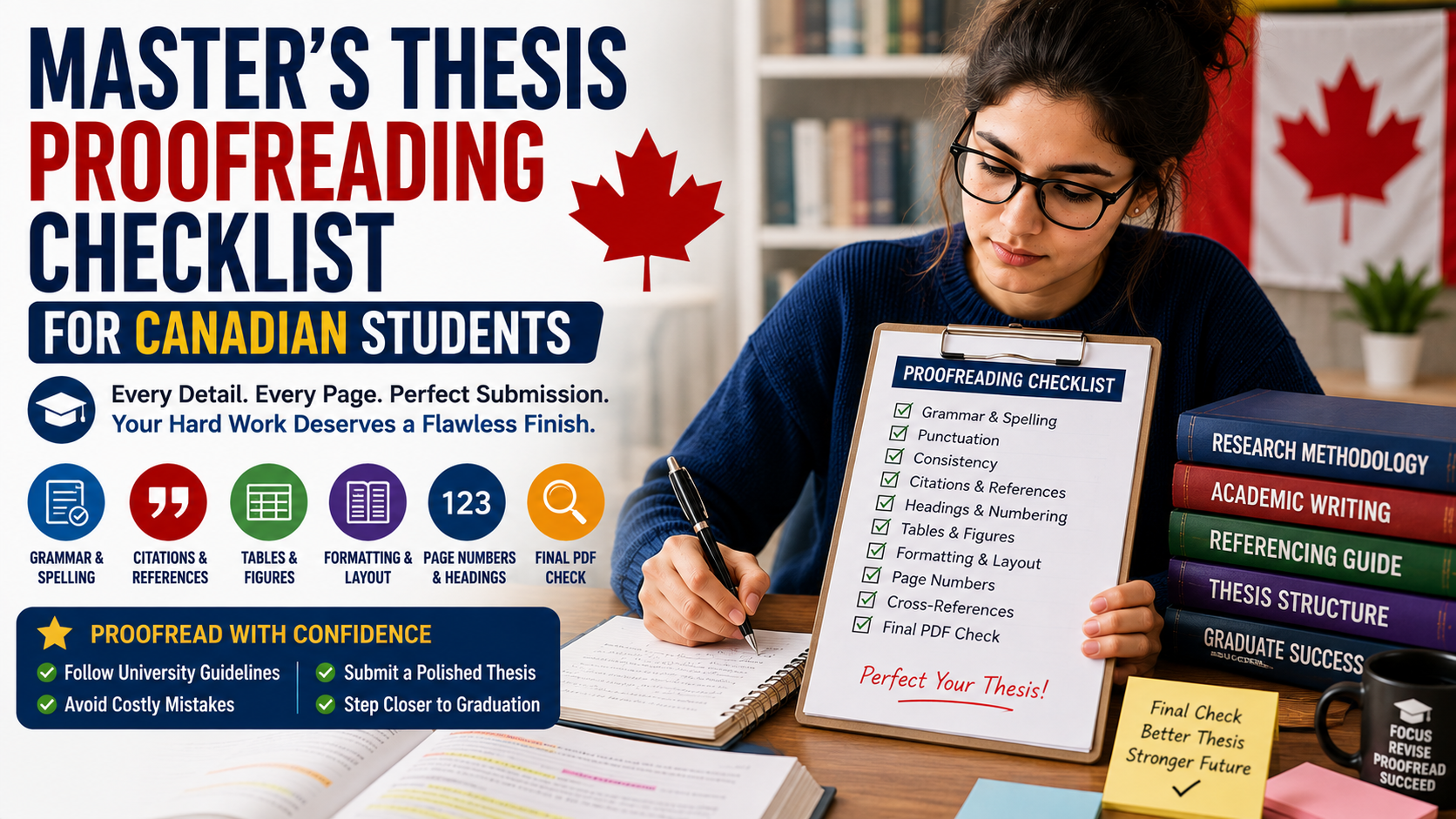
A master's thesis proofreading checklist helps students identify small errors that can remain hidden after multiple rounds of editing. It also helps separate proofreading from larger academic revisions that should be handled with the student's supervisor or supervisory committee.
The University of British Columbia states that students are responsible for proofreading their thesis carefully and checking that the final version is complete, accurate and free of errors. UBC specifically recommends checking numbering, abbreviations, units, symbols, headings, line spacing, tables, typographical errors and grammatical errors.
The University of Toronto similarly requires students in thesis programs to complete required corrections and ensure the final thesis is correctly formatted before completing their degree requirements.
What Is Master's Thesis Proofreading?
Master's thesis proofreading is the final review of an existing thesis to identify and correct errors in spelling, grammar, punctuation, formatting, consistency, references and presentation.
Proofreading is different from rewriting or conducting new research.
A proofreading review may check:
Spelling
Grammar
Punctuation
Typographical errors
Sentence-level consistency
Headings
Capitalisation
Abbreviations
Units
Symbols
Tables
Figures
Page numbers
Citations
References
Cross-references
Formatting consistency
The goal is to make the final document accurate, consistent and professionally presented.
Why Is Thesis Proofreading Important for Canadian Students?
A thesis contains many interconnected elements. A small error can appear in several places.
For example, a change to a chapter title may require updates to:
Table of contents
Chapter heading
Cross-references
Running headers
Supervisor feedback documents
Similarly, changing a table number can require changes to references throughout the thesis.
UBC advises students to carefully proofread their thesis and notes that errors cannot simply be corrected after the final thesis has been accepted into its repository.
This makes the final proofreading stage particularly important.
Master's Thesis Proofreading Checklist
Use the following checklist before submitting your final thesis.
1. Check the Title Page
Review the title page for:
Correct thesis title
Correct student name
Correct degree name
Correct department or program
Correct university name
Correct submission wording
Correct date
Required institutional formatting
Correct capitalisation
Do not assume that another university's title-page format applies to your institution.
2. Check the Committee Page
If your university requires a committee page, confirm:
All required committee members are listed
Names are spelled correctly
Academic titles are correct
Required signatures or approvals are present
Committee roles are correctly identified
Formatting follows university requirements
UBC provides specific Master's and doctoral committee-page templates and examples as part of its thesis preparation resources.
3. Proofread the Abstract
The abstract should be checked separately from the main thesis.
Look for:
Grammar errors
Spelling errors
Unclear sentences
Incorrect terminology
Inconsistent research objectives
Incorrect methodology description
Incorrect findings
Incorrect numerical values
Incorrect conclusion
Unnecessary repetition
Most importantly, make sure the abstract accurately reflects the final thesis.
If your research findings changed during revision, update the abstract accordingly.
4. Check the Table of Contents
The table of contents should match the actual thesis.
Check:
Every chapter appears
Chapter titles match
Section titles match
Subsection titles match
Page numbers are correct
Heading hierarchy is consistent
No outdated headings remain
No missing sections appear
UBC's thesis guidance specifies that the table of contents should include the required preliminary pages, main divisions, subdivisions, bibliography and appendices, with appropriate page numbers.
5. Check the List of Tables
If your thesis contains tables, check:
Every table is listed
Table numbers are sequential
Table titles match the thesis
Page numbers are correct
Tables appear in the correct order
Every table is referenced in the text
For example:
Table 1 → Table 2 → Table 3 → Table 4
should not accidentally become:
Table 1 → Table 3 → Table 2 → Table 4
6. Check the List of Figures
Review:
Figure numbers
Figure titles
Figure captions
Page numbers
Cross-references
Figure order
Image quality
Consistent formatting
Every figure referenced in the text should correspond to the correct figure.
7. Check Chapter Headings
Headings should be consistent throughout the thesis.
Check:
Font
Size
Capitalisation
Numbering
Spacing
Alignment
Heading hierarchy
For example:
2.1 Literature Review
2.1.1 Previous Research
2.1.2 Research Gap
should follow the same structural pattern throughout the document.
8. Check Grammar and Sentence Structure
Read the thesis carefully for:
Subject-verb agreement
Verb tense
Articles
Prepositions
Sentence fragments
Run-on sentences
Comma errors
Pronoun consistency
Awkward phrasing
Repeated words
Inconsistent terminology
Do not rely entirely on automated grammar software.
Academic terminology can sometimes be incorrectly flagged by general-purpose grammar tools.
9. Check Spelling
Search for common errors involving:
Research terminology
Author names
University names
Technical terms
Canadian spelling conventions where required
British/American spelling consistency
Abbreviations
Most importantly, choose one spelling convention and apply it consistently unless your discipline or university requires something specific.
10. Check Academic Terminology
Create a list of important terminology used in your thesis.
Check whether each term is used consistently.
For example, do not alternate unnecessarily between:
"participants"
"respondents"
"subjects"
if these terms have different meanings in your research.
Likewise, ensure that key concepts have the same meaning throughout the thesis.
11. Check Abbreviations
The first occurrence of an abbreviation should follow your university or discipline's conventions.
For example:
Artificial Intelligence (AI)
After defining it, use the same abbreviation consistently.
Check:
Every abbreviation is defined where required
Undefined abbreviations are identified
Capitalisation is consistent
Abbreviations are used consistently
Abbreviation lists are updated
12. Check Numbers, Units and Symbols
This is particularly important for science, engineering, health, business and quantitative research.
Check:
Decimal values
Percentages
Currency
Measurement units
Statistical symbols
Mathematical symbols
Greek letters
Superscripts
Subscripts
Negative signs
Special characters
UBC specifically recommends checking consistent abbreviations and units of measurement, as well as correct symbols and special characters.
13. Check Citations
Review every in-text citation.
Ask:
Does every citation refer to a real source?
Is the author's name spelled correctly?
Is the publication year correct?
Is the citation style consistent?
Are page numbers included where required?
Are direct quotations cited correctly?
Are multiple-author citations formatted consistently?
Never fabricate citations or references to fill gaps.
14. Check the Reference List
Your reference list should be checked independently.
Look for:
Missing references
Unused references
Incorrect author names
Incorrect publication years
Incorrect titles
Incorrect journal names
Missing DOI information where required
Incorrect URLs
Incorrect punctuation
Inconsistent formatting
A useful final check is:
In-text citation → Reference list
and then:
Reference list → In-text citation
This two-way check can reveal sources that were accidentally omitted or left unused.
15. Check Your Referencing Style
Your university or graduate program may specify a particular referencing system.
Common systems include:
APA
Chicago
MLA
Vancouver
Harvard
OSCOLA
Discipline-specific styles
UBC advises students to use a style guide approved by their supervisor or graduate program and explains that the style guide affects headings, referencing, bibliographies, tables and figure captions.
Your university's own thesis requirements take priority where they differ from a general style guide.
16. Check Tables
Every table should be reviewed for:
Correct numbering
Correct title
Consistent formatting
Accurate data
Correct units
Clear column headings
Appropriate decimal places
Source information where required
Correct text references
Also check that tables do not split awkwardly across pages unless permitted by your university's formatting rules.
17. Check Figures and Charts
Review:
Figure numbering
Captions
Labels
Axis titles
Units
Legends
Font sizes
Image resolution
References in the text
Consistency between figures
Make sure the final version contains the correct version of every figure.
18. Check Cross-References
Search your thesis for references such as:
"see Chapter 2"
"as shown in Table 4"
"Figure 7 illustrates..."
"see Appendix B"
Then verify every reference.
A common final-draft problem is that the text refers to a table or figure that was renumbered during revision.
19. Check Page Numbers
Review:
Preliminary-page numbering
Main-text numbering
Appendix numbering
Page-number position
Missing page numbers
Duplicate page numbers
Blank pages
Roman versus Arabic numerals where required
Your university may have specific requirements for page numbering.
20. Check Margins and Page Layout
Formatting requirements vary between Canadian universities.
For example, UBC specifies page size, margins, paragraph presentation and chapter placement for its text-based theses.
Check your own institution's requirements for:
Page size
Margins
Line spacing
Paragraph spacing
Font
Font size
Chapter starts
Headers
Footers
Page numbers
Never copy another student's formatting without checking your own university's current requirements.
21. Check Line Spacing and Table Formatting
Look for inconsistent:
Line spacing
Paragraph spacing
Table spacing
Caption spacing
Heading spacing
Indentation
UBC's final-submission guidance specifically recommends checking consistent line spacing and table formatting.
22. Check the Table of Contents After Formatting
Do not generate the table of contents once and assume it remains accurate.
After final formatting:
Update the table of contents.
Check all page numbers.
Check heading text.
Compare the contents page against the actual thesis.
Update it again after any structural change.
23. Check the Introduction
The final introduction should match the final research.
Check:
Research problem
Research questions
Objectives
Scope
Background
Thesis structure
Terminology
If your research questions changed during the thesis process, ensure they are consistent everywhere.
24. Check the Methodology Chapter
Review:
Research design
Participants/sample
Data collection
Instruments
Procedures
Ethical considerations
Analysis methods
Limitations
Ensure that the methodology description accurately represents what you actually did.
25. Check the Results Chapter
Review:
Results match the analysis
Tables contain correct values
Figures contain correct values
Statistical notation is consistent
Results answer the research questions
No unsupported claims are presented as findings
Do not introduce new unsupported conclusions while proofreading.
26. Check the Discussion Chapter
Make sure:
Findings are interpreted correctly
Discussion relates to research questions
Relevant literature is connected to findings
Implications are explained
Limitations are acknowledged
Claims are supported
Conclusions do not exceed the evidence
Proofreading should not change the underlying interpretation of your research without academic justification.
27. Check the Conclusion
Your conclusion should accurately reflect the completed thesis.
Check:
Research questions are addressed
Main findings are summarised
Contribution is explained
Implications are appropriate
Limitations are acknowledged where required
Future research is discussed where appropriate
No new unsupported evidence is introduced
28. Check the Appendices
Review:
Appendix numbering
Appendix titles
References to appendices
Survey instruments
Interview protocols
Additional tables
Supporting documents
Supplementary material
UBC's thesis component guidance includes appendices among the components that may need to appear in the thesis structure and table of contents.
29. Check the PDF
Do not proofread only the Word or LaTeX source file.
Open the actual final PDF.
Check:
No missing pages
No blank pages
No broken tables
No cropped figures
No missing symbols
No incorrect page breaks
No font substitution
No broken hyperlinks
No corrupted characters
No formatting shifts
The PDF you submit should be the version you have actually reviewed.
30. Perform a Final Search-Based Proofread
Use targeted searches for common errors.
Search for:
Double spaces
" "
Incorrect quotation marks
"teh"
"recieve"
"definately"
"occured"
"seperate"
"their" / "there"
"affect" / "effect"
Placeholder text such as "[INSERT]"
"TODO"
"TBC"
"XXX"
Also search for temporary comments and tracked changes.
31. Remove Comments and Track Changes
Before submitting, check:
No Word comments remain
No unresolved tracked changes remain
No hidden text is present
No reviewer notes remain
No placeholder text remains
No draft annotations remain
This is one of the easiest things to overlook during a final submission.
32. Check File Naming
Follow your university's file-naming requirements.
Check:
Correct student identifier if required
Correct thesis title or abbreviated title if required
Correct file extension
No unnecessary duplicate files
Correct final version
University of Toronto's electronic thesis guidance notes that specific formatting and file-naming requirements apply to thesis submissions.
33. Check the Final Submission Requirements
Before uploading, verify:
Submission portal
Deadline
File format
File size
Required forms
Supervisor approval
Required corrections
Copyright requirements
Embargo or restriction requirements
Final formatting requirements
At UBC, for example, a thesis must be approved and accepted into cIRcle—not merely submitted—to meet applicable final-submission deadlines.
34. Master's Thesis Proofreading Checklist: Final Version
Use this condensed checklist immediately before submission:
Academic Accuracy
Research questions are correct
Objectives are consistent
Methodology is accurate
Results are accurate
Discussion reflects findings
Conclusion reflects the research
Language
Grammar checked
Spelling checked
Punctuation checked
Academic terminology consistent
Tenses consistent
Abbreviations consistent
References
Every citation checked
Every citation appears in references
Every reference is cited where required
Referencing style is consistent
URLs/DOIs checked
Tables and Figures
Tables numbered correctly
Figures numbered correctly
Captions consistent
Labels correct
Units correct
Cross-references correct
Formatting
Page size correct
Margins correct
Font correct
Line spacing correct
Headings consistent
Page numbers correct
Table of contents updated
Lists of tables/figures updated
Final File
PDF checked
Comments removed
Track changes removed
No placeholder text
No missing pages
File name correct
Submission requirements checked
Supervisor approval obtained where required
When Should You Proofread Your Master's Thesis?
Do not leave the entire proofreading process until the final few hours.
A better workflow is:
Supervisor Feedback → Academic Revisions → Structural Review → Copy Editing → Formatting → Proofreading → PDF Check → Final Submission
The University of Toronto recommends starting early and leaving substantial time for editing during the final stages of thesis completion.
UBC also recommends using thesis-checking resources before submission and notes that students should allow enough time to make any required changes.
Can Canadian Master's Students Hire a Thesis Proofreader?
It depends on the university and the permitted scope of assistance.
Some Canadian universities provide specific guidance on external editing.
The University of Toronto states that students seeking an external copy editor require a strong rationale and prior approval from their supervisor(s) and supervisory committee. It also states that the intellectual content of the thesis cannot be modified through external editing and that the editor's contribution must be identified.
UBC similarly advises students and supervisors to discuss whether hiring an editor is appropriate and to agree on the editing tasks to be performed.
Therefore, students should check their university's current academic-integrity and thesis-editing policies before hiring external proofreading or editing support.
What Is the Difference Between Proofreading and Editing?
Proofreading is generally the final check for errors after the document has been edited and formatted, while editing can involve broader improvements to language, clarity and consistency.
A proofreading checklist may focus on:
Typographical errors
Spelling
Punctuation
Grammar
Formatting inconsistencies
Incorrect page breaks
Small style inconsistencies
Editing can be broader and may involve:
Sentence clarity
Academic language
Structure
Coherence
Terminology
Consistency
The two services should not automatically be treated as identical.
Should You Proofread Chapter by Chapter or the Entire Thesis?
Both approaches are useful.
First proofread each chapter individually.
Then conduct a whole-thesis consistency review.
For example:
Chapter-Level Review
Check:
Grammar
Spelling
Citations
Tables
Figures
References
Whole-Thesis Review
Check:
Terminology
Research questions
Objectives
Heading structure
Table numbering
Figure numbering
Cross-references
Abbreviations
References
Formatting
The second stage catches problems that are difficult to identify when looking at one chapter at a time.
Common Master's Thesis Proofreading Mistakes
Mistake 1: Proofreading Only the Main Text
Students often forget the abstract, references, appendices and preliminary pages.
Mistake 2: Ignoring the PDF
Formatting problems can appear during PDF conversion.
Mistake 3: Checking Grammar but Not Numbers
A single incorrect number can change the meaning of a research finding.
Mistake 4: Forgetting Cross-References
A table or figure may have been renumbered during revision.
Mistake 5: Not Updating the Table of Contents
A final heading change can make the contents page inaccurate.
Mistake 6: Leaving Track Changes Enabled
Hidden comments and revisions should be removed before the final version is submitted.
Mistake 7: Using the Wrong University Formatting Rules
Canadian universities do not necessarily use identical thesis requirements.
Mistake 8: Treating Proofreading as Academic Revision
Proofreading should not replace supervisor-guided decisions about methodology, analysis or research contribution.
How to Proofread a Master's Thesis Efficiently
Use multiple passes instead of attempting to identify every type of error simultaneously.
Pass 1: Academic Consistency
Check:
Research questions
Objectives
Findings
Conclusions
Terminology
Pass 2: Language
Check:
Grammar
Spelling
Punctuation
Sentence clarity
Pass 3: References
Check:
Citations
Reference list
Style
DOI/URL details
Pass 4: Visual Elements
Check:
Tables
Figures
Captions
Numbering
Cross-references
Pass 5: Formatting
Check:
Margins
Fonts
Spacing
Headings
Page numbers
Contents pages
Pass 6: Final PDF
Review the exact PDF that will be submitted.
Final Master's Thesis Proofreading Checklist for Canadian Students
Before clicking Submit, ask yourself:
Have I checked every chapter?
Have I checked the abstract and conclusion?
Have I checked every citation and reference?
Have I checked every table and figure?
Have I checked page numbers and cross-references?
Have I updated the table of contents?
Have I checked the actual PDF?
Have I removed comments and tracked changes?
Have I followed my university's current thesis formatting requirements?
Have I completed all supervisor or committee corrections?
Have I confirmed that any external proofreading or editing support complies with my university's rules?
If the answer to all of these questions is yes, your thesis is in a much stronger position for final submission.
Final Takeaway
A master's thesis proofreading checklist helps Canadian graduate students identify language, citation, formatting, consistency and presentation errors before submitting their final thesis.
The most effective final review is not limited to grammar. Students should check the entire document, including preliminary pages, chapters, tables, figures, references, appendices, cross-references and the final PDF.
Most importantly, university-specific requirements take priority. UBC, the University of Toronto and other Canadian institutions publish their own thesis formatting, correction and editing requirements, so students should always consult their graduate school and supervisor before final submission.
External proofreading or editing may be appropriate in some circumstances, but students should confirm what assistance is permitted and retain responsibility for their own scholarly work and intellectual contribution.
Frequently Asked Questions
Everything you need to know about our services


