How to Improve a Low-Graded Assignment Before Resubmission
Introduction
Receiving a disappointing grade on an assignment can be discouraging, especially after investing significant time and effort. However, many universities allow students to revise and resubmit assignments or improve future assessments based on lecturer feedback.
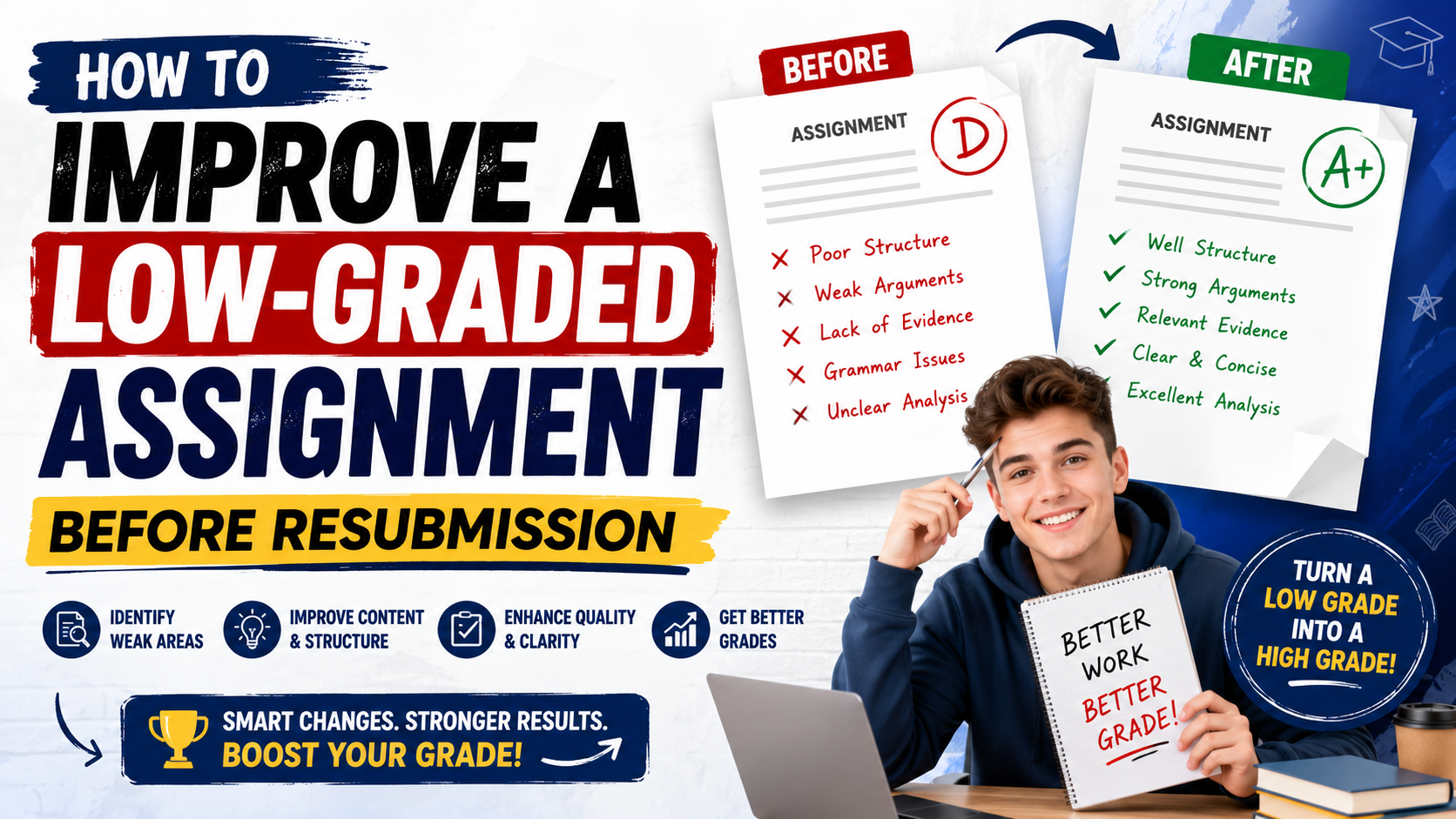
A low grade doesn't necessarily reflect your academic potential—it often highlights areas where your work can be strengthened. By carefully reviewing feedback and making targeted improvements, you can significantly increase the quality of your assignment before resubmission.
In this guide, you'll learn a practical step-by-step approach to improving a low-graded assignment while maintaining academic integrity.
Why Assignments Receive Low Grades
Before making revisions, it's important to understand why assignments lose marks.
Common reasons include:
Misunderstanding the assignment question
Weak critical analysis
Limited academic research
Poor essay structure
Lack of evidence to support arguments
Grammar and spelling mistakes
Incorrect referencing
Weak conclusion
Failure to follow the marking rubric
Formatting errors
Identifying the root cause helps you focus your revision efforts.
Step 1: Read Every Comment Carefully
Many students only look at the final grade.
Instead, carefully review:
Lecturer comments
Annotation notes
Marking rubric
Feedback summary
Suggested improvements
Avoid becoming defensive. Feedback is designed to help you improve your academic performance.
Step 2: Compare Your Assignment with the Rubric
The marking rubric explains exactly how your work was assessed.
Check whether you met the criteria for:
Knowledge and understanding
Critical analysis
Research quality
Academic writing
Referencing
Presentation
Originality
Highlight areas where you lost the most marks.
Step 3: Understand the Assignment Question Again
Many low grades result from answering a different question than the one that was asked.
Ask yourself:
Did I answer every part of the question?
Did I address the learning outcomes?
Did I stay focused throughout?
Did I meet the required word count?
If necessary, rewrite your introduction to better reflect the assignment objectives.
Step 4: Strengthen Your Research
High-quality assignments rely on credible academic evidence.
Use:
Peer-reviewed journal articles
Academic books
University library databases
Government publications
Professional reports
Replace outdated or unreliable sources with more authoritative references.
Step 5: Improve Critical Analysis
Describing information is rarely enough to earn high marks.
Instead:
Compare different viewpoints.
Evaluate evidence.
Discuss strengths and weaknesses.
Explain why findings matter.
Link arguments back to the assignment question.
Critical thinking is one of the biggest factors that distinguishes high-scoring assignments.
Step 6: Improve the Structure
A well-organized assignment is easier to read and evaluate.
Ensure your work includes:
Introduction
Clearly explain:
Topic
Aim
Scope
Main argument
Main Body
Each paragraph should contain:
One main idea
Supporting evidence
Critical discussion
A clear transition to the next point
Conclusion
Summarize your key findings without introducing new evidence.
Step 7: Review Referencing
Incorrect referencing can reduce marks and raise academic integrity concerns.
Check:
In-text citations
Reference list
Author names
Publication years
Page numbers for quotations
Consistent formatting
Follow the citation style required by your university, such as Harvard, APA 7, OSCOLA, MLA, Chicago, IEEE, or Vancouver.
Step 8: Edit for Clarity
Strong academic writing is:
Clear
Concise
Objective
Formal
Logical
Remove:
Repetition
Informal language
Long, confusing sentences
Unsupported claims
Good editing improves readability without changing your original ideas.
Step 9: Proofread Carefully
Before resubmitting:
Check for:
Grammar
Spelling
Punctuation
Formatting
Headings
Page numbers
Tables
Figures
Reference consistency
Reading your assignment aloud often helps identify awkward sentences.
Step 10: Compare Your Revised Version
After completing revisions:
Compare:
Original assignment
Lecturer feedback
Revised assignment
Confirm that every major comment has been addressed before resubmission.
Common Mistakes During Resubmission
Avoid these common errors:
Ignoring lecturer feedback
Making only superficial changes
Adding unnecessary content
Forgetting updated references
Submitting without proofreading
Missing the resubmission deadline
A thoughtful revision is usually more effective than a complete rewrite.
How AssignmentCart Can Help
AssignmentCart provides ethical academic support for students revising assignments before resubmission.
Our services include:
Assignment review
Feedback interpretation
Editing and proofreading
Academic writing improvement
Referencing assistance
Formatting checks
Literature review guidance
Research support
Our goal is to help students understand academic expectations and improve the quality of their work while complying with university academic integrity policies.
Assignment Resubmission Checklist
Before uploading your revised assignment, make sure you have:
✔ Read all lecturer feedback.
✔ Improved weak arguments.
✔ Added stronger academic sources.
✔ Enhanced critical analysis.
✔ Corrected referencing errors.
✔ Improved grammar and clarity.
✔ Followed the marking rubric.
✔ Checked formatting requirements.
✔ Proofread the final version.
✔ Saved a backup copy.
Why Students Choose AssignmentCart
Students trust AssignmentCart because we offer:
Experienced academic experts
Subject-specific support
Affordable pricing
Confidential assistance
Editing and proofreading
Referencing guidance
Fast turnaround
Quality-focused academic support
We help students present stronger, more polished assignments before resubmission.
Final Thoughts
A low assignment grade isn't the end of your academic journey. With careful analysis of lecturer feedback, stronger research, improved critical thinking, and thorough editing, you can significantly enhance your work before resubmission.
Treat every piece of feedback as an opportunity to develop your academic skills. By focusing on meaningful improvements rather than quick fixes, you'll be better prepared for future assignments and assessments.
If you need guidance interpreting feedback, improving structure, or refining your writing, AssignmentCart provides ethical academic support to help you submit your best possible work.
Frequently Asked Questions
Everything you need to know about our services
Related Posts

Assignment Due Tomorrow? Emergency Assignment Help in Ireland

Affordable Assignment Help for International Students in Ireland
