Harvard Referencing Help for University Assignments
Introduction
Referencing is an essential part of academic writing. Whether you are preparing an essay, report, coursework, research project, or dissertation, you need to acknowledge the sources you use to support your arguments.
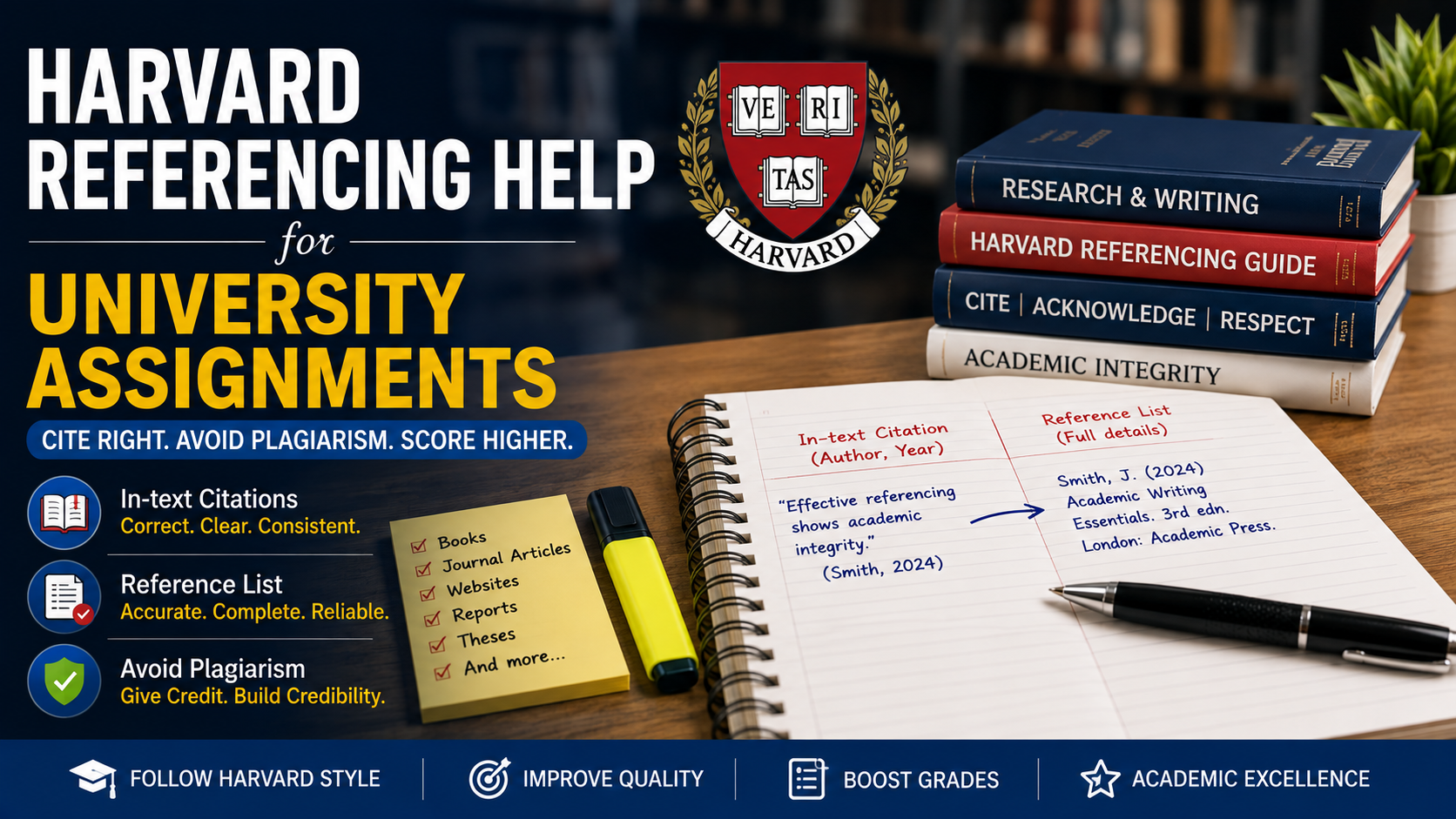
For many university students, Harvard referencing can be confusing because different universities and institutions may use slightly different versions of the Harvard style. Students often struggle with in-text citations, reference lists, multiple authors, websites, journal articles, books, and sources without publication dates.
Getting the referencing right is important because inaccurate or incomplete citations can affect the academic quality of an assignment and may create academic-integrity concerns.
This guide explains how Harvard referencing works, how to reference common sources, common mistakes students make, and how appropriate academic support can help you improve your university assignments.
What Is Harvard Referencing?
Harvard referencing is an author-date referencing system commonly used in academic writing.
Instead of using numbered footnotes for every source, Harvard referencing generally identifies a source in the text using the author's surname and publication year.
For example:
Academic writing requires a clear connection between evidence and argument (Smith, 2024).
The full details of the source are then provided in the reference list at the end of the assignment.
A basic Harvard citation therefore follows this structure:
Author + Year
The reference list provides the information needed for the reader to identify and locate the original source.
Why Is Harvard Referencing Important?
Referencing serves several purposes.
1. It Gives Credit to Original Authors
If you use another researcher's ideas, findings, arguments, or words, you should acknowledge the original source.
2. It Supports Your Arguments
Academic sources provide evidence for the claims you make in your assignment.
3. It Allows Readers to Verify Your Sources
A properly formatted reference helps readers locate the original publication.
4. It Demonstrates Academic Research
Good referencing shows that your arguments are supported by relevant academic literature.
5. It Helps You Avoid Plagiarism
Using another person's work without appropriate acknowledgement can constitute plagiarism.
Referencing alone does not make an assignment academically sound, but it is an important part of responsible academic writing.
How Does Harvard Referencing Work?
Harvard referencing generally has two main components:
In-text citation
The source is acknowledged within the body of your assignment.
Example:
Social media can influence consumer purchasing behaviour (Brown, 2023).
Reference list
The complete publication details appear at the end of the assignment.
Example:
Brown, T. (2023) Consumer behaviour in the digital age. London: Academic Press.
The exact punctuation, capitalisation, formatting, and ordering can differ between Harvard variants.
Therefore, always check your university's official referencing guidance before submitting an assignment.
Harvard In-Text Citations
In-text citations are placed close to the information they support.
A basic citation usually includes:
(Author, Year)
For example:
Effective communication can improve organisational performance (Wilson, 2022).
If you mention the author directly in your sentence, only the year may need to appear in parentheses:
Wilson (2022) argues that effective communication can improve organisational performance.
Both approaches can be appropriate depending on how you structure your sentence and the specific Harvard guide you are following.
Harvard Referencing for Two Authors
When a source has two authors, both authors are generally included in the citation.
For example:
(Taylor and Brown, 2024)
Or:
Taylor and Brown (2024) suggest that...
The exact treatment of "and" and "&" can vary between institutional Harvard guides, so follow your university's preferred version.
Harvard Referencing for Multiple Authors
Sources with three or more authors may be cited using the first author's surname followed by et al. in some Harvard variants.
For example:
(Smith et al., 2024)
Or:
Smith et al. (2024) found that...
However, the rules for multiple authors can differ between Harvard versions.
This is one reason students should avoid relying on a generic online referencing generator without checking their university's requirements.
Harvard Referencing a Book
A typical Harvard book reference includes:
Author surname, Initial(s). (Year) Title of book. Edition. Place of publication: Publisher.
For example:
Smith, J. (2023) Understanding academic research. 3rd edn. London: Academic Press.
Not every university requires exactly the same elements or punctuation.
Always check your institution's Harvard referencing guide.
Harvard Referencing a Journal Article
A journal article reference typically includes:
Author
Publication year
Article title
Journal title
Volume
Issue
Page range
DOI where required or available
A simplified example is:
Williams, R. (2024) 'Digital learning and student engagement', Journal of Higher Education, 18(2), pp. 120–138.
If a DOI is available, your university may require it to be included.
Harvard Referencing a Website
Web pages can be more complicated because online information may have:
Individual authors
Organisations as authors
Publication dates
Updated dates
No publication date
No named author
A generic structure may look like:
Organisation/Author (Year) Title of webpage. Available at: URL (Accessed: date).
For example:
University Research Centre (2025) Academic writing guidance. Available at: [website address] (Accessed: 4 August 2026).
The precise format depends on your university's Harvard guide.
Harvard Referencing a Government Report
Government publications can often be referenced using the relevant government department or agency as the author.
A typical structure might include:
Organisation (Year) Title of report. Place of publication: Publisher.
For online reports, your institution may require the URL and access date.
Government and official institutional publications can be particularly useful when supporting claims involving statistics, regulations, policies, or national trends.
Harvard Referencing a Chapter in an Edited Book
When referencing a chapter written by a particular author in an edited collection, you generally need to identify:
Chapter author
Publication year
Chapter title
Editor(s)
Book title
Edition where applicable
Publisher information
Chapter page range
For example:
Brown, L. (2023) 'Understanding consumer behaviour', in Smith, J. (ed.) Contemporary marketing research. 2nd edn. London: Academic Press, pp. 45–62.
Check your university's guide for the exact format.
Harvard Referencing a Dissertation or Thesis
If you use another student's dissertation or thesis as a source, you may need to include:
Author
Year
Title
Type of thesis/dissertation
Institution
Repository or database information where applicable
For example:
Jones, A. (2024) Consumer attitudes towards sustainable fashion. Master's dissertation. University Name.
The exact format can vary according to your institution and the location of the thesis.
Harvard Referencing an Online Journal Article
Online journal articles can usually be referenced using the article's standard bibliographic information.
Depending on your university's requirements, you may also need:
DOI
Database information
URL
Access date
If a DOI is available, it is often preferable to use the DOI format required by your institution rather than an unstable database URL.
Harvard Referencing Sources With No Author
Sometimes you may find a source without a named individual author.
In these cases, the organisation responsible for the publication may be treated as the author.
For example:
World Health Organisation (2025) Report title. Available at: [URL].
If there is genuinely no identifiable author, check your university's referencing guidance before using the source.
Avoid inventing an author simply to make the citation fit a template.
Harvard Referencing Sources With No Date
Some websites do not provide an obvious publication date.
Depending on the Harvard variant used by your institution, you may need to use an abbreviation such as:
n.d.
This indicates that no date is available.
For example:
Organisation Name (n.d.) Webpage title. Available at: [URL] (Accessed: 4 August 2026).
However, check your university's official guidance because conventions can vary.
Direct Quotes in Harvard Referencing
If you copy the exact words from a source, you should identify them as a quotation and provide an appropriate citation.
A short quotation might appear as:
"Academic research requires careful evaluation of evidence" (Smith, 2024, p. 25).
The page number is generally important for direct quotations where available.
For longer quotations, your university may require block-quotation formatting.
Do not present another author's exact words as your own.
Paraphrasing in Harvard Referencing
Paraphrasing means expressing another author's idea in your own words while maintaining the original meaning.
For example:
Original idea:
A researcher argues that student engagement is influenced by both academic and social factors.
Paraphrased:
Student engagement can be affected by academic experiences as well as interactions within the wider university environment (Author, Year).
Even though the wording has changed, the underlying idea still comes from the source.
Therefore, you still need a citation.
Paraphrasing does not mean simply replacing a few words with synonyms.
Good paraphrasing involves genuinely understanding the source and expressing the relevant idea independently.
Harvard Referencing vs Plagiarism
One of the most important things students should understand is that plagiarism is not limited to copying sentences word for word.
Potential problems can occur when students:
Copy text without citation
Use another person's ideas without acknowledgement
Closely paraphrase a source without citation
Submit another student's work
Reuse their own previous work where this is prohibited
Use fabricated or unverifiable sources
Misrepresent the origin of information
Proper referencing is one part of avoiding plagiarism, but academic integrity also involves producing work honestly and following your university's assessment rules.
Common Harvard Referencing Mistakes
1. Using the Wrong Harvard Style
There is no single universally identical Harvard referencing format.
Different universities may provide their own version.
Always follow your institution's official guide.
2. Missing In-Text Citations
If an academic claim is based on a source, make sure the source is appropriately acknowledged.
3. Missing Sources From the Reference List
Every source cited in the assignment should generally correspond to an entry in the reference list.
4. Adding Unused Sources
Do not add sources to your reference list simply to make it longer.
Your reference list should accurately reflect the sources used.
5. Incorrect Author Names
Check spelling carefully.
A misspelled author's name can make a source difficult to identify.
6. Incorrect Publication Dates
Check the actual publication information rather than relying on a random date displayed by a search engine.
7. Forgetting Page Numbers for Quotes
Where your referencing guide requires page numbers for direct quotations, include them.
8. Inconsistent Formatting
Your references should follow a consistent style.
Common problems include inconsistent:
Capitalisation
Italics
Punctuation
Dates
Page ranges
URLs
Access dates
9. Citing Search Engines Instead of Original Sources
A search engine helps you find information; it is generally not the academic source itself.
Reference the original book, journal article, report, webpage, or other source whenever possible.
10. Relying Entirely on Automatic Citation Generators
Citation generators can save time, but they may produce incorrect formatting or incomplete information.
Always verify generated references against your university's requirements and the original source.
How to Create a Harvard Reference List
Your reference list should normally appear at the end of your assignment.
Check your university's instructions for:
Alphabetical ordering
Hanging indentation
Line spacing
Capitalisation
Italics
DOI formatting
URL formatting
Access dates
A typical reference list might contain:
Brown, T. (2023) Consumer behaviour in the digital age. London: Academic Press.
Smith, J. and Taylor, R. (2024) 'Digital learning and student engagement', Journal of Education, 20(3), pp. 100–118.
University Name (2025) Academic writing guidance. Available at: [URL] (Accessed: 4 August 2026).
Again, the exact formatting should follow your university's specific Harvard guide.
How to Reference Sources Correctly
A useful workflow is:
Step 1: Identify the source type
Is it a:
Book?
Journal article?
Website?
Report?
Thesis?
Book chapter?
Conference paper?
Step 2: Collect the bibliographic information
Record:
Author
Year
Title
Publisher
Journal
Volume
Issue
Pages
DOI or URL where relevant
Step 3: Create the in-text citation
Connect the source to the specific claim or idea in your assignment.
Step 4: Create the full reference
Add the complete source information to your reference list.
Step 5: Check consistency
Compare the citation and reference against your university's Harvard guide.
Step 6: Verify the original source
Make sure the source actually says what you claim it says.
Harvard Referencing Checklist
Before submitting your assignment, check:
In-text citations
Have all borrowed ideas been cited?
Are author names spelled correctly?
Are publication years correct?
Are direct quotations clearly identified?
Are page numbers included where required?
Reference list
Does every cited source appear in the reference list?
Are references arranged according to your university's requirements?
Are titles formatted consistently?
Are journal details complete?
Are URLs and DOIs formatted correctly?
Are access dates included where required?
Source quality
Have you used relevant academic sources?
Have you prioritised original research?
Have you checked the credibility of websites?
Have you avoided fabricated or unverifiable references?
How Harvard Referencing Help Can Improve an Assignment
Referencing should support your academic argument rather than simply appear at the end of your paragraphs.
Good referencing helps demonstrate:
Evidence-based reasoning
Engagement with academic literature
Understanding of the subject
Academic integrity
Research skills
Critical engagement with sources
However, adding more references does not automatically make an assignment better.
The quality, relevance, credibility, and use of sources matter more than simply increasing the number of citations.
A strong assignment uses sources purposefully to support claims, compare perspectives, establish context, and develop a critical argument.
When Should You Get Harvard Referencing Help?
Students may benefit from appropriate academic guidance when they:
Are unsure which Harvard variant their university uses
Struggle with complex source types
Have inconsistent references
Are unsure how to cite websites
Need help checking a reference list
Are confused about citations for multiple authors
Need help distinguishing quoting from paraphrasing
Have supervisor or tutor feedback about referencing
Need proofreading of citations and references
Are working on a dissertation with a large bibliography
Getting your references checked before submission can help you identify inconsistencies and missing information.
Harvard Referencing Help for University Assignments
AssignmentCart provides academic support for students working on essays, assignments, reports, dissertations, research projects, and other academic work.
Referencing-related support may include:
Harvard citation guidance
Reference-list formatting
Citation consistency checks
Bibliography organisation
Academic proofreading
Source-format checking
Assignment editing
Dissertation referencing support
Students should always check their university's official referencing requirements because Harvard formatting can vary between institutions.
Any external academic support should also comply with the institution's academic-integrity and third-party assistance policies.
How to Make Harvard Referencing Easier
You don't have to wait until the night before your deadline to organise your references.
A better approach is to maintain your references throughout the research process.
When you find a useful source, immediately record:
Author
Year
Title
Publication
Publisher
Page numbers
DOI or URL
Access date where applicable
You can also use reference-management software to organise your sources.
However, automated tools should still be checked manually because metadata can be incomplete or incorrectly formatted.
Final Thoughts
Harvard referencing may initially seem complicated, but it becomes much easier once you understand the basic relationship between in-text citations and the reference list.
The most important principle is simple:
If you use someone else's idea, evidence, words, or information, acknowledge the source appropriately.
From books and journal articles to websites, reports, dissertations, and online publications, each source needs to be referenced according to the Harvard style required by your university.
Remember that Harvard referencing is not completely standardised. Your university's official referencing guide should always take priority over a generic online example.
If you are struggling with citations, reference-list formatting, or academic writing, appropriate referencing and proofreading support can help you identify errors and improve the consistency of your assignment.
Ultimately, effective referencing is about more than formatting. It helps demonstrate where your evidence comes from, strengthens your academic arguments, and shows that you have engaged responsibly with existing scholarship.
Frequently Asked Questions
Everything you need to know about our services
Related Posts

Harvard Referencing Help for Singapore University Assignments

APA 7 Assignment Help for Master's Students in Ireland
