Dissertation Literature Review Help: A Complete Guide for Students
Introduction
A literature review is one of the most important chapters of a dissertation. It demonstrates your understanding of existing research, identifies gaps in academic knowledge, and explains how your own study contributes to the field. Unlike a simple summary of sources, a strong literature review requires critical analysis, synthesis of evidence, and logical organisation.
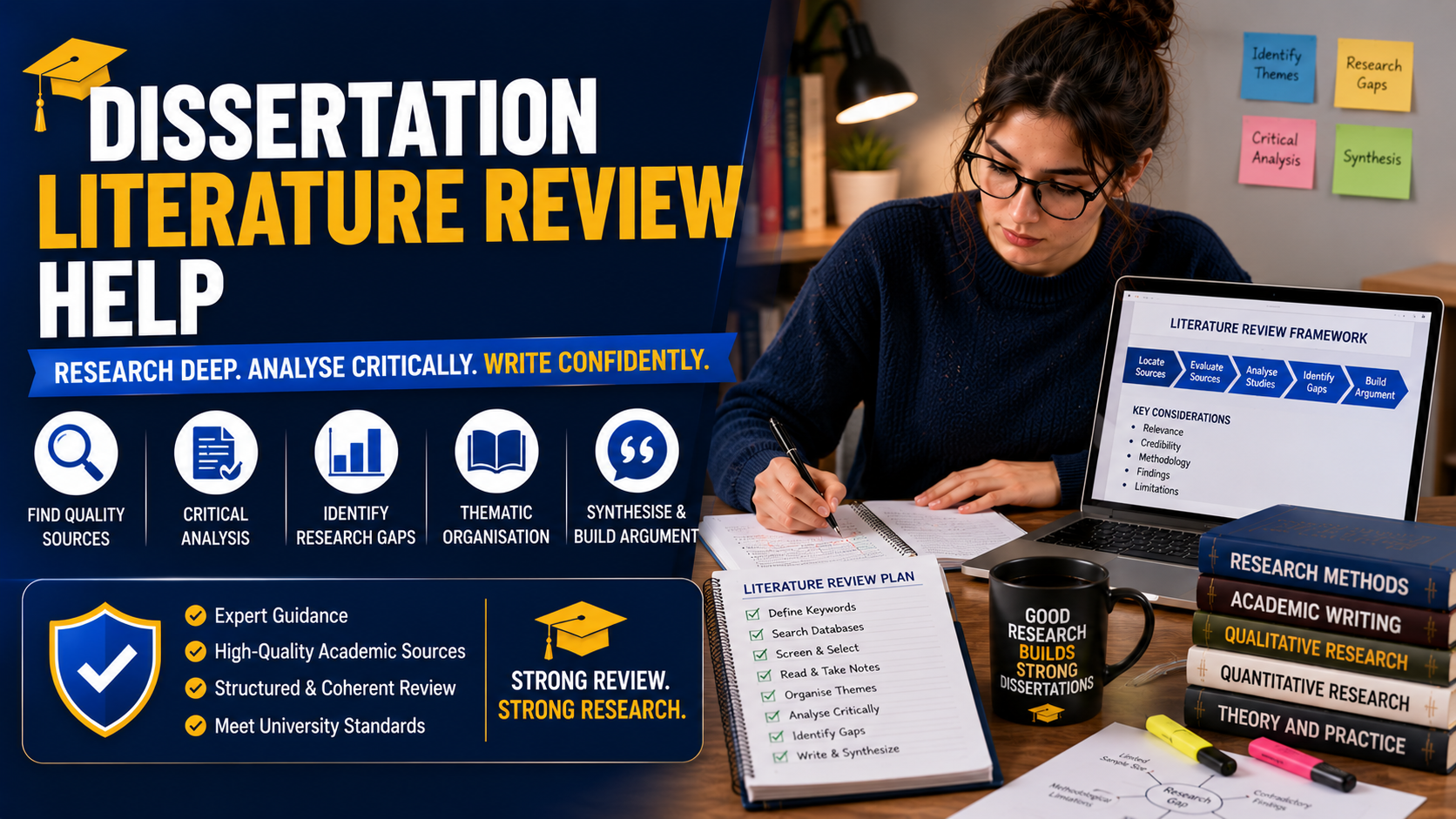
Many students seek dissertation literature review help because they find it challenging to locate high-quality academic sources, evaluate research, and build a coherent argument. Ethical academic support—such as research guidance, source evaluation, proofreading, editing, and feedback—can help students improve their own literature review while maintaining academic integrity.
This guide explains what a dissertation literature review is, how to structure it, common mistakes to avoid, and practical strategies for writing a high-quality review.
What Is a Dissertation Literature Review?
A dissertation literature review is a critical analysis of published academic research related to your dissertation topic.
Rather than simply describing previous studies, it should:
Summarise existing knowledge
Compare different viewpoints
Evaluate research quality
Identify trends
Highlight research gaps
Explain how your dissertation contributes to the field
The literature review provides the academic foundation for your research.
Why Is the Literature Review Important?
A well-written literature review helps you:
Demonstrate subject knowledge
Show awareness of current research
Justify your research topic
Identify unanswered questions
Develop theoretical understanding
Support your research methodology
It also shows examiners that your research is based on credible academic evidence.
Steps to Write a Strong Literature Review
1. Define Your Research Scope
Before searching for sources, clearly define:
Research topic
Research questions
Objectives
Keywords
Time period (if applicable)
A focused scope makes literature searching more effective.
2. Search Academic Sources
Use credible databases such as:
Google Scholar
JSTOR
Scopus
Web of Science
PubMed (for health sciences)
IEEE Xplore (for engineering and technology)
University library databases
Prioritise peer-reviewed journal articles, academic books, conference papers, and reputable reports.
3. Evaluate Your Sources
Ask questions such as:
Is the source peer-reviewed?
Is the research current?
Is the methodology reliable?
Are the findings supported by evidence?
Does the study relate directly to my research?
High-quality sources strengthen your literature review.
4. Organise the Literature
Rather than discussing one source at a time, group research by themes, theories, or methods.
For example:
Theme 1
Research on online learning
Theme 2
Studies about student engagement
Theme 3
AI tools in higher education
A thematic structure improves readability and analysis.
5. Critically Analyse the Research
Critical analysis means discussing:
Strengths
Weaknesses
Agreements
Disagreements
Research limitations
Future research opportunities
Avoid simply summarising each article.
6. Identify Research Gaps
Explain what previous studies have not fully explored.
Research gaps may include:
Limited populations
Outdated data
Contradictory findings
Understudied topics
Methodological limitations
Your dissertation should aim to address one or more of these gaps.
7. Link the Literature to Your Research
Conclude each section by explaining how the reviewed literature supports your own study.
This demonstrates the relevance of your dissertation.
Common Structure of a Literature Review
A typical literature review includes:
Introduction
Explain:
Research topic
Scope
Search strategy
Structure
Main Body
Organise research using:
Themes
Chronology
Methodology
Theory
Include comparison, evaluation, and synthesis.
Conclusion
Summarise:
Key findings
Research gaps
Relationship to your dissertation
Transition to methodology
Common Mistakes Students Make
Avoid:
Listing studies without analysis
Using outdated sources
Overreliance on websites instead of scholarly research
Weak organisation
Missing research gaps
Inconsistent referencing
Poor transitions between sections
How Dissertation Literature Review Help Can Support Students
Ethical academic support may include:
Literature search guidance
Source evaluation
Research organisation
Critical analysis coaching
Academic editing
Proofreading
Referencing assistance
Feedback on draft chapters
The objective is to strengthen your own work while promoting independent learning.
Can AI Help with Literature Reviews?
AI tools can assist with:
Brainstorming keywords
Summarising articles
Explaining theories
Organising themes
Improving grammar
However, students should:
Verify AI-generated summaries.
Read original academic papers.
Follow university AI policies.
Ensure all analysis reflects their own understanding.
Tips for Writing an Excellent Literature Review
To improve your literature review:
Start searching early.
Use recent peer-reviewed sources.
Take organised research notes.
Group studies into themes.
Analyse rather than summarise.
Identify research gaps.
Maintain consistent referencing.
Proofread carefully before submission.
Why Choose AssignmentCart?
AssignmentCart provides ethical dissertation literature review support through:
Literature review guidance
Research assistance
Academic editing
Proofreading
Referencing support
Critical analysis feedback
Subject-specific tutoring
Confidential communication
Our goal is to help students develop stronger literature reviews while maintaining academic integrity and independent research skills.
Final Thoughts
A strong literature review demonstrates your understanding of existing research and establishes the academic foundation for your dissertation. By evaluating scholarly sources, identifying research gaps, and developing a clear critical argument, you can produce a literature review that strengthens the overall quality of your research.
Ethical dissertation literature review help—through research guidance, source evaluation, proofreading, editing, and feedback—can support your learning while ensuring your dissertation remains your own original academic work.
Frequently Asked Questions
Everything you need to know about our services
Related Posts

Dissertation Formatting Service: A Complete Guide for University Students

Dissertation Proofreading Services: Why Every Dissertation Needs a Final Review
