Dissertation Discussion Chapter Help for Master's Students
Introduction
The discussion chapter is often considered the most intellectually demanding part of a master's dissertation. Unlike the results chapter, where you simply present your findings, the discussion chapter requires you to interpret those findings, explain their significance, compare them with existing research, and demonstrate your critical thinking skills.
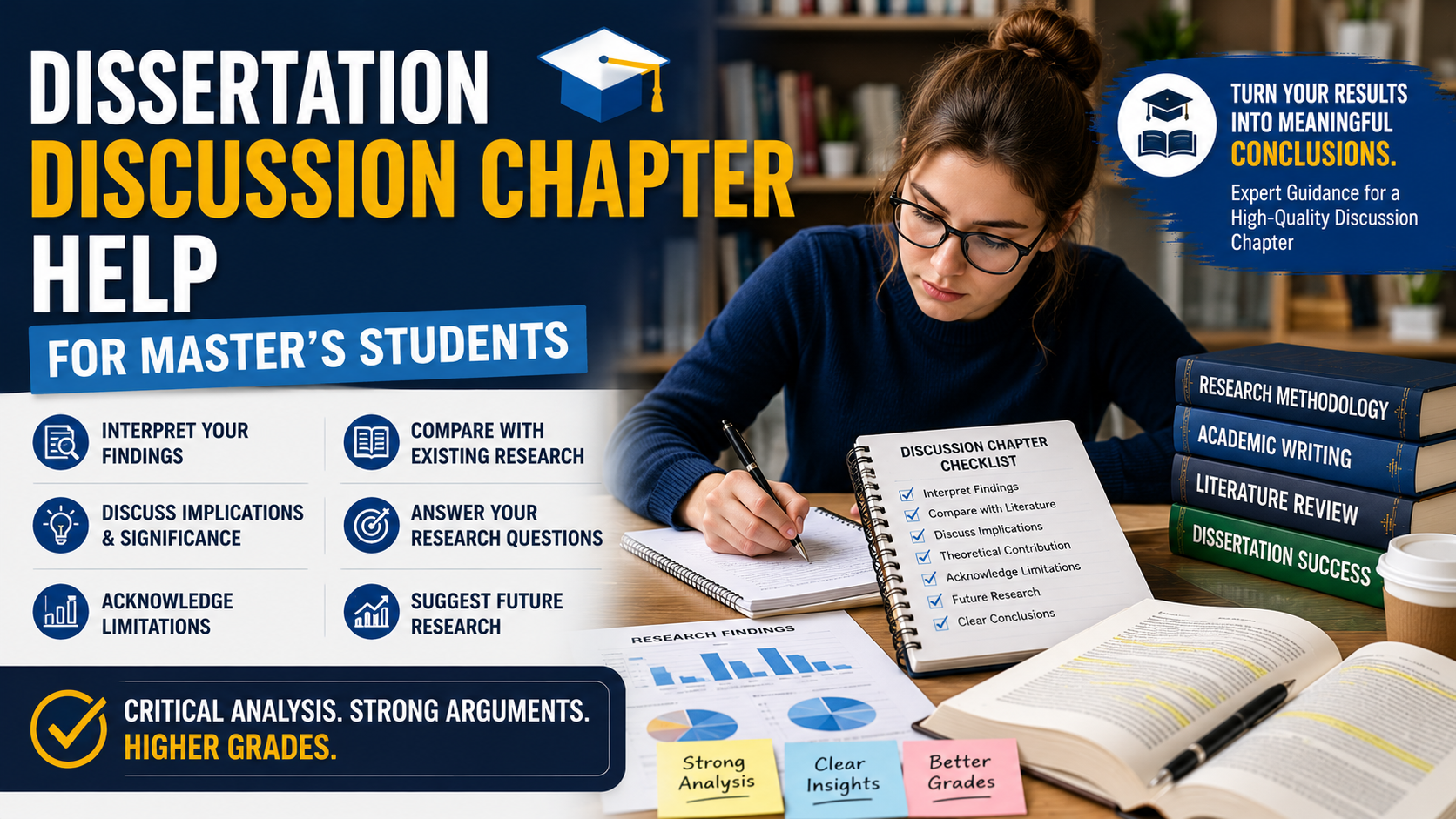
Many master's students find this chapter challenging because it requires more than summarising data—it requires analysis, evaluation, and academic argument. A well-written discussion chapter shows examiners that you understand the broader implications of your research and can contribute meaningfully to your field of study.
Whether you're studying at Trinity College Dublin (TCD), University College Dublin (UCD), University College Cork (UCC), Dublin City University (DCU), University of Galway, University of Limerick (UL), Maynooth University, Technological University Dublin (TU Dublin), or another university, understanding how to structure and write your discussion chapter can significantly improve your dissertation.
This guide explains how to write an effective discussion chapter and how AssignmentCart provides ethical academic support throughout the dissertation process.
What Is the Dissertation Discussion Chapter?
The discussion chapter explains what your research findings mean. It connects your results to your research objectives, research questions, literature review, and theoretical framework.
Instead of presenting raw data, you explain:
What your findings reveal
Why the findings are important
How they compare with previous studies
Whether they support your research objectives
What practical or theoretical implications they have
This chapter demonstrates your ability to think critically rather than simply report information.
Why the Discussion Chapter Is Important
Examiners assess your ability to:
Interpret research findings
Apply critical thinking
Compare results with existing literature
Explain unexpected findings
Draw logical conclusions
Demonstrate academic maturity
A strong discussion chapter often distinguishes high-scoring dissertations from average submissions.
Typical Structure of a Discussion Chapter
Most master's dissertations include the following sections.
Brief Summary of Findings
Begin with a concise overview of your key findings.
Do not repeat the entire results chapter.
Instead, remind readers of the most important outcomes before interpreting them.
Interpretation of Findings
Explain what your findings actually mean.
Consider questions such as:
Why did these results occur?
What patterns emerged?
Were the findings expected?
How do the results answer your research questions?
Focus on interpretation rather than description.
Compare Findings with Previous Research
One of the most important parts of the discussion chapter is comparing your findings with existing academic literature.
Discuss whether your results:
Support previous studies
Contradict earlier research
Extend existing knowledge
Reveal new perspectives
Support your discussion using credible academic sources.
Discuss Practical Implications
Explain how your findings may be useful in practice.
Depending on your discipline, this may include:
Business recommendations
Healthcare improvements
Educational policy
Engineering applications
Technology implementation
Public policy implications
Demonstrating practical relevance strengthens your dissertation.
Discuss Theoretical Implications
If your dissertation uses a theoretical framework, explain:
Whether your findings support existing theories
Whether new theoretical insights emerged
Whether previous assumptions should be reconsidered
This demonstrates deeper academic understanding.
Acknowledge Limitations
Every research project has limitations.
Common examples include:
Small sample sizes
Limited geographical coverage
Time constraints
Limited access to participants
Data collection challenges
Acknowledging limitations demonstrates honesty and academic integrity.
Recommendations for Future Research
Suggest areas where future researchers could expand your work.
For example:
Larger sample sizes
Different research methods
International comparisons
Longitudinal studies
New variables
Recommendations show that you understand the wider research landscape.
Common Mistakes in Discussion Chapters
Students frequently lose marks because they:
Repeat the results chapter
Fail to interpret findings
Ignore the literature review
Introduce entirely new results
Make unsupported claims
Overgeneralise conclusions
Ignore research limitations
Write descriptively instead of critically
Avoiding these mistakes significantly improves the quality of your discussion.
Tips for Writing a High-Scoring Discussion Chapter
Answer Your Research Questions
Every major finding should connect directly to your research objectives.
Examiners expect clear links between:
Research questions
Results
Discussion
Conclusions
Use Critical Analysis
Instead of simply stating what happened, explain:
Why it happened
Why it matters
How it compares with previous studies
What it contributes to knowledge
Critical analysis is one of the most heavily assessed skills.
Support Every Argument
Use credible academic sources, including:
Peer-reviewed journals
Academic books
Government reports
Professional organisations
Industry publications
Evidence strengthens your discussion.
Maintain Academic Tone
Write objectively by:
Avoiding emotional language
Supporting claims with evidence
Using formal academic vocabulary
Remaining analytical throughout
Professional writing improves credibility.
Keep the Chapter Organised
Use clear headings and logical transitions between sections.
A well-structured discussion is easier for examiners to follow.
How AssignmentCart Can Help
AssignmentCart provides ethical academic support for master's students preparing dissertation discussion chapters across a wide range of disciplines.
Our services include:
Discussion chapter guidance
Academic editing
Proofreading
Literature review support
Research methodology guidance
Critical analysis improvement
Referencing assistance
Formatting reviews
Academic writing feedback
Our objective is to help students improve the clarity, organisation, and presentation of their academic work while respecting university academic integrity policies.
Why Master's Students Choose AssignmentCart
Students trust AssignmentCart because we provide:
Experienced academic professionals
Subject-specific experts
Confidential support
Affordable pricing
Fast turnaround
Detailed quality reviews
Flexible revision options
Responsive customer support
We help students present well-structured, analytical, and professionally written dissertation chapters.
Discussion Chapter Checklist
Before submitting your dissertation, ensure you have:
✔ Interpreted your findings clearly.
✔ Connected results to your research questions.
✔ Compared findings with previous studies.
✔ Explained practical implications.
✔ Discussed theoretical implications.
✔ Acknowledged research limitations.
✔ Suggested future research directions.
✔ Used credible academic sources.
✔ Applied the correct referencing style.
✔ Proofread the chapter carefully.
Ethical Use of Academic Support
Academic support should strengthen your understanding while preserving the originality of your research.
AssignmentCart helps students:
Improve academic writing
Strengthen critical analysis
Refine dissertation structure
Review referencing
Enhance clarity
Receive constructive academic feedback
Students should always ensure that their final submissions comply with their university's academic integrity policies.
Final Thoughts
The discussion chapter is where your research truly comes to life. By interpreting your findings, comparing them with previous studies, acknowledging limitations, and demonstrating critical thinking, you show examiners that you understand the significance of your research beyond the data itself.
If you need guidance with discussion chapter writing, proofreading, editing, literature reviews, formatting, or referencing, AssignmentCart provides ethical academic support to help master's students prepare high-quality dissertations with confidence.
Frequently Asked Questions
Everything you need to know about our services
Related Posts

Best Research Proposal Writing Help in Ireland

Common Dissertation Mistakes That Cost Students Marks
