Dissertation Conclusion Writing Help That Impresses Examiners
Introduction
The conclusion is the final chapter your examiner reads, making it one of the most influential sections of your dissertation. While it should not introduce new information, it should leave readers with a clear understanding of your research, demonstrate how your objectives have been achieved, and highlight the significance of your findings.
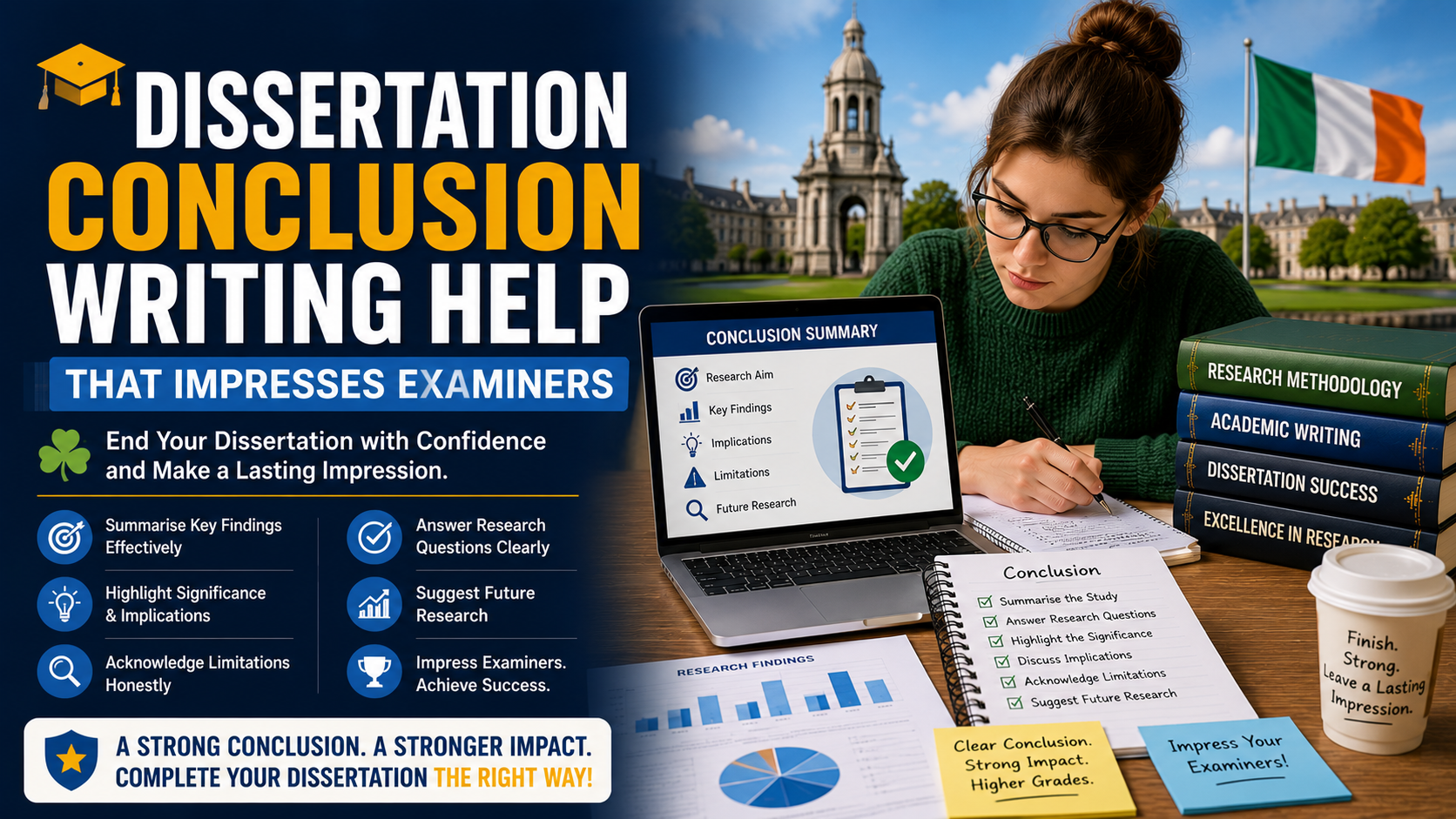
Many students underestimate the importance of the conclusion. After months of research and writing, they often rush this chapter, resulting in a weak ending that fails to showcase the value of their work. A strong conclusion ties your dissertation together, reinforces your key findings, and leaves a lasting positive impression.
Whether you're studying at Trinity College Dublin (TCD), University College Dublin (UCD), University College Cork (UCC), Dublin City University (DCU), University of Galway, University of Limerick (UL), Maynooth University, Technological University Dublin (TU Dublin), or another Irish university, understanding how to write a compelling dissertation conclusion can improve the overall quality of your submission.
This guide explains how to write an effective dissertation conclusion and how AssignmentCart provides ethical academic support throughout your dissertation journey.
What Is a Dissertation Conclusion?
The conclusion is the final chapter that summarises your research and demonstrates how your study has answered the research questions.
Its purpose is to:
Summarise the key findings
Answer the research objectives
Highlight the significance of the research
Discuss practical implications
Acknowledge limitations
Suggest future research
The conclusion should provide closure while reinforcing the contribution of your dissertation.
Why the Conclusion Is Important
Examiners expect the conclusion to:
Demonstrate critical thinking
Show that research objectives have been achieved
Present logical conclusions based on evidence
Reinforce the importance of the study
Leave a professional final impression
A weak conclusion can reduce the overall impact of an otherwise excellent dissertation.
Structure of an Effective Dissertation Conclusion
Restate the Research Aim
Begin by reminding readers of your original research aim.
Avoid copying your introduction word for word.
Instead, briefly explain the purpose of your research in light of the completed study.
Summarise Key Findings
Highlight the most important findings from your research.
Focus on:
Major discoveries
Significant trends
Research outcomes
Answers to research questions
Keep the summary concise without repeating earlier chapters.
Explain the Contribution of Your Research
Discuss how your research contributes to:
Academic knowledge
Professional practice
Industry understanding
Policy development
Future research
Clearly explain why your study matters.
Discuss Practical Implications
Explain how your findings may be applied in real-world situations.
Examples include:
Business decision-making
Healthcare improvements
Educational strategies
Engineering solutions
Technology implementation
Demonstrating practical value strengthens your dissertation.
Acknowledge Research Limitations
Every dissertation has limitations.
These may include:
Small sample sizes
Time constraints
Limited access to participants
Budget restrictions
Geographic limitations
Acknowledging limitations demonstrates academic honesty.
Recommend Future Research
Suggest areas where future researchers can build upon your work.
Examples include:
Larger populations
Different research methods
International studies
Long-term research
Emerging technologies
Future research recommendations show critical thinking beyond your own project.
Common Mistakes in Dissertation Conclusions
Students often lose marks because they:
Introduce entirely new evidence
Repeat previous chapters word for word
Fail to answer research questions
Write vague conclusions
Ignore research limitations
End abruptly without summarising contributions
Include unsupported opinions
A focused and well-structured conclusion avoids these issues.
Tips for Writing a High-Scoring Conclusion
Keep It Focused
Summarise the most important aspects of your research.
Avoid unnecessary detail.
Link Back to Your Objectives
Ensure every major conclusion connects to your research aims and objectives.
This demonstrates a coherent research journey.
Avoid New Information
Do not introduce:
New theories
New statistics
Additional findings
New references
Everything in the conclusion should be based on previous chapters.
Write with Confidence
Present your conclusions clearly using formal academic language.
Avoid uncertain phrases where your evidence supports a clear conclusion.
Proofread Carefully
Review:
Grammar
Spelling
Formatting
References
Flow between paragraphs
A polished conclusion leaves a stronger final impression.
How AssignmentCart Can Help
AssignmentCart provides ethical academic support for students completing dissertations across a wide range of subjects.
Our services include:
Dissertation conclusion guidance
Academic editing
Proofreading
Literature review support
Research methodology guidance
Referencing assistance
Formatting reviews
Dissertation feedback
Academic writing support
Our objective is to help students improve the clarity, organisation, and presentation of their academic work while respecting university academic integrity policies.
Why Students Choose AssignmentCart
Students choose AssignmentCart because we provide:
Experienced academic professionals
Subject-specific experts
Confidential support
Affordable pricing
Fast turnaround
Detailed academic reviews
Flexible revision options
Responsive customer support
We help students produce professionally written dissertations that are ready for final submission.
Dissertation Conclusion Checklist
Before submitting your dissertation, ensure you have:
✔ Restated your research aim.
✔ Summarised your key findings.
✔ Answered your research questions.
✔ Highlighted the significance of your study.
✔ Discussed practical implications.
✔ Acknowledged limitations.
✔ Suggested future research.
✔ Proofread the chapter carefully.
Ethical Use of Academic Support
Academic support should strengthen your understanding while preserving the originality of your work.
AssignmentCart helps students:
Improve dissertation structure
Strengthen academic writing
Refine conclusions
Review referencing
Improve formatting
Receive constructive academic feedback
Students should always ensure that their final submissions comply with their university's academic integrity policies.
Final Thoughts
A strong dissertation conclusion does more than summarise your research—it demonstrates the value of your study, answers your research questions, and leaves examiners with a clear understanding of your contribution. By writing a focused, evidence-based conclusion that highlights your key findings and acknowledges limitations, you can significantly strengthen the overall quality of your dissertation.
If you need assistance with dissertation conclusions, editing, proofreading, formatting, referencing, or overall dissertation preparation, AssignmentCart provides ethical academic support to help students submit polished, high-quality academic work with confidence.
Frequently Asked Questions
Everything you need to know about our services
Related Posts

Dissertation Proofreading Checklist Before Submission

Why Students Choose Professional Dissertation Editing Services
