Assignment Proofreading Before Submission for NZ University Students
Introduction
Submitting a university assignment is more than simply checking for spelling mistakes. Before you click Submit, your work should be clear, consistent, properly referenced and aligned with the assignment instructions.
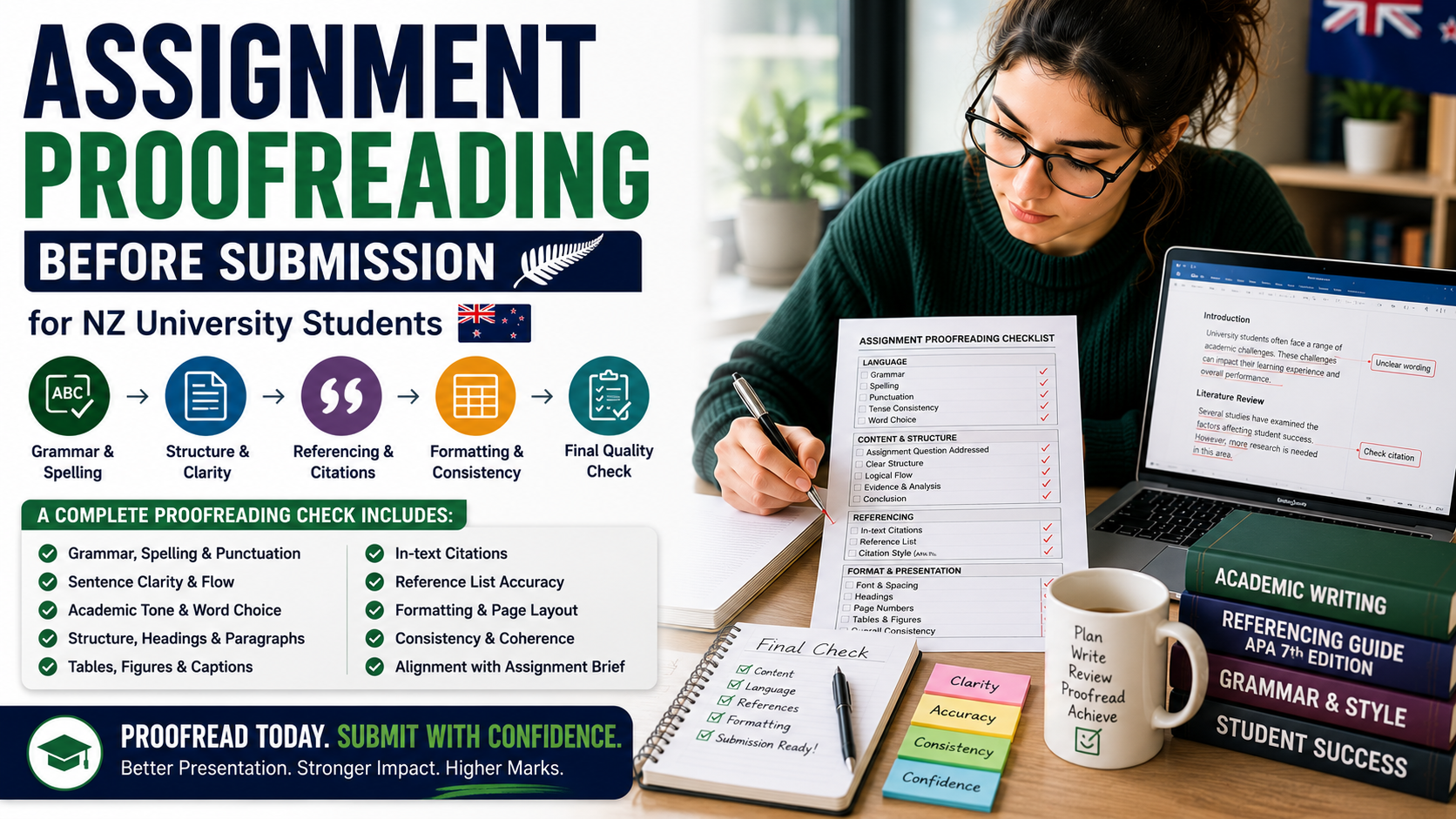
For New Zealand university students, assignment proofreading before submission can help identify grammar problems, unclear sentences, inconsistent formatting, referencing errors and other presentation issues that may affect the readability of academic work.
Whether you are preparing an essay, report, case study, reflective assignment, research paper or postgraduate coursework submission, a final proofreading check can provide an important quality-control step before submission.
This guide explains what assignment proofreading involves, what students should check before submitting their work and how professional proofreading support can improve the final presentation of an assignment.
What Is Assignment Proofreading?
Assignment proofreading is the final review of an academic document to identify and correct surface-level errors and improve clarity.
Proofreading can include checking:
Spelling
Grammar
Punctuation
Sentence structure
Word choice
Typographical errors
Capitalisation
Formatting consistency
Headings
In-text citations
Reference-list consistency
Tables and figures
Page numbers
Overall presentation
Proofreading is different from writing an assignment from scratch.
The student's original ideas, arguments, research and conclusions should remain their own.
The purpose of proofreading is to improve the accuracy and presentation of work that has already been written.
Why Proofread an Assignment Before Submission?
Small mistakes can make otherwise strong academic work harder to read.
For example, an assignment may contain:
"The results shows that students was experiencing significant challenges."
A proofreading review can identify the subject-verb agreement problems and improve the sentence to:
"The results show that students were experiencing significant challenges."
The underlying idea has not changed.
The sentence has simply been corrected so that the academic writing is clearer.
A final proofreading review can also identify inconsistencies that are difficult to notice when you have repeatedly read your own work.
Assignment Proofreading for NZ University Students
New Zealand universities have their own assessment requirements, academic conventions and policies.
Students may submit assignments in formats such as:
Essays
Reports
Case studies
Literature reviews
Reflective writing
Research papers
Lab reports
Business reports
Policy analyses
Presentations
Project reports
Nursing assignments
Education assignments
Law assignments
Engineering assignments
Postgraduate coursework
The exact proofreading requirements depend on the assignment and subject.
Students should always check their course outline, assignment brief and university instructions before submission.
What Does a Final Assignment Proofreading Check Include?
A useful final proofreading review can be divided into several stages.
1. Assignment Instructions
Before checking individual sentences, compare the completed assignment with the original brief.
Check:
Required word count
Required sections
Question or topic
Submission format
Referencing style
Required sources
Formatting requirements
File type
Assessment criteria
Submission deadline
An assignment can be grammatically perfect but still lose marks if it does not answer the assigned question.
2. Grammar and Sentence Structure
Grammar errors can affect the clarity of academic writing.
Common issues include:
Subject-verb agreement
Incorrect verb tense
Sentence fragments
Run-on sentences
Incorrect articles
Pronoun problems
Incorrect prepositions
Inconsistent tense
Awkward sentence construction
For example:
Incorrect:
"The study were conducted among university students."
Corrected:
"The study was conducted among university students."
The correction improves grammatical accuracy without changing the research claim.
3. Spelling and Typographical Errors
Typographical mistakes are easy to introduce when writing quickly.
Common examples include:
Missing letters
Repeated words
Incorrectly typed words
Missing spaces
Extra spaces
Incorrect capitalisation
Transposed letters
Students should not rely entirely on automatic spellcheck because software may not recognise contextual errors.
For example:
"The results were effect by workload."
A spellchecker may not necessarily flag "effect" because it is a valid word.
The intended word is:
"The results were affected by workload."
Contextual proofreading is therefore important.
4. Academic Word Choice
Academic assignments should use precise language.
Instead of:
"A lot of students had problems."
A more precise version may be:
"Many students reported difficulties."
However, proofreading should not unnecessarily make every sentence complicated.
Good academic writing should be:
Clear
Precise
Appropriate
Concise
Evidence-based
Using complicated vocabulary simply to sound academic can make an assignment less readable.
5. Sentence Clarity
Long sentences can sometimes hide unclear arguments.
For example:
"The research, which was conducted across several universities and involved students from different academic backgrounds, showed that workload, which is considered by many researchers to be an important factor in student performance, can potentially influence academic outcomes."
The sentence contains several ideas.
A proofreading review may recommend separating the ideas:
"The research was conducted across several universities and included students from different academic backgrounds. The findings suggest that workload may influence academic outcomes."
The meaning is easier to follow.
6. Paragraph Structure
Proofreading should not stop at individual sentences.
Each paragraph should have a logical purpose.
A useful academic paragraph structure is:
Topic Sentence → Evidence → Explanation → Analysis → Link
Before submitting, ask:
Does the paragraph have a clear main idea?
Is the evidence relevant?
Have I explained the evidence?
Does the paragraph contribute to my argument?
Does it connect logically to the next paragraph?
If a paragraph contains several unrelated ideas, it may need restructuring.
7. Assignment Introduction
The introduction should establish what the assignment is about.
Depending on the type of assignment, it may include:
Background
Context
Topic
Research problem
Purpose
Main argument
Scope
Structure of the assignment
Before submission, check whether the introduction prepares the reader for the discussion that follows.
8. Assignment Conclusion
The conclusion should bring the discussion together.
Check whether it:
Addresses the assignment question
Summarises the major arguments
Reflects the evidence presented
Avoids introducing completely new arguments
Provides an appropriate final statement
A conclusion should not simply repeat the introduction word-for-word.
9. Referencing and Citations
Referencing is one of the most important parts of final assignment checking.
Depending on the course, students may be required to use:
APA
MLA
Chicago
Harvard
OSCOLA
Vancouver
Other discipline-specific styles
Students should check their course requirements rather than assuming that one referencing style applies across their entire university.
In-Text Citation Checks
Check that:
Citations appear where required
Author names are spelled correctly
Publication years are accurate
Multiple-author citations follow the required style
Direct quotations contain appropriate page or location information where required
Every important source-based claim is appropriately supported
For example, if your university requires APA 7, check whether the citation format follows the relevant APA rules.
Reference List Checks
Before submission, compare your in-text citations with your reference list.
Ask:
Does every cited source appear in the reference list?
And:
Does every reference-list entry actually appear in the assignment?
Look for:
Missing references
Duplicate references
Incorrect author names
Incorrect publication dates
Incorrect titles
Incorrect journal information
Missing DOI or URL where required
Incorrect punctuation
Incorrect italics
Inconsistent formatting
Reference managers can help, but they should still be checked manually.
Assignment Formatting Checklist
Formatting requirements vary by university and course.
A final formatting review may include:
Font
Font size
Line spacing
Margins
Page numbers
Heading hierarchy
Paragraph spacing
Indentation
Tables
Figures
Captions
Appendices
Cover page
Student identification information where required
Do not assume that every New Zealand university uses identical formatting requirements.
Follow the instructions provided for your specific course.
Checking Tables and Figures
Tables and figures can contain errors that are easy to overlook.
Check:
Numbering
Titles
Labels
Units
Captions
References in the main text
Data consistency
Formatting
Source information
If the assignment says "Table 2", make sure that a Table 2 actually exists.
Similarly, if a paragraph refers to Figure 3, check that Figure 3 is correctly numbered.
Checking Headings
Headings should follow a consistent hierarchy.
For example:
1. Introduction
2. Literature Review
2.1 Theoretical Background
2.2 Previous Research
3. Discussion
Avoid switching randomly between:
Bold headings
Underlined headings
Different font sizes
Different capitalisation styles
unless the assignment instructions specifically require them.
Academic Tone Before Submission
Academic writing should be appropriate for the discipline.
Avoid unnecessary:
Slang
Informal expressions
Conversational language
Unsupported claims
Excessive rhetorical questions
Overly emotional language
For example:
Informal:
"This issue is a really big problem for heaps of students."
More appropriate:
"This issue presents a significant challenge for many students."
However, academic tone should not make the writing unnecessarily complicated.
Checking Evidence and Claims
Proofreading should also include a basic consistency check between claims and evidence.
Ask:
Is this claim supported by a source?
Does the source actually support the claim?
Have I exaggerated the evidence?
Have I confused correlation with causation?
Have I made an unsupported generalisation?
Have I accurately represented the source?
For example, avoid turning:
"The study found an association between workload and stress."
into:
"The study proved that workload causes stress."
unless the research design genuinely supports a causal conclusion.
Checking Your Assignment Against the Marking Rubric
The marking rubric can act as a final quality-control tool.
Create a simple checklist from the assessment criteria.
For example:
Assessment Criterion | Checked? |
|---|---|
Answers the question | ✓ |
Uses appropriate evidence | ✓ |
Critical analysis | ✓ |
Logical structure | ✓ |
Referencing | ✓ |
Academic writing | ✓ |
Conclusion | ✓ |
Formatting | ✓ |
This helps identify areas that may need attention before submission.
Proofreading Strategies for Students
Read the Assignment Aloud
Reading aloud can reveal:
Missing words
Awkward sentences
Repetition
Poor transitions
Long sentences
Your brain often corrects mistakes automatically when you read silently.
Reading aloud makes some problems easier to notice.
Read From the End
For spelling and sentence-level errors, read the document from the final paragraph towards the beginning.
This reduces the tendency to focus on the overall meaning and can make individual errors more noticeable.
Use a Printed Copy
Some students identify errors more easily on paper than on a screen.
Use a printed version to check:
Spelling
Formatting
Page numbers
Headings
References
Tables
Take a Break Before Proofreading
Proofreading immediately after finishing an assignment can be difficult because you already know what you intended to write.
If possible, take a break before the final review.
Returning later can make errors easier to identify.
Automated Proofreading Tools
Grammar and spelling software can identify potential problems.
Common tools include:
Microsoft Word Editor
Google Docs spelling and grammar tools
Grammarly
Other writing-support software
However, automated tools are not perfect.
They may:
Misinterpret context
Suggest inappropriate wording
Change academic meaning
Introduce unnecessary complexity
Miss discipline-specific terminology
Students should review suggestions rather than accepting every automated correction.
Assignment Proofreading vs Editing
Proofreading and editing are related but different.
Proofreading
Focuses mainly on final-stage errors such as:
Grammar
Spelling
Punctuation
Typos
Formatting
Referencing consistency
Editing
May involve deeper improvements to:
Structure
Argument flow
Clarity
Paragraph organisation
Academic expression
Logical transitions
Substantive Editing
Can involve more extensive work with:
Argument structure
Research logic
Organisation
Interpretation
Overall coherence
The appropriate level of support depends on how developed the assignment already is.
Assignment Proofreading for International Students in NZ
International students studying at New Zealand universities may face additional challenges with academic English.
Common issues can include:
Articles
Prepositions
Academic vocabulary
Sentence structure
Punctuation
Verb tense
Academic conventions
Referencing
Conciseness
Proofreading can help identify language issues while preserving the student's original meaning and argument.
Students should also use university academic-learning or language-support services where available.
Proofreading for Different Assignment Types
Essay Proofreading
Focus on:
Thesis statement
Paragraph flow
Evidence
Analysis
Citations
Conclusion
Report Proofreading
Check:
Executive summary
Headings
Sections
Tables
Figures
Recommendations
Referencing
Case Study Proofreading
Check:
Case evidence
Analysis
Theoretical application
Recommendations
Supporting sources
Reflective Assignment Proofreading
Check:
First-person usage where appropriate
Reflection
Evidence
Critical thinking
Connection between experience and theory
Research Paper Proofreading
Check:
Research question
Methodology
Results
Discussion
References
Tables and figures
Final 30-Minute Assignment Proofreading Checklist
If your deadline is approaching, use this quick checklist.
First 5 Minutes: Assignment Requirements
Check:
Question
Word count
Required sections
File format
Submission instructions
Next 10 Minutes: Content
Check:
Introduction
Main argument
Evidence
Analysis
Conclusion
Next 5 Minutes: Language
Check:
Grammar
Spelling
Sentence clarity
Repeated words
Typographical errors
Next 5 Minutes: References
Check:
In-text citations
Reference list
Referencing style
Missing sources
Final 5 Minutes: Formatting
Check:
Headings
Page numbers
Tables
Figures
Spacing
File name
Then open the final file and make sure you are submitting the correct version.
Common Assignment Proofreading Mistakes
Mistake 1: Proofreading Only for Spelling
Academic proofreading involves more than spelling.
Mistake 2: Ignoring the Assignment Question
A grammatically perfect assignment can still fail to answer the question.
Mistake 3: Accepting Every Grammar-Tool Suggestion
Automated suggestions should be reviewed manually.
Mistake 4: Forgetting References
A final reference check is essential.
Mistake 5: Ignoring Formatting Requirements
Course-specific instructions should take priority.
Mistake 6: Proofreading While Exhausted
Fatigue makes it easier to miss obvious errors.
Mistake 7: Making Last-Minute Major Changes
Large structural changes immediately before submission can introduce new mistakes.
Why Professional Assignment Proofreading Can Help
Students who have completed their own assignment may choose proofreading support to obtain an additional quality check.
Professional proofreading can help identify:
Grammar errors
Spelling mistakes
Awkward sentences
Inconsistent terminology
Formatting inconsistencies
Citation inconsistencies
Reference-list issues
Typographical errors
Clarity problems
The service should work from the student's existing material rather than replacing the student's original academic work.
Students should also confirm that external proofreading assistance is permitted under their university's academic-integrity and assessment rules.
Academic Integrity and Proofreading
Proofreading should not become unauthorized authorship of assessed work.
Students should remain responsible for:
Ideas
Arguments
Research
Analysis
Conclusions
Sources
Academic decisions
Before using external assistance, students should check the relevant university and course policies.
Where AI or automated writing tools are involved, students should also check current institutional requirements regarding acceptable use.
Assignment Submission Checklist for NZ Students
Before clicking the final submission button, ask:
Did I answer the exact assignment question?
Did I follow the assessment brief?
Is my word count within the required range?
Is the structure logical?
Are paragraphs clear?
Is my grammar correct?
Have I checked spelling?
Have I removed unnecessary repetition?
Are claims supported by appropriate evidence?
Are citations correctly formatted?
Does every in-text citation have a corresponding reference?
Does every reference-list entry appear in the assignment?
Are tables and figures correctly labelled?
Are headings consistent?
Are page numbers correct?
Does the formatting follow the course instructions?
Have I checked the marking rubric?
Is the submitted file the correct version?
Have I checked academic-integrity requirements?
Have I checked any applicable AI-use requirements?
Have I submitted the correct document before the deadline?
Final Thoughts
Assignment proofreading before submission for NZ university students is an important final quality-control step.
A strong proofreading process checks more than spelling. It examines grammar, clarity, paragraph structure, references, citations, formatting, tables, figures and compliance with the assignment brief.
The most effective final review follows this order:
Assignment Requirements → Content → Structure → Language → Evidence → Referencing → Formatting → Final Submission
Taking time to proofread before submission can make an assignment clearer, more consistent and easier for the marker to read.
Most importantly, proofreading should support the student's own academic work rather than replace it. New Zealand university students should always follow the academic-integrity, assessment and AI-use requirements of their specific institution and course.
Frequently Asked Questions
Everything you need to know about our services
Related Posts

Academic Proofreading Services for New Zealand University Students

PhD Thesis Proofreading Services for New Zealand Students
