Assignment Due Tomorrow? What You Should Do
Introduction
An assignment due tomorrow can turn a normal study day into a stressful race against the clock. If you still have research to complete, sections to write, references to organise, and formatting to fix, it can feel impossible to finish everything on time.
The good news is that you still have options.
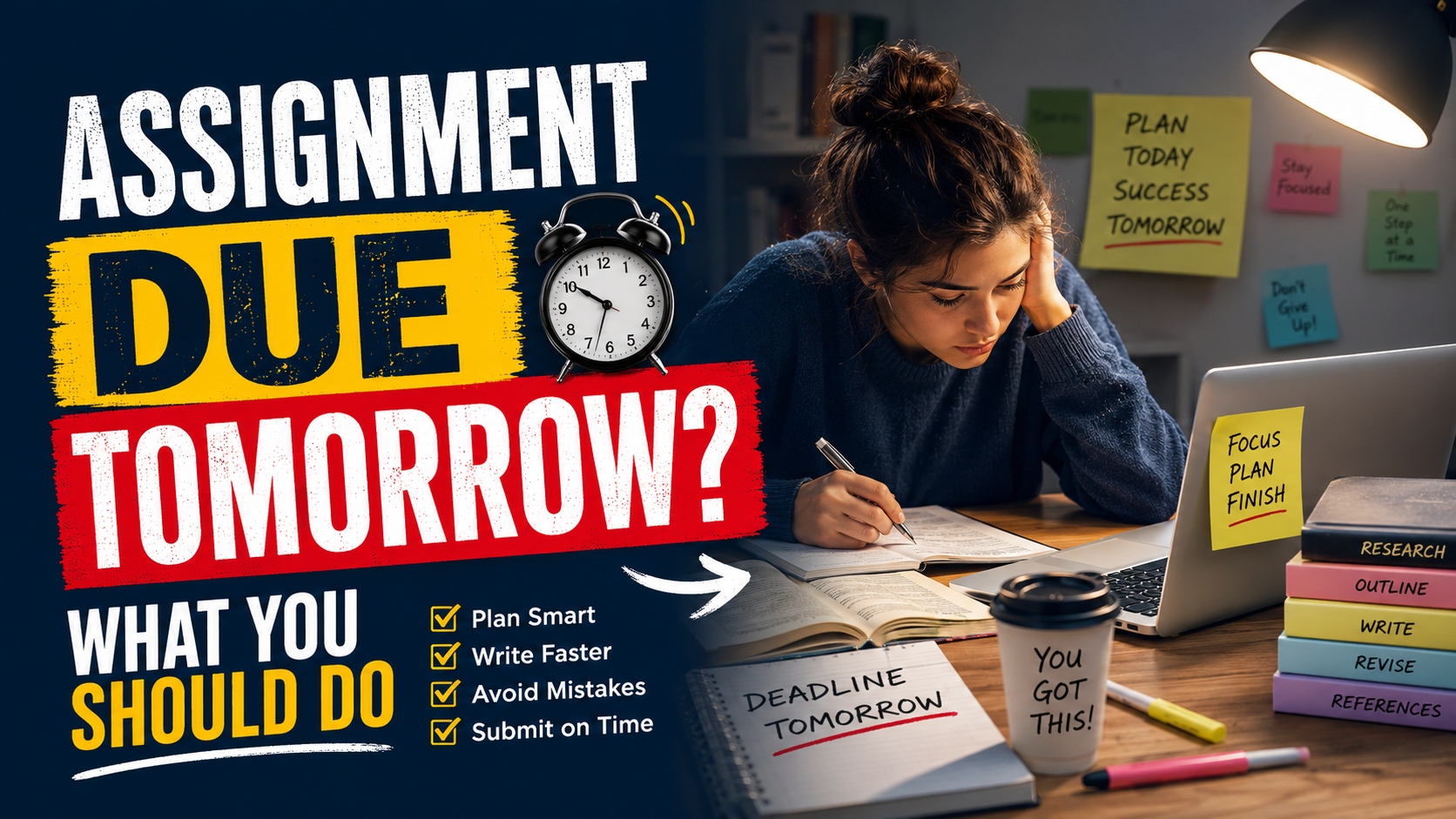
Instead of panicking or spending hours trying to decide where to start, focus on the tasks that will have the biggest impact on completing your assignment properly and submitting it before the deadline.
This guide explains exactly what to do when your assignment is due tomorrow, including how to prioritise your work, structure your time, avoid common mistakes, and get professional academic support if you need it.
What Should You Do If Your Assignment Is Due Tomorrow?
If your assignment is due tomorrow, your priority should be completion, quality control, and submission rather than trying to make everything perfect.
Follow these steps:
Check the exact deadline.
Read the assignment brief carefully.
Break the assignment into manageable sections.
Create a realistic emergency schedule.
Research only what you need.
Write the main sections first.
Add citations and references systematically.
Proofread and format your work.
Check the submission requirements.
Submit before the deadline.
The biggest mistake students make is spending too much time on one section while leaving the rest unfinished.
1. Check Your Exact Assignment Deadline
Before doing anything else, confirm the submission deadline.
Check your:
University learning platform
Assignment brief
Course portal
Module handbook
Lecturer's instructions
Submission page
Pay attention to the date, time, and time zone.
For example, an assignment stating that it is due at 11:59 PM may have a completely different deadline from one due at 4:00 PM.
Don't assume that "tomorrow" means you have the entire day available. If your university deadline is 11:59 AM, you could have significantly less time than expected.
Quick tip
Set your own internal deadline at least 30–60 minutes before the official deadline.
This gives you time to deal with:
Upload problems
Internet issues
File conversion errors
Incorrect document versions
Submission portal problems
2. Read the Assignment Brief Again
When you're under pressure, it is tempting to start writing immediately.
Don't.
Spend a few minutes reading the assignment question and marking the important requirements.
Look for:
Word count
Number of questions
Required sections
Learning outcomes
Referencing style
Required sources
Formatting requirements
Case studies
Submission instructions
File format
Assessment criteria
Understanding exactly what your lecturer is asking can prevent hours of unnecessary work.
Ask yourself:
What does the question actually want me to do?
Look for command words such as:
Analyse
Evaluate
Compare
Critically discuss
Explain
Examine
Assess
Justify
Critique
These words determine the type of response you need.
For example, if the question asks you to critically evaluate a theory, simply describing the theory is unlikely to be enough.
3. Break the Assignment Into Smaller Tasks
A large assignment can feel overwhelming when viewed as one massive task.
Instead, divide it into smaller pieces.
For example, if you have a 3,000-word assignment:
Section | Approx. Words |
|---|---|
Introduction | 250–300 |
Main Discussion 1 | 600 |
Main Discussion 2 | 600 |
Main Discussion 3 | 600 |
Critical Evaluation | 500 |
Conclusion | 250–300 |
You don't have to follow these exact proportions. The structure should depend on your assignment brief.
The important thing is to turn:
"I need to write 3,000 words."
into:
"I need to complete the introduction, three discussion sections, evaluation, and conclusion."
That makes the workload much easier to manage.
4. Create an Emergency Assignment Schedule
With only one day remaining, you need to use your time strategically.
A simple emergency schedule could look like this:
First 30 minutes
Read the brief
Identify requirements
Create your structure
Gather essential sources
Next 2–3 hours
Write the main body
Focus on answering the question
Add citations as you write
Next 1–2 hours
Complete remaining sections
Write the introduction
Write the conclusion
Next 30–60 minutes
Proofread
Check references
Check formatting
Check word count
Final 15–30 minutes
Save the final version
Check the file
Upload it
Confirm submission
Your schedule should be based on the amount of work remaining rather than trying to copy someone else's study routine.
5. Don't Try to Research Everything
One of the biggest time-wasters when an assignment is due tomorrow is excessive research.
You don't need to read dozens of papers from beginning to end.
Instead, identify the sources most relevant to your argument.
Look for:
Peer-reviewed journal articles
Academic books
Government publications
Official reports
University resources
Relevant professional organisations
Recent academic research
Use your assignment question to guide your research.
For example, if your question asks you to evaluate the impact of artificial intelligence on education, searching for broad information about AI may produce thousands of results.
Instead, focus your research around specific themes such as:
AI-assisted learning
Academic integrity
Student engagement
Personalised learning
Assessment
AI limitations
This makes your research much more efficient.
6. Start With the Main Body
Many students struggle because they try to write the perfect introduction first.
When you're working under extreme time pressure, you don't necessarily need to do that.
Start with the main argument or discussion.
Write the sections where you already understand what you want to say.
You can return to the introduction later.
A useful paragraph structure is:
Point → Evidence → Explanation → Critical Analysis → Link
For example:
Make your main point.
Then support it with academic evidence.
Explain why the evidence matters.
Critically analyse its relevance or limitations.
Finally, connect the discussion back to the assignment question.
This is much stronger than simply listing facts.
7. Focus on Analysis, Not Just Description
A common problem with rushed assignments is that students describe information without analysing it.
Description
"Social media has become increasingly popular among university students."
Analysis
"Although social media can facilitate communication and peer collaboration, its academic value depends on how students use these platforms. Excessive use may also contribute to distraction and reduced study time, meaning that accessibility does not automatically translate into improved academic performance."
The second example goes beyond stating a fact.
It explains why the issue matters and introduces a balanced perspective.
If your assignment uses words such as analyse, evaluate, critically discuss, assess, or critique, make sure your paragraphs demonstrate critical thinking.
8. Add References While You Write
Don't leave all your referencing until the final five minutes.
Add citations as you write each section.
For example:
Artificial intelligence is increasingly being integrated into higher education, creating both opportunities for personalised learning and concerns surrounding academic integrity (Author, 2025).
Then add the complete source to your reference list.
This is much safer than trying to remember which source supports which argument later.
Also check which referencing style your university requires, such as:
APA
Harvard
MLA
Chicago
OSCOLA
IEEE
Vancouver
Don't assume that every assignment uses the same style.
9. Don't Invent References
When you're rushing, there can be a temptation to add references just to make the assignment look academic.
Avoid this.
Never invent:
Authors
Journal articles
Publication dates
Page numbers
DOI numbers
Statistics
Quotes
Make sure the sources you cite actually exist and support the statements you're making.
Academic credibility is more important than having a long reference list.
10. Write the Introduction After You Understand Your Argument
If you're struggling with the introduction, leave it until you've written the main body.
A strong introduction generally tells the reader:
What the assignment is about
What the key issue is
What areas will be discussed
What position or argument the assignment will develop
Keep it focused.
You don't need to explain everything in the introduction.
11. Write a Clear Conclusion
Your conclusion should not introduce a completely new argument.
Instead, bring together the key findings from your discussion.
A useful conclusion can:
Summarise the main arguments
Answer the assignment question
Highlight the most important finding
Provide an overall evaluation
Avoid simply repeating your introduction word-for-word.
12. Leave Time for Editing
Even if your assignment is technically complete, don't submit immediately.
Reserve some time for checking.
Look for:
Content
Did I answer the actual question?
Did I address every part of the brief?
Is my argument clear?
Have I included critical analysis?
Structure
Does each paragraph have a purpose?
Are the sections logically connected?
Is the conclusion consistent with the discussion?
Referencing
Are citations included?
Are sources correctly formatted?
Does every in-text citation appear in the reference list?
Presentation
Correct font?
Correct spacing?
Correct headings?
Correct page numbers?
Correct word count?
Correct file format?
13. Use a Final Assignment Checklist
Before submission, quickly check:
Assignment checklist
☐ I answered the exact assignment question.
☐ I followed the assignment brief.
☐ I stayed within the required word count.
☐ I included relevant academic sources.
☐ I used the required referencing style.
☐ My paragraphs contain analysis rather than only description.
☐ My introduction explains the purpose of the assignment.
☐ My conclusion answers the question.
☐ My references are complete.
☐ I checked spelling and grammar.
☐ I checked formatting.
☐ I uploaded the correct file.
☐ I submitted before the deadline.
What If You Know You Can't Finish the Assignment Yourself?
Sometimes the problem isn't simply procrastination.
You might have:
A very large assignment
Multiple deadlines
A dissertation and assignments due together
Work or family commitments
Difficulty understanding the topic
Trouble structuring your argument
Problems with academic writing
Limited time because of an unexpected situation
If you realistically cannot complete everything to an acceptable standard before the deadline, consider getting professional academic support rather than submitting rushed or incomplete work.
Academic support can be useful for areas such as:
Assignment structure
Research guidance
Academic writing
Critical analysis
Referencing
Proofreading
Editing
Dissertation support
Formatting
If you use an academic support service, make sure you understand your university's rules regarding third-party assistance and academic integrity.
The final submitted work should comply with your institution's policies.
Assignment Due Tomorrow? Don't Panic.
Having an assignment due tomorrow doesn't mean you should spend the remaining time panicking.
Your priority should be simple:
Understand → Plan → Write → Reference → Review → Submit.
Don't waste hours trying to make one paragraph perfect while the rest of your assignment remains unfinished.
Focus on answering the question, supporting your arguments with appropriate evidence, demonstrating critical thinking, and meeting the submission requirements.
And most importantly, don't wait until the final few minutes to upload your work.
A rushed assignment can still be organised, focused, and academically credible if you use the remaining time strategically.
Need Urgent Assignment Support?
If your deadline is approaching and you're struggling with your assignment, professional academic support can help you work through areas such as research, structure, writing, editing, proofreading, and referencing.
AssignmentCart provides academic support for students working on assignments, essays, dissertations, and other university-level academic work.
Whether you need help understanding your assignment requirements, improving your academic writing, checking your structure, or polishing your work before submission, getting support early can make the final stage much less stressful.
Don't let deadline pressure stop you from producing your best possible academic work. Get Assignment Help →
Conclusion
Having an assignment due tomorrow can feel overwhelming, but panic rarely helps you finish the work. The best approach is to focus on what matters most: understanding the assignment brief, creating a realistic plan, completing the key sections, using appropriate academic sources, checking your references, and leaving enough time for proofreading and submission.
If you are running out of time, don't spend hours trying to make one section perfect while the rest of your assignment remains incomplete. Prioritise the requirements of the brief and make steady progress toward a complete, well-structured submission.
Remember the basic process:
Understand → Plan → Write → Reference → Review → Submit.
And if you genuinely cannot complete the assignment on your own before the deadline, consider seeking appropriate academic support as early as possible. The sooner you get help with research, structure, writing, editing, or proofreading, the more time you have to review your work and make sure it meets your university's requirements.
Most importantly, don't wait until the final few minutes to submit. Give yourself a buffer for unexpected technical problems and make sure you receive confirmation that your assignment has been successfully submitted.
Frequently Asked Questions
Everything you need to know about our services
Related Posts

Assignment Due Tonight? Emergency Help for Singapore Students

Assignment Due Tomorrow? Emergency Assignment Help in Ireland
