APA 7 Referencing Help for New Zealand Students
Introduction
Referencing is one of the most important parts of academic writing. Whether you are preparing an essay, assignment, report, research proposal, dissertation, or thesis, you need to acknowledge the sources you use to develop your arguments.
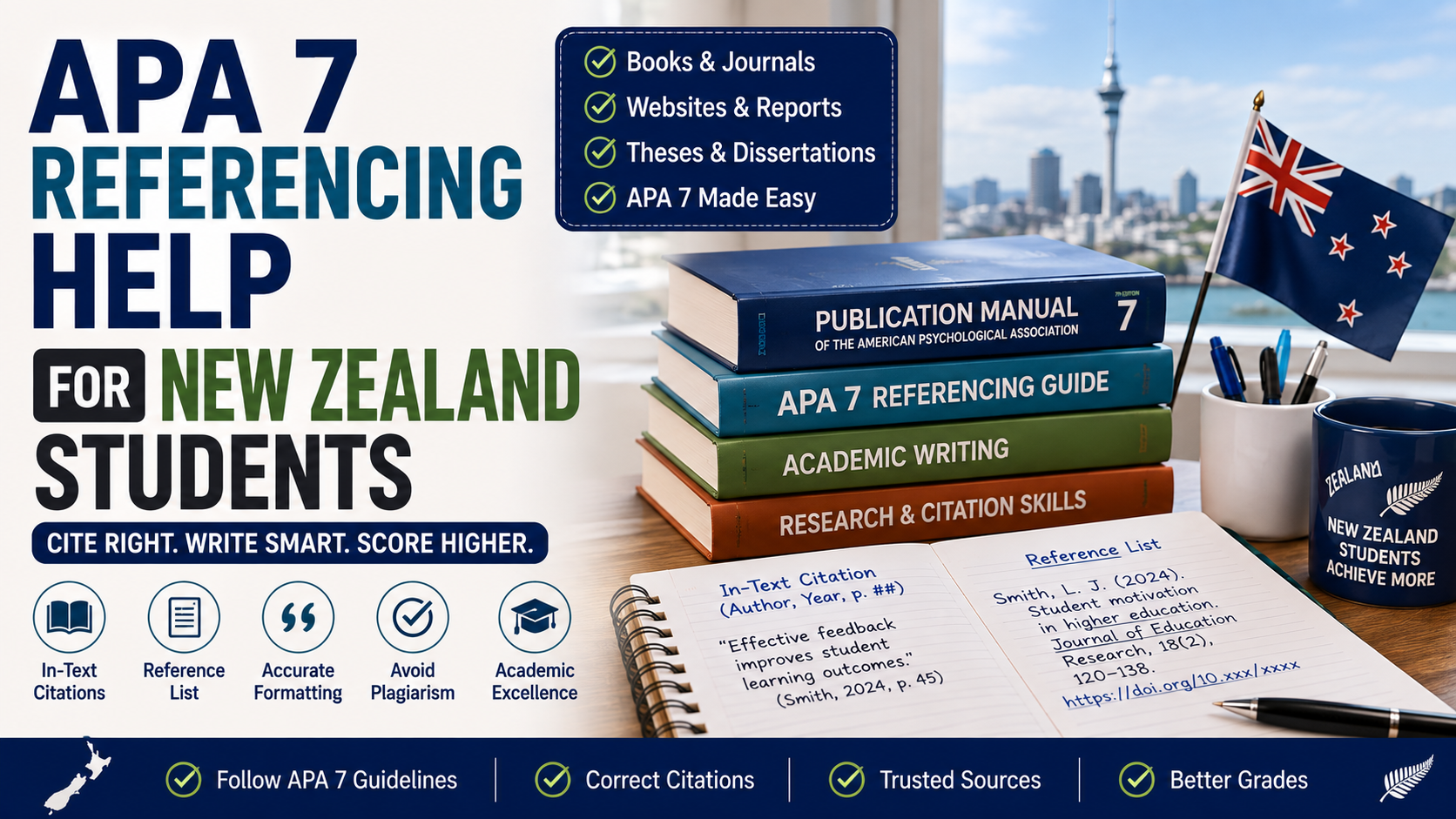
For many students, APA 7 referencing can initially seem complicated. In-text citations, reference lists, multiple authors, journal articles, websites, government reports, DOIs, direct quotations, and missing publication dates can all create uncertainty.
For students studying at universities in New Zealand, another important consideration is that your institution or individual course may provide specific referencing instructions. Even when APA 7 is the required style, local guidelines may explain formatting requirements in greater detail.
This guide provides practical APA 7 referencing help for New Zealand students, including citation examples, reference-list formats, common mistakes, and tips for checking your references before submission.
What Is APA 7 Referencing?
APA 7 refers to the 7th edition of the Publication Manual of the American Psychological Association.
It is an author-date referencing system commonly used in academic writing, particularly in subjects such as:
Psychology
Education
Health sciences
Nursing
Social sciences
Business
Behavioural sciences
Other research-based disciplines
APA 7 generally uses two connected components:
In-text citations within your assignment
A reference list at the end of your work
For example:
Effective feedback can influence students' learning experiences (Smith, 2024).
The complete source would then appear in the reference list.
Why Is APA 7 Referencing Important?
Referencing does more than show where information came from.
It helps you:
Give credit to original authors
When you use another researcher's ideas, findings, theories, or words, appropriate citation acknowledges their contribution.
Support your arguments
Academic sources provide evidence that can strengthen the claims you make.
Help readers locate sources
A properly formatted reference gives readers enough information to identify and locate the original source.
Demonstrate research skills
A well-developed reference list shows that you have engaged with relevant academic literature.
Support academic integrity
Correct citation is an important component of responsible academic writing and helps distinguish your own ideas from information obtained from other sources.
How Does APA 7 Referencing Work?
APA 7 referencing generally follows a simple principle:
In-text citation → Reference list entry
For example, an in-text citation might be:
(Wilson, 2024)
The corresponding reference provides the full publication information.
A basic book reference could look like:
Wilson, J. (2024). Understanding academic research. Academic Press.
The exact reference depends on the type of source you are using.
APA 7 In-Text Citations
APA 7 generally uses the author's surname and year of publication for in-text citations.
For example:
Academic writing requires students to evaluate evidence critically (Taylor, 2024).
You can also incorporate the author's name into the sentence:
Taylor (2024) argues that students need to evaluate academic evidence critically.
These are often referred to as:
Parenthetical citations
Narrative citations
The citation should appear close to the information it supports.
APA 7 Referencing for Two Authors
When a source has two authors, both authors are included in the citation.
For example, a parenthetical citation may be:
(Smith & Jones, 2024)
A narrative citation may be:
Smith and Jones (2024) found that...
APA 7 uses & inside parenthetical citations but generally uses and when the authors' names form part of the sentence.
APA 7 Referencing for Three or More Authors
For a work with three or more authors, APA 7 generally uses the first author's surname followed by et al. from the first citation.
For example:
(Smith et al., 2024)
Or:
Smith et al. (2024) reported that...
The reference list contains the authors according to APA 7's author-list rules.
APA 7 Referencing a Book
A basic APA 7 book reference generally follows this structure:
Author, A. A. (Year). Title of book. Publisher.
For example:
Brown, T. J. (2024). Understanding academic research. Academic Press.
APA 7 generally does not require the publisher's location for books.
This is different from some older referencing styles and can be a source of confusion for students who have previously used Harvard referencing.
APA 7 Referencing a Journal Article
A journal article reference generally includes:
Author(s)
Publication year
Article title
Journal title
Volume
Issue
Page range
DOI where available
For example:
Williams, R. T. (2024). Student engagement in digital learning environments. Journal of Higher Education, 18(2), 120–138. https://doi.org/xxxxx
The exact DOI should always be copied from the original article rather than invented.
APA 7 Referencing a Website
When referencing a webpage, you may need information such as:
Author or organisation
Publication date
Page title
Website name where applicable
URL
A simplified example is:
Ministry of Education. (2025). Supporting student learning. https://www.example.govt.nz/example
If the author and website name are the same, APA 7 may not require the website name to be repeated.
Always check the original webpage and your university's APA guidance before finalising the reference.
APA 7 Referencing a Government Source
Government departments and agencies can be important sources for university assignments, particularly when researching:
Education
Health
Employment
Economics
Population
Social policy
Public administration
Regulations
An organisation can act as the group author.
For example:
Ministry of Education. (2025). Title of report. URL
The exact format depends on the type of government publication.
For New Zealand assignments, make sure you distinguish between the government department that produced the information and a secondary website that merely discusses it.
Whenever possible, consult the original government publication.
APA 7 Referencing a Report
A report may be referenced differently depending on who produced it and whether it has an individual or organisational author.
A general structure may look like:
Organisation Name. (2025). Title of report. Publisher or URL.
If the organisation is both the author and publisher, APA 7 rules may mean the publisher is omitted.
Do not assume every PDF downloaded from the internet is automatically a journal article or report. Identify the actual source type first.
APA 7 Referencing a Chapter in an Edited Book
A chapter in an edited book requires information about both the chapter author and the book editor.
A simplified format is:
Brown, L. M. (2024). Understanding student motivation. In J. Smith & R. Taylor (Eds.), Contemporary education research (pp. 45–62). Academic Press.
Check the source carefully to determine whether you are referencing an individual chapter or the entire edited book.
APA 7 Referencing a Thesis or Dissertation
If you use a dissertation or thesis as an academic source, you may need to include:
Author
Year
Title
Type of thesis
University
Repository or database information
For example:
Jones, A. R. (2024). Student experiences of online learning [Master's thesis, University Name]. University Repository.
The exact format can differ depending on whether the thesis is unpublished, available through a university repository, or indexed in a database.
APA 7 Direct Quotations
A direct quotation uses the author's exact words.
For example:
"Academic writing requires careful evaluation of evidence" (Smith, 2024, p. 25).
For a direct quotation, APA 7 generally requires a page number when one is available.
If the source does not have page numbers, another appropriate locator may sometimes be used, depending on the source.
Longer quotations may require block-quotation formatting.
Always check APA 7 requirements for the length and presentation of the quotation.
APA 7 Paraphrasing
Paraphrasing means expressing another author's idea in your own words while preserving the original meaning.
For example:
Original idea:
Researchers argue that effective feedback can improve student learning.
Paraphrase:
Appropriate feedback may contribute to improved learning outcomes for students (Author, Year).
Even though the wording has changed, the idea still comes from the original source.
Therefore, the source still needs to be cited.
Simply replacing several words with synonyms is not effective academic paraphrasing.
A good paraphrase demonstrates that you understand the original idea and can explain it independently.
APA 7 and Page Numbers
Page numbers are particularly important for direct quotations.
For example:
(Taylor, 2024, p. 45)
For a quotation spanning multiple pages:
(Taylor, 2024, pp. 45–46)
For paraphrasing, a page number is not generally required under standard APA 7 rules, although providing a page or other locator can sometimes help readers locate a specific idea.
Always follow your university's requirements if they provide additional instructions.
APA 7 Sources With Multiple Authors
APA 7 has specific rules for handling multiple authors.
For example, three or more authors are generally shortened to the first author followed by et al. in in-text citations.
However, the reference list follows different rules and may include multiple authors.
This is why students should not simply apply the in-text citation format to their reference list.
APA 7 Sources With No Author
If a source genuinely does not identify an individual author, determine whether an organisation is responsible for the content.
For example:
New Zealand Education Research Council. (2025). Title of resource. URL
Do not invent an individual author simply because the referencing template expects one.
If there is no identifiable author at all, consult the relevant APA 7 guidance before deciding how to format the citation.
APA 7 Sources With No Date
Some webpages and online materials do not display a publication date.
APA 7 can use n.d., meaning "no date," where appropriate.
For example:
Organisation Name. (n.d.). Title of webpage. URL
However, you should first check whether a publication or update date is available elsewhere on the original source.
APA 7 DOI Formatting
A DOI, or Digital Object Identifier, provides a persistent identifier for many academic publications.
Where a DOI is available, APA 7 generally presents it as a URL.
For example:
Do not create a DOI manually.
Copy the DOI from a reliable source such as the original journal article or publisher.
APA 7 Reference List vs Bibliography
Students sometimes use the terms "reference list" and "bibliography" interchangeably, but they can describe different things depending on the academic style being used.
In APA 7, the reference list contains sources cited in the work.
Therefore, do not automatically add every source you read during your research unless it is relevant and your assignment instructions specifically require a bibliography.
Always check your course requirements.
APA 7 Reference List Formatting
Your APA 7 reference list should be carefully formatted.
Common considerations include:
Alphabetical ordering
Hanging indentation
Author formatting
Publication year
Title capitalisation
Italicisation
Journal volume and issue
Page ranges
DOI formatting
URL formatting
For example:
Brown, T. J. (2024). Understanding academic research. Academic Press.
Smith, L. R., & Jones, P. K. (2024). Student engagement in online learning. Journal of Education, 18(2), 120–138. https://doi.org/xxxxx
The exact formatting should be checked against your university's APA 7 requirements.
Common APA 7 Referencing Mistakes
1. Using Harvard Rules With APA 7
Harvard and APA 7 are different referencing systems.
Do not mix formatting conventions.
2. Forgetting the Publication Year
APA 7 places significant emphasis on the publication year.
Check that your citation matches the source.
3. Using Incorrect Author Formatting
Make sure author surnames and initials are correctly recorded.
4. Incorrect Capitalisation
APA 7 has specific rules for capitalising titles.
Do not automatically capitalise every major word in a reference title.
5. Missing DOIs
If a relevant journal article has a DOI, check whether your university expects it to be included.
6. Incorrect URLs
Make sure URLs lead to the correct source.
7. Missing In-Text Citations
A reference list alone does not show which sources support specific claims in your assignment.
8. Mismatched Citations and References
A source cited in the assignment should correspond correctly to its reference-list entry.
9. Using Citation Generators Without Checking Them
Automatic tools can make mistakes.
Always verify the generated citation against the original source.
10. Fabricating References
Never create a reference simply because you need a citation.
Every academic reference should correspond to a real source that you have actually consulted.
APA 7 Referencing for New Zealand University Students
New Zealand students may encounter APA 7 across disciplines and institutions, but the exact academic requirements can differ between universities, faculties, schools, and courses.
Your lecturer or course guide may specify:
Which referencing style to use
Whether APA 7 is mandatory
How sources should be presented
Whether URLs are required
How direct quotations should be handled
Whether additional formatting rules apply
Therefore, don't assume that a generic APA website is always the final authority for your assignment.
Your university's official academic-learning or library guidance should take priority.
How to Check APA 7 References Before Submission
A simple checking process can prevent many common errors.
Step 1: Identify the source type
Determine whether the source is a:
Book
Journal article
Website
Report
Thesis
Book chapter
Government publication
Step 2: Collect the original information
Record the:
Author
Date
Title
Publisher
Journal
Volume
Issue
Pages
DOI
URL
Step 3: Create the in-text citation
Add the citation where you use the source.
Step 4: Create the reference-list entry
Add the full publication information.
Step 5: Compare both entries
Make sure the author and year match.
Step 6: Check APA 7 formatting
Review punctuation, capitalisation, italics, author formatting, and links.
Step 7: Compare against your university guide
This final step is particularly important for New Zealand students because individual institutions and courses may provide additional requirements.
APA 7 Referencing Checklist
Before submitting your assignment, ask:
In-text citations
Have I cited borrowed ideas?
Have I cited paraphrased information?
Are direct quotations clearly identified?
Are author names correct?
Are publication years correct?
Are page numbers included for quotations where available?
Reference list
Does every in-text citation have a corresponding reference?
Have I included the correct author?
Is the publication year correct?
Is the title formatted correctly?
Are journal details complete?
Are DOIs formatted correctly?
Are URLs accurate?
Academic quality
Are my sources credible?
Are they relevant to my research question?
Have I used appropriate academic literature?
Have I avoided fabricated references?
Have I checked my university's APA 7 guidance?
How APA 7 Referencing Can Strengthen Your Assignment
Good referencing is not simply about following formatting rules.
It should contribute to the quality of your academic argument.
Effective use of sources allows you to:
Support claims with evidence
Compare academic perspectives
Identify disagreements in the literature
Establish theoretical context
Demonstrate subject knowledge
Develop critical analysis
Show engagement with research
An assignment with hundreds of references is not automatically better than an assignment with fewer sources.
The important question is whether your sources are relevant, credible, appropriately integrated, and used to support your argument.
When Should New Zealand Students Get APA 7 Referencing Help?
Referencing support can be useful if you:
Are unfamiliar with APA 7
Have recently switched from Harvard to APA
Are unsure how to reference journal articles
Have a large dissertation reference list
Are struggling with DOI or URL formatting
Need to check citations for multiple authors
Have received feedback about referencing errors
Need help reviewing a reference list
Want your assignment proofread before submission
Are preparing a research proposal, dissertation, or thesis
Getting your references checked before the deadline can give you time to correct inconsistencies.
APA 7 Referencing Help for Assignments and Dissertations
AssignmentCart provides academic support for students working on university assignments, essays, reports, research projects, dissertations, and theses.
Referencing-related support can include:
APA 7 citation guidance
Reference-list checking
Citation consistency reviews
Academic proofreading
Reference formatting
Dissertation referencing support
Assignment editing
Academic writing guidance
Students should always follow the referencing requirements provided by their university or course.
If you use external academic support, make sure it complies with your institution's academic-integrity and third-party assistance policies.
How to Make APA 7 Referencing Easier
One of the easiest ways to reduce referencing stress is to record source information while you research.
When you find a useful source, immediately save:
Author names
Publication date
Title
Journal or publisher
Volume and issue
Page numbers
DOI
URL
Do not leave all your referencing until the final hours before submission.
You can also use reference-management software to organise your sources.
However, automated referencing tools are not perfect. They may misidentify authors, dates, titles, or publication types.
Always verify automatically generated references against the original source and your university's APA 7 requirements.
Final Thoughts
APA 7 referencing becomes much easier once you understand the basic relationship between in-text citations and the reference list.
The core principle is straightforward:
Identify the source in your text and provide enough information in the reference list for readers to locate it.
The challenge comes from the different rules that apply to books, journal articles, websites, reports, government publications, theses, multiple authors, direct quotations, and online sources.
For students in New Zealand, it is particularly important to check the official referencing guidance provided by your university, faculty, or course. Even when APA 7 is the required style, your institution may provide additional instructions or examples.
Good referencing is also about more than formatting. Your sources should be credible and relevant, and they should be integrated meaningfully into your academic argument.
If you are struggling with APA 7 citations or a large reference list, appropriate academic guidance and proofreading can help you identify inconsistencies and improve the presentation of your work.
Ultimately, accurate referencing demonstrates responsible engagement with academic sources and helps make your assignment clearer, more credible, and academically sound.
Frequently Asked Questions
Everything you need to know about our services
Related Posts

APA 7 Referencing Service for Singapore Students

APA 7 Assignment Help for Master's Students in Ireland
